Namibia's Orange Basin: The Newest Petrostate Reads Angola's Playbook
In April 2026 a country with no commercial oil history opened formal negotiations with TotalEnergies over the field that could rewrite its economy. Windhoek is determined not to repeat its neighbour's mistakes — but the clock, the geology and the gas argue among themselves.
The prize, and its fine print
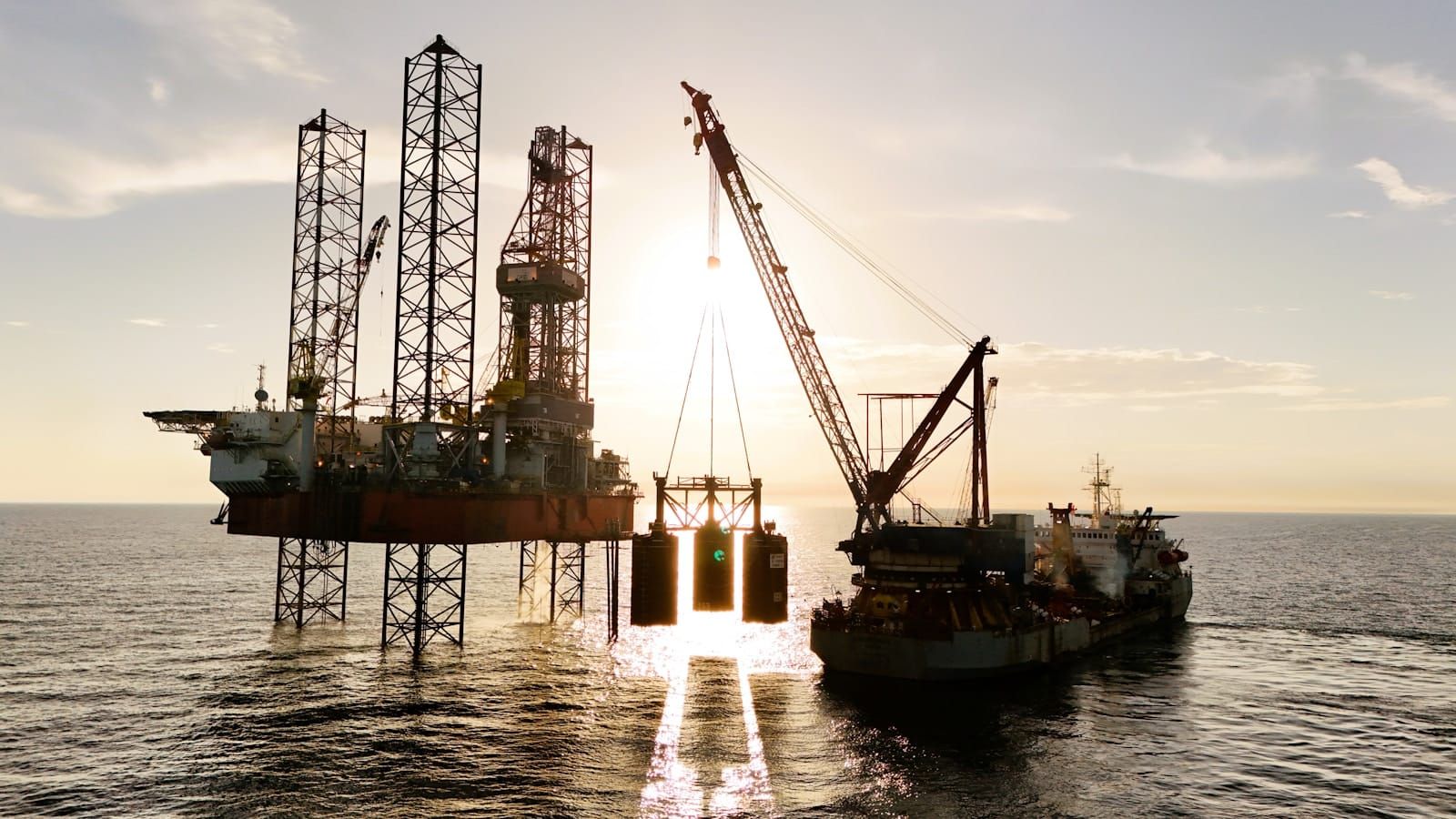
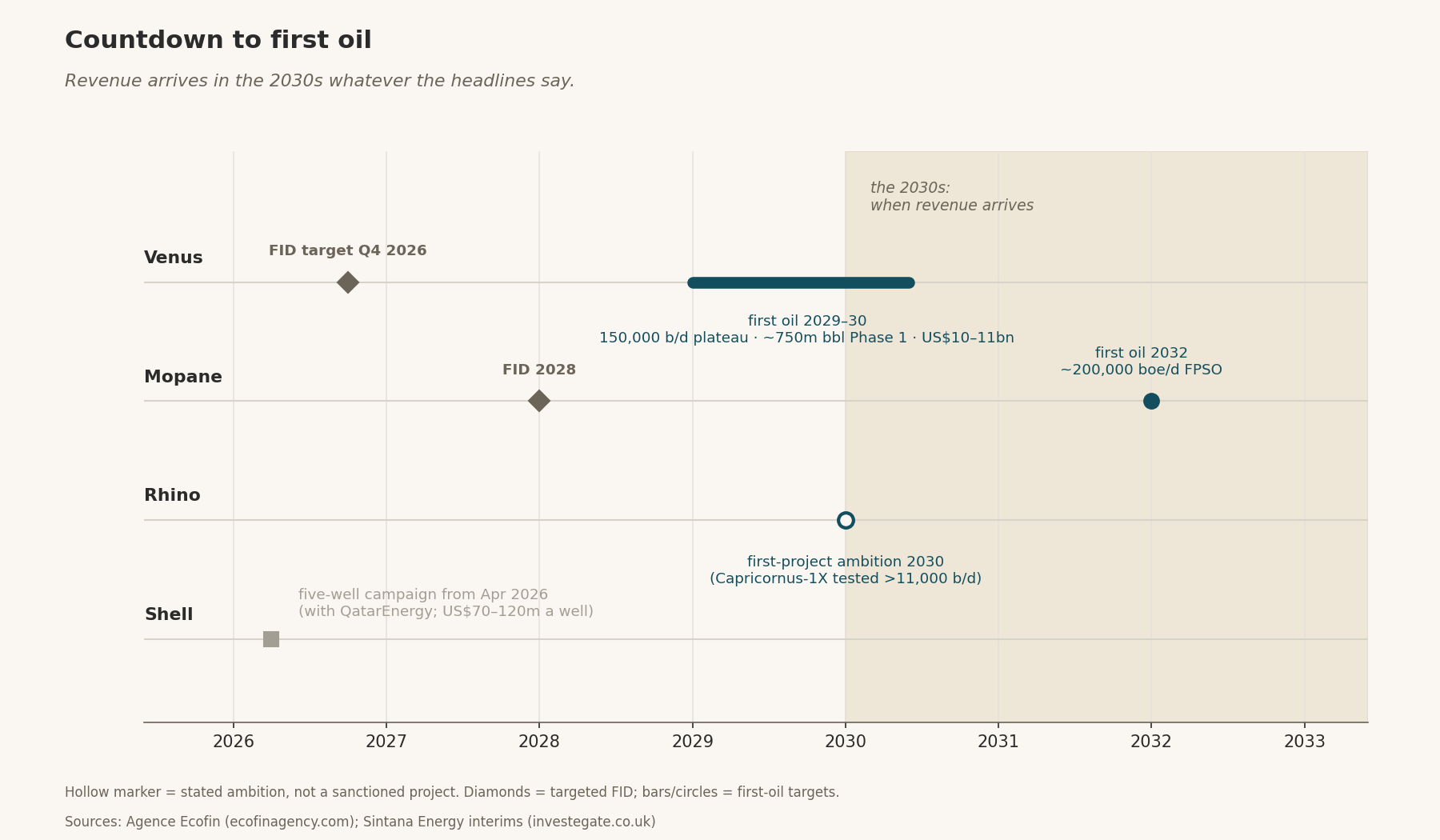
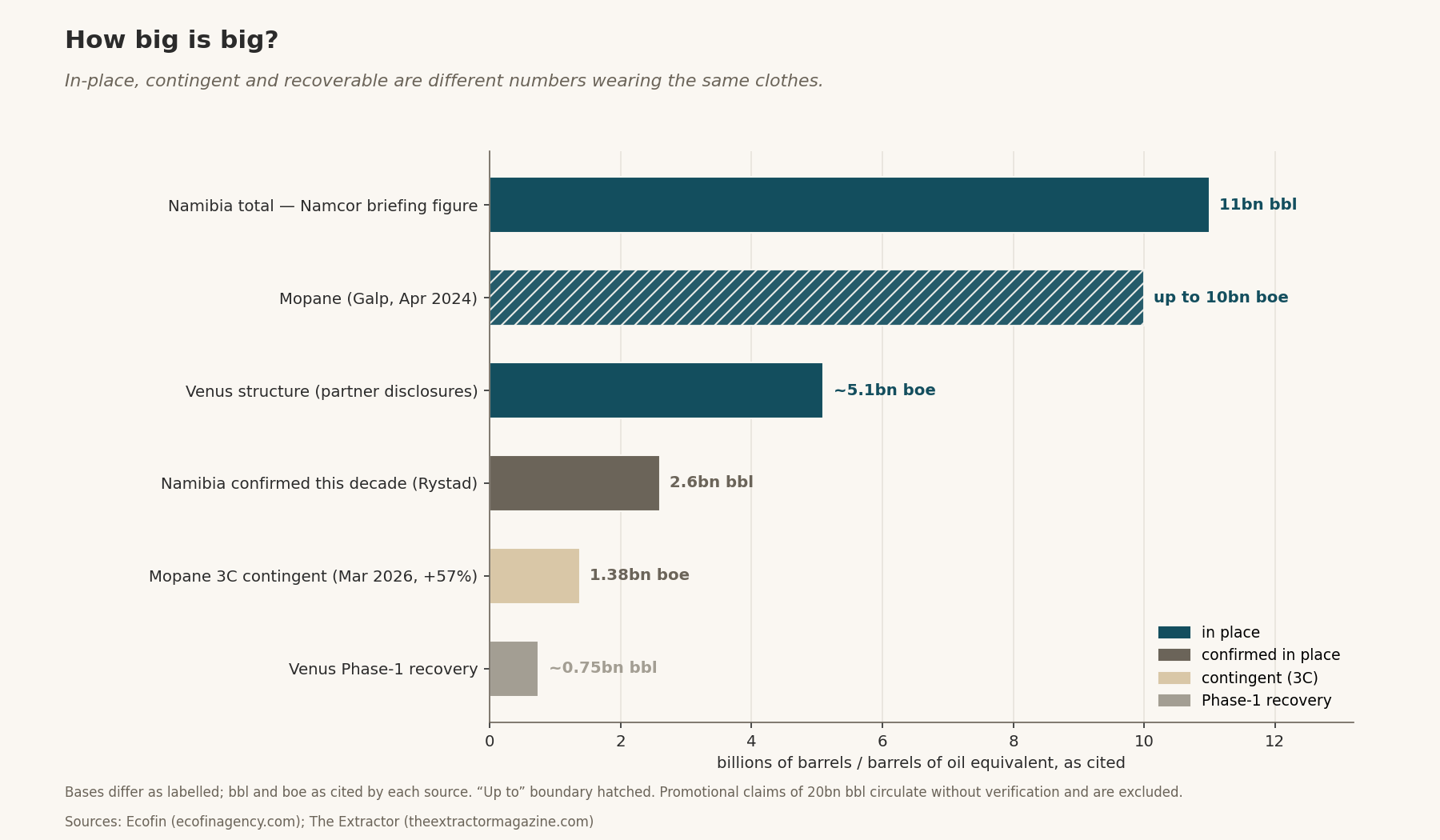
In April 2026, in a ministry building in Windhoek, Namibian officials sat down across from TotalEnergies to negotiate the Field Development Plan for Venus — the discovery that turned the Orange Basin from frontier geology into the most watched address in world oil. The stakes on the table: a first phase designed to recover about 750 million barrels at a plateau of 150,000 barrels a day, from a single floating production vessel in 3,000 metres of water, at a cost contractors put at US$10–11 billion, according to Windhoek Observer and Offshore-Energy.biz. The discovery well, Venus-1X, was announced in February 2022 and found an 84-metre net oil column in high-quality Lower Cretaceous sands, some 290 kilometres offshore. The national oil company Namcor called it "transformational", per The Extractor. Precision matters here: the 750 million barrels is a Phase-1 recovery figure. Partner disclosures put the whole structure at roughly 5.1 billion barrels of oil equivalent in place, with perhaps 2 billion recoverable and 4.8 trillion cubic feet of associated gas — different bases, often blurred in promotional copy, per Meren Energy's disclosure. A final investment decision is targeted for the fourth quarter of 2026, with first oil in 2029–2030; Namibian officials prefer 2029, while TotalEnergies' Patrick Pouyanné calls that an "upside scenario", per Agence Ecofin.
Venus is not alone. Galp's Mopane, announced in April 2024, could hold up to 10 billion barrels of oil equivalent in place — an in-place number, not a recoverable one; its 3C contingent resources were raised 57 per cent in March 2026 to 1.38 billion boe, per Ecofin. In December 2025 TotalEnergies agreed to take a 40 per cent operated stake in Mopane's licence, carrying half of Galp's costs, and now targets FID in 2028 and first oil in 2032 from a 200,000 boe/d FPSO, per Sintana Energy's interims. Shell, meanwhile, wrote down about US$400 million on its Graff and Jonker discoveries in January 2025 — permeability and gas content defeated nine wells, per Offshore-Technology — then quietly returned in April 2026 with a five-well campaign alongside QatarEnergy, testing deeper leads. At US$70–120 million a well, that is the industry's verdict that the basin humbled a supermajor but did not beat it.
The negotiation of the century
Namibia brings to the table an economy with 36.9 per cent unemployment, no commercial oil history, and a president — Netumbo Nandi-Ndaitwah, elected in December 2024 — who took personal charge of the mines and energy portfolio in October 2025, per Energy Capital & Power. TotalEnergies brings revenue of about €182 billion and fifty years of African operating experience. The asymmetry is the story.
The disputes are concrete. First, gas: Venus holds an estimated 4.8 trillion cubic feet of associated gas, and Namibia wants it piped ashore to generate power for a grid that imports electricity; TotalEnergies prefers to reinject it to sustain reservoir pressure and oil flow. The question was unresolved at the April FDP review, with no confirmed precedent for reinjection at this depth and scale, per Ecofin. Second, the fiscal regime: the 1991 petroleum law is under revision, a new Upstream Petroleum Unit sits in the Presidency, and the SWAPO manifesto promises "at least 30 per cent carried interest for the State in all upstream licences" — a campaign commitment, not law, but one analysts warn could slow final investment decisions, per IJG's Oil & Gas Update. A Local Content Act, a petroleum regulator and port upgrades at Walvis Bay and Lüderitz are in the same pipeline.
The revenue promise comes with a timing caveat. Venus's environmental and social impact assessment projects up to €12 billion in state revenue over 25 years — but only at US$75 a barrel, and only after development costs are amortised, pushing the bulk of receipts past the mid-2030s, per Ecofin's review. The Bank of Namibia and the mines ministry project oil contributing up to 18 per cent of GDP at peak production, per FurtherAfrica — an official aspiration, not a forecast. Rystad Energy counts about 2.6 billion barrels confirmed in place this decade, with a peak potential near 700,000 barrels a day if every project proceeds, per The Extractor. "If" is carrying a great deal of weight.
Learning from the neighbour
Namibia does not need to imagine how oil wealth can disappoint. It can drive north. Angola — sub-Saharan Africa's second crude exporter — still imports roughly 72 per cent of the fuel it consumes, some 3.3 million tonnes of refined products a year on Sonangol's figures, per Hydrocarbon Processing; its first refinery since independence, the 30,000-barrel-a-day Cabinda plant, entered commercial production only in April 2026, per Africa Oil+Gas Report. Oil there supplies about 95 per cent of exports and over 60 per cent of fiscal revenue, and when Luanda cut fuel subsidies in July 2025, the resulting diesel price rise triggered riots in which at least 22 people died. The lesson Windhoek draws is not that oil fails, but that a crude pump attached to someone else's refinery is not an industrial policy.
The comparisons are explicit. Guyana moved from discovery to production in five years and is now the benchmark for speed — and for the argument about fiscal terms that follows any Stabroek-scale success; analysts have framed Namibia's task as striking the right balance between investor appeal and national take. Norway supplies the savings architecture. Angola supplies the warning. The originality of Namibia's position is that it can study all three before a single commercial barrel flows.
So the playbook is being annotated. Where Angola centralised, Namibia is legislating before the first barrel: a sovereign fund launched in 2022, with stabilisation and intergenerational sub-funds borrowed from the Norwegian model; an IMF Article IV consultation in June 2025 that urged a "rigorous monitoring framework" for oil revenues, early receipts directed at gross debt reduction, and the fund's integration into the budget framework, per OilNOW's summary of the IMF staff report. Where Angola's national champion became a state within a state, Namcor sits at a carried 10 per cent across the key licences — an equity stake whose institutional capacity is still under construction. And where Angola exported crude and imported petrol, Namibia has quietly let a refinery study drop off its implementation plan, betting instead on gas-to-power and on exporting into a tightening Atlantic market. The regional context sharpens every choice: Angola's output is in long decline, and a basin capable of 700,000 barrels a day would reorder SADC's energy map between Luanda, Windhoek and Pretoria.
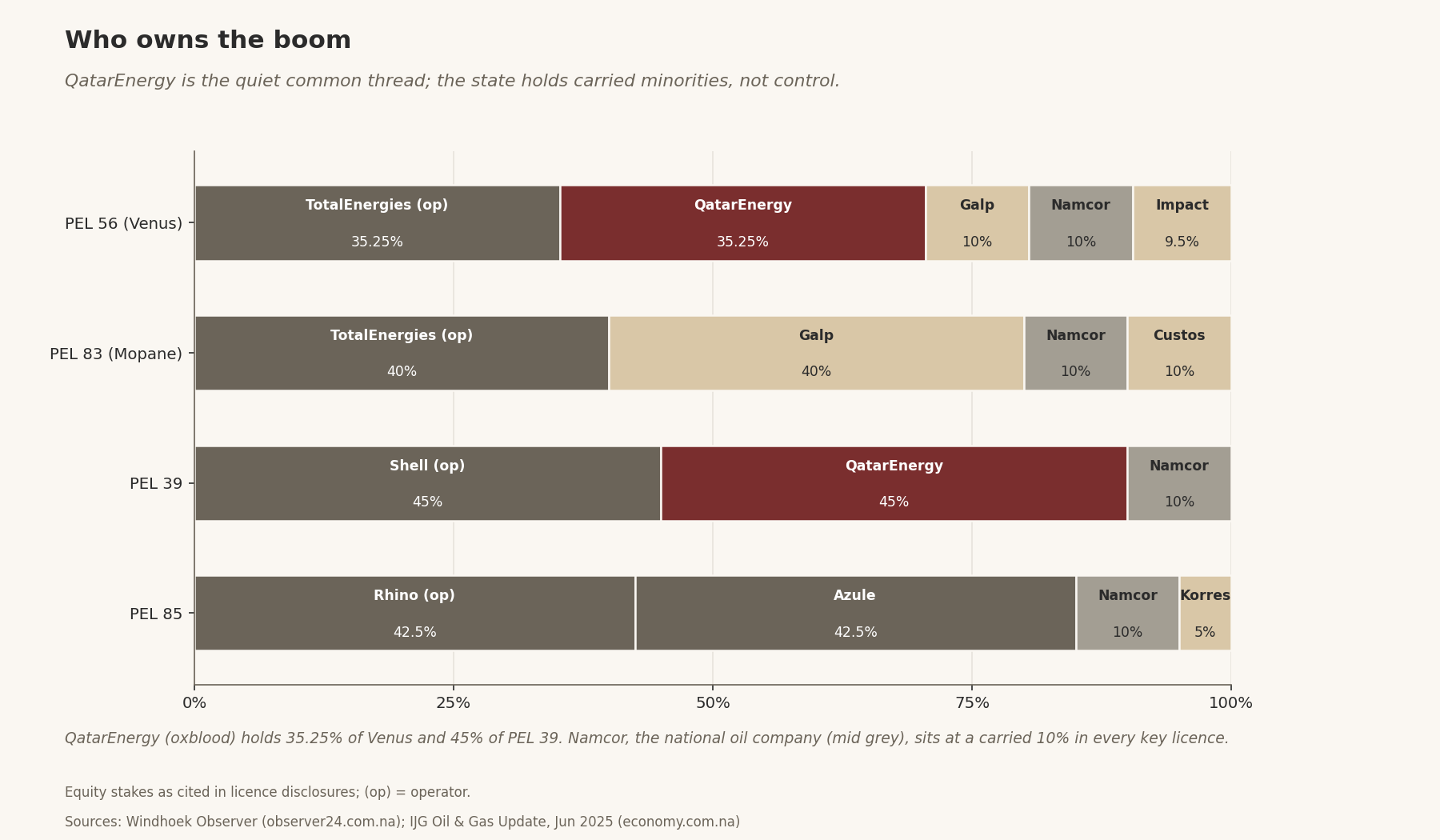
The wider industry is repositioning around the same Atlantic-margin logic that produced Guyana's boom. QatarEnergy is the quiet common thread, holding 35.25 per cent of Venus and 45 per cent of Shell's block. Chevron has drilled its own Namibian wildcat, Woodside is shooting seismic, and the junior ecosystem — Sintana with eight licences after its Challenger takeover, Eco Atlantic, Oregen, Stamper — works the periphery while Petrobras seeks farm-ins, per World Oil. Rhino Resources, backed by bp and Eni's Azule Energy, tested more than 11,000 barrels a day of light oil at Capricornus-1X and wants a first project by 2030; BW Energy is appraising the Kudu gas field for an offshore gas-to-power concept. TotalEnergies' own portfolio shows the basin does not respect the border: it also holds South Africa's Block 3B/4B, with roughly 4 billion boe of unrisked prospective resource. OPEC has reportedly signalled interest in Namibia joining its Charter of Cooperation once production begins, according to BriefGlance — a single-source claim, unconfirmed by OPEC itself, but a sign of how the cartel's courtship of new African producers is already being read in Windhoek.
The honest ledger
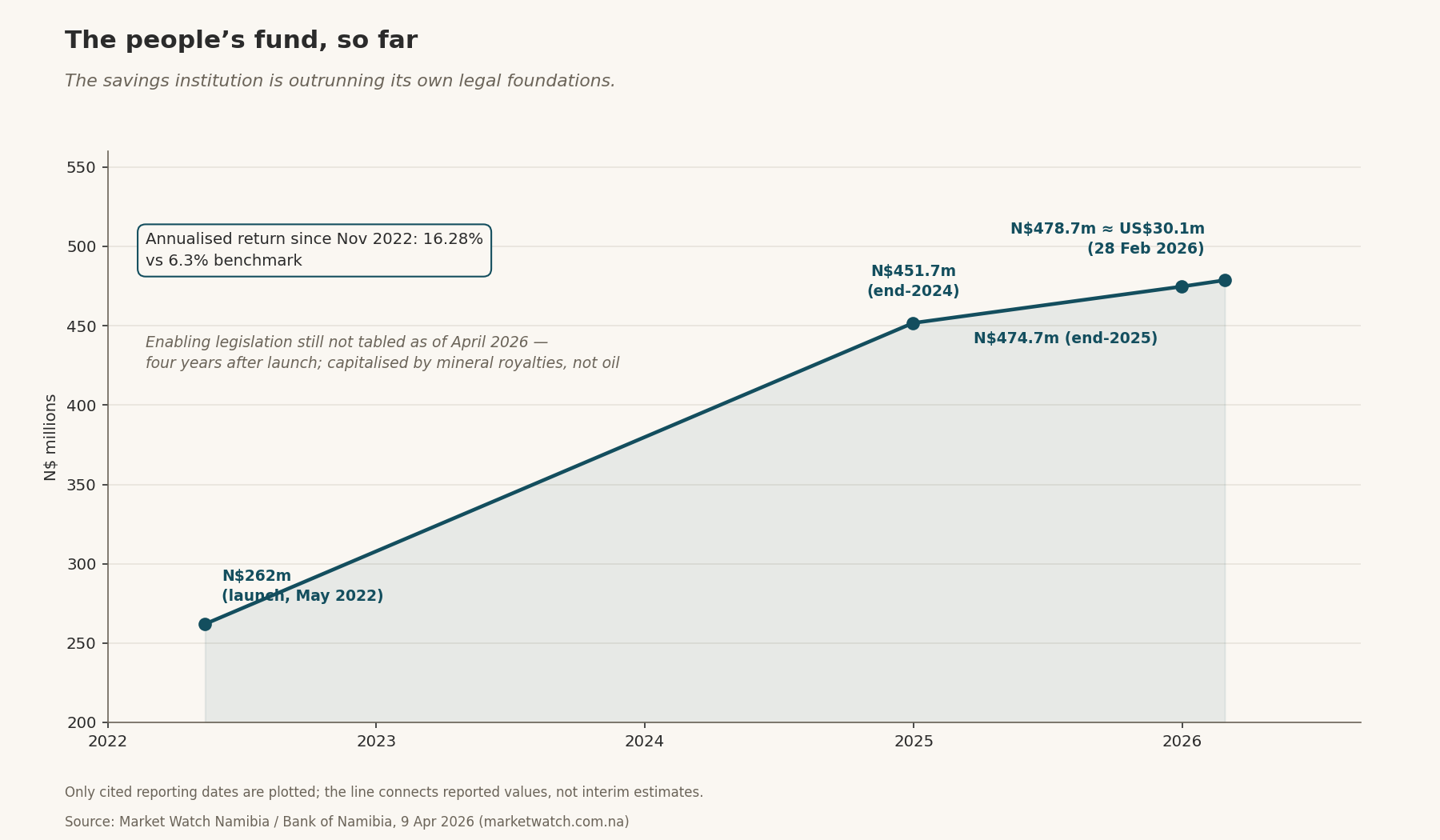
The strongest evidence against the boom narrative is Namibia's own savings account. The Welwitschia Sovereign Wealth Fund, launched in May 2022 with N$262 million of seed money, held N$478.7 million — about US$30.1 million — at the end of February 2026, earning a creditable 16.28 per cent annualised against a 6.3 per cent benchmark, per Market Watch Namibia. It is capitalised by mineral royalties and tax streams, not oil. Its enabling legislation, promised "in due course" in this year's state of the nation address, had still not been tabled as of April 2026 — four years after launch. A Norway-style intergenerational fund that exists without a law is a statement of intent, not yet an institution.
The geology, too, has filed dissenting opinions. Shell's US$400 million write-down demonstrated that the Orange Basin is real but not uniformly rich. The headline resource numbers span an honest range — 11 billion barrels cited by Namcor, 2.6 billion confirmed in place per Rystad, up to 10 billion in place at Mopane alone per Galp — and promotional claims of 20 billion barrels circulate without verification. Regulatory fragility sits just across the border: a South African court annulled TotalEnergies' offshore environmental permits there in 2025, a reminder that litigation can idle rigs along the same shared coast. And Namibia is hedging its own bet, pairing the oil play with a green-hydrogen strategy — the HyIron plant inaugurated in April 2025, the Hyphen megaproject's FID no earlier than end-2026 — on the theory that crude revenue should fund the successor economy rather than compete with it.
New Axis read
The 2026 FID is as much a political deadline as an engineering one. If Windhoek secures gas-to-shore, a credible fiscal law and a legislated sovereign fund before TotalEnergies commits its US$10–11 billion, Namibia will have done something no African producer managed at the start: write the rules before the money arrived. The risks are equally concrete — a manifesto promise of 30 per cent state carry could spook the very capital the deal needs, and the oil price at which Venus pays the state handsomely is above today's forward curve. Watch three markers: the FDP signature, the Welwitschia bill reaching parliament, and Shell's five wells. Angola's playbook is open on the table; Namibia's margin notes are the interesting part.
Charts & visuals
X: A country with no oil history and 36.9% unemployment is negotiating a US$10–11bn deal with TotalEnergies. Namibia read Angola's playbook first — and wrote in the margins.
LinkedIn: Namibia's Orange Basin could deliver first oil by 2029–2030 and, at peak, a projected 18% of GDP — but the sovereign wealth fund holds just US$30m and its law is four years overdue. Our analysis examines the Venus and Mopane negotiations, Shell's US$400m cautionary tale, and how Windhoek is annotating the playbook of its crude-exporting, fuel-importing neighbour Angola. The 2026 FID is a political deadline as much as an engineering one.
Author
Sign up for New Axis Media newsletters.
Stay up to date with curated collection of our top stories.