Beyond the Debt-Trap Cliché: What Africa-China Infrastructure Really Looks Like in 2026
The “debt-trap” story dominated a decade of headlines. The reality is messier and more revealing: Chinese lending has collapsed from its peak, some flagship projects genuinely underperformed, and African states are learning to renegotiate on their own terms.
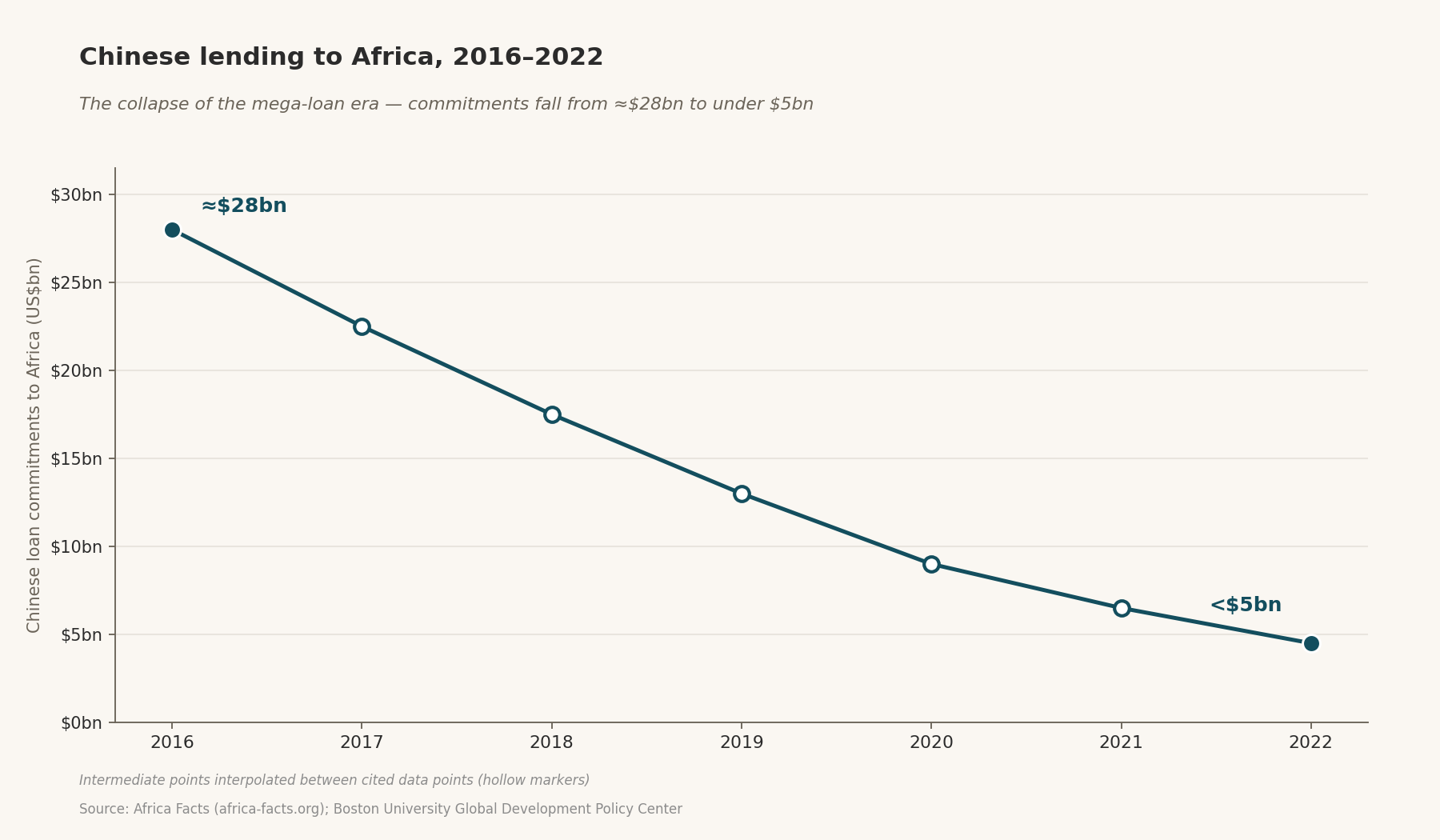
Few narratives have been as durable — or as lazily applied — as the “Chinese debt trap” in Africa. The story goes that Beijing deliberately extends unpayable loans to seize strategic assets when borrowers default. It is an intuitive tale, endlessly repeated in Western commentary, and the 2026 evidence demands a more precise account. The headline fact is that Chinese lending to Africa has not surged but collapsed: annual loan commitments fell from roughly $28 billion in 2016 to under $5 billion by 2022, according to Boston University’s Global Development Policy Center (Africa Facts). The era of the mega-loan is largely over — a fact difficult to square with the image of an ever-expanding predatory creditor.
The grain of truth
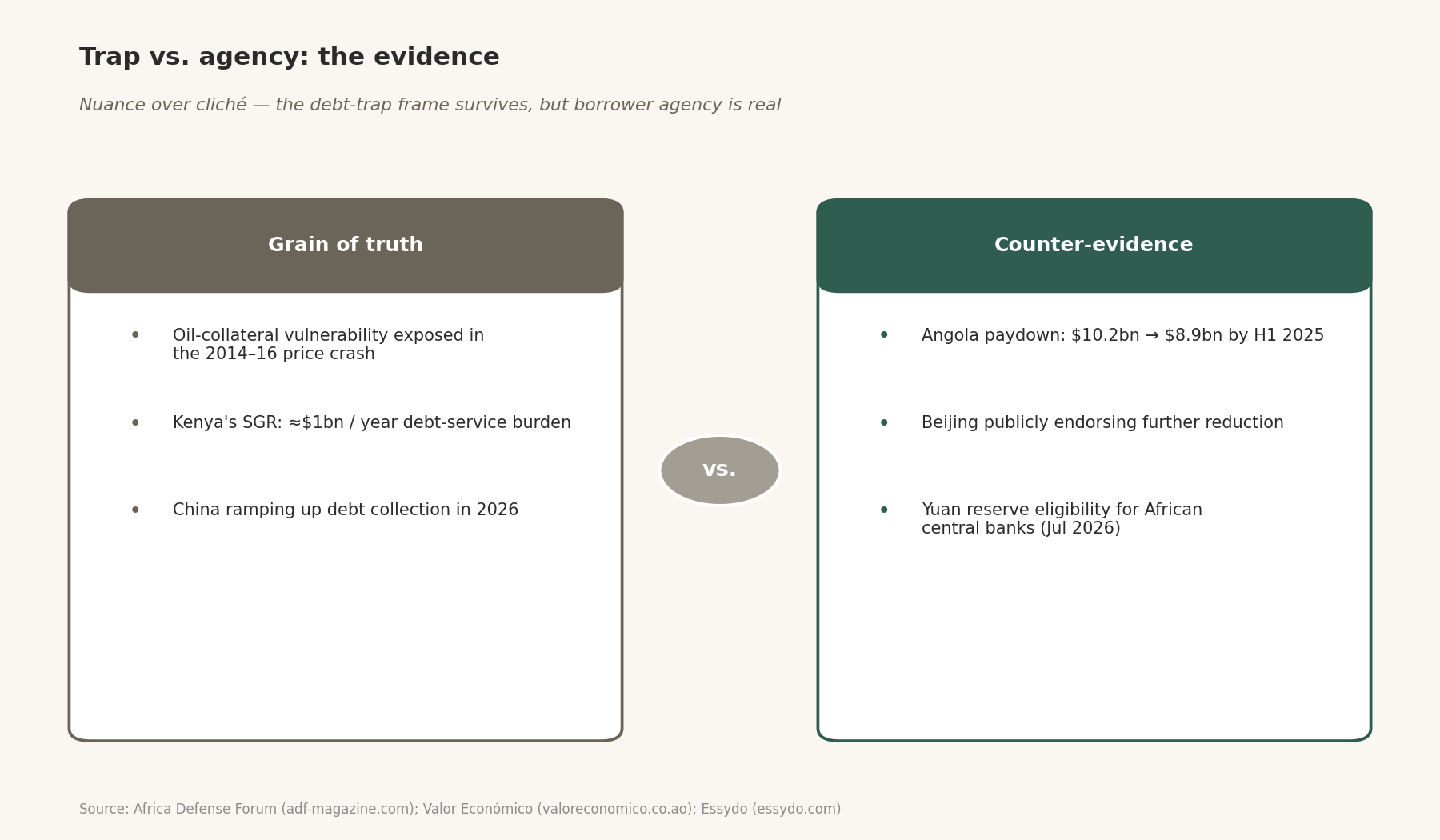
The debt-trap framing is not baseless, and it would be dishonest to pretend otherwise. Angola’s oil-collateralised borrowing genuinely amplified its vulnerability when oil prices crashed in 2014–2016 (Africa Facts). Collateralising loans against a volatile commodity concentrated risk in exactly the wrong way. And some flagship projects have underperformed badly. Kenya’s Chinese-financed Mombasa–Nairobi railway “failed to perform as anticipated,” leaving Nairobi paying about $1 billion a year in principal and interest on a project that came “with promises of great profits but has become a major financial burden” (Africa Defense Forum). In 2026, China has been “ramping up debt collection” across the continent (Africa Defense Forum). Where projects generated less revenue than promised — and some did — the debt became a genuine drag on national budgets. The critique of over-optimistic feasibility studies and opaque terms is fair.
Where the cliché breaks down
But three facts complicate the trap thesis. First, African states are paying down Chinese debt, sometimes rapidly — Angola cut its exposure from $10.2 billion to $8.9 billion in the first half of 2025 and expected further reductions, hardly the profile of a captured debtor (Africa Defense Forum; Reuters). A country genuinely trapped cannot simply retire the debt on its own timetable.
Second, Beijing has publicly signalled that Angola’s debt reduction “will continue,” with its ambassador projecting further cuts — cooperation, not coercion (Valor Económico). A creditor executing a strategy to seize assets does not cheer on early repayment. Third, the relationship is deepening in new areas even as old debt shrinks: Angola authorised banks to count yuan toward reserve requirements in July 2026, and China remains active in Angolan clean-energy projects (Essydo; Global Voices). The relationship is maturing, not collapsing — which is not the trajectory a “trap” would follow.
The new pattern: from megaprojects to leverage
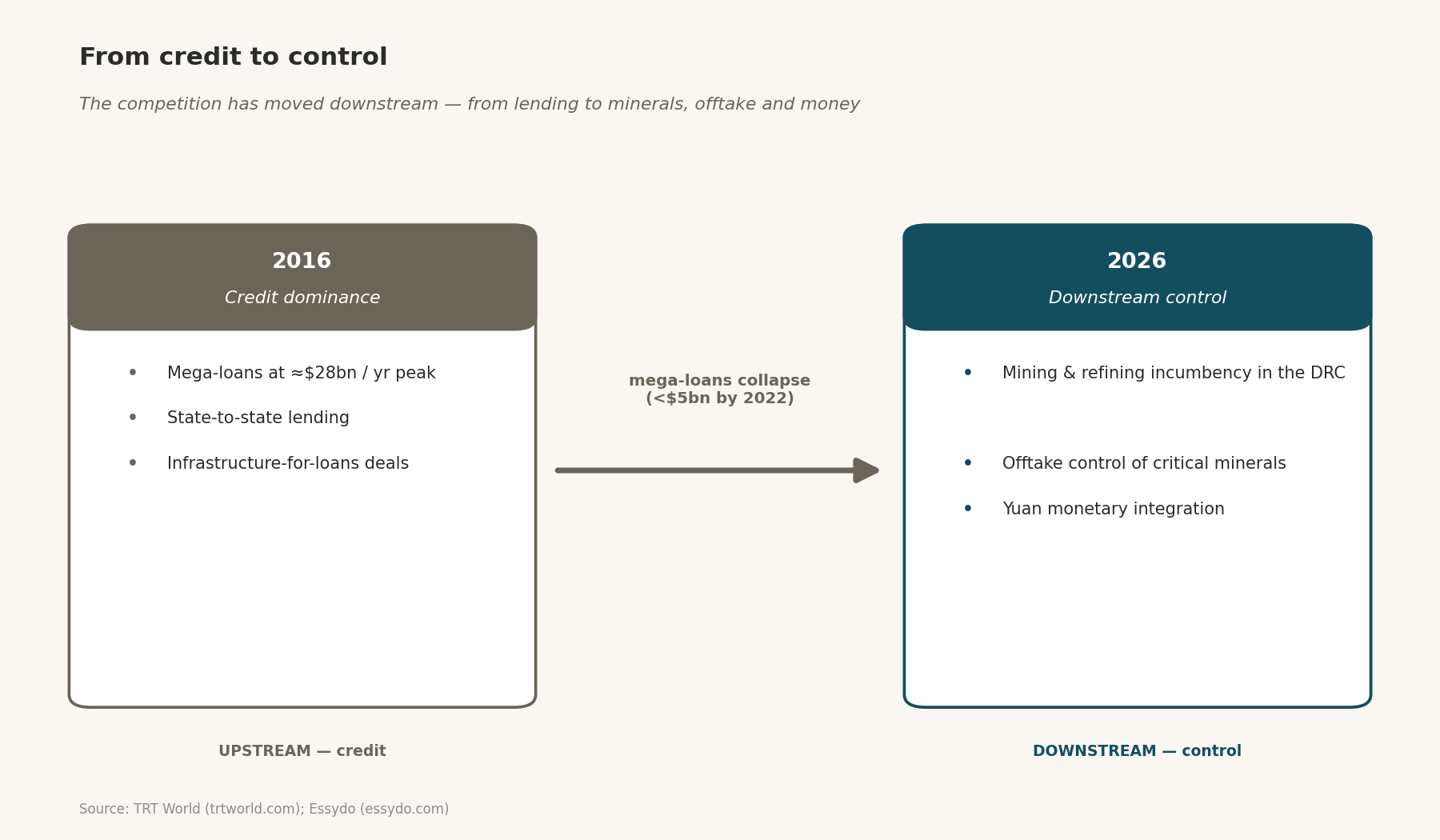
The infrastructure relationship is evolving from a lending model to a positioning model. China remains the dominant player in the DRC’s mining sector — the region that exports the minerals critical for batteries and the energy transition (TRT World). Its edge is no longer cheap credit but incumbency: existing operations, established processing capacity, long-standing relationships, and control of the offtake agreements that determine where minerals ultimately go. This is a more durable form of influence than debt — and harder for rivals to dislodge.
This is precisely why the US-backed Lobito Corridor is framed as “the West’s answer to China’s dominance in African mining” (see Articles 4 and 6) (RTL Today / AFP). The competition has shifted from who lends to who controls the flow and the refining. In the new phase, the strategic asset is not a loan on a balance sheet but a position in the supply chain — a mine, a smelter, a port concession, an offtake contract. Understanding China’s African role in 2026 means looking not at debt figures but at these downstream positions.
The honest ledger
A fair assessment reads both columns. Chinese infrastructure delivered roads, railways, ports and power that African governments wanted and Western financiers often would not fund — filling a genuine gap when the alternative was frequently no project at all. Some of it was overpriced, opaque, or economically unviable. Some clean-energy projects arrived “with heavy debt” (Global Voices). But the defining feature of 2026 is African agency: governments renegotiating terms, diversifying creditors, and playing patrons against one another (Trends N Africa). The same governments that once had few alternatives to Chinese credit now have Gulf capital, US development finance and their own domestic markets — and they are using that optionality.
The New Axis read
The debt-trap cliché flatters everyone except Africans — it casts China as an omnipotent predator and African governments as hapless victims, erasing the agency that is the central fact of the story. The reality of 2026 is a lending relationship that has shrunk, matured, and become one input among many in African statecraft. The right question is not “did China trap Africa?” but “which projects generated returns, on what terms, and who is capturing the value now?” On that question, the record is genuinely mixed — some projects transformed economies, others burdened them — and that is exactly why it deserves better than a cliché. The more useful frame for 2026 is not Chinese omnipotence but a multipolar contest in which African states, at last, have leverage to negotiate.
Charts & visuals
X: The “China debt trap” story missed the real news: Chinese lending to Africa collapsed from ~$28bn (2016) to <$5bn (2022). Some projects flopped. But African states are paying down & renegotiating. Agency, not capture. 🧵
LinkedIn: The “Chinese debt trap” dominated a decade of headlines. The 2026 data tells a more useful story: lending collapsed from ~$28bn to under $5bn a year, some flagship projects genuinely underperformed — and African governments are now paying down debt, diversifying creditors and renegotiating terms. New Axis Media moves past the cliché to the ledger that actually matters.
Author
Sign up for New Axis Media newsletters.
Stay up to date with curated collection of our top stories.