Angola and China After the Debt Boom: The Quiet Unwinding of the “Angola Model”
Angola was the flagship of China’s oil-backed lending in Africa. Now it’s paying that debt down fast, diversifying its creditors — and even letting banks count yuan toward reserves. The relationship isn’t ending; it’s being renegotiated.

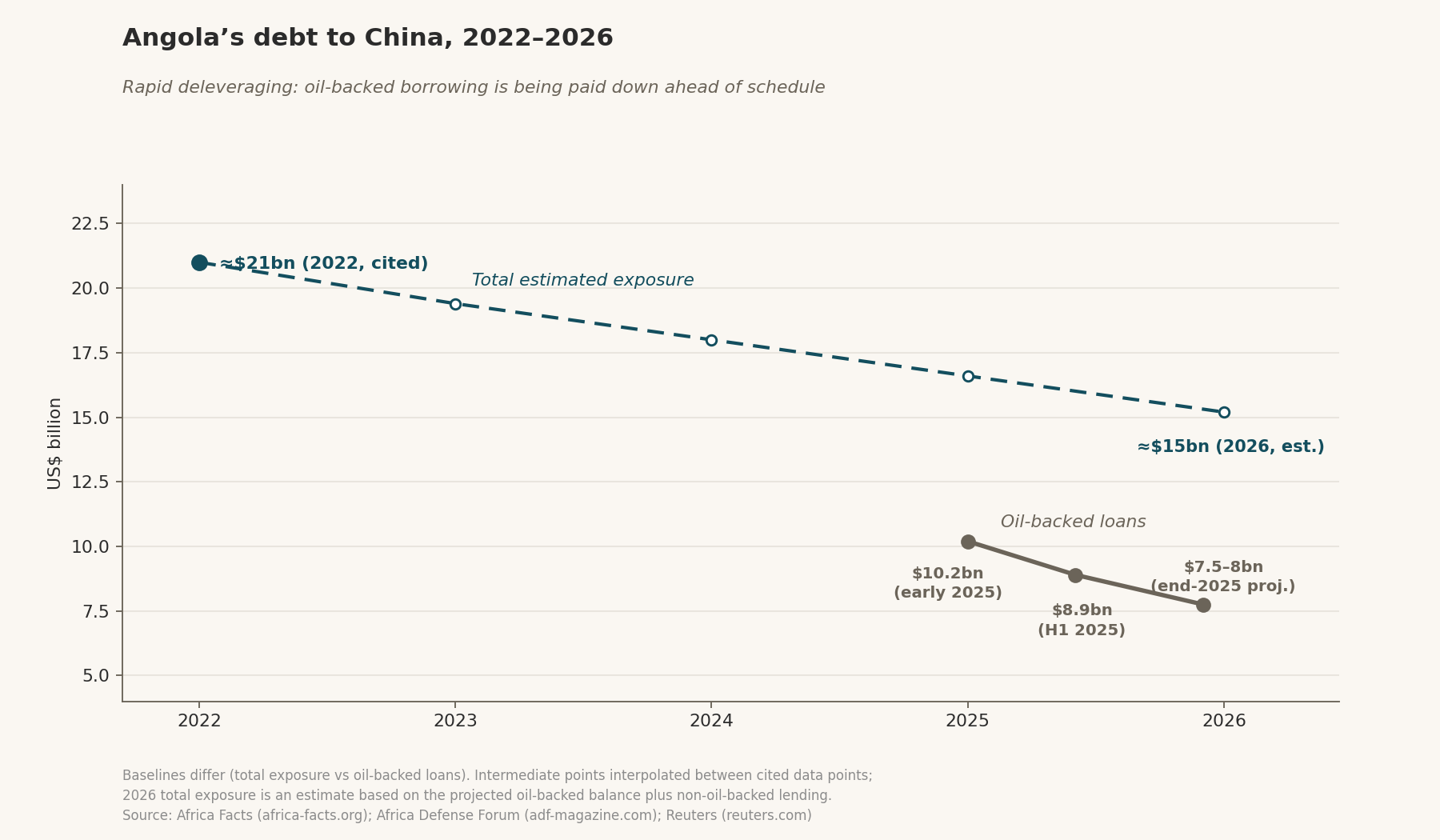
No relationship better captured the “Angola model” of Chinese lending in Africa: loans collateralised against oil revenues, repaid in barrels, financing infrastructure built largely by Chinese firms. The model had a clear logic for both sides. For Angola, emerging from civil war with little access to Western capital and a pressing need to rebuild, Chinese credit came fast and without the governance conditions the IMF would impose. For China, oil collateral made the loans safe and secured a supply of crude for its growing economy. At its peak, Angola led all African nations in debt to China, with an estimated $21.0 billion owed as of 2022 — more than double the next-largest borrower on the continent (Africa Facts). That model left Angola “acutely vulnerable when global oil prices collapsed in 2014–2016” (Africa Facts) — because when the barrel is both the collateral and the repayment mechanism, a price crash squeezes the borrower from every direction at once.
The rapid unwinding
The striking story of 2025–2026 is how fast Angola is deleveraging from Beijing. It paid down $1.3 billion in Chinese debt in the first half of 2025 alone, bringing outstanding debt down from $10.2 billion to $8.9 billion — about 9% of GDP (Africa Defense Forum). Angola projected oil-backed China loans would drop to $7.5–8 billion by year-end 2025 (Reuters). And by mid-2026, Angola’s government announced a further reduction, with the Chinese ambassador in Luanda, Zhang Bin, indicating the debt could fall to $11 billion “in the coming months” — cited as roughly a 70% reduction from a 2025 figure that had exceeded $24 billion (Valor Económico).
A word of caution on the numbers: the differing baselines across sources reflect whether one counts only oil-backed loans or total Chinese exposure — figures spanning roughly $8.9 billion to $24 billion. Editors should treat the trajectory (rapid, sustained reduction) as the reliable signal and any single headline figure as approximate; a fully reconciled number would require a primary statement from the BNA or Finance Ministry. What is not in dispute is the direction: Angola is retiring its Chinese obligations at a pace that would have seemed implausible during the crisis years.
Why the model is fading everywhere
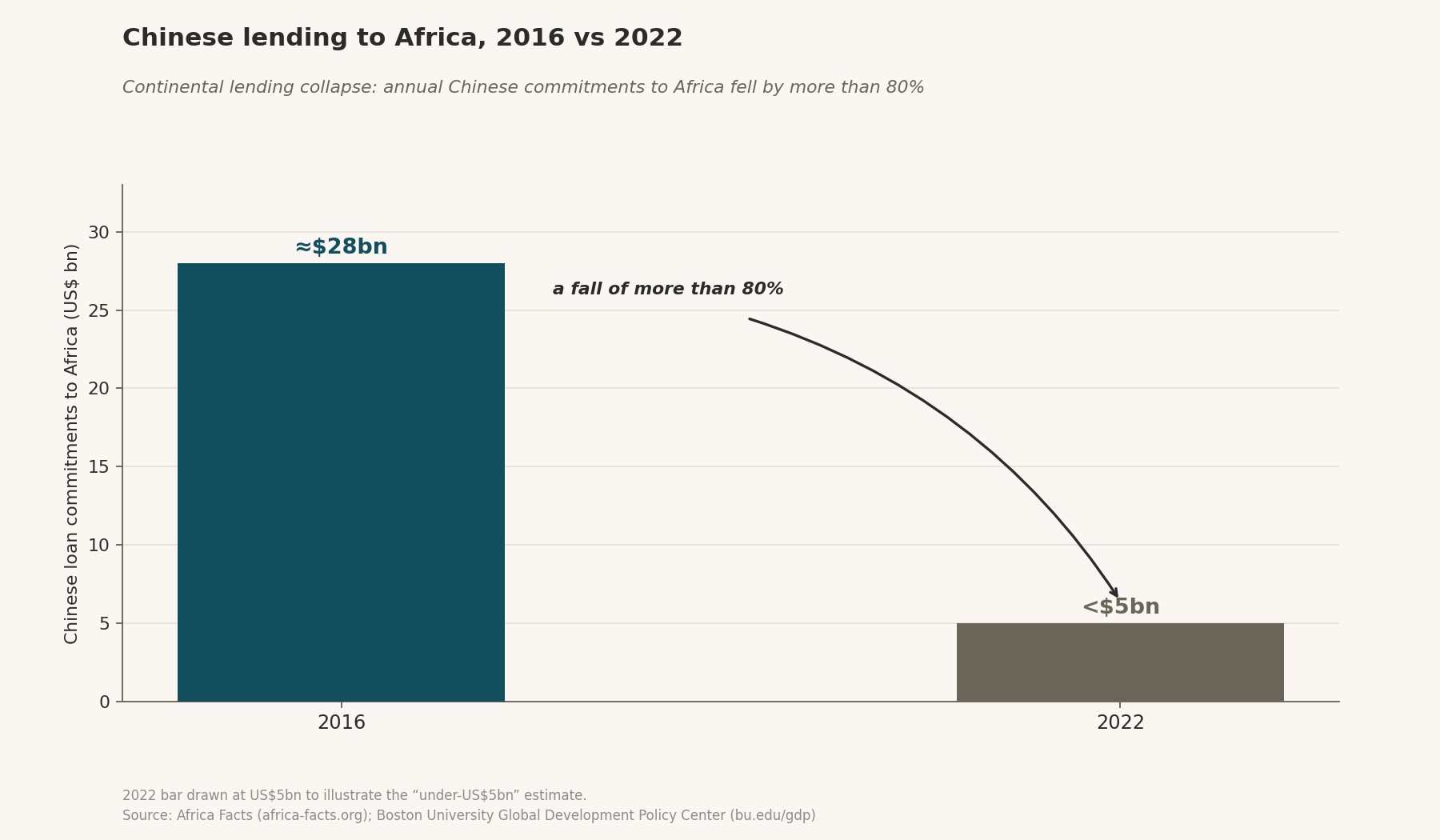
Angola’s deleveraging tracks a continental shift. Chinese lending to Africa has slowed sharply since its peak: annual loan commitments fell from roughly $28 billion in 2016 to under $5 billion by 2022, per Boston University’s Global Development Policy Center (Africa Facts). Several forces drove the retreat: China’s own economic slowdown and tighter capital discipline; a wave of distressed loans that made Chinese lenders more cautious; and hard lessons from projects that failed to generate the returns needed to service their debt. The era of the no-strings mega-loan is largely over, replaced by smaller, more selective and more commercially scrutinised financing.
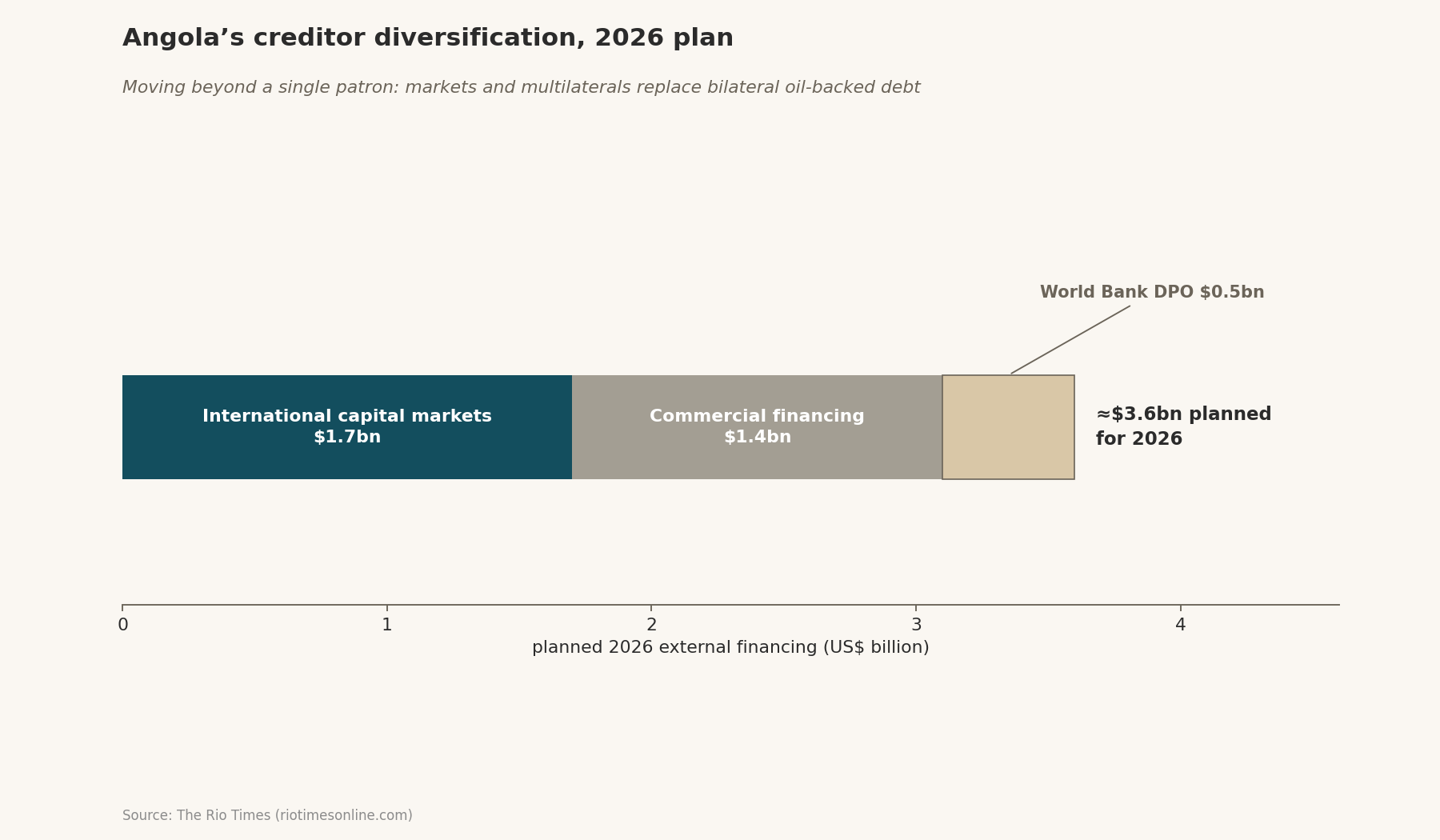
One analysis captured the pivot in a headline: “China’s Grip on African Debt Eases as Angola Shifts Toward Domestic Creditors” (Trends N Africa). Angola’s own 2026 debt strategy — raising money on international capital markets, from commercial lenders, and via the World Bank — is itself evidence of creditor diversification away from a single patron (The Rio Times). Domestic borrowing, too, keeps more of the debt-service burden circulating within the Angolan economy rather than flowing abroad.
Not decoupling — reconfiguring
But this is renegotiation, not rupture. In July 2026 the BNA authorised commercial banks to count Chinese yuan holdings toward their mandatory reserve requirements — a technical move with strategic weight, signalling deeper monetary integration with China even as oil-backed debt shrinks (Essydo). Elevating the yuan to a reserve-eligible currency is the kind of quiet institutional step that outlasts any single loan; it embeds the renminbi in Angola’s financial plumbing and reflects China’s broader push to internationalise its currency across the Global South.
China also remains active in Angola’s energy sector, including in clean-power projects — though some of those, too, have arrived “with heavy debt,” according to reporting on Chinese green-power financing in Angola (Global Voices). The relationship is not being severed; it is being rebalanced — less oil-backed lending, more monetary and sectoral integration.
The debt-trap cliché, examined
Angola’s experience complicates the popular “debt-trap” narrative in both directions. On one hand, oil-collateralised lending genuinely amplified Angola’s vulnerability to price shocks (Africa Facts). The vulnerability was real, and the crisis years were painful. On the other, Angola is demonstrably able to pay the debt down — rapidly — and Beijing has signalled the reduction will continue, hardly the behaviour of a creditor seeking to seize strategic assets (Valor Económico). A creditor engineering a “trap” does not encourage its debtor to pay it off early. Meanwhile, China has ramped up debt collection across the continent, and where projects underperformed — as with Kenya’s flagship railway — the burden has been real (Africa Defense Forum). The lesson is neither “predatory China” nor “benign partner,” but something more useful: the terms, the collateral, and the underlying project economics matter more than the lender’s nationality. A well-structured loan for a productive asset builds an economy; a poorly structured loan for a white elephant burdens one — regardless of whose flag flies over the financing.
The strategic frame
Angola is doing something more sophisticated than “pivoting West.” It is diversifying its dependencies — paying down China, courting the US on Lobito (see Article 4), welcoming Gulf port operators (see Article 10), and deepening yuan integration all at once. For a mid-sized African state, the goal is not to pick a bloc but to avoid being captured by any single one. This is the essence of strategic non-alignment in a multipolar era: extract capital, technology and infrastructure from every suitor while conceding permanent loyalty to none.
That is the real post-debt-boom strategy — and other African governments are watching whether it works. If Angola can retire its Chinese debt, attract US and Gulf capital, and preserve market access all while keeping its options open, it will have written a playbook for how mid-sized resource states navigate a world of competing great powers. If it overextends — courting too many patrons, servicing too much debt — it will become a cautionary tale instead. Either way, the “Angola model” of the 2000s is being quietly retired, and something more deliberate is taking its place.
Charts & visuals
X: Angola was the flagship of China’s oil-for-loans model in Africa. Now it’s paid down ~$1.3bn in H1 2025 alone, is diversifying creditors, and is letting banks count yuan toward reserves. The “debt trap” story was never that simple. 🧵
LinkedIn: Angola once owed China more than any other African nation. Today it’s deleveraging fast, courting US-backed infrastructure, welcoming Gulf capital — and simultaneously deepening yuan integration. This isn’t “pivoting West.” It’s a mid-sized state diversifying its dependencies so no single power can capture it. New Axis Media on the quiet unwinding of the “Angola model.”
Author
Sign up for New Axis Media newsletters.
Stay up to date with curated collection of our top stories.