Angola's 2026 IMF verdict: growth held, deficit slipped
The Fund signed off on Angola's 2026 budget while flagging a 4.1% deficit, a thinning current account, and a banking system still tied to the sovereign.
Why it matters. Angola's 2026 story is not a crisis story. It is a margin story: growth is holding while the revenue base thins, and every policy choice from here is a trade between debt service and everything else.
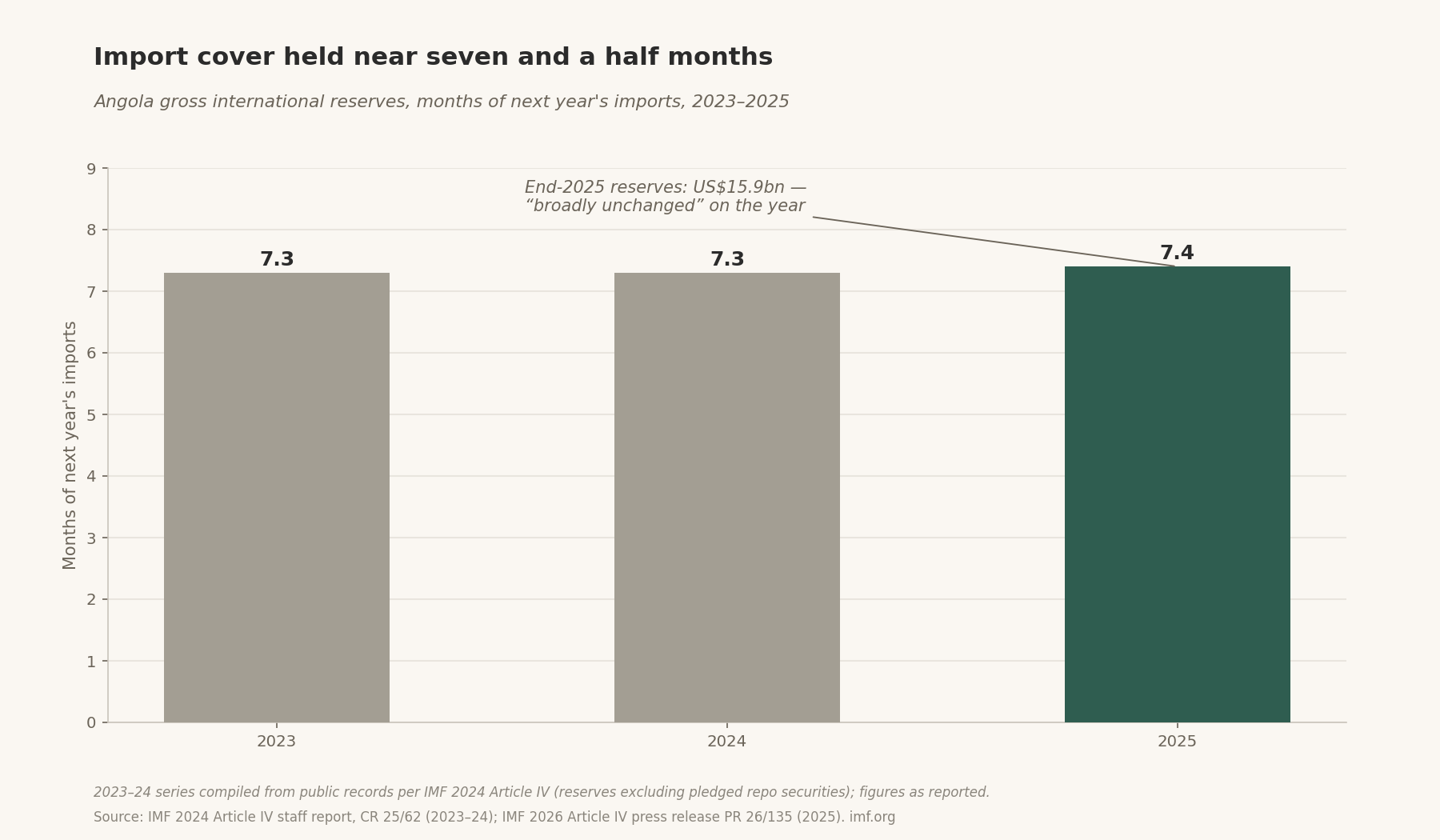
The facts. The IMF Executive Board concluded Angola's Article IV consultation on 1 May 2026, reporting that growth held at 3.1% in 2025 despite a significant decline in oil production, and that lower oil revenues plus expenditure slippages produced an overall fiscal deficit of 4.1% of GDP, per the IMF Executive Board press release. Inflation eased to 12.4% in March 2026, and the current account surplus narrowed to a preliminary 0.4% of GDP as oil exports fell and the kwanza appreciated in real terms. Reserves ended 2025 broadly unchanged at 7.4 months of import cover. The consultation was published as IMF Country Report No. 2026/094, and ran alongside a Financial Sector Assessment Program whose system stability assessment found persistent deficiencies in corporate governance, risk management, and supervision of related-party and concentration risk.
Context. The Fund's 2025 post-financing assessment had already warned that Angola's debt service was becoming "equivalent to oil tax revenue," with external debt service of US$10.5 billion (9.1% of GDP) due in 2025 and a heavy repayment cluster running through 2026–29, according to the IMF post-financing assessment report. Directors' 2026 asks were specific: sustained consolidation under the Fiscal Sustainability Law, any oil windfall used to cut debt rather than spend, faster revenue mobilisation, continued fuel subsidy reform with protection for the vulnerable, greater exchange-rate flexibility, and prompt delivery of the FATF action plan.
Between the lines. Two sentences in the Board statement carry the most weight. First, the instruction that windfalls go to debt reduction — an implicit judgement that Luanda's spending discipline weakens whenever oil cooperates. Second, the flag on the "sovereign-bank nexus": Angolan banks hold the state's paper, so a fiscal shock is a banking shock, which is why the FSAP language on resolving problem banks matters more than it looks.
What to watch. Whether the 2026 budget's expenditure adjustment actually lands in outturn data; the pace of FATF action-plan delivery ahead of the October 2026 plenary; any resumption of fuel price adjustments; and whether FX intervention becomes rules-based as Directors requested.
Method and sources. Built from the IMF Executive Board press release, the published country report record, the 2026 FSAP stability assessment, and the 2025 post-financing assessment. No unpublished figures were used.
Related reading: Angola's 2026–2029 debt wall (Report); Power Map: who decides Angola's money; What an IMF Article IV consultation actually is.
Charts & visuals
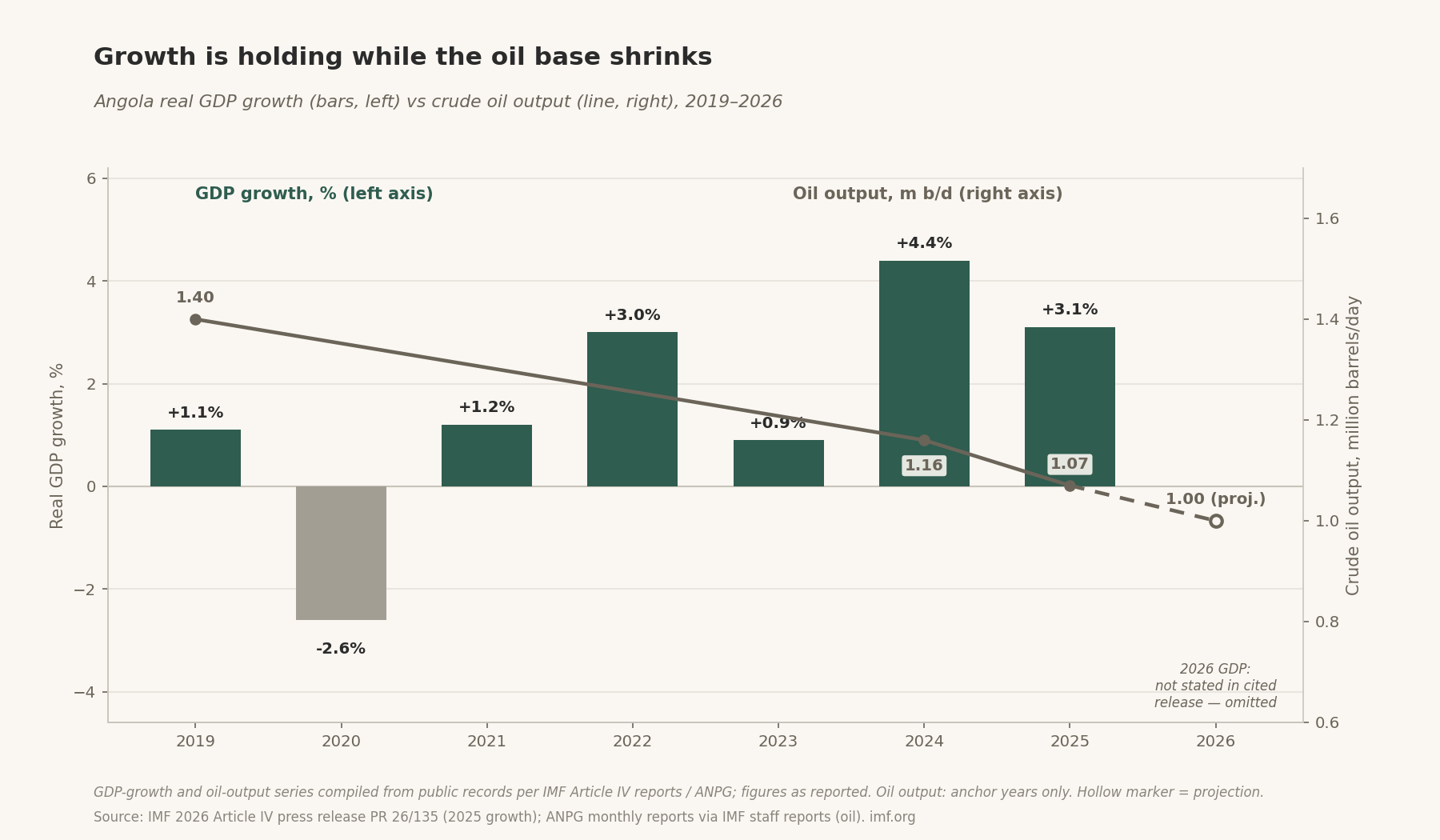
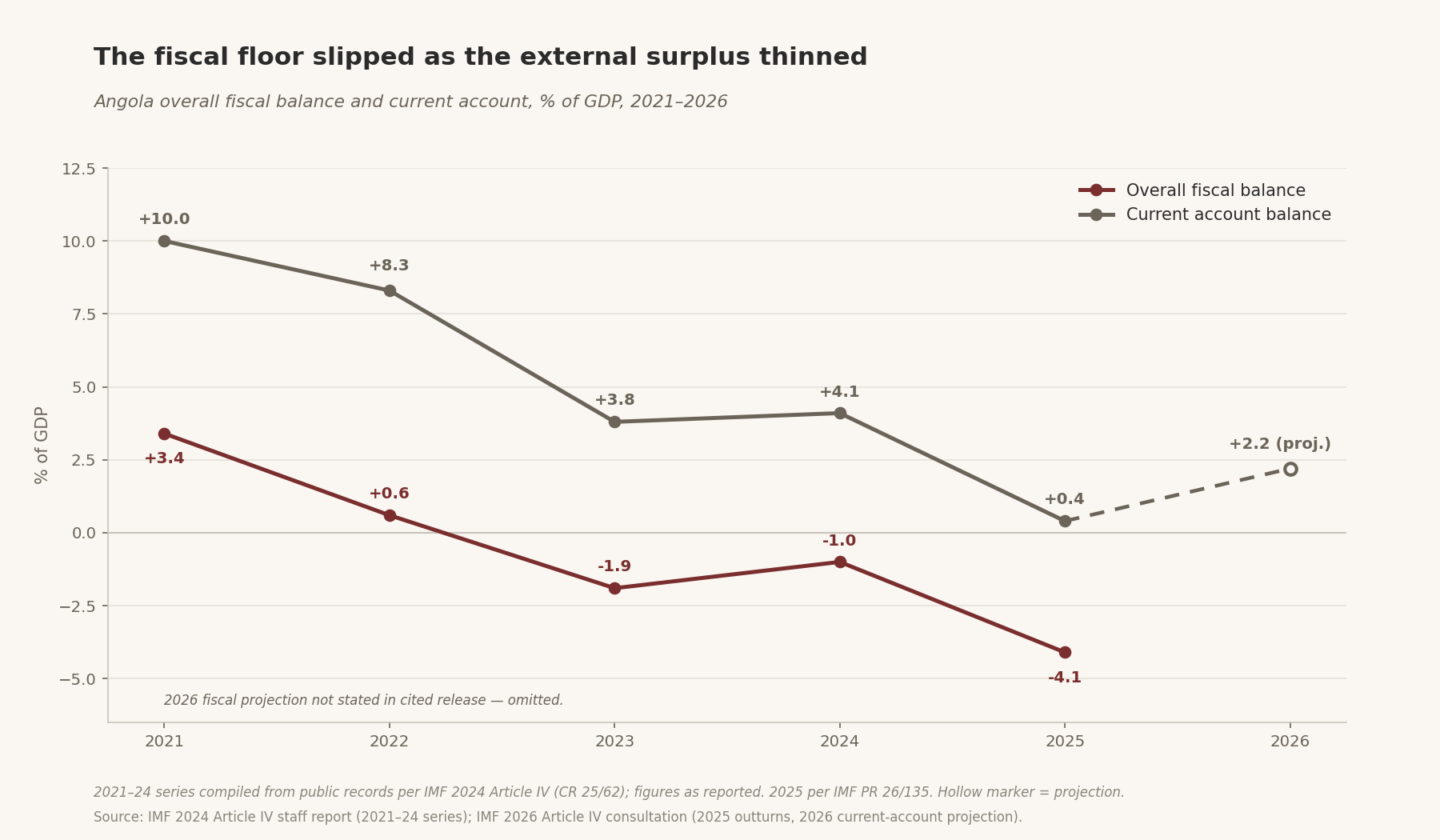
X: Angola grew 3.1% in 2025 while oil production fell. The IMF's read: deficit 4.1% of GDP, current account down to 0.4%, and a banking system still bolted to the sovereign. What the Fund actually asked Luanda to do →
LinkedIn: The IMF closed Angola's 2026 Article IV consultation with an unusually specific instruction: use any oil windfall to cut debt, not to spend. Growth held at 3.1% in 2025, but the deficit widened to 4.1% of GDP and the current account surplus thinned to 0.4%. Alongside it, the first full FSAP in years flagged the sovereign-bank nexus and legacy NPLs. Our brief on what the Fund said, and what it means for the 2027 fiscal cycle.
Author
Sign up for New Axis Media newsletters.
Stay up to date with curated collection of our top stories.