Power Map: who decides Angola's money
Five institutions set Angola's fiscal, monetary and resource policy. Here is who holds each node, and what each one controls.

Why it matters. Angola's economic decisions are made in a small number of clearly identifiable seats. Knowing which seat controls which lever is the difference between reading announcements and reading policy.
The nodes.
| Node | Officeholder / body | Controls | Source |
|---|---|---|---|
| Presidency | President João Lourenço | Appointment power over state company boards and regulators; sets budget priorities; AU rapporteur role for 2026 | AU 2026 Bureau composition |
| Economic coordination | Minister of State José de Lima Massano | Cross-ministry economic coordination; previously BNA governor | VerAngola on the 2023 BNA handover |
| Finance | Minister Vera Daves de Sousa | Budget, borrowing plan, Eurobond issuance and buybacks, subsidy pricing decisions | Bloomberg on the March 2026 Eurobond allocation |
| Central bank | BNA Governor Manuel António Tiago Dias, confirmed 2023 | Policy rate, FX intervention, bank supervision, inflation target path | Central Banking on his appointment ; BNA July 2026 policy communiqué reporting |
| National oil company | Sonangol Chairman and CEO Sebastião Pai Querido Gaspar Martins | Upstream and downstream assets, Barra do Dande terminal, deferred IPO | Sonangol's own leadership page ; Plataforma Media on the IPO deferral |
| Upstream regulator | ANPG | Licensing, production and export reporting | ANPG output data via allAfrica |
| Diamond state company | Endiama | Production targets, Catoca and Luele output, De Beers joint venture | Endiama roadshow deck |
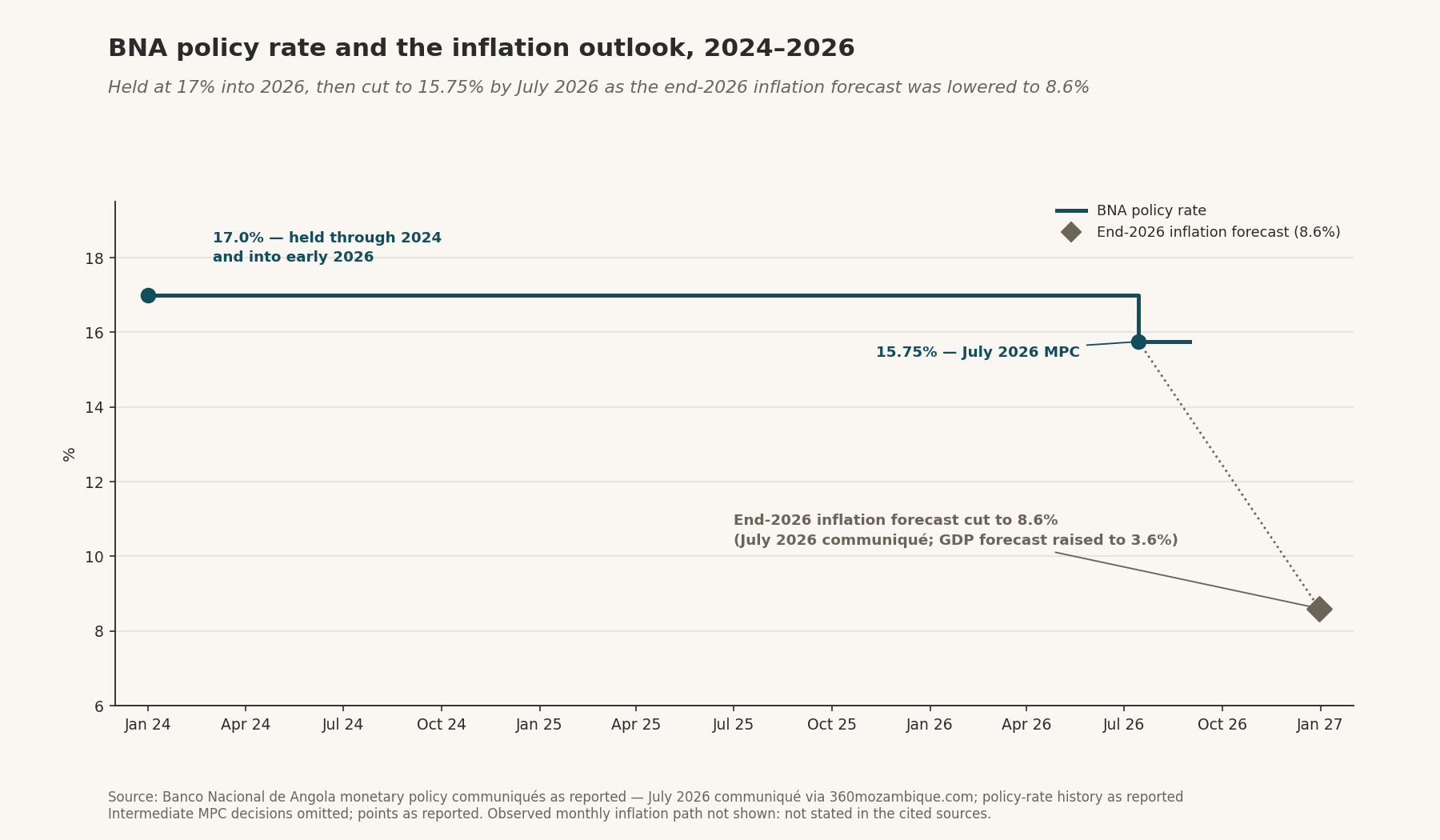
The facts behind the nodes. Tiago Dias, a Bordeaux-trained economist who joined the BNA in 1997 and served as deputy governor from 2016, was confirmed governor in 2023 after José de Lima Massano moved to the Minister of State role, per Central Banking and VerAngola. At the July 2026 monetary policy committee he cut the end-2026 inflation projection to 8.6% and raised the growth forecast to 3.6%, per reporting of the communiqué; in June 2026 he publicly reaffirmed tightening prudential limits for bank soundness, per allAfrica, and has set out fintech and cross-border regulatory harmonisation priorities in an interview with the Africa Financial Summit. Finance Minister Vera Daves de Sousa has been the public face of both subsidy pricing — confirming the phased removal and the 2025 pause, per Bloomberg — and debt management, including the March 2026 buyback allocation.
Between the lines. Three features define this map. Appointment power is centralised in the presidency, so institutional independence is functional rather than structural. The Massano– Tiago Dias sequence means the central bank and the economic coordination ministry share a common technocratic lineage, which tends to align monetary and fiscal messaging. And Sonangol's deferred privatisation keeps a large balance sheet inside the state, which matters for contingent liabilities and for who controls downstream pricing.
What to watch. Any board reshuffles at Sonangol or Endiama; whether the BNA moves to a rules-based FX intervention framework as the IMF urged; PROPRIV's conclusion and the 2027 IPO decision; and whether subsidy pricing authority shifts from discretion to formula.
Method and sources. Company and central bank primary sources, Central Banking and VerAngola for appointment records, Bloomberg for finance ministry decisions, regulator data via allAfrica, Endiama's own investor deck, and Plataforma Media for the IPO timetable. No unnamed sources were used and no internal editorial metadata is published.
Related reading: Angola's 2026–2029 debt wall; Angola's fuel price ladder; Angola's diamond paradox.
Charts & visuals
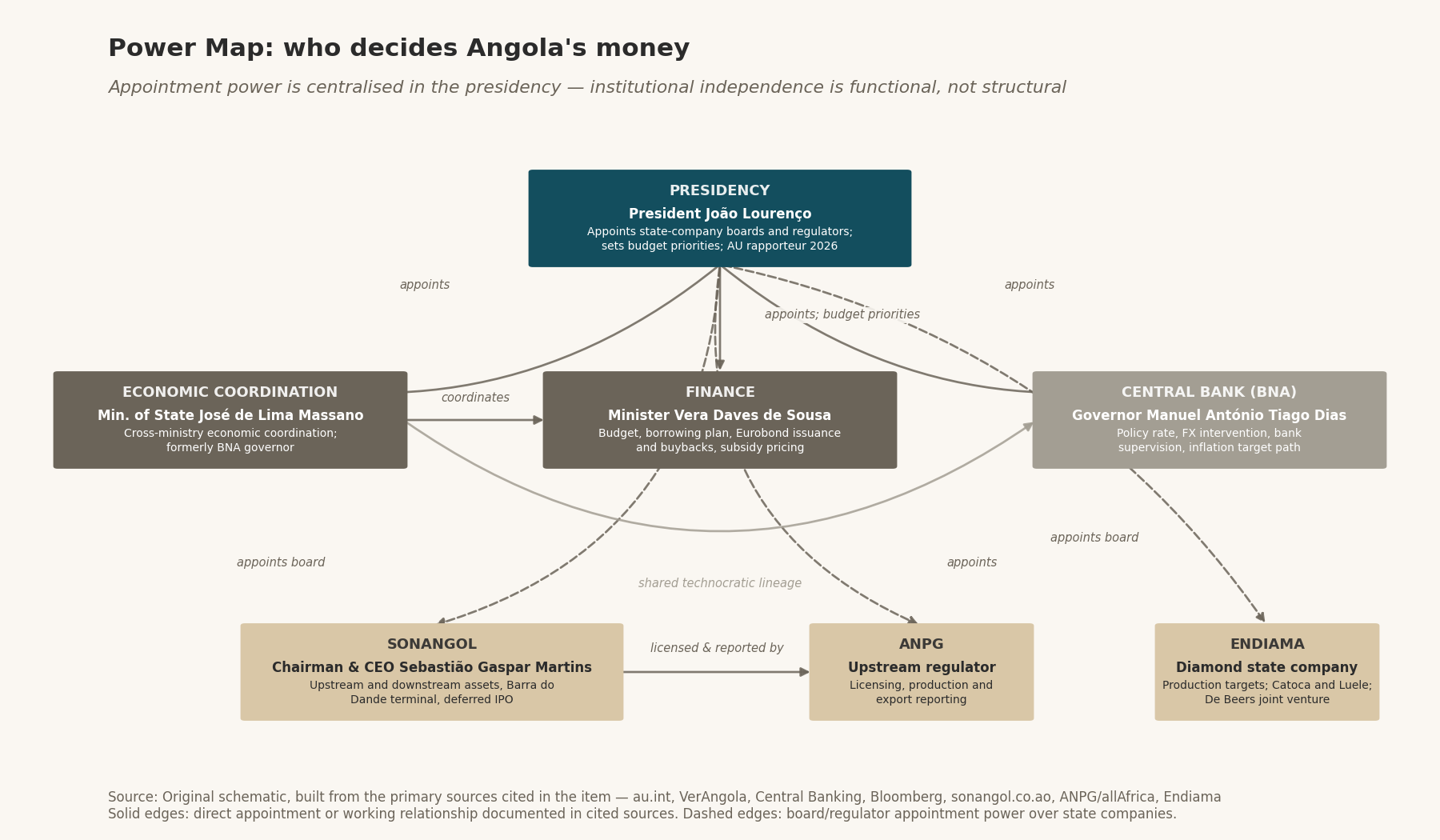
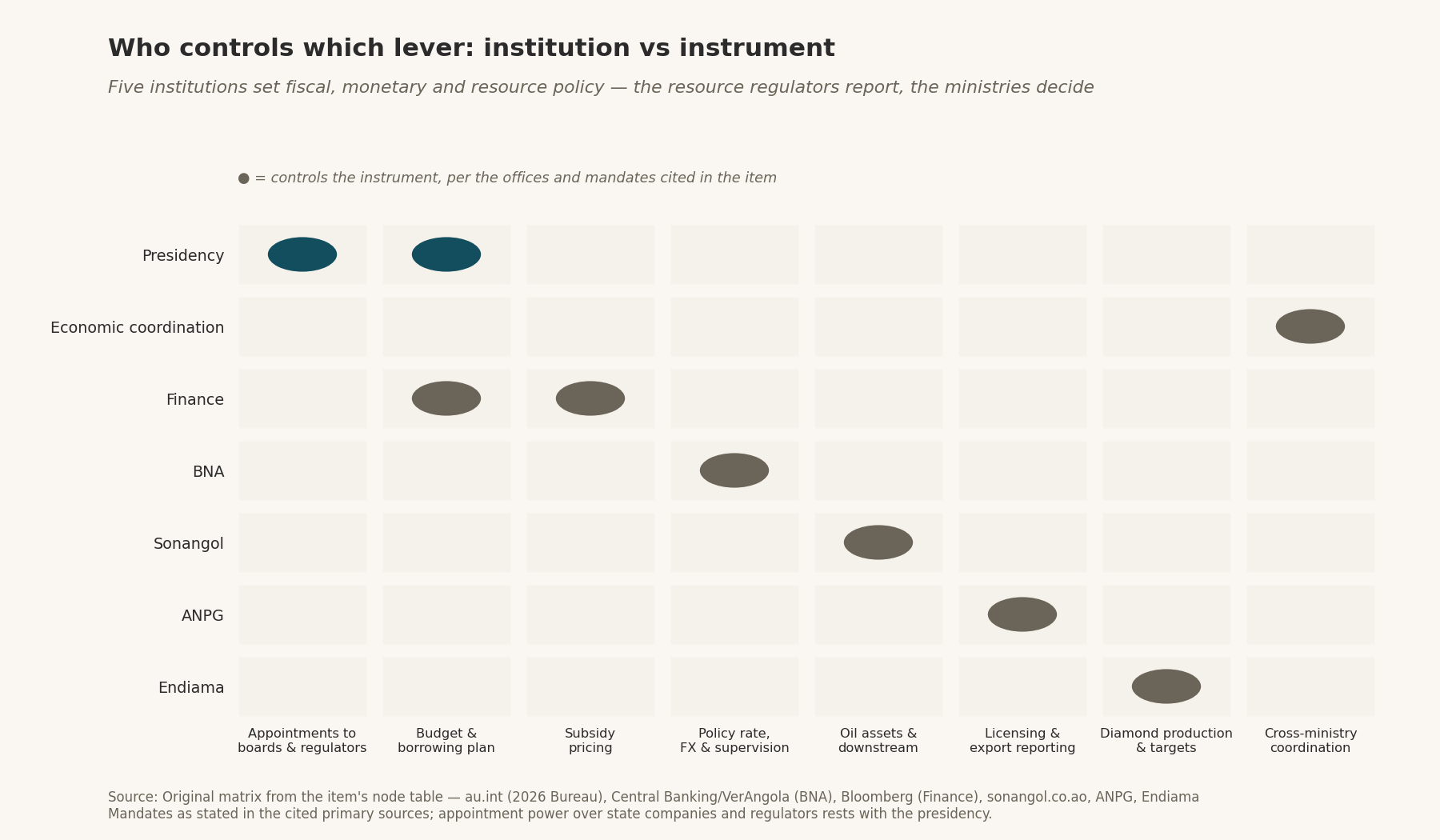
X: Angola's economic policy runs through five seats: the presidency, economic coordination, finance, the BNA, and Sonangol. Who holds each, and which lever each actually controls
LinkedIn: New Axis Power Map: who decides Angola's money. Five institutions set fiscal, monetary and resource policy — the presidency, the Minister of State for Economic Coordination, the Ministry of Finance, Banco Nacional de Angola, and Sonangol, with ANPG and Endiama controlling resource reporting. We name the officeholders, cite the primary sources, and set out which lever each seat actually controls. Reference material for anyone negotiating, lending, or reporting in Angola.
Author
Sign up for New Axis Media newsletters.
Stay up to date with curated collection of our top stories.