Angola country brief: the arithmetic of a million barrels
Oil output is being defended, not grown. Gas has started, non-oil GDP is outpacing the wells, and the budget still runs on crude.
Why it matters. Angola's entire fiscal and external position turns on one number that the state can no longer easily raise: barrels per day.
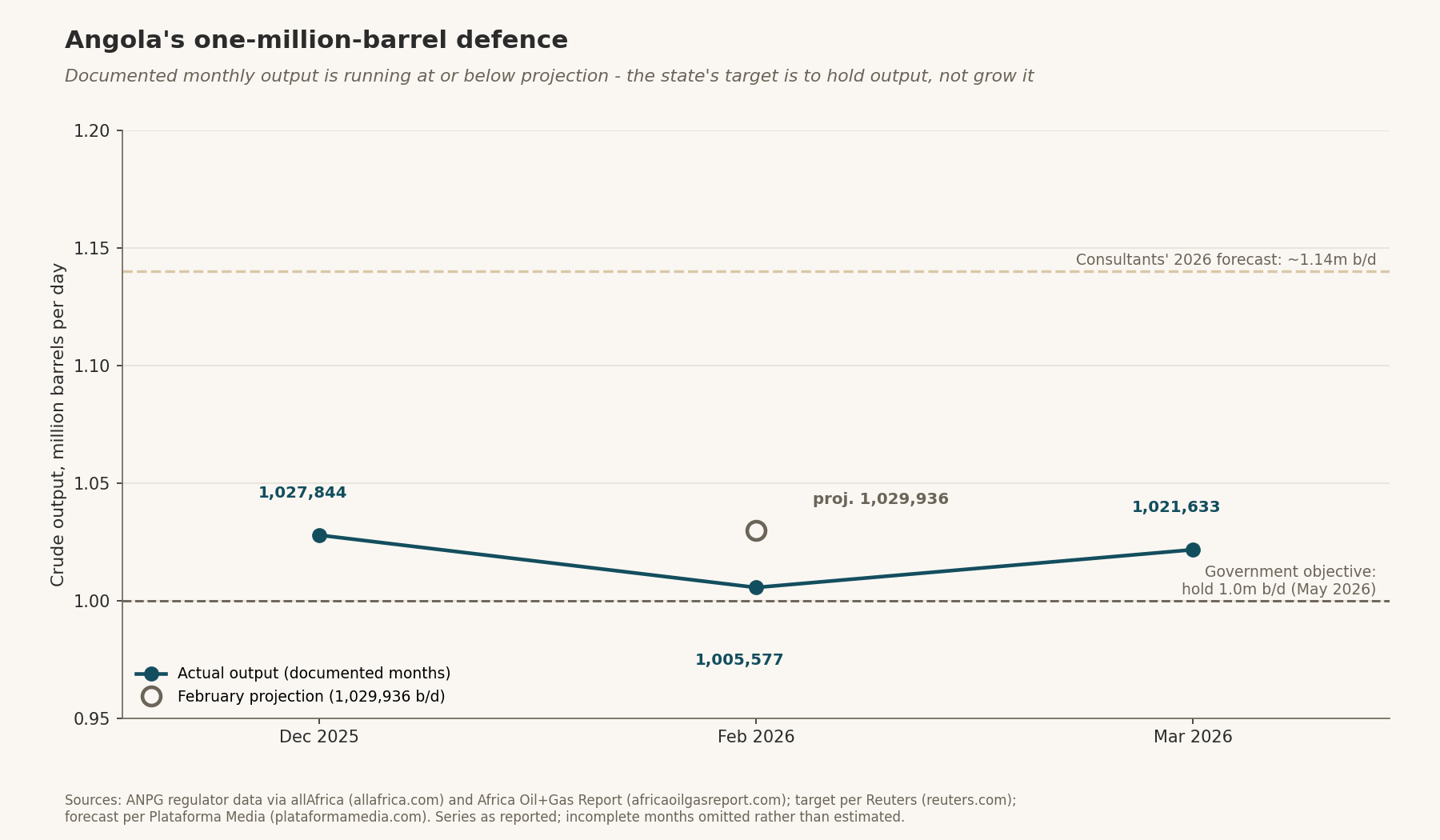
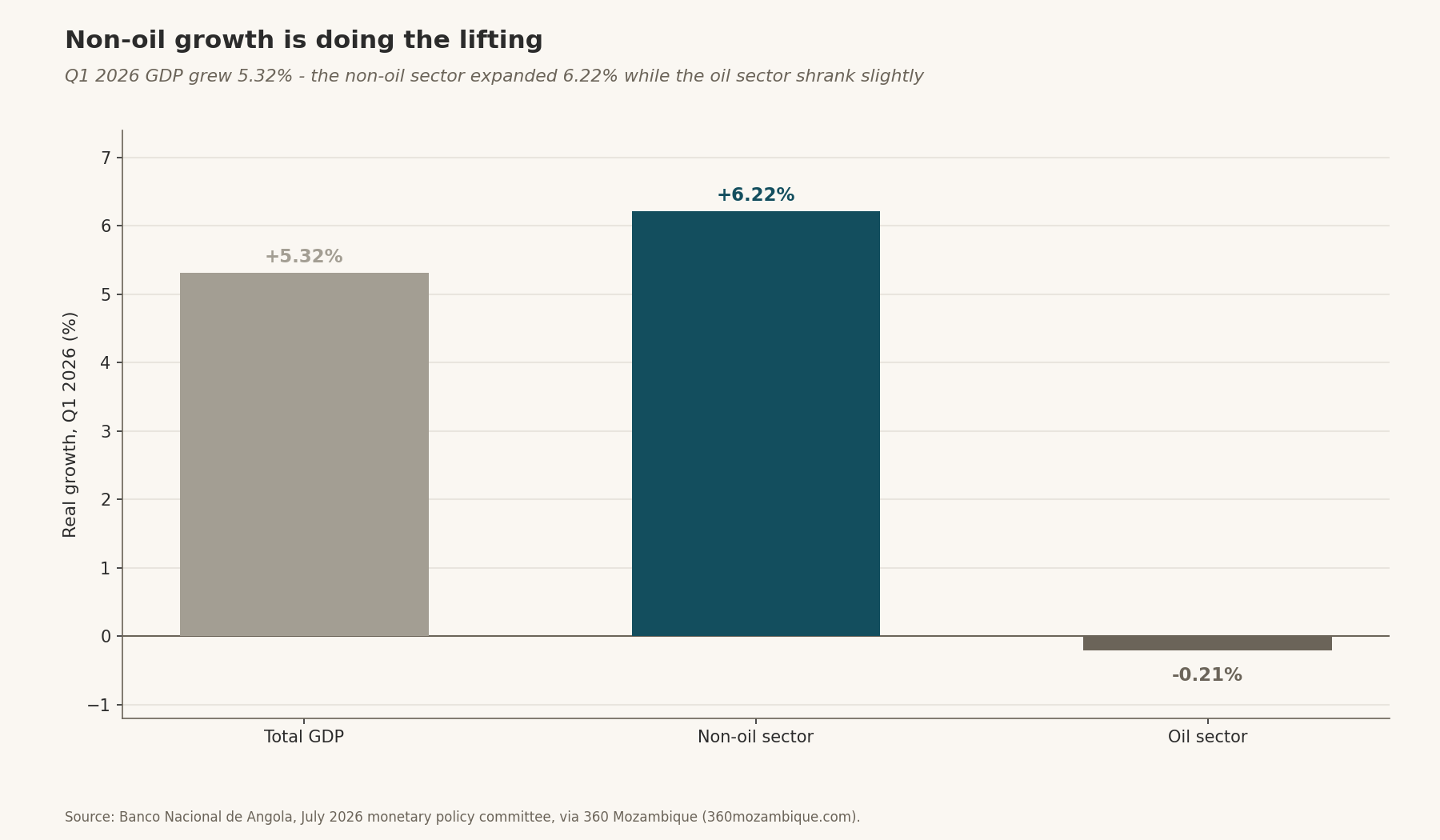
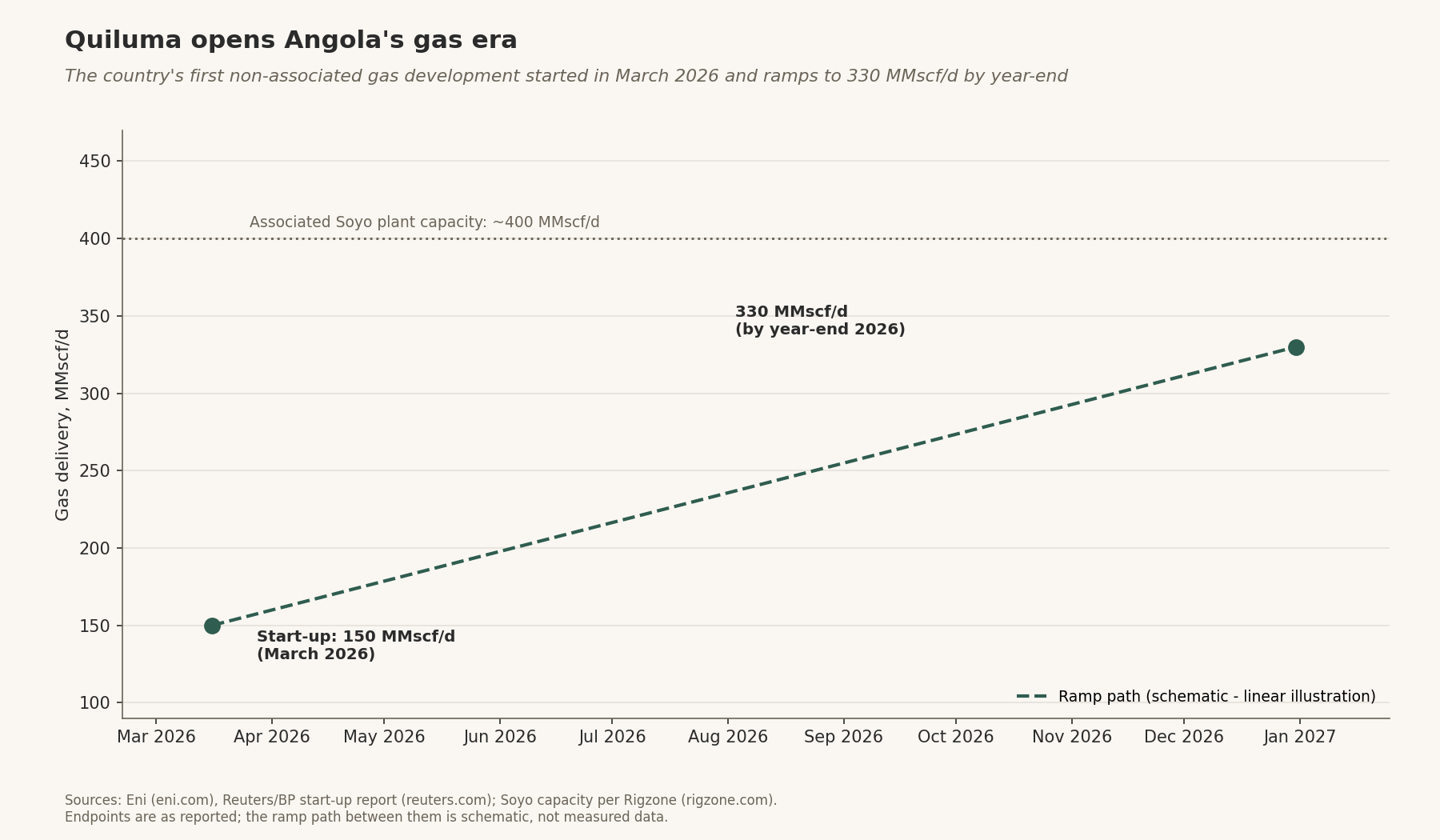
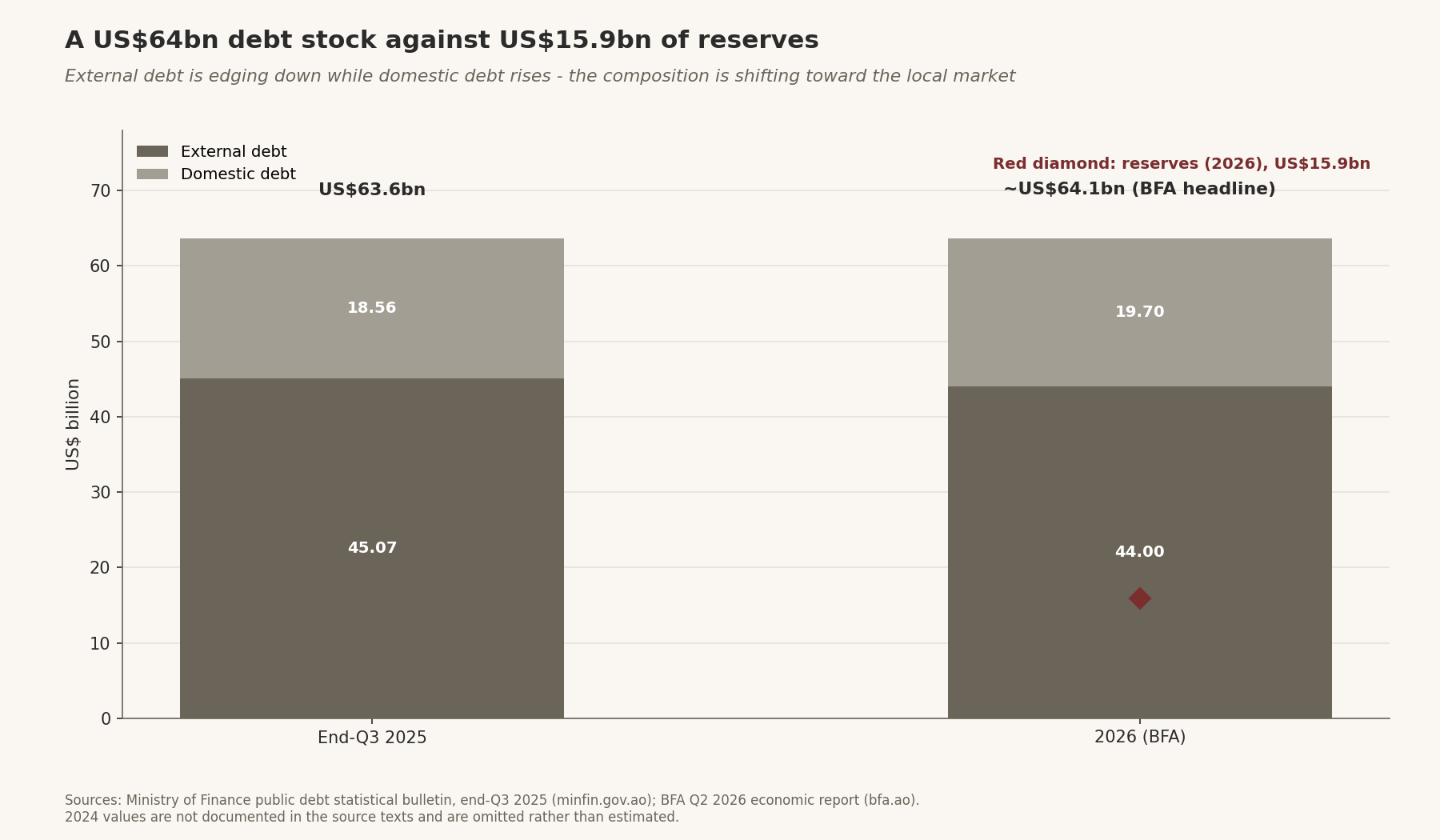
The facts. Angola produced 1,005,577 barrels a day in February 2026, below the 1,029,936 b/d projected, according to regulator data reported via allAfrica. Output was 1,021,633 b/d in March 2026, with exports of 1,151,930 b/d and just 11,934 b/d delivered to the Luanda refinery, the country's only fully functional plant, per Africa Oil+Gas Report. December 2025 averaged 1,027,844 b/d, and consultants forecast a 6.5% rise to about 1.14 million b/d in 2026 on the ramp-up of projects started in 2025, per Plataforma Media. The government's own framing is defensive: the minister said in May 2026 that the "primary objective is to sustain production at one million barrels per day over the next year", noting IEA data showing output down from 1.16 million b/d in 2024 to 1.07 million in 2025 and that the Cabinda refinery runs at 30,000 b/d, Reuters reported. Gas is the new line: Azule Energy started up the Quiluma field in March 2026 at 150 MMscf/d, ramping to 330 MMscf/d by year-end, Angola's first non-associated gas development, per Eni and Reuters; the associated Soyo plant has about 400 MMscf/d capacity and the Agogo and Ndungu oil developments target a combined peak of roughly 175,000 b/d, per Rigzone. On the macro side, the central bank reported first-quarter 2026 GDP growth of 5.32%, with the non-oil sector up 6.22% and the oil sector down 0.21%, and cut its end-2026 inflation projection to 8.6% while raising its growth forecast to 3.6%, per 360 Mozambique's report of the July 2026 monetary policy committee. Public debt stood at about US$64.1 billion in 2026, with external debt at US$44 billion and reserves at US$15.9 billion, per Banco de Fomento Angola's Q2 2026 economic report.
Context. Angola left OPEC in 2024 over quota disputes, per Reuters. Since then it has been managing decline with new offshore projects rather than reversing it — while the IMF recorded a significant production fall in 2025 that widened the deficit to 4.1% of GDP, per the Executive Board press release.
Between the lines. Three structural facts define Angola in 2026. Refining is negligible, so a crude exporter imports fuel and subsidises it. Non-oil GDP now grows faster than oil GDP, but non-oil revenue does not, which is the diversification gap the IMF keeps naming. And gas gives Angola a second export product for the first time in a decade, small in volume but strategically useful for LNG utilisation and domestic industry.
What to watch. Whether output holds at or above 1.0 million b/d through 2026; the Quiluma ramp to 330 MMscf/d and Maboqueiro start-up; Cabinda refinery expansion; non-oil revenue as a share of GDP in the 2027 budget; and the BNA's path to single-digit inflation.
Method and sources. Regulator production reports via allAfrica and Africa Oil+Gas Report, Reuters for ministerial targets and IEA comparisons, Eni and Reuters for the gas start-up, Rigzone for facility capacities, BNA communiqué reporting for GDP and inflation, BFA for debt and reserves, and the IMF for fiscal outcomes.
Related reading: The IMF's Angola verdict; Angola's fuel price ladder; Power Map: who decides Angola's money.
Charts & visuals
X: Angola's target is not growth. It is holding one million barrels a day. February output: 1,005,577 b/d. Refinery intake: 11,934 b/d. First non-associated gas started in March. The country brief →
LinkedIn: Angola's oil ministry has set an explicitly defensive target: hold production at one million barrels per day. February 2026 output came in at 1,005,577 b/d, below projection, and the country refines barely 12,000 b/d domestically. The bright spots are elsewhere — first non-associated gas from Quiluma in March, non-oil GDP up 6.22% in Q1, and a central bank inflation forecast cut to 8.6%. Our standing country brief on the arithmetic that drives everything else.
Author
Sign up for New Axis Media newsletters.
Stay up to date with curated collection of our top stories.