Angola's fuel price ladder: five hikes, one fiscal target
Gasoline nearly doubled in 2023, diesel almost tripled by mid-2025, and the reform paused after deadly protests. The sequence, in numbers.

Why it matters. Fuel subsidy reform is the single largest discretionary fiscal lever Angola holds. Every adjustment is measurable, and so is the political ceiling it hit in 2025.
The facts — the ladder.
| Date | Product | Price before | Price after | Change |
|---|---|---|---|---|
| Jun 2023 | Gasoline | 160 Kz/l | 300 Kz/l | +87.5% |
| Apr 2024 | Diesel | 140 Kz/l | 200 Kz/l | +43% |
| Mar 2025 | Diesel | 200 Kz/l | 300 Kz/l | +50% |
| Jul 2025 | Diesel | 300 Kz/l | 400 Kz/l | +33% |
| Sep 2025 onward | Both | — | Pause | 0% |
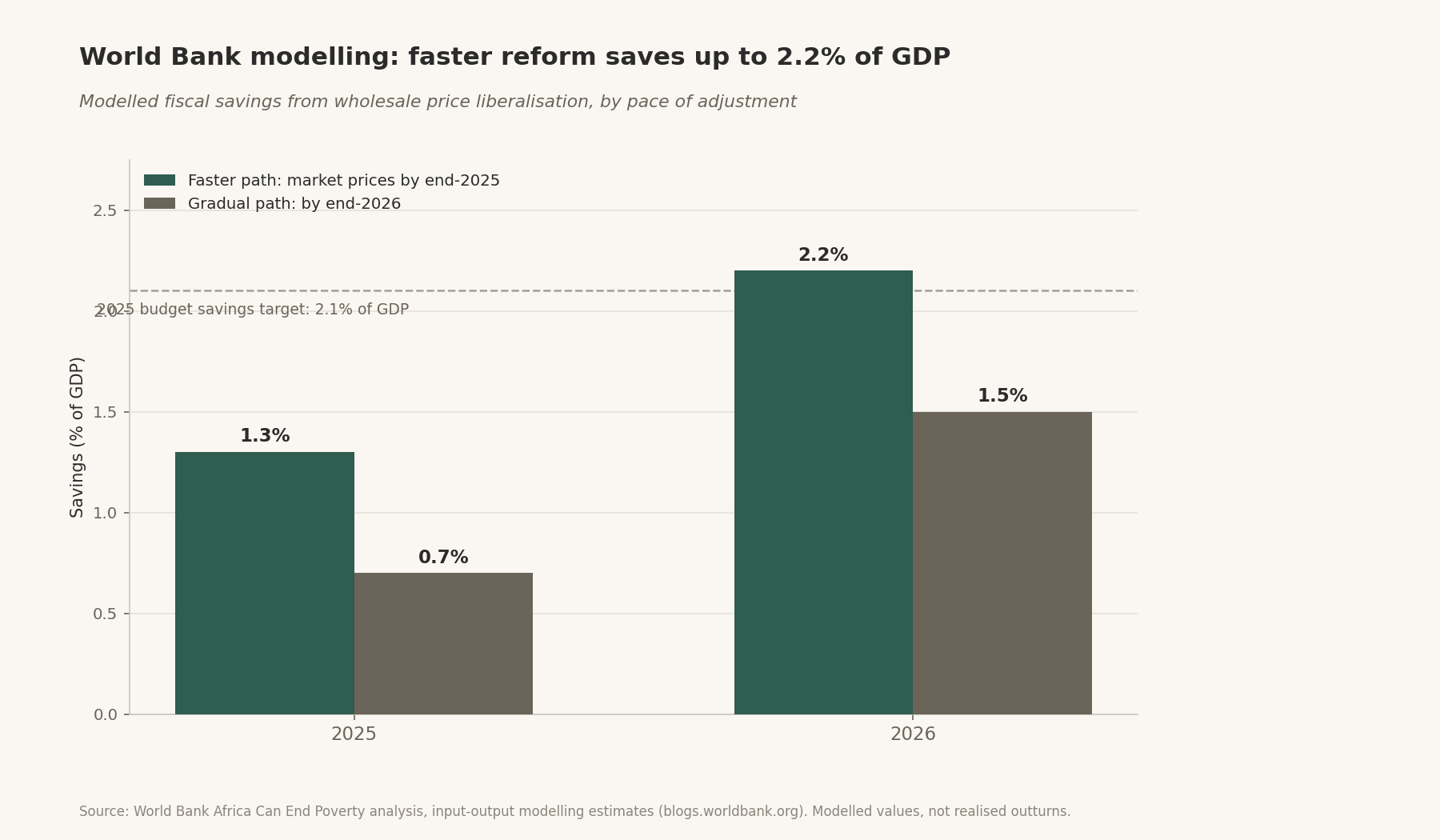
The June 2023 gasoline move and the April 2024 diesel move were the first price changes since 2016 and cut subsidies by roughly 40% and 9% respectively, per a World Bank Africa Can End Poverty analysis of Angola's fuel subsidy reform. The March 2025 diesel increase to 300 kwanza a litre came three weeks after the IMF said subsidies costing about US$3 billion in 2024 — roughly what Angola spent on health and education combined — should be eliminated, Bloomberg reported. Diesel rose again to 400 kwanza in July 2025, with the finance minister noting subsidies had equalled about 4% of GDP in 2023 and external repayments of roughly US$9 billion falling due the following year, per FurtherAfrica. Mass protests followed in late July 2025, documented by the Bretton Woods Project, which also notes authorities targeted savings of 2.1% of GDP in the 2025 budget. In September 2025 the government signalled no further increases while it assessed the impact, Bloomberg reported. Mitigation included a 50 billion kwanza (about US$60 million) credit line for SMEs and continued selective support for transport, agriculture, and fisheries, per FurtherAfrica.
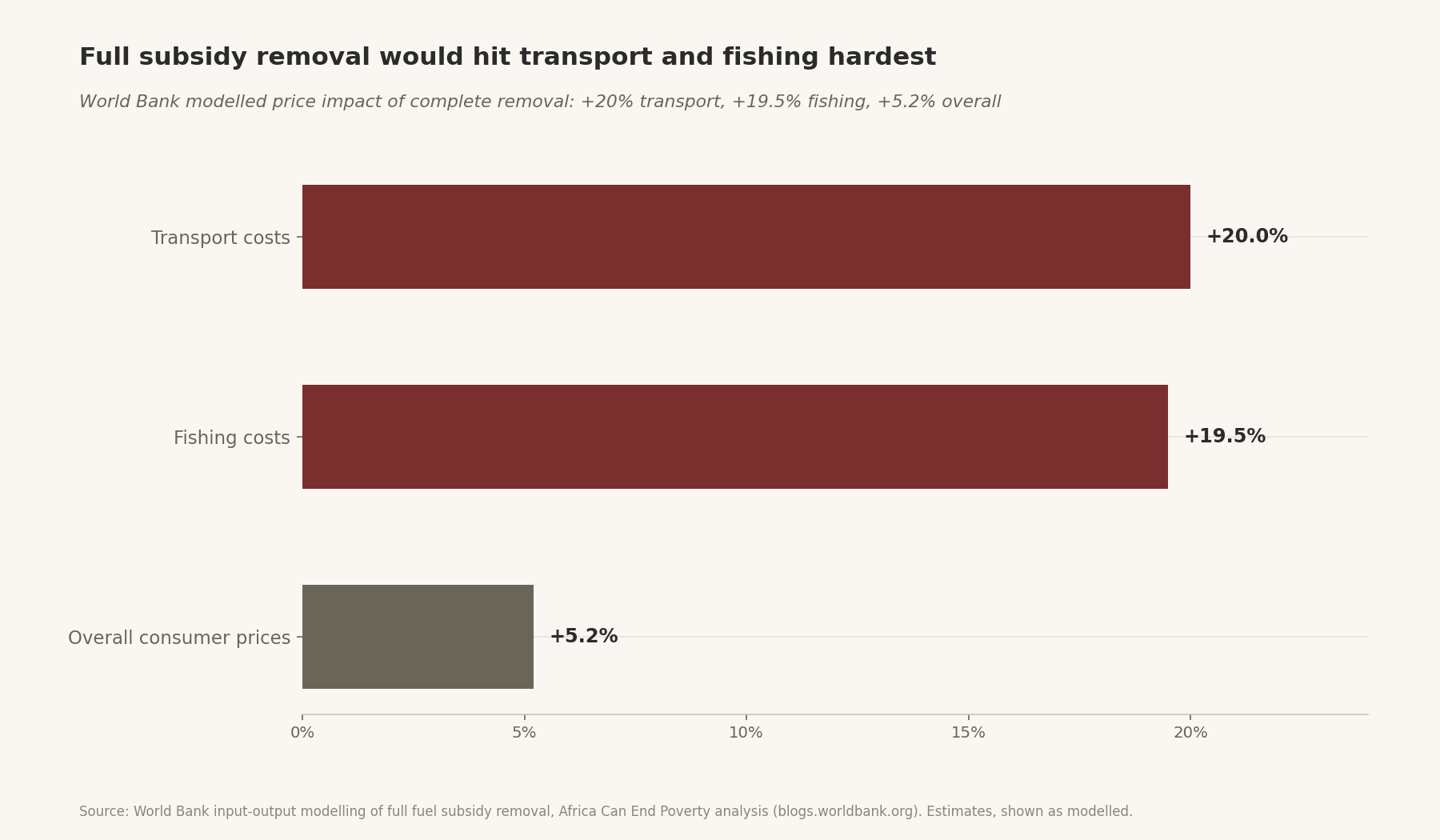
The fiscal arithmetic. World Bank modelling put savings from moving wholesale prices to market levels by end-2025 at 1.3% of GDP in 2025 and 2.2% in 2026, against 0.7% and 1.5% under a more gradual path to end-2026 — and estimated that full removal would raise overall prices by 5.2%, with fishing costs up 19.5% and transport up 20%, per the same World Bank analysis. In its 2026 Article IV conclusions the IMF again listed advancing subsidy reform "while protecting the most vulnerable" as a key priority, per the Executive Board press release.
Context. LPG and kerosene — the cooking fuels used by lower-income households — have been sequenced last by design, which is why the political cost so far has landed on transport and haulage.
Between the lines. The pause is the finding. Angola has demonstrated it can execute large administered price moves, and it has also demonstrated the ceiling: an unindexed, discretionary adjustment schedule invites a confrontation at every step. An automatic formula-based mechanism would remove the political event, which is exactly why it keeps being deferred.
What to watch. Any resumption of adjustments in the 2027 budget cycle; whether an automatic pricing formula is published; realised fiscal savings versus the 2.1% of GDP target; and the fate of Kwenda cash transfer coverage.
Method and sources. World Bank modelling and reform chronology, Bloomberg reporting on the 2025 adjustments and the pause, FurtherAfrica on the July 2025 increase and mitigation package, Bretton Woods Project on protests and budget targets, IMF Executive Board conclusions.
Related reading: The IMF's Angola verdict; Angola's 2026–2029 debt wall.
Charts & visuals
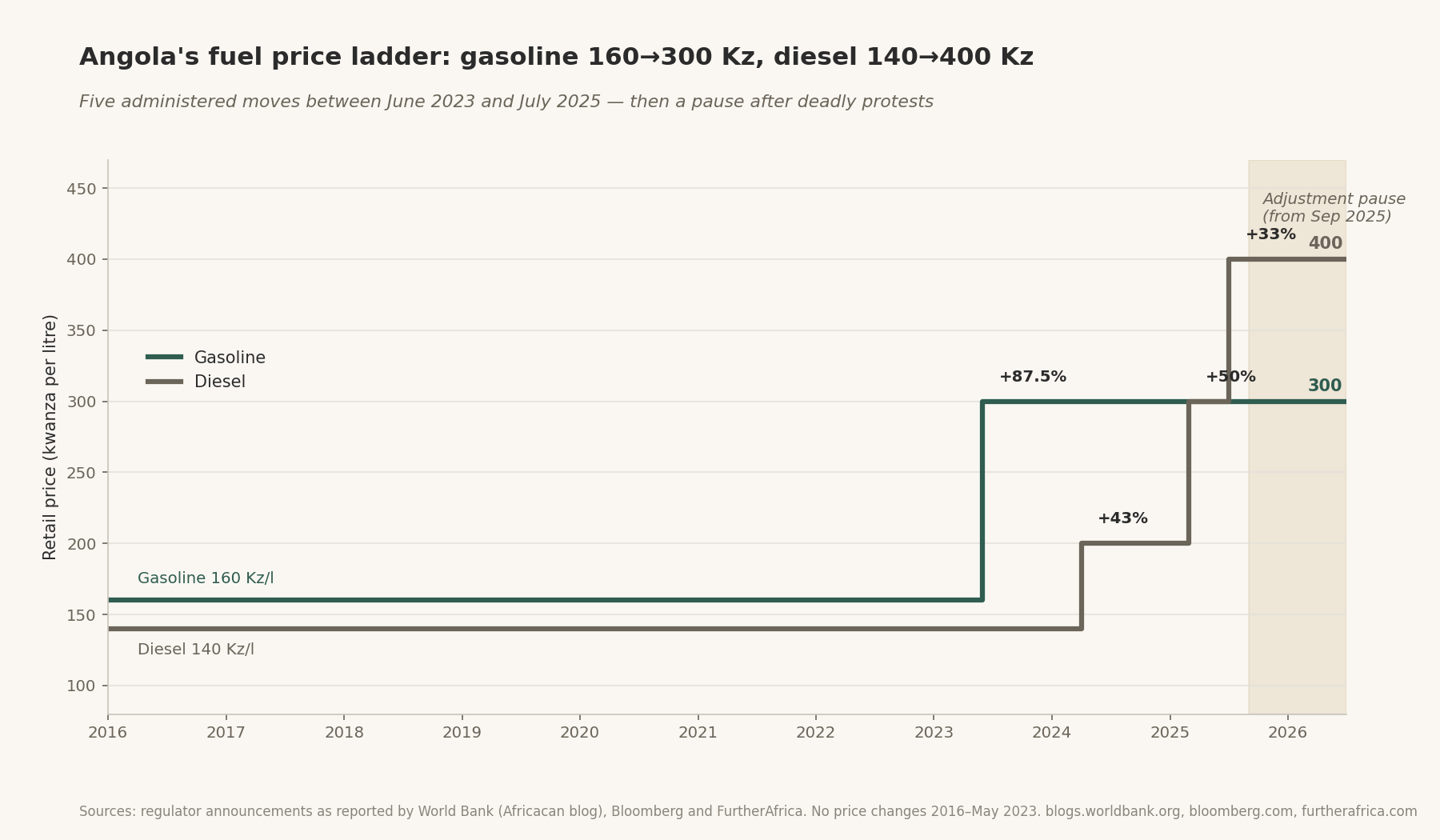
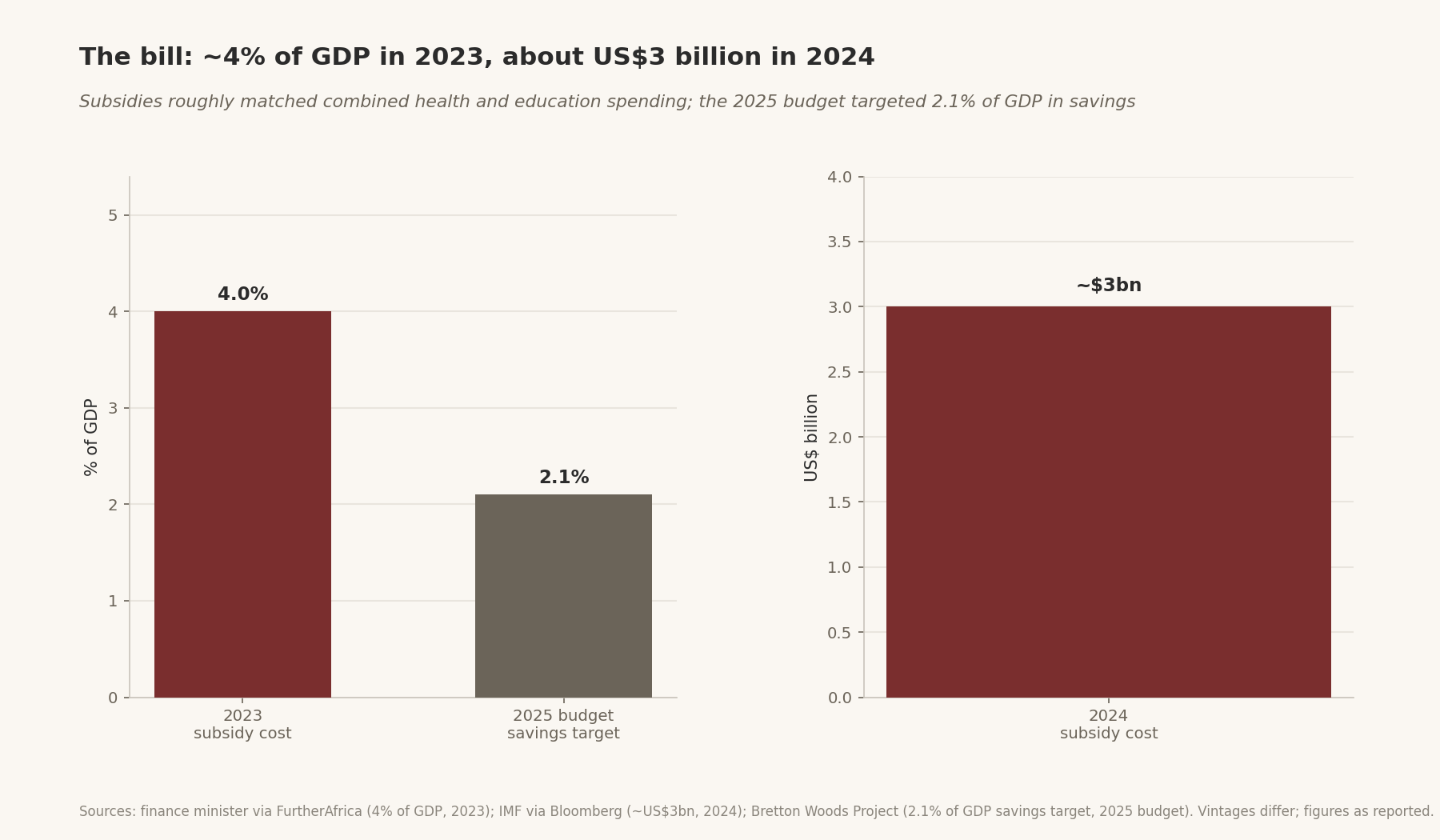
X: Angola's fuel reform in five moves: gasoline 160 → 300 Kz (2023), diesel 140 → 200 → 300 → 400 Kz (2024–25), then a pause after deadly protests. Subsidies cost ~$3bn in 2024. The full ladder, with the fiscal maths →
LinkedIn: Angola's fuel subsidy reform is the clearest fiscal experiment in the region, and it now has a documented ceiling. Gasoline rose 87.5% in June 2023; diesel went 140 → 200 → 300 → 400 kwanza between April 2024 and July 2025; adjustments paused after the protests that followed. Subsidies cost about $3bn in 2024 — comparable to health and education combined. World Bank modelling puts the savings at 1.3–2.2% of GDP depending on pace. Our data note assembles the full ladder.
Author
Sign up for New Axis Media newsletters.
Stay up to date with curated collection of our top stories.