The compact era: how the US rewired African health aid
Thirty-one bilateral MOUs replaced a grant architecture. The new model demands co- investment, and in some cases data.

Why it matters. The delivery model for African health financing changed inside twelve months, from donor grants to negotiated bilateral compacts with domestic co-payment. Ministries of finance, not only health, now own the consequences.
The facts. The US State Department's America First Global Health Strategy, issued in September 2025, set out multi-year bilateral agreements as the replacement architecture. By late April 2026 the department reported 31 MOUs signed globally worth US$20.6 billion — US$12.8 billion in US assistance and US$7.8 billion in country co-investment — according to a June 2026 EQUINET working paper tracking the rollout, with the department's own account submitted to Congress in a report on global health compacts and bilateral agreements. Individual deals show the shape: a five-year, US$936 million MOU with Malawi, per the State Department's announcement, and a US$121 million Angola MOU signed 19 March 2026 — US$71 million from Washington against US$50 million from Luanda, reported by DevelopmentAid. The New York Times reported more than US$11 billion in five-year commitments across 16 African countries as of mid-January 2026, describing the totals as a steep drop from pre-review levels. Human Rights Watch has alleged that agreements with at least seven African governments tie assistance to access to surveillance data and pathogen specimens, as summarised by JURIST. Independent researchers meanwhile documented cascading service disruption from the 2025 contract cancellations, including a JAMA Network Open study of Uganda's Nakivale settlement discussed by Medical Xpress.
Context. The compacts follow the dismantling of USAID and the cancellation of the overwhelming majority of its contracts and grants in 2025. They are structured around commodity purchases, frontline health worker financing, and surveillance data systems rather than programme grants to intermediaries.
Between the lines. Three structural shifts are embedded in the model. Co-investment converts health financing into a fiscal negotiation, which advantages countries with fiscal room and penalises those without. Bilateralism removes the pooled-risk logic of multilateral funds, so terms now vary by relationship. And where data access is part of the consideration, the compact is not only a health instrument — it is an intelligence and biosecurity arrangement, which is precisely why the terms should be public.
What to watch. Publication of the full MOU texts; whether co-investment commitments appear in national budgets; PEPFAR transition milestones reported to Congress; and whether any government renegotiates data provisions.
Method and sources. US State Department strategy and congressional reporting, EQUINET's tracking working paper, the NYT's reporting on totals, DevelopmentAid on the Angola agreement, HRW findings via JURIST, and peer-reviewed impact research via Medical Xpress.
Related reading: Angola country brief; The 9 percent tax on going home.
Charts & visuals
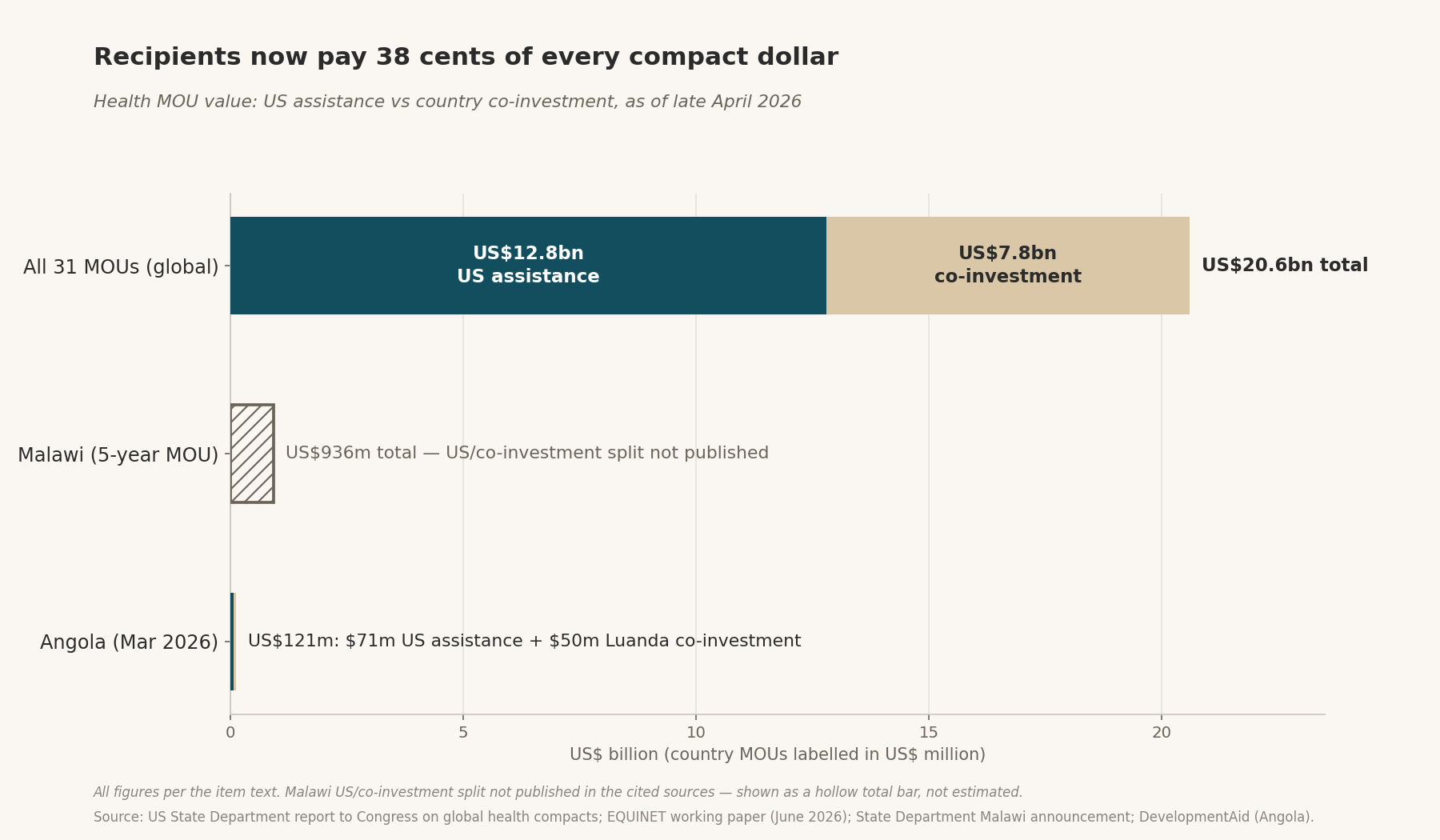
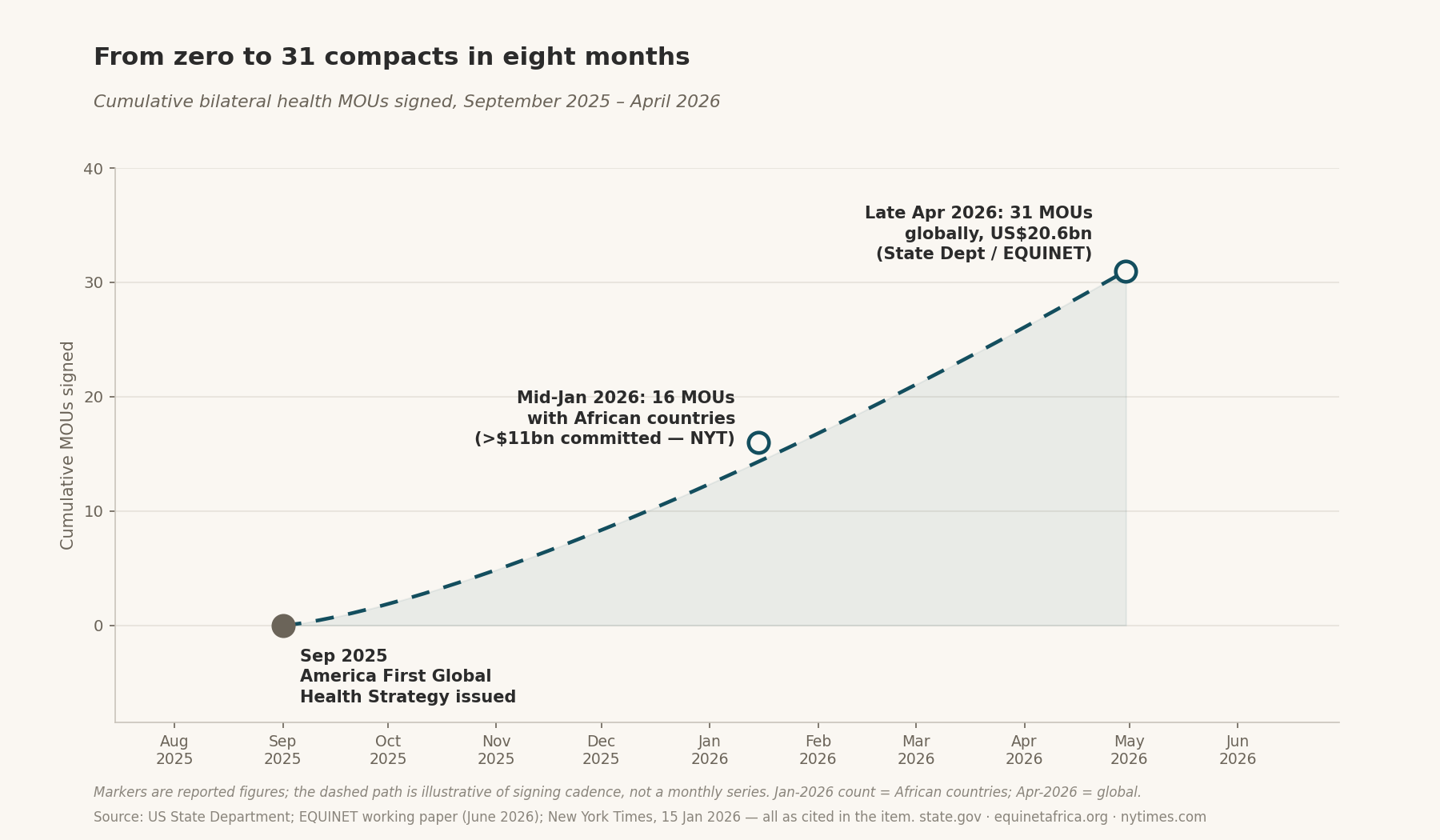
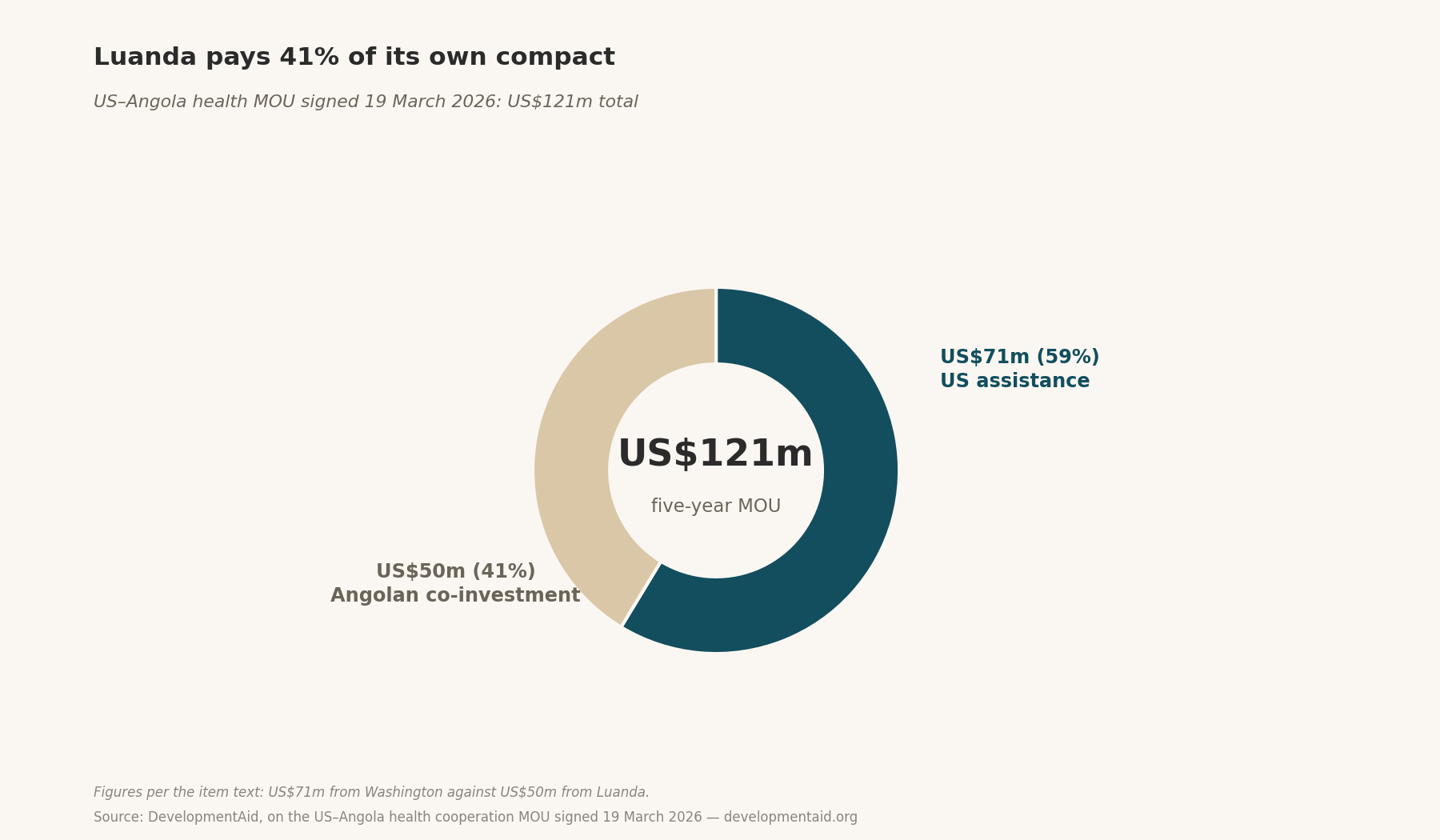
X: 31 bilateral health MOUs. $20.6bn headline value — $12.8bn US, $7.8bn from recipient governments. Angola's: $71m from Washington, $50m from Luanda. The grant era ended; the compact era has terms →
LinkedIn: African health financing has been re-architected in under a year. In place of USAID grants: 31 bilateral MOUs worth $20.6bn, of which $7.8bn is recipient-government coinvestment. Angola signed in March 2026 — $71m US, $50m domestic. Malawi's runs to $936m over five years. Human Rights Watch says some agreements also cover surveillance data and pathogen specimens. Health financing is now a fiscal and sovereignty negotiation.
Author
Sign up for New Axis Media newsletters.
Stay up to date with curated collection of our top stories.