A seat at the table is not yet a say on the menu: the AU's G20 moment and the twenty-year siege of the Security Council
— In Johannesburg, Africa chaired the world's top economic table while the United States boycotted the meal. Formal access is compounding; power over outcomes is the harder acquisition.
--- On the weekend of 22–23 November 2025, the G20 convened on African soil for the first time. The Johannesburg summit adopted a Leaders' Declaration over the empty chairs of the United States, which boycotted the meeting in objection to language on climate, Ukraine and Gaza, as Reuters reported via CNBC Africa and Insights on India summarised. Four days later, President Trump said South Africa would not be invited to the 2026 summit in Miami and that "all payments and subsidies" to the country would stop. Pretoria called the move punitive, and noted that the presidency instruments had been duly handed to a US embassy official at the foreign ministry's headquarters after Washington declined senior-level attendance, per AllAfrica. The episode captures Africa's institutional moment in miniature: a seat at the table secured, the power over the menu still contested.
From guest to member
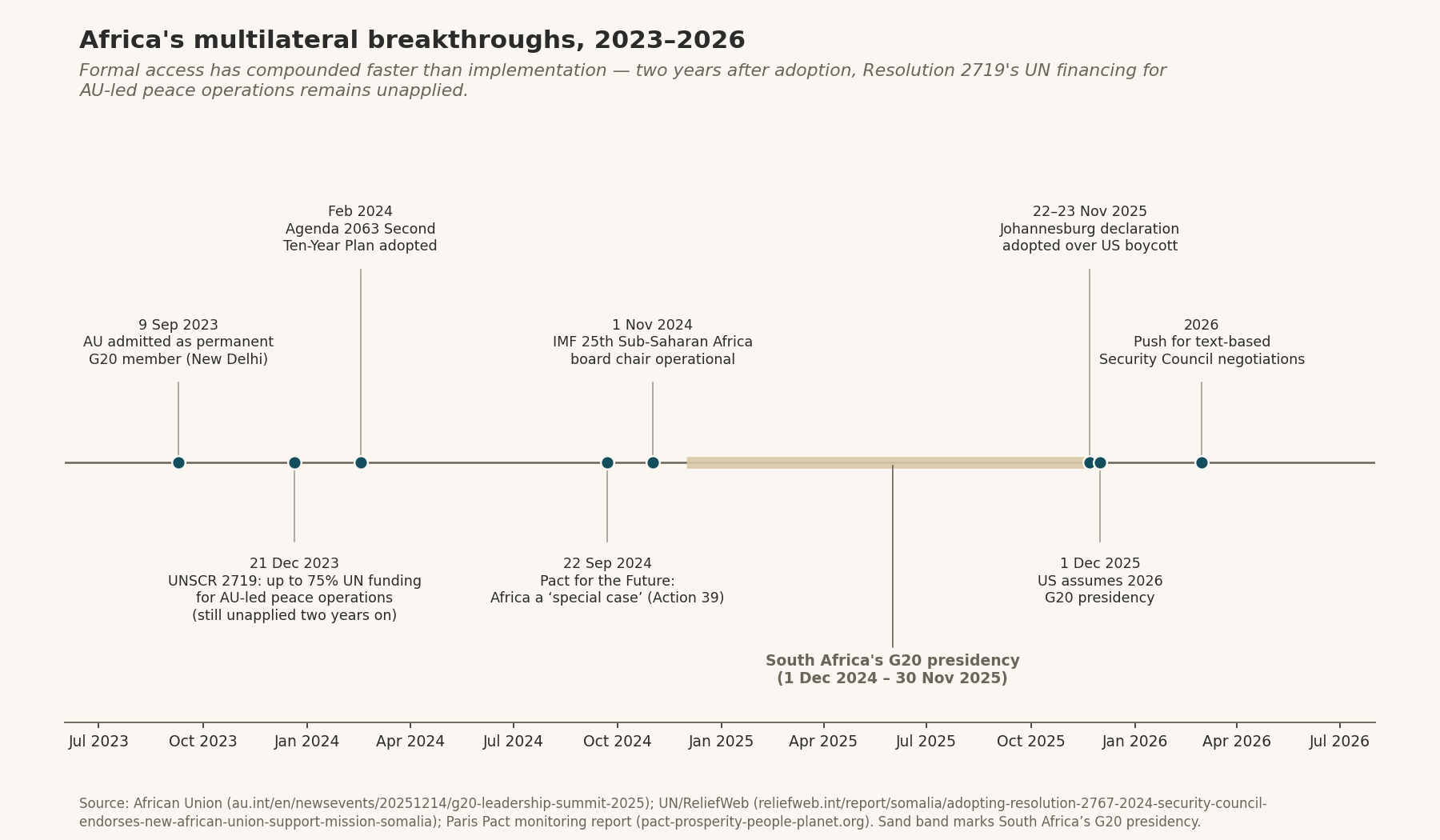
The formal breakthrough came on 9 September 2023, when the African Union was admitted as a permanent member of the G20 at the New Delhi leaders' summit — graduating from "invited international organisation", a status held since 2010, to parity with the European Union, per the African Union and India's Ministry of External Affairs. The enlarged group of 21 members represents about 85% of world GDP, more than 75% of world trade and roughly two-thirds of world population, in the G20's conventional framing, via tralac.
The AU arrived with homework done. Its Assembly adopted six strategic priorities for G20 engagement: fast-tracking Agenda 2063; reform of international financial institutions; agriculture and food security; a just energy transition; trade and investment for the African Continental Free Trade Area; and sovereign credit ratings plus vaccine and pharmaceutical manufacturing, per the AU's G20 explainer. Representation is structured: the Assembly chairperson, with the Commission chairperson, covers leaders' summits; the Executive Council chair leads at foreign-minister level; the finance committee chair covers the finance track.
Johannesburg, and the empty chair
South Africa held the presidency from 1 December 2024 to 30 November 2025 — the first African state to do so — under the theme "Solidarity, Equality, Sustainability", with four priorities: disaster resilience; debt sustainability for low-income countries; finance for a just energy transition; and critical minerals for inclusive growth, per tralac. Three task forces carried the work: inclusive growth and industrialisation, food security, and artificial-intelligence and data governance. The machinery ground through 51 Sherpa and finance-track meetings by mid-May 2025; a Taskforce on Global Wealth Inequality chaired by Joseph Stiglitz launched in August 2025; and finance ministers produced a debt declaration on sustainable debt management and credit-rating transparency in October 2025, per a Leadership Online compilation.
Then came the declaration over American absence — adopted neither "unanimously" nor "with US consent", since the United States was not in the room. The handover curdled into dispute. On 1 December 2025 the US formally assumed the 2026 presidency with three priorities of its own — cutting regulatory burdens, securing "affordable and reliable energy supply chains", and advancing new technologies — with Miami hosting the leaders' summit in America's 250th-anniversary year, and the UK and South Korea confirmed for 2027 and 2028, per AllAfrica and Evrim Agaci. African officials draw a different lesson from the sequence: the Commission chairperson argued at the Africa–France summit in Nairobi in May 2026 that the AU's G20 seat "demonstrates that global governance institutions can evolve", per Daily News Egypt. Both readings are true. The door opened; the draught came in with it.
Ezulwini at twenty
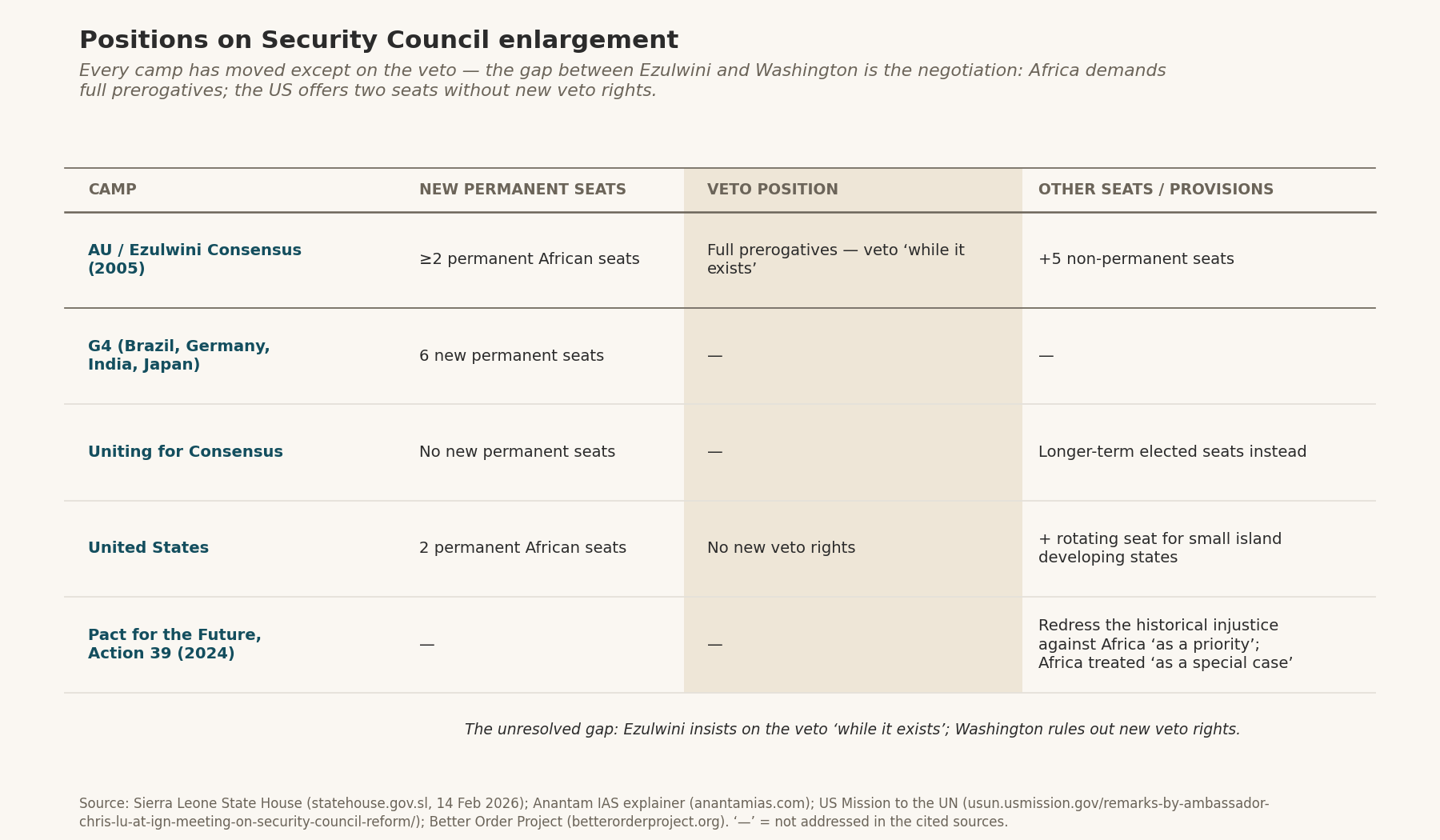
The longer siege is the UN Security Council. The Common African Position — the 2005 Ezulwini Consensus and the Sirte Declaration — demands no fewer than two permanent seats with full prerogatives, including the veto "while it exists", plus five non-permanent seats, as Sierra Leone's State House restated at the position's twentieth anniversary. Africa's 54 UN member states — the largest regional bloc, over a quarter of the organisation's membership — hold no permanent seat, while a majority of UN peacekeeping operations are in Africa, per FrontPage Africa.
The machinery is now pointed at text. The AU Committee of Ten, coordinated by Sierra Leone's President Julius Maada Bio, held a Freetown retreat in April 2025 that produced an "African Reform Model", a strategic roadmap and an aide-mémoire, endorsed at the committee's 13th ministerial in Lusaka; at the 39th AU Assembly in February 2026, Bio urged a shift "from general advocacy to text-based negotiations" in the intergovernmental negotiations, per State House. The textual ground has shifted. The Pact for the Future, adopted by the UN General Assembly on 22 September 2024 without a vote — a Russian amendment was blocked 143–7, with 15
abstentions — contains the first Assembly-endorsed parameters for Council reform. Action 39(a) commits members to "redress the historical injustice against Africa as a priority and, while treating Africa as a special case, improve the representation of the underrepresented and unrepresented regions and groups"; Action 40 pushes the negotiations towards a "consolidated model", per De Maribus, the Better Order Project and an Amani Africa background paper. The United States announced in September 2024, and restated on 19 November 2024, support for two permanent African seats plus a rotating seat for small island developing states — explicitly without extending the veto, per the US Mission to the UN.
That gap is the core unresolved issue: Africa insists on the veto "while it exists"; Washington rules out new veto rights. There is no convergence to report. Nor is the intra-African question settled — which states would occupy the seats is a contest the consensus deliberately defers. Discipline on the formula itself sometimes slips: the canonical demand is at least two permanent and five non-permanent seats, though some recent African statements have misstated the second figure. The UN Secretary-General has repeatedly backed correcting the "historic injustice", reaffirming the need for Council reform with stronger African representation at the 39th AU Summit, per the AU.
Power on someone else's credit card
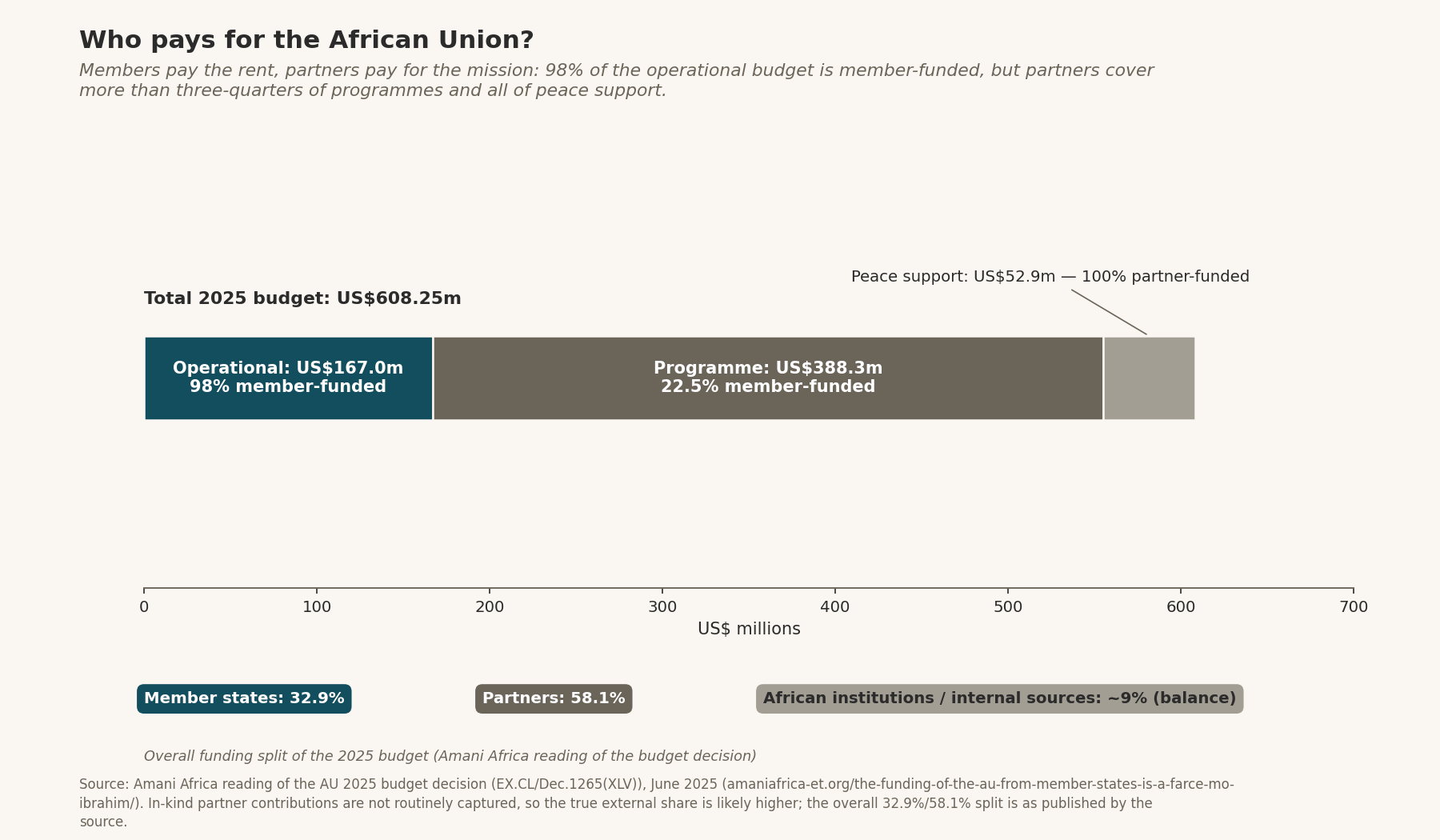
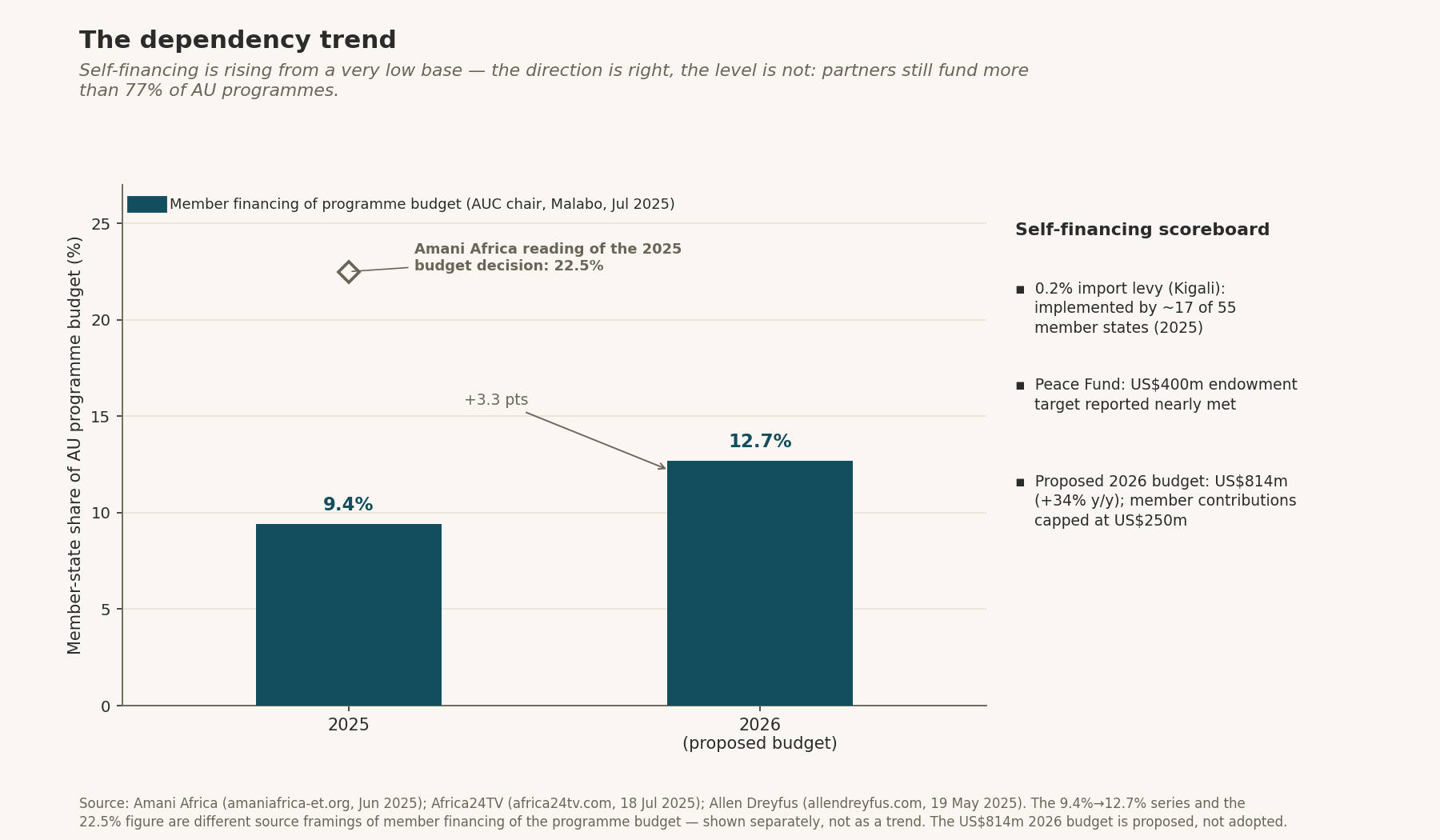
The binding constraint is financial. The AU's 2025 budget was US$608.25m. Member states covered 98% of the US$167.0m operational budget but only 22.5% of the US$388.3m programme budget; peace support operations, at US$52.9m, were entirely partner-funded — an overall split of 32.9% member states against 58.1% partners, according to Amani Africa's reading of the budget decision; in-kind partner contributions are not routinely captured, so the true external share is likely higher. The proposed 2026 budget was US$814m, up 34% year-on-year, with member-state contributions capped at US$250m; the Commission chairperson told the Malabo Executive Council that member financing of the programme budget rose from 9.4% in 2025 to 12.7% in 2026, while partners still fund more than 77% of programmes; member states do now cover the operating budget in full, per Allen Dreyfus and Africa24TV. The US$814m is a proposal, not an adopted figure.
Self-financing instruments lag. Only about 17 of 55 member states were implementing the Kigali 0.2% import levy by 2025, though the Peace Fund's US$400m endowment target was reported nearly met, per Amani Africa, the Ethiopian foreign ministry and the AU Peace Fund page. The peace-financing instrument tells the same story. Security Council Resolution 2719, adopted unanimously on 21 December 2023, allows AU-led peace operations, case by case, to draw up to 75% of their budgets from UN assessed contributions. Two years on, it remained
unimplemented: the Council failed to reach consensus on applying it to the AU mission in Somalia in May 2025 after US objections, and Resolution 2767 of 27 December 2024 — passed 14–0–1, the US abstaining — authorised that mission only with "hybrid" 2719 financing from 1 July 2025, contingent on progress, per UN meeting coverage via ReliefWeb, the Stimson Center and ISS Africa.
The incremental ledger
Elsewhere, the wins are real but thin. At the IMF, a 25th Executive Board chair for Sub-Saharan Africa became operational on 1 November 2024 — raising the region's elected directors from two to three — after the 16th General Review's 50% quota increase; approaches to a new quota formula were to be developed by June 2025 under the 17th Review, per the Paris Pact monitoring report. The World Bank's 2025 shareholding review was mandated, but its outcome is not confirmed in available sources — it cannot yet be counted as a win. Agenda 2063's Second Ten-Year Implementation Plan (2024–2033), the "decade of accelerated implementation", was adopted in February 2024 around seven "moonshots", per the Mo Ibrahim Foundation and AUDA-NEPAD.
External courtship continues: the 7th AU–EU Summit in Luanda in November 2025 and the Africa–France Summit in Nairobi in May 2026 both foregrounded Security Council reform, per Daily News Egypt and Streamline. And Africa is no voting monolith: in December 2025 General Assembly votes, Ethiopia and Uganda backed the Chernobyl resolution for the first time while South Africa, Egypt and Nigeria abstained and the US, Russia and China voted against; the Iran resolution passed 78–27–64 with African states spread across all three columns — illustrative examples rather than a systematic dataset, per a Valdai Club analysis.
Leadership churn shapes the campaign's continuity. Mahmoud Ali Youssouf of Djibouti won the Commission chair on 15 February 2025 after seven rounds against Raila Odinga, taking office that March; Angola's João Lourenço chaired the Union in 2025; Burundi's Évariste Ndayishimiye holds the 2026 chair, elected at a 39th summit themed on water and sanitation, per the AU and AU.
New Axis read
The ledger is genuinely mixed. Access has compounded — G20 membership, a presidency, a Johannesburg declaration adopted over a boycott, a third IMF chair, the Pact's "special case" language — each increment real, none decisive. The two structural gaps sit exactly where they were: the veto, which Washington will not extend and Ezulwini will not drop; and money, with partners funding more than three-quarters of AU programmes while 38 member states leave the 0.2% levy unimplemented. Three tests will mark 2026–27: whether the intergovernmental negotiations move to text with the African model on the table; whether the 12.7% programme-financing share keeps rising or stalls as rhetoric; and whether the AU's six G20 priorities survive a Miami presidency that has already signalled a different agenda. Institutional power is not seized in summits; it accrues to those who pay, persist and negotiate from text. Africa has the text. The payment schedule is the story to watch.
---
Charts & visuals
X: Africa has 54 UN votes and, since 2023, a G20 seat — but zero permanent Security Council chairs, and partners fund 77% of the AU's programmes. What is a seat at the table actually worth?
LinkedIn: The first G20 summit on African soil adopted a declaration over an American boycott — a snapshot of how far Africa's institutional campaign has come, and how far it has to go. Our new feature traces the AU's path from New Delhi admission to the Johannesburg presidency, the 20-year Ezulwini siege of the Security Council, and the budget numbers behind the rhetoric: partners still fund more than three-quarters of AU programmes. Access has compounded; power over outcomes is the next acquisition.
Author
Sign up for New Axis Media newsletters.
Stay up to date with curated collection of our top stories.