Rating the Raters: Africa's Cost-of-Capital Fight and the Battle Over the "Prejudice Premium"
African governments say the gatekeepers of global capital systematically overcharge them; the counter-evidence says governance, not geography, drives the grades. With a bruising public rupture at Afreximbank and the African Union's own rating agency preparing its first verdicts, an old grievance…

The firing
On 23 January 2026, one of Africa's most important financial institutions did something borrowers are not supposed to do. The African Export-Import Bank terminated its relationship with Fitch Ratings. Days earlier, Fitch had cut the Cairo-based trade bank from BBB- to BB+ — below investment grade — and once the bank walked out, the agency withdrew its ratings and coverage altogether, a rupture documented by the specialist outlet Finance in Africa. In market language, Afreximbank had fired its referee.
The dispute had been building for months. In June 2025 Fitch cut the bank from BBB to BBB-, estimating its non-performing loans at 7.1 per cent against the 2.44 per cent the bank reported. The African Peer Review Mechanism (APRM), the African Union's governance watchdog, hit back within 48 hours, calling the downgrade "based on flawed loan classification" and "legally incongruent"; it later attacked "the quality of the rating analysis itself". Moody's followed with its own cut, Baa1 to Baa2, in July 2025. Then came the break over Ghana — where Afreximbank insisted its preferred-creditor status should shield it from being treated as a commercial creditor in the restructuring. Context cuts both ways: Ghana and the bank settled a US$750 million loan dispute on 25 December 2025, and the bank had won a US$657 million arbitration award against South Sudan the previous May — evidence, depending on the reader, either of enforceable claims or of a loan book under genuine strain.
The grades that remain tell their own story. Afreximbank currently carries AAA from China's CCXI, A from Johannesburg-based GCR, A- from Japan Credit Rating Agency, Baa2 from Moody's and BBB+ from S&P, per the bank's own disclosure, June 2026. One bank, five agencies, six notches of disagreement. Whatever else it proves, the spread shows that a credit rating is a judgement, not a measurement — and who gets to judge is now a political question.
The case for a "prejudice premium"
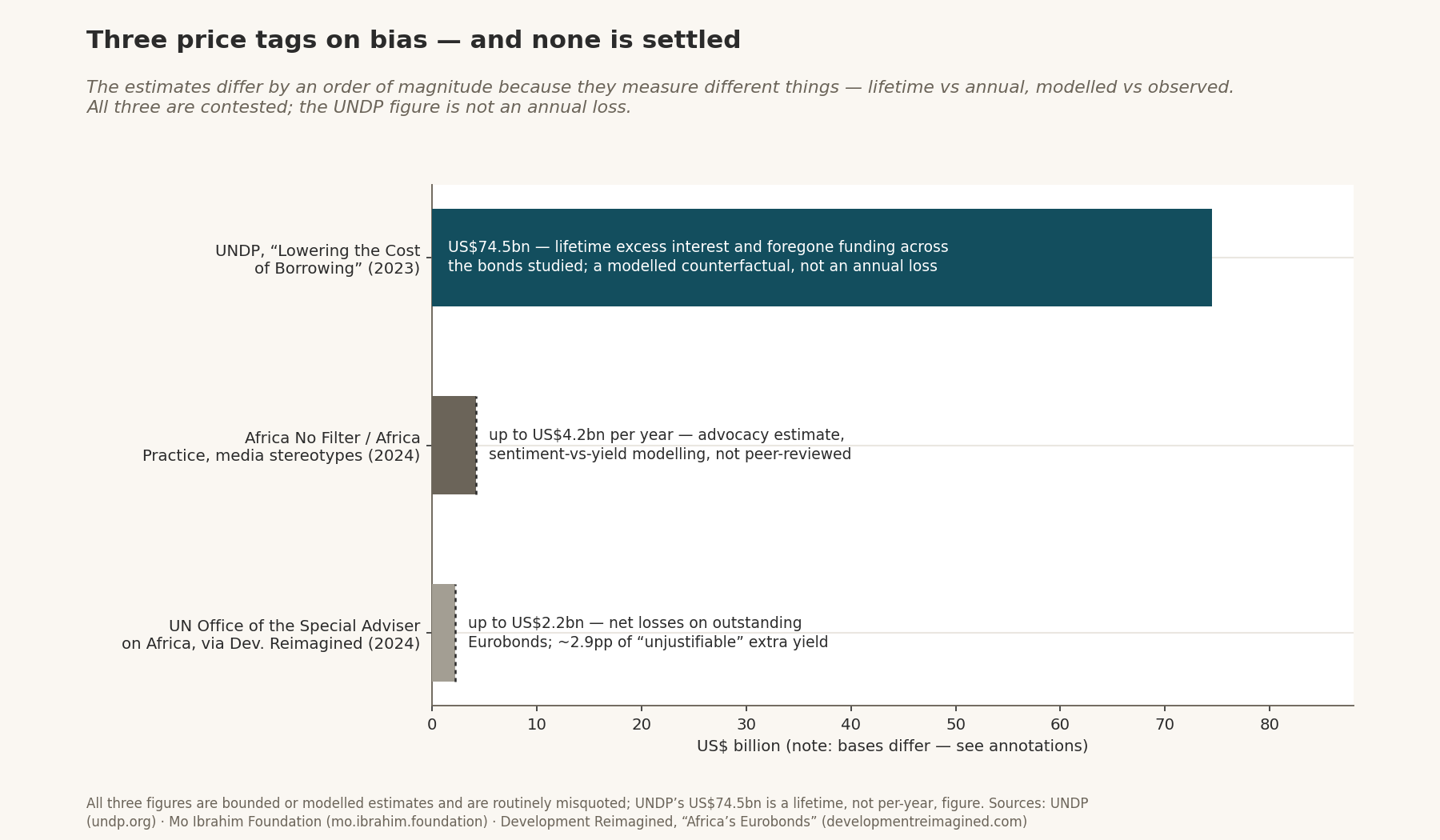
The flagship evidence is the UNDP's April 2023 study "Lowering the Cost of Borrowing", produced with the Brookings Institution's Africa Growth Initiative and the consultancy AfriCatalyst. Controlling for macroeconomic fundamentals, it found African sovereigns face "idiosyncratic" rating penalties worth up to US$74.5 billion in excess interest and foregone funding — nearly 12 per cent more than all net official development assistance to Africa in 2020, according to the UNDP and AfriCatalyst. Two cautions attach, and this article applies both. The figure is a lifetime estimate across the bonds studied, not an annual loss — it is routinely misquoted as per-year. And it rests on the UNDP's own counterfactual of what ratings should have been: a modelled estimate, large and rigorous in its own terms, but contestable by construction.
The political amplification has been loud. UN Secretary-General António Guterres told an Addis Ababa audience in May 2026 that African countries "often have to pay up to three times the benchmark rates" for borrowing, per Xinhua. Mia Mottley's Bridgetown framing — rich countries borrow at 1–4 per cent while "it's around 14 per cent for poorer countries", as she put it at COP27, via the World Economic Forum — has become the diplomatic default.
Two further studies feed the case. Research by the UN Office of the Special Adviser on Africa, cited by Development Reimagined, values an "unjustifiable bias against African countries" at roughly 2.9 percentage points of extra yield, translating into net losses of up to US$2.2 billion on outstanding Eurobonds, per the "Africa's Eurobonds" report, May 2024. And "The Cost of Media Stereotypes to Africa", published in October 2024 by Africa No Filter and Africa Practice, argues that negative global-media framing inflates African sovereign yields by up to US$4.2 billion a year: 88 per cent of coverage of Kenyan elections was negative, against 48 per cent for Malaysia, and Egypt pays about a percentage point more than Thailand, its "fundamentals twin", according to the Mo Ibrahim Foundation's summary. That study is advocacy research built on sentiment-versus-yield modelling, not peer-reviewed economics. Its number belongs in the debate, not the ledger.
The case against: governance and the counterfactual
The strongest recent synthesis cuts the other way. In March 2026 the German Institute for International and Security Affairs (SWP) reviewed the empirical literature and reached an uncomfortable conclusion: studies do find home-country bias and subjectivity in ratings, but quantitative work has not demonstrated a systematic, Africa-specific penalty once governance quality and economic fundamentals are controlled, per SWP's Megatrends Spotlight. Emerging markets generally are rated less favourably than advanced economies; governance is the core driver. Prejudice may shape individual decisions without being provable in the aggregate. The structural facts, at least, are not in dispute:
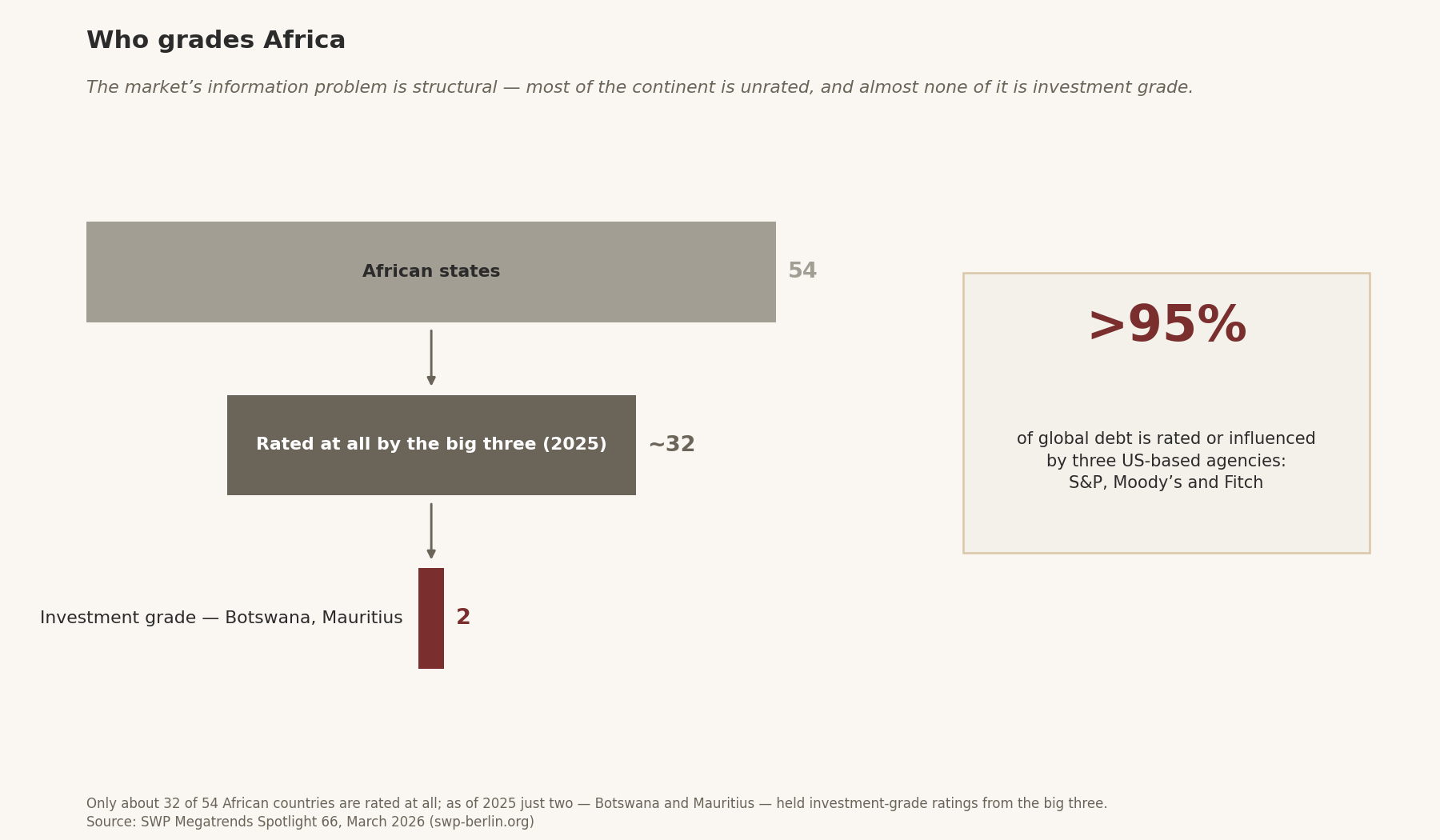
Three US-based agencies — S&P, Moody's and Fitch — rate or influence more than 95 per cent of global debt.
Only about 32 of 54 African countries are rated at all; as of 2025 just two, Botswana and Mauritius, held investment-grade ratings from the big three.
African-owned rating capacity exists but is small: Augusto & Co in Nigeria, Bloomfield in Côte d'Ivoire, and GCR in South Africa — which Moody's now owns outright, a detail that captures the incumbents' reach. All per SWP.
The remedy, argue the sceptics, sits with governments. Vera Songwe, former executive secretary of the UN Economic Commission for Africa, has said borrowers must "do their homework": faster statistics, cleaner debt data, more transparency. SWP cites Benin as a state that managed its ratings engagement well — and was rewarded with market access on terms its peers could not match. The strongest defensible claim is therefore narrower than the slogan: African sovereigns pay more than peers with similar fundamentals — which the UNDP documents — and the industry's Africa model, built on unsolicited ratings and thin on-the-ground presence, is hard to defend. Both things can be true at once.
AfCRA: building a referee
The AU's institutional answer is the African Credit Rating Agency (AfCRA). The AU Executive Council endorsed its creation in July 2024, on a deliberately un-statist design: independent, privately owned rather than government-owned, self-sustaining, and focused initially on local-currency ratings, per EDB Mauritius. In September 2025, on the sidelines of the UN General Assembly in New York, Mauritius was announced as host; registration and licensing through the Mauritian Financial Services Commission followed, with first ratings expected in 2026 and full operationalisation targeted for the second quarter, according to the APRM.
Precision matters here. As of mid-July 2026 there is no public evidence that AfCRA has issued a single rating; SWP noted in March that initial ratings were "expected by June 2026". The honest description is "in set-up", not "operational" — a distinction its champions blur at their peril. The design problem is a credibility trap. If AfCRA rates softly to please issuers, markets will ignore it; if it rates hard, the governments that built it may abandon it. Misheck Mutize, the APRM's lead expert on credit ratings and the agency's most visible champion, has said repeatedly in public remarks that AfCRA will issue downgrades where necessary. The structural answers — private ownership, a local-currency focus, a Mauritian licence under a recognised regulator — are meant to make that promise credible. The first rating, promised for this year, is the first test. Watch who is rated, and whether the verdict costs someone money.
The deeper logic is jurisdictional. A local-currency rating speaks to domestic pension funds and regional banks, not to the Eurobond desks of London and New York. Success for AfCRA would deepen the markets where African savings already sit; it would not, by itself, move the dollar price of a Kenyan or Angolan bond. Those expectations are best set now.
The pincer: dear money, shrinking aid
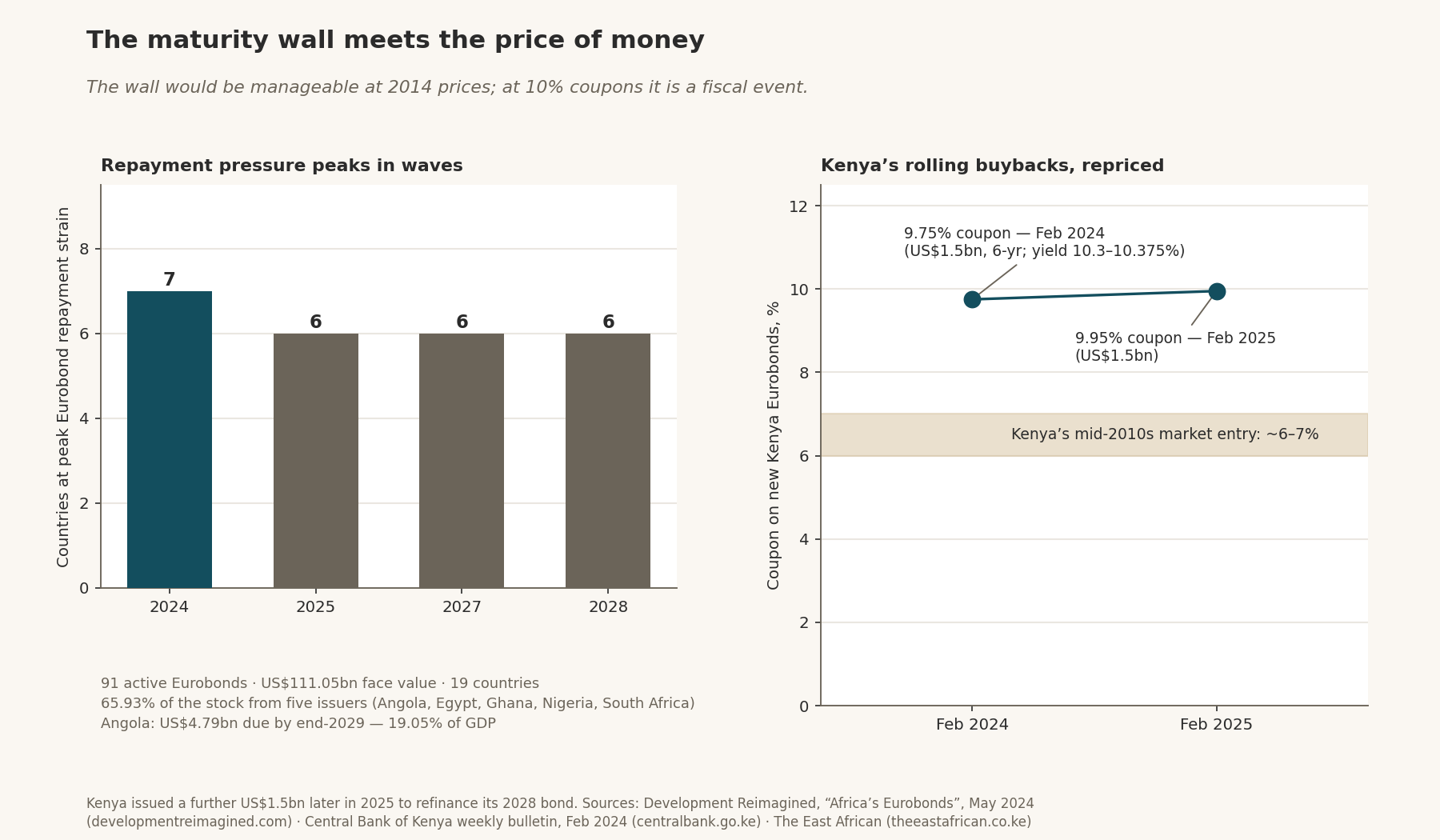
Ratings matter this much because two other forces have collided with them. The first is a maturity wall priced at punitive rates. Nineteen African countries hold 91 active Eurobonds with a combined face value of US$111.05 billion; five issuers — Angola, Egypt, Ghana, Nigeria and South Africa — account for 65.93 per cent of the stock, and Egypt alone has 22 bonds outstanding, per Development Reimagined. Repayment strain peaks in waves — seven countries in 2024, six each in 2025, 2027 and 2028. Angola, whose Eurobond debt equals 19.05 per cent of GDP, must pay US$4.79 billion by end-2029, all of it within two years.
Kenya shows the new price of the gate. In February 2024 it issued a US$1.5 billion six-year bond at a 9.75 per cent coupon — a yield of 10.3–10.375 per cent — to retire part of a US$2 billion bond due that June, per the Central Bank of Kenya. In February 2025 came another US$1.5 billion at 9.95 per cent, and later in 2025 a further US$1.5 billion to refinance the 2028 bond, a rolling-buyback strategy that has drawn a public World Bank warning Nairobi appears to have ignored, per The East African. Coupons near 10 per cent have replaced the roughly 6–7 per cent Kenya paid when it first entered the market a decade ago.
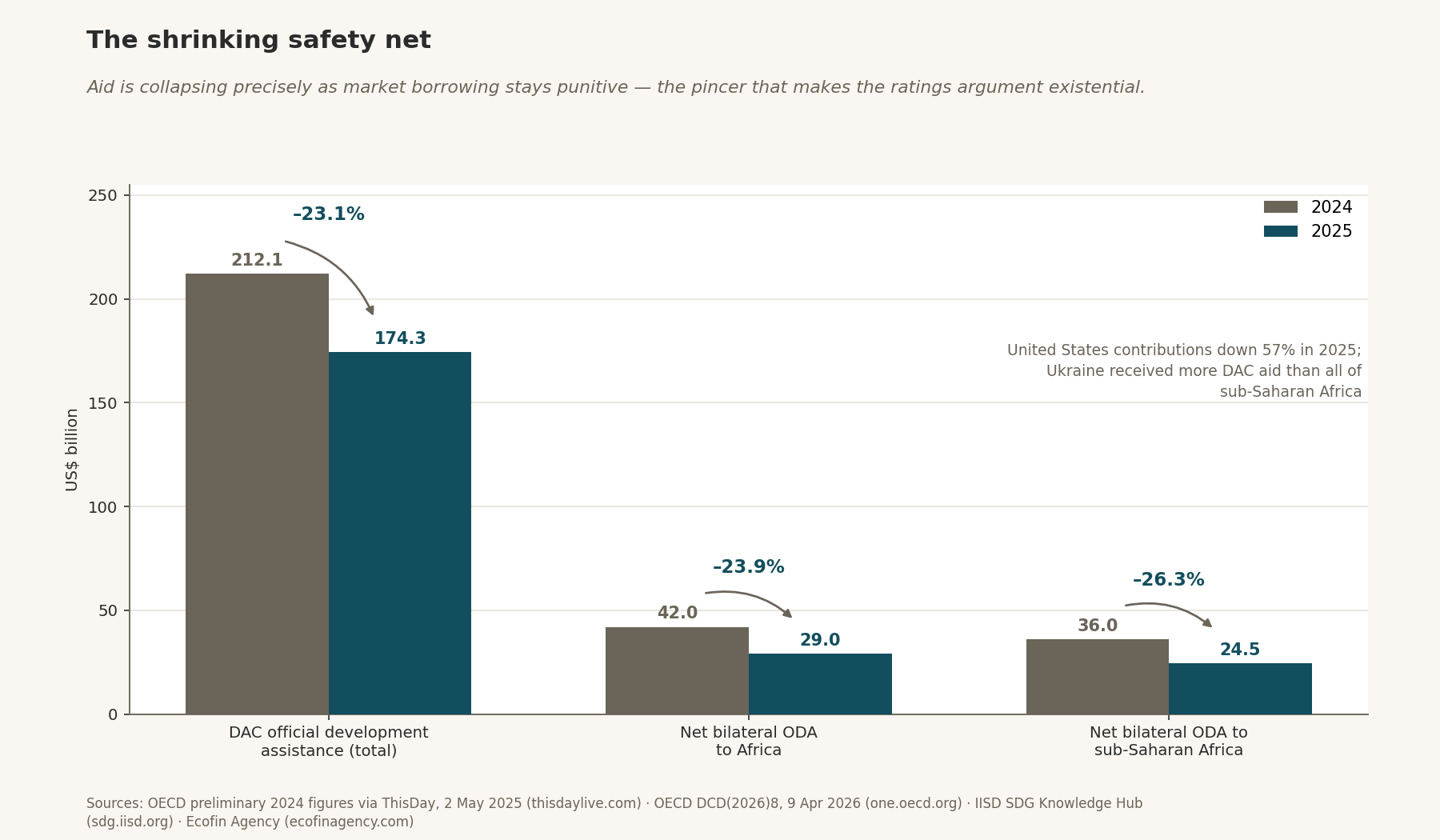
The second force is the collapse of the alternative. Official development assistance from DAC donors fell 7.1 per cent in real terms to US$212.1 billion in 2024, with net bilateral aid to Africa at US$42 billion, per the OECD's preliminary figures. In 2025 DAC aid fell a record 23.1 per cent to US$174.3 billion — United States contributions were down 57 per cent — while bilateral aid to Africa dropped 23.9 per cent to US$29.0 billion and to sub-Saharan Africa 26.3 per cent to US$24.5 billion; Ukraine, including support channelled through EU institutions, received more DAC aid than all of sub-Saharan Africa, per OECD DCD(2026)8, Ecofin Agency and IISD. The concessional era is ending faster than the market era is becoming affordable.
The response has moved from grievance to plumbing. The IMF's US$650 billion special drawing rights allocation of August 2021 delivered roughly US$33 billion — under 5 per cent — to a continent with 18 per cent of world population; the G20's US$100 billion rechanneling pledge runs through the IMF's PRGT and RST trusts, while the AfDB and Afreximbank have proposed using SDRs as hybrid capital for multilateral banks, per the Sustainable Finance Lab and the ONE Campaign's tracker. Bridgetown 3.0, the Barbadian-led reform agenda now threaded through African climate-finance diplomacy, demands a new SDR issuance of at least US$650 billion, US$300 billion a year of affordable 30–50-year MDB finance, US$500 billion a year of mobilised private capital — and, pointedly, greater "transparency and consistency" from credit rating agencies, per the Bridgetown Initiative and AFRODAD's African reading. The AfDB, for its part, points to its 2019 capital increase of US$115 billion, the largest in its history, per the bank itself. The ratings fight has been absorbed into a much larger argument about who owns the machinery of global public finance — one in which Chinese raters, Gulf capital and reformed development banks are all bidding for position.
New Axis read
Both sides of this fight are right, and that is the story. African borrowers demonstrably pay more than countries with similar fundamentals, and the rating industry's Africa coverage is indefensibly thin. Yet the econometrics does not convict geography once governance is priced in — and the loudest numbers in circulation are modelled estimates, not audited losses. The actionable frontier is therefore double. AfCRA must prove, with a hard and credible first rating, that an African agency can say no to African issuers; and finance ministries must make bias harder to allege by publishing data that leaves less room for judgement. Watch three things: AfCRA's inaugural verdict, the next Eurobond coupons out of Nairobi and Luanda, and whether the argument keeps migrating from complaint to contract — into SDR plumbing, hybrid capital and local-currency markets where foreign gatekeepers matter less. The cost of capital is now the central variable of African development. The fight over who measures it has only begun.
Charts & visuals
X: Fitch called Afreximbank junk. The bank fired Fitch. Now the AU's own rating agency is due its first verdicts in 2026 — and the US$74.5bn "prejudice premium" claim is fighting the data.
LinkedIn: The fight over African credit ratings has moved from conference panels to open rupture: Afreximbank terminated Fitch in January after a cut to junk, and the African Union's own agency, AfCRA, is due to issue first ratings this year from Mauritius. The evidence cuts both ways — the UNDP's US$74.5bn bias estimate is a lifetime, modelled figure, while new SWP research finds no systematic Africa-specific penalty once governance is controlled. Our analysis holds both truths, and explains why the real crisis is the pincer of 10% Eurobond coupons and collapsing aid.
Author
Sign up for New Axis Media newsletters.
Stay up to date with curated collection of our top stories.