Africa’s Demographic Dividend Is Real. So Is the Jobs Cliff.
The continent’s youth boom is routinely called its greatest asset. Whether it becomes a dividend or a crisis depends on a single number that isn’t rising fast enough: jobs.
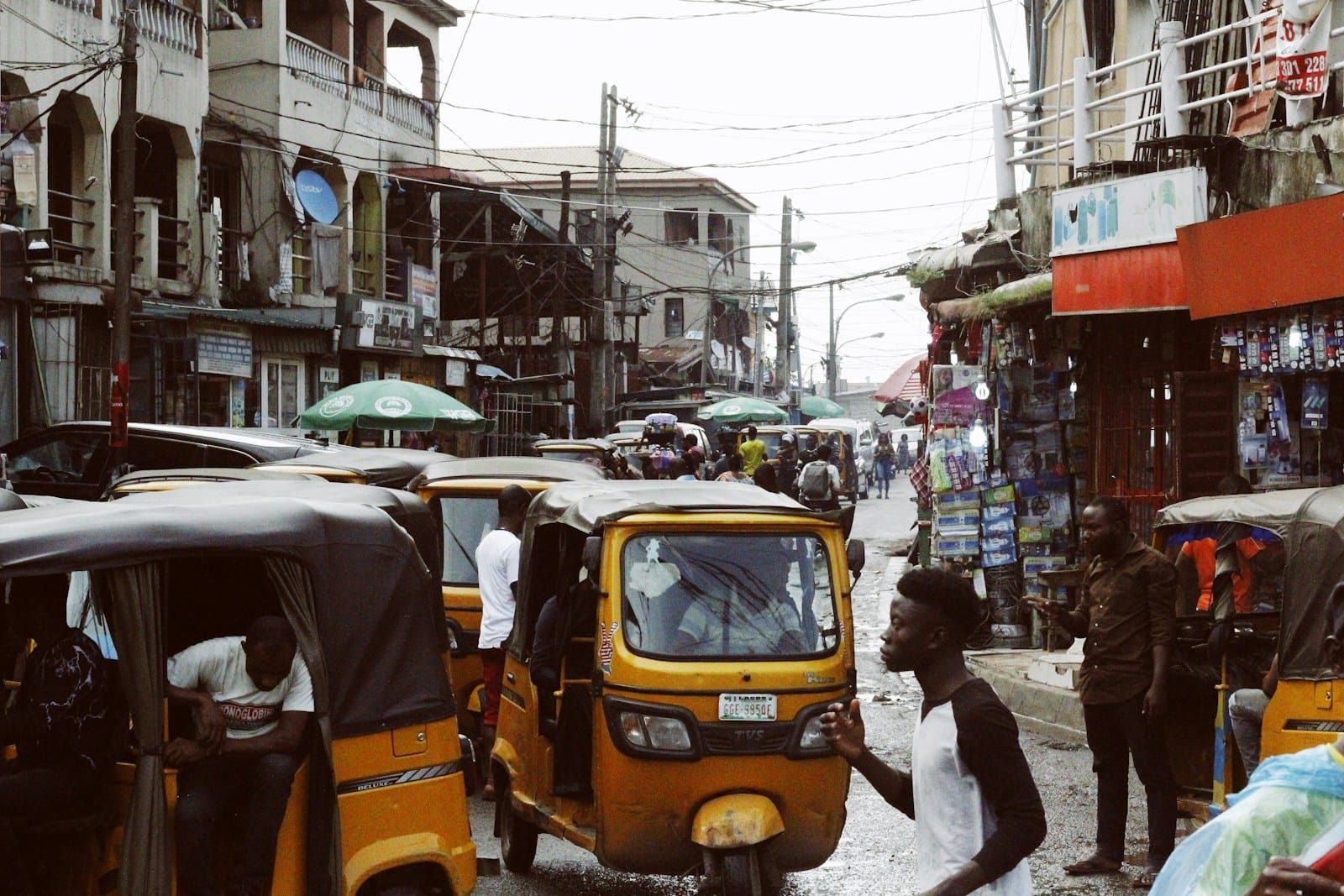
Africa has the youngest population on Earth, and the arithmetic of that youth is the single most important long-run fact about the continent’s economy. Handled well, it is a demographic dividend: a swelling workforce that can power decades of growth, as it did in East Asia. Handled badly, it is a jobs cliff — millions of young people entering labour markets that cannot absorb them, with all the political and social consequences that follow. In 2026, both futures are live, and the deciding variable is employment.
The scale is almost hard to grasp
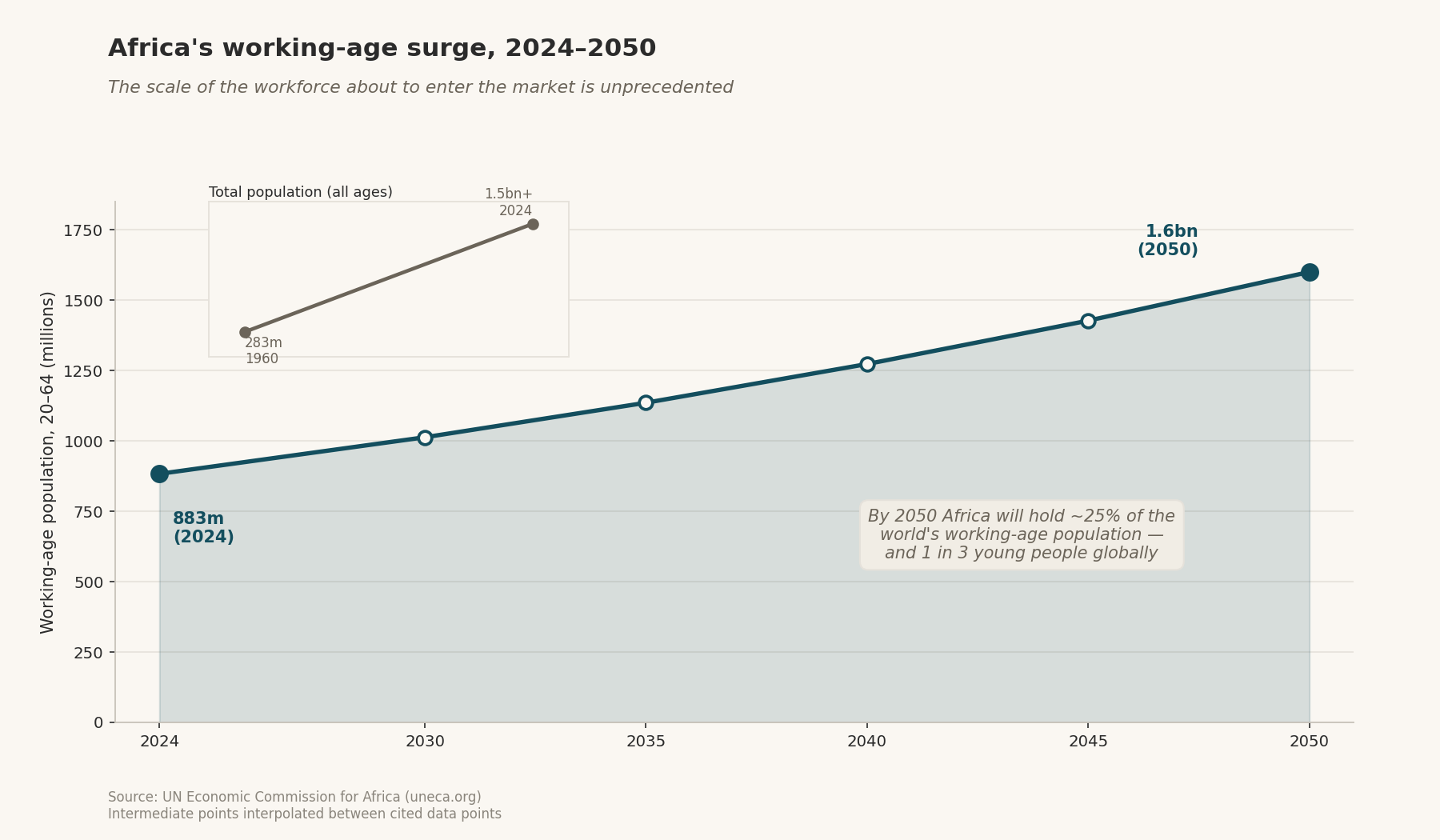
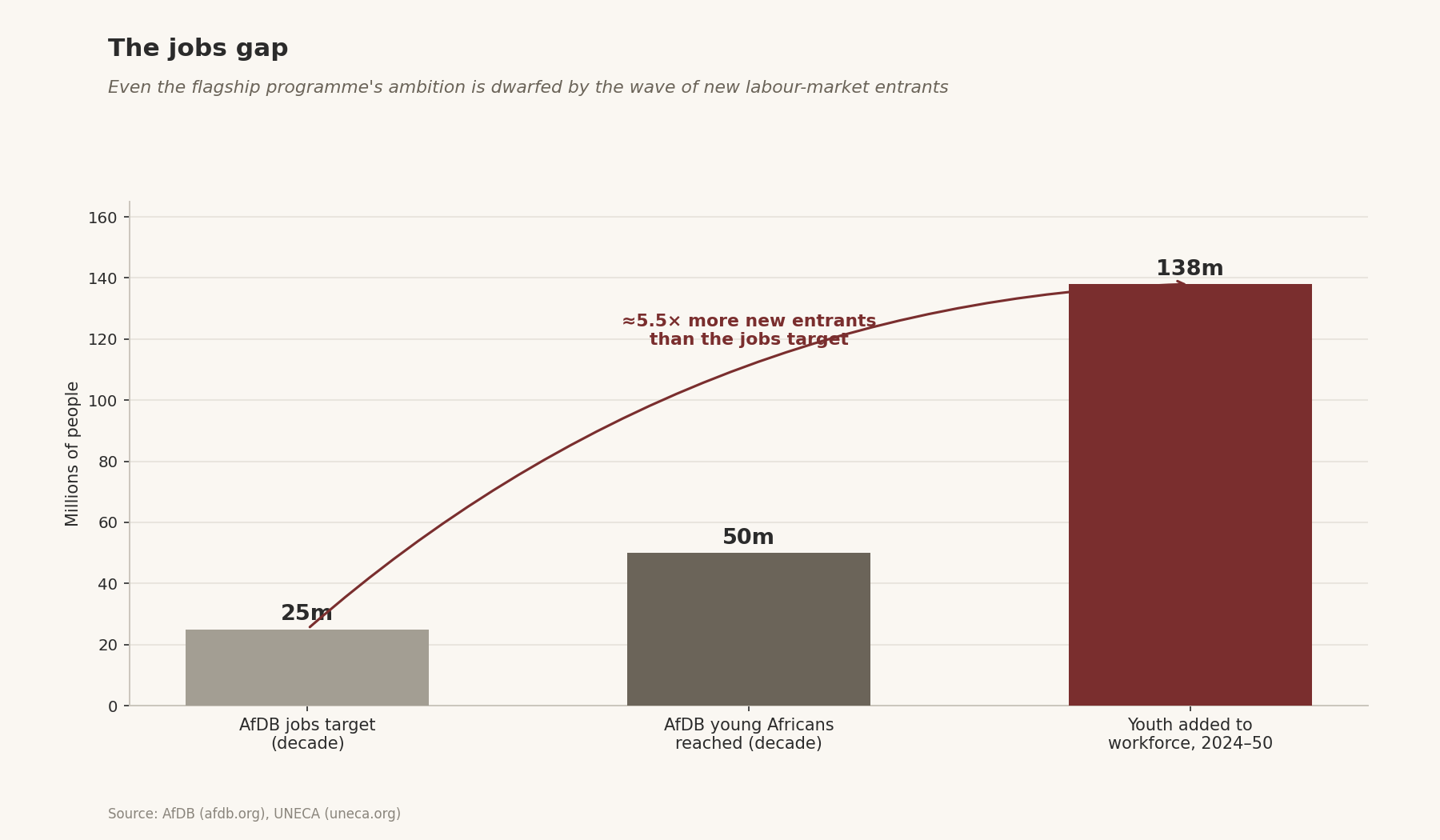
The demographic weight is generational and global. Africa’s population expanded from 283 million in 1960 to more than 1.5 billion in 2024, and its working-age population (ages 20–64) is projected to increase from 883 million in 2024 to 1.6 billion in 2050 — by which point Africa will constitute almost 25 percent of the global working-age population (UN Economic Commission for Africa). By 2050, one in every three young people globally will be African, even as Africa adds 138 million to its youth population between 2024 and 2050 (UN Economic Commission for Africa). In other words, the future of the global workforce is disproportionately African — a fact with profound implications not only for the continent but for global labour markets, migration, and consumer demand.
That is the opportunity. The problem is that a demographic window opens only for a limited time, and capturing the dividend “requires more time and stronger effort” than many governments have mustered (UN Economic Commission for Africa). A youth bulge becomes a dividend only if those young people are educated, healthy and — above all — employed. Otherwise the same numbers become a liability.
The scale of the jobs challenge
The African Development Bank’s flagship youth-employment programme frames the stakes in hard numbers: its Jobs for Youth in Africa Strategy set out to create 25 million jobs and reach over 50 million young Africans across a decade — a target that itself signals the size of the gap it was designed to close (AfDB Jobs for Youth; AfDB brochure). The initiative’s aims — expanding employment, strengthening human capital, and building durable labour-market linkages — map precisely onto the continent’s central development problem: growth that does not generate enough formal jobs (AfDB brochure). The mismatch between a rapidly growing working-age population and a slowly growing pool of formal employment is the defining economic tension of the era — and it is why “jobless growth” is the phrase that haunts African policymakers.
The Angola microcosm
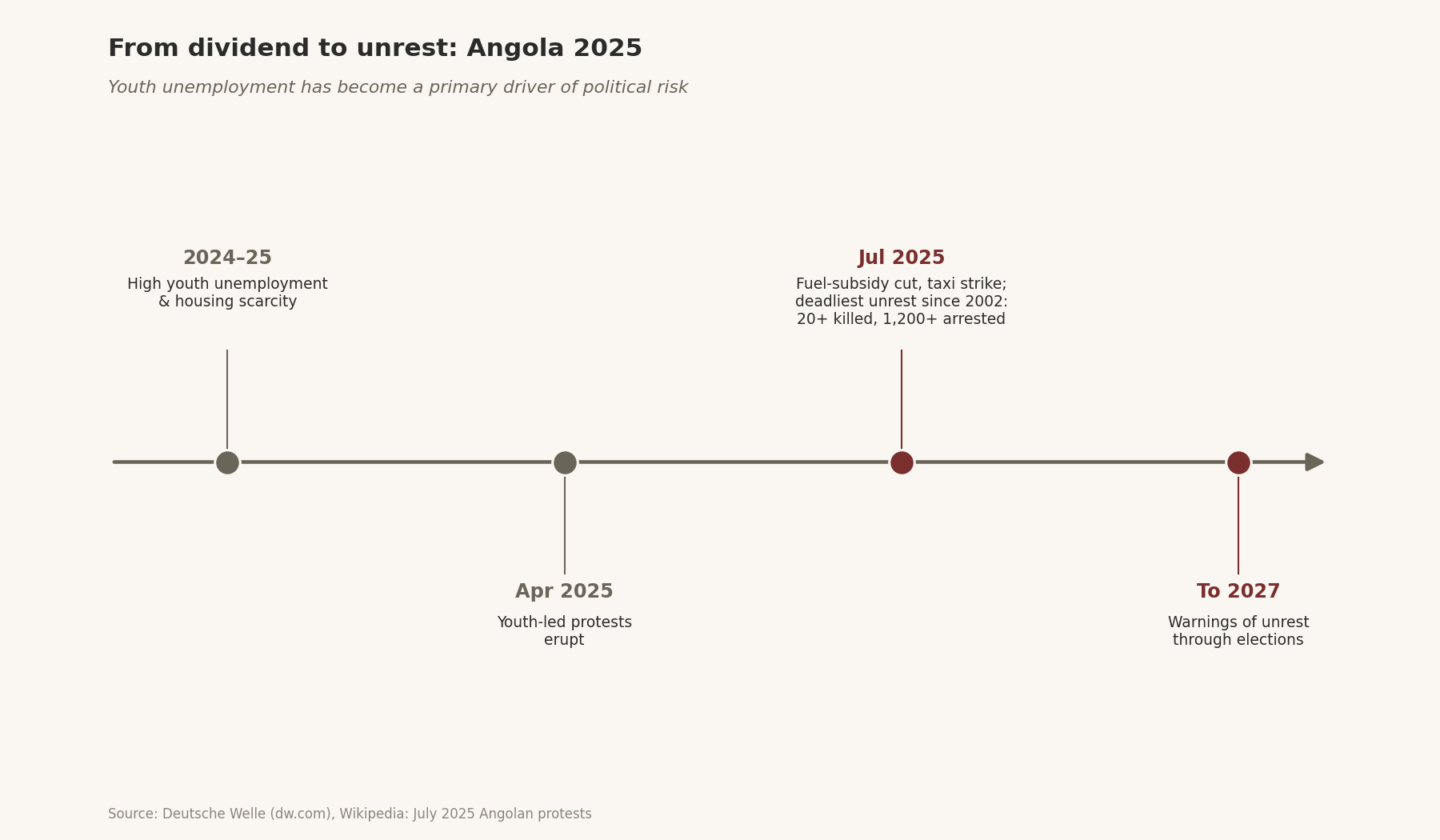
Angola shows what happens when the jobs cliff meets the street. High youth unemployment, inadequate housing, decaying infrastructure and blocked access to education are daily realities for many young Angolans (Deutsche Welle). Young people have been “at the forefront of anti-government protests,” driven by corruption, police violence, and demands rooted in poverty and hunger (BBC). As one activist told the BBC, “the looting was simply the method young people chose to attract attention from those in power,” warning of more unrest through the 2027 elections (BBC).
Angola’s 2025 protests — the deadliest civil unrest since the civil war — are what a demographic dividend looks like when it curdles into a jobs crisis (Wikipedia: July 2025 Angolan protests). The lesson generalises across the continent: where young people cannot find work, the frustration does not disappear; it converts into political risk, migration pressure, and instability (see Article 18 for the full Angolan case). Macroeconomic stabilisation — Angola’s disinflation and rate cuts — does not, by itself, create the jobs the streets demanded.
The “industries without smokestacks” debate
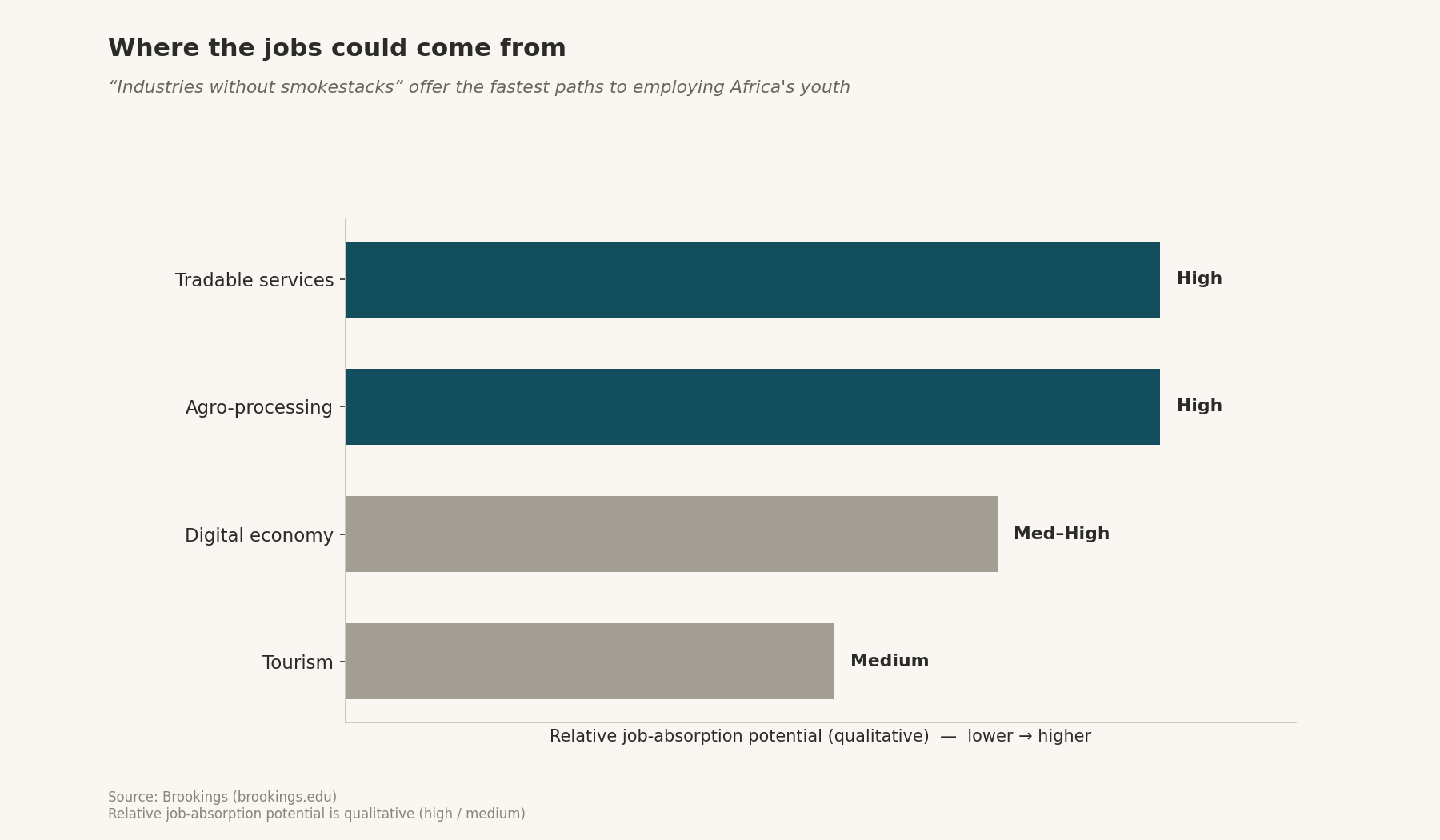
How can Africa generate jobs at the required scale? Traditional manufacturing-led industrialisation is one path, but it faces headwinds — automation, competition from established Asian manufacturers, and the difficulty of replicating the export-led model that lifted East Asia. Development economists increasingly point to “industries without smokestacks” — tradable services, agro-processing, tourism, and the digital economy — as ways to absorb youth employment without waiting for a full manufacturing revolution (Brookings). This reframes the jobs debate: the question is not only “how does Africa industrialise?” but “which sectors can employ young people fastest?” Services and agro-processing may absorb labour more quickly than factories, and they align with Africa’s existing strengths in areas like fintech (see Article 15) and the creative economy (see Article 20).
Where the demographic dividend meets other trends
The jobs challenge intersects with every other story in this package. The creative economy and football are labour-intensive youth sectors (see Articles 19 and 20). Digital and fintech can create both jobs and the platforms to formalise informal work (see Article 15). Urbanisation concentrates young workers in cities that must generate employment or face unrest (see Article 17). And the AI opportunity — Microsoft estimates up to $136 billion in productivity gains for Africa — will only translate into jobs if African youth have the skills and infrastructure to capture it (TechCabal). The demographic dividend is not a standalone asset; it is a multiplier that amplifies whatever economic path a country chooses. A young population accelerates a country toward prosperity if it is employed and toward crisis if it is not.
The New Axis read
The demographic dividend is the most over-promised and under-delivered concept in African development discourse. It is not automatic. A young population is a dividend only if it is employed, educated and healthy; otherwise it is a liability that shows up as migration pressure, informality, and — as Angola demonstrated in 2025 — political instability. With Africa set to hold a quarter of the world’s working-age population by 2050, the stakes are not merely African but global. The countries that will convert youth into growth are those that treat job creation not as one policy among many but as the organising priority of the state — investing in education, opening space for the private sector, and betting on the fast-employing sectors rather than waiting for a manufacturing miracle. The clock is the harshest fact in African economics: the young people are already here, and the jobs are not arriving fast enough.
Charts & visuals
X: Africa’s demographic dividend is real — by 2050, 1 in 3 young people globally will be African and the continent will hold ~25% of the world’s working-age population. So is the jobs cliff. The AfDB targeted 25m jobs for a reason. The clock is the harshest fact. ⏳
LinkedIn: “Demographic dividend” is the most over-promised phrase in African development. New Axis Media examines the hard reality: Africa’s working-age population will nearly double to 1.6 billion by 2050 — a quarter of the world’s total — but a young population is an asset only if it’s employed. The AfDB’s 25-million-jobs target signals the gap; Angola’s 2025 youth-led unrest shows the cost of failure. The young people are here. The jobs aren’t arriving fast enough.
Author
Sign up for New Axis Media newsletters.
Stay up to date with curated collection of our top stories.