Africa's Digital Stack: Fintech Leadership, the AI Scramble, and the Data-Sovereignty Dilemma
Africa leads the world in mobile money and is racing to build an AI economy. But with less than 2% of global compute on the continent, the defining battle is over who controls African data — and where the value lands.

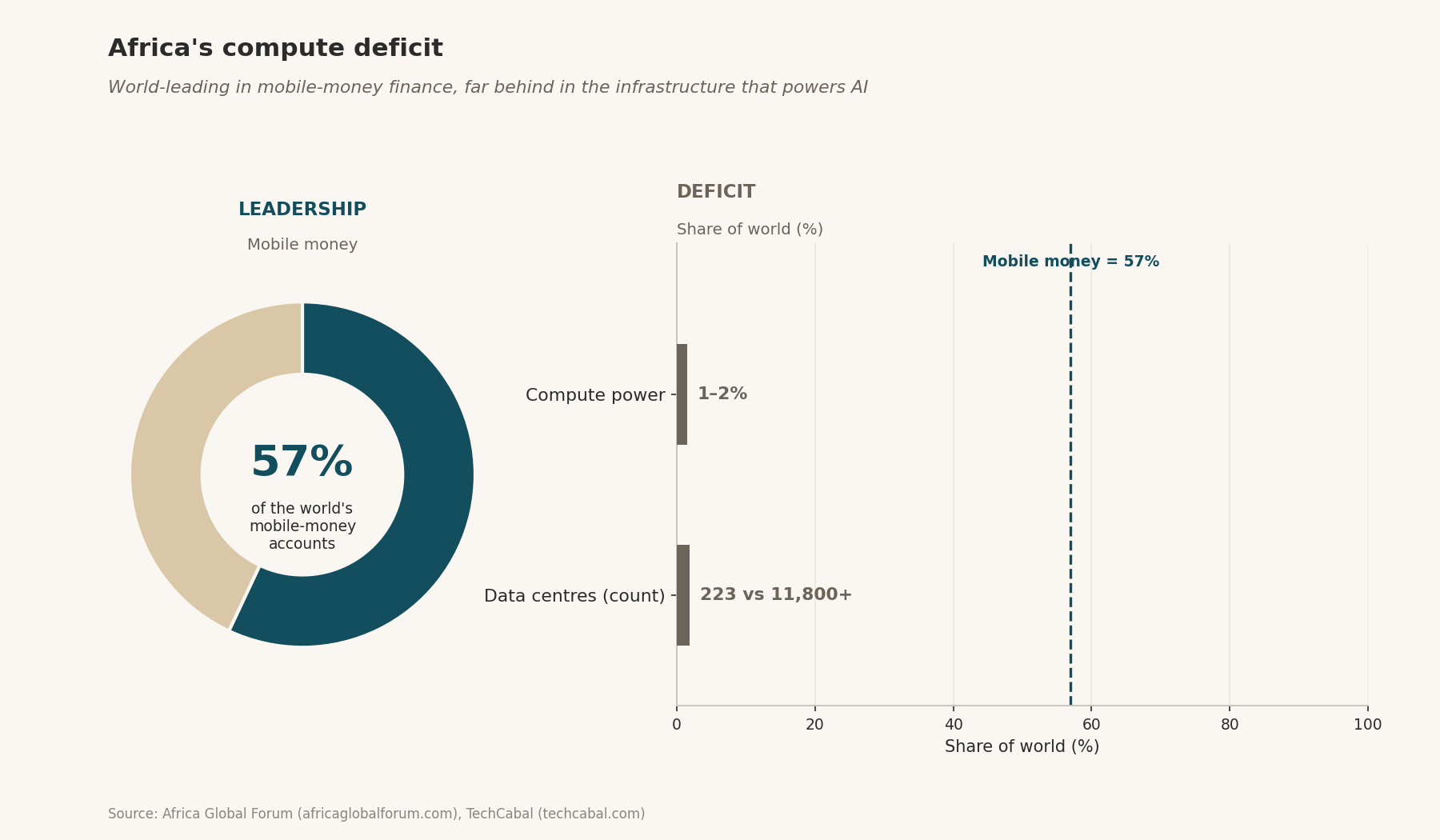
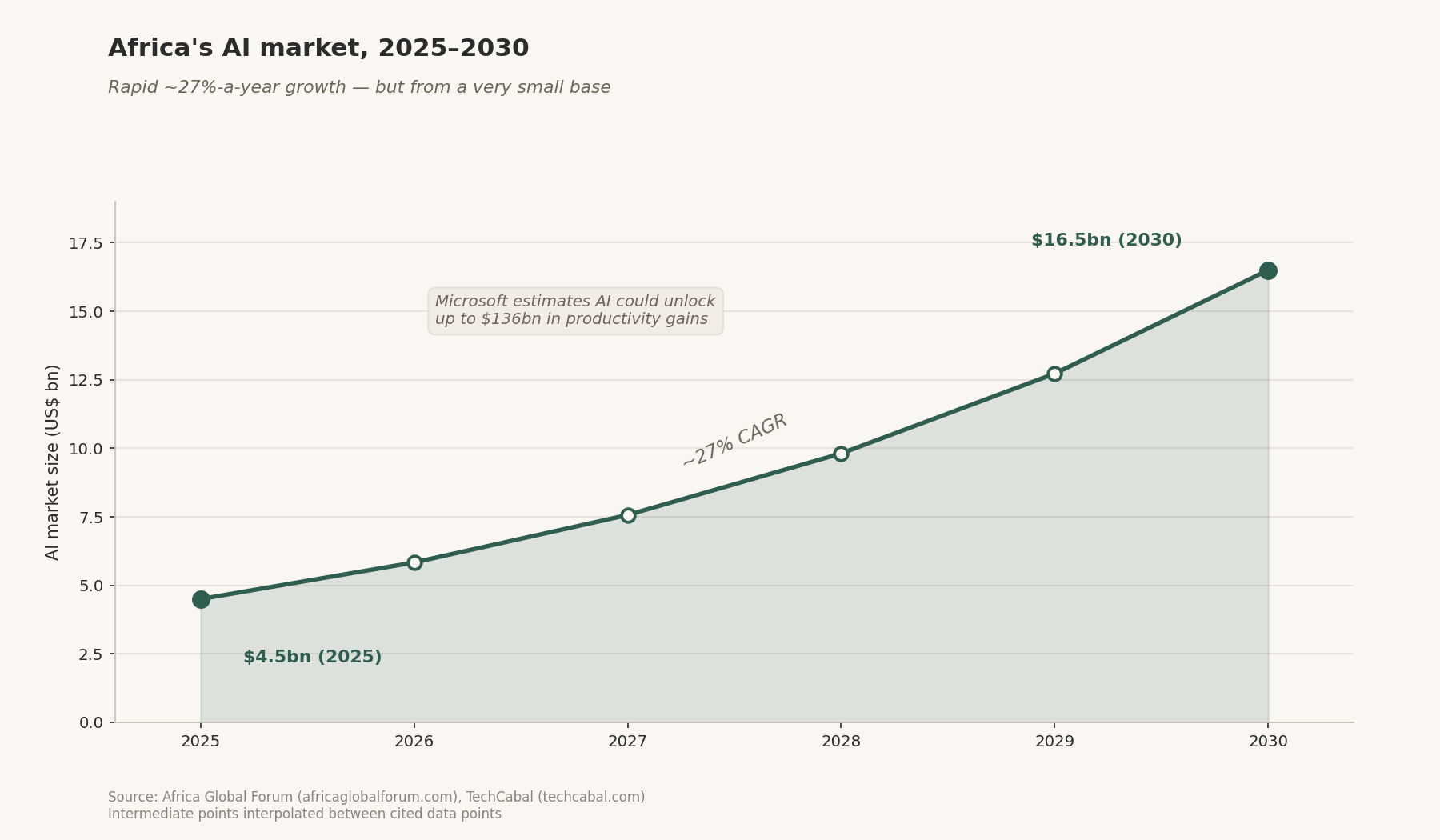
If there is one domain where Africa is not a follower but a leader, it is digital finance. The continent holds 57% of the world's mobile-money accounts — a genuine, homegrown technological advantage built on necessity and mobile-first adoption (Africa Global Forum). This leadership was not handed down from Silicon Valley; it was invented in Africa, by African firms solving African problems — moving money in economies where bank branches were scarce but mobile phones were ubiquitous. That fintech foundation is the launchpad for Africa's next digital ambition: an AI economy that is "increasingly homegrown, policy-backed, and sector-focused," with the African AI market projected to grow from $4.5 billion in 2025 to $16.5 billion by 2030 — roughly 27% annual growth (Africa Global Forum).
The compute deficit
The ambition collides with a brutal infrastructure gap. "We only have about 1% or 2% of global compute power in Africa," Microsoft's Akua Gyekye told TechCabal — a fundamental constraint on any AI strategy (TechCabal). As of mid-2025, Africa had 223 data centres across 38 countries — less than 0.02% of the world's total of more than 11,800 (TechCabal). The imbalance is stark: a continent that will soon hold a quarter of the world's workers (see Article 14) hosts a rounding error's worth of the world's computing capacity.
Microsoft estimates AI could add as much as $136 billion in productivity gains across Africa — but only if the continent can build infrastructure and enable secure, cross-border data flows (TechCabal). Without compute, Africa risks becoming a consumer of AI built elsewhere and a supplier of the raw data that trains it — the same extractive dynamic seen in minerals and oil, transposed to the digital realm. Building data-centre and compute capacity is therefore not a technical footnote but the central strategic question of Africa's digital decade.
The data-sovereignty dilemma
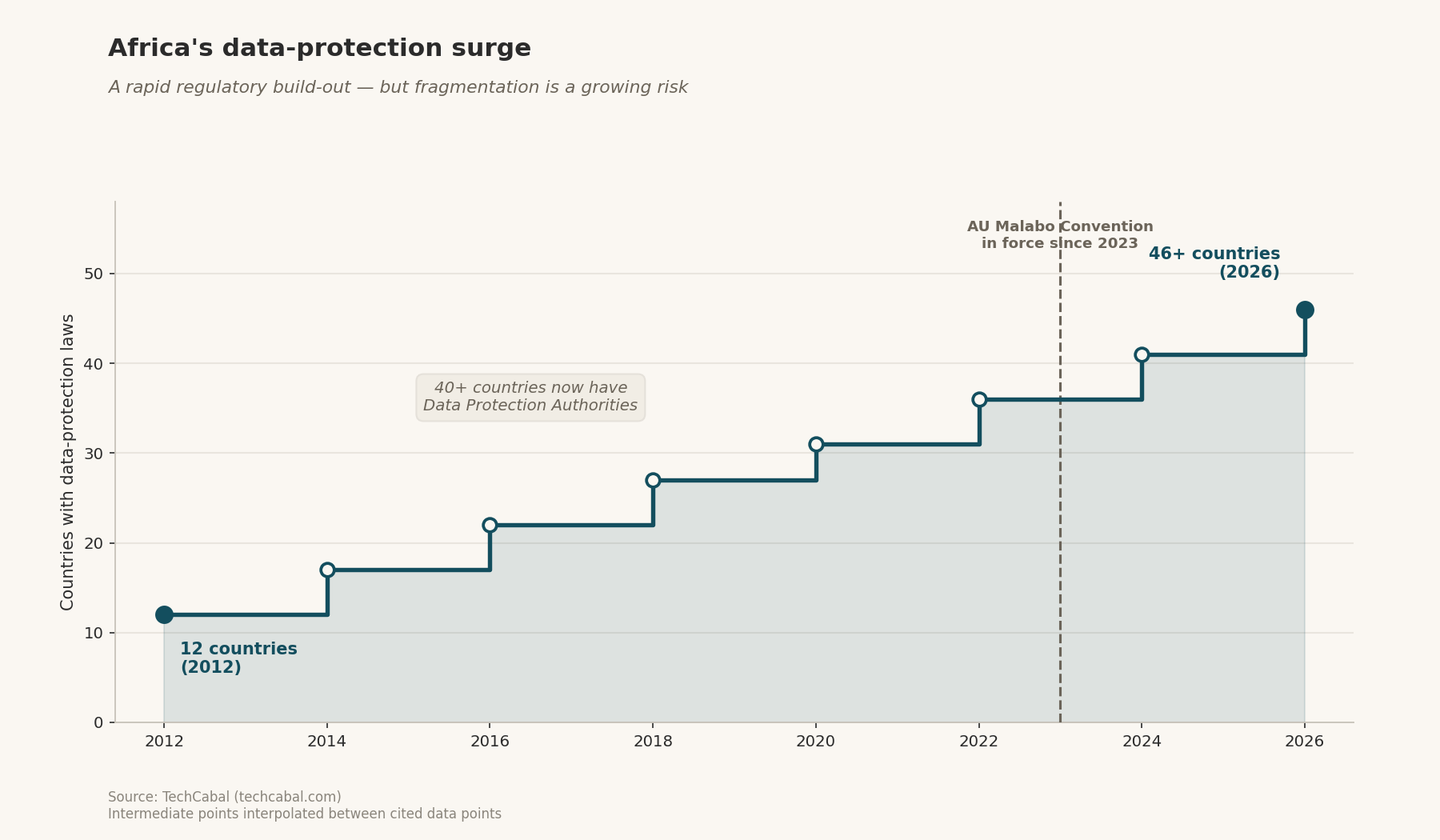
Here lies the central tension. Most data used to train today's AI models does not come from Africa, producing "algorithms that struggle with local languages, agronomic realities, financial behaviors and the continent's specific healthcare contexts" (Stellarix). An AI trained without African data serves African users poorly — misunderstanding local languages, misreading local conditions — while extracting value from whatever African data it does ingest. In response, governments are asserting data sovereignty: at least 46 African countries have now enacted data-protection legislation (up from just 12 in 2012), and more than 40 operate dedicated Data Protection Authorities, with the African Union's Convention on Cyber Security and Personal Data Protection helping align frameworks since it entered force in 2023 (TechCabal). The regulatory build-out in barely more than a decade has been remarkable.
But sovereignty cuts both ways. Well-intentioned localisation rules "can create data silos," and requiring data to stay physically within borders can undermine the cross-border flows that AI needs — sometimes offering less security than cloud providers, not more (TechCabal). The risk is a fragmented continent where 54 different national data regimes make it harder, not easier, to build the scale that AI and the AfCFTA-era digital economy require. Nigeria illustrates the hard edge: its BVN and NIN identity data are designated Critical National Information Infrastructure under a 2024 order, meaning they cannot be transferred abroad without specific regulatory approval — a constraint that must be resolved at the infrastructure level (Dev.to / Afriex). Sovereignty and integration are in genuine tension, and getting the balance wrong in either direction carries real costs.
The value-capture question
The deeper issue is not where data sits but who profits from it. As one policy briefing framed it, the defining question is "not only whether Africa participates in the AI economy, but whether value created from African data, talent, and deployment is captured within African economies" (Africa AI Intelligence Briefing). This is the same question that runs through every article in this package: Africa is rich in the raw input — here, data and talent — and the contest is over who captures the value it generates. The question of who controls Africa's AI infrastructure — and at what cost — is now openly contested, with AU ministers meeting in Tangier in April 2026 to coordinate strategy (Al Jazeera).
Ambition meets policy churn
Continental ambition is high but implementation is uneven. In April 2025, representatives from 54 African nations signed the African Declaration on Artificial Intelligence in Kigali, described as the most ambitious AI-sovereignty commitment in Global South history (AI Security Info). Yet even the continent's most mature digital jurisdiction stumbled: South Africa "entered Q1 2026 with the most mature data protection regime on the continent and exited it with a withdrawn AI policy" (Lawyers Hub / AFD report). The gap between grand continental declarations and messy national implementation is the pattern to watch: signing a declaration is easy; building compute, harmonising 54 legal regimes, and turning ambition into functioning policy is hard.
The New Axis read
Africa's digital story defies both techno-optimism and Afro-pessimism. The continent genuinely leads in mobile money and has a fast-growing, homegrown AI ecosystem — but it hosts almost none of the world's compute and risks having its data mined for value captured elsewhere. The strategic imperative is clear: build compute and data-centre capacity, harmonise data rules so sovereignty does not become fragmentation, and — above all — ensure that value from African data lands in African economies. This is the same pattern seen in minerals and oil: Africa is rich in the raw input (here, data) and must fight to move up the value chain. The digital economy is the newest arena of an old contest — and, given fintech's homegrown success, the arena where Africa has already proven it can win when it owns the platform.
Charts & visuals
X: Africa holds 57% of the world's mobile-money accounts — but just 1-2% of global compute and 223 data centres (<0.02% of the world). The real AI battle isn't adoption. It's who controls African data & where the value lands. 🧵
LinkedIn: Africa leads the world in mobile money and has a fast-growing, homegrown AI ecosystem projected to hit $16.5bn by 2030. But it hosts almost none of the world's compute, and most models are trained on non-African data. New Axis Media on the data-sovereignty dilemma — and the real question: not whether Africa joins the AI economy, but whether the value lands in African economies.
Author
Sign up for New Axis Media newsletters.
Stay up to date with curated collection of our top stories.