African Culture as Global Infrastructure: Music, Film, Fashion, and the Diaspora Economy
Afrobeats fills global charts, Nollywood is a production powerhouse, and African design shapes runways. Culture is now one of the continent's most powerful exports — but the platforms that distribute it, and capture its value, are mostly owned elsewhere.

Somewhere in the last decade, African culture stopped being a niche and became infrastructure — a system through which the continent projects influence, generates revenue, and reshapes global taste. Afrobeats and Amapiano dominate playlists; Nigerian cinema is a production juggernaut; African fashion and design appear on international runways; and a vast diaspora acts as both market and amplifier. The New Axis question is not whether African culture matters globally — that is settled — but who owns the platforms that carry it and who captures the value it creates. It is the same question that runs through minerals, energy, data and football (see Articles 15, 16 and 19), transposed to the domain where Africa's global dominance is least disputed.
A homegrown creative surge — and a value warning
The creative economy is increasingly recognised by African governments as a diversification strategy in its own right. Angola, for instance, has moved to create a new cultural policy explicitly aimed at diversifying its oil-dependent economy — a recognition that music, film and the arts are economic sectors, not just national ornaments (allAfrica). Angola's own music market, home to globally-exported genres like kuduro and kizomba, is tracked as a growing commercial sector (6Wresearch).
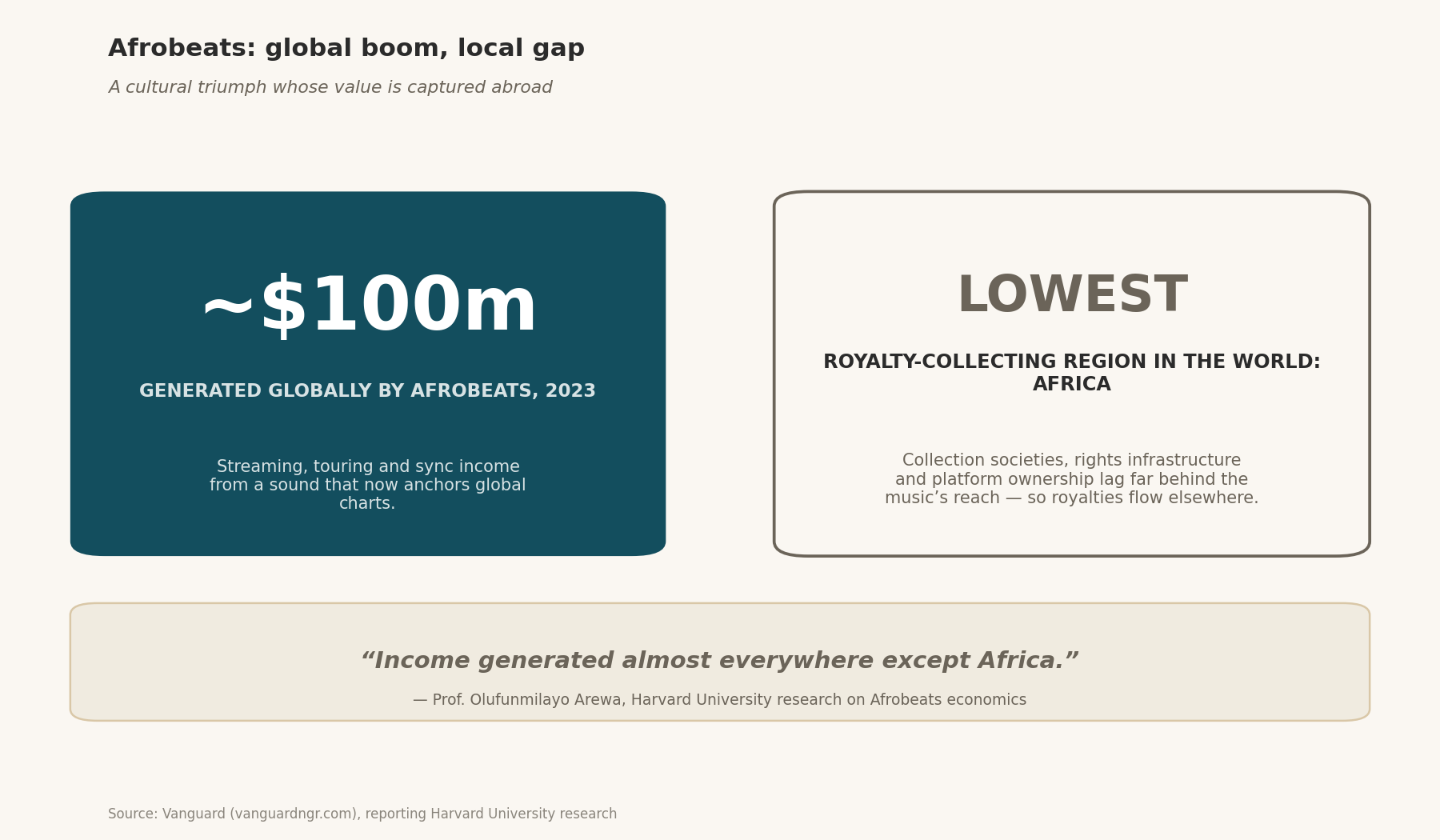
But the flagship cautionary tale comes from Afrobeats. Research by Harvard University warned that Africa is failing to capture the economic value of Afrobeats despite the genre's rapid global expansion: Afrobeats generated an estimated $100 million globally in 2023, fuelled by streaming growth and international touring, yet "Africa remains the world's lowest royalty-collecting region," even as music consumption across the continent grows (Vanguard). As the report's presenter, Professor Olufunmilayo Arewa, put it: "Afrobeats is a historic triumph of African creativity, but structurally, the global boom is generating income almost everywhere except Africa" (Vanguard). The imbalance, the report found, stems from extractive global industry structures, opaque royalty and contracting systems, weak local data infrastructure, widespread informality, and underdeveloped African touring and live-performance markets (Vanguard).
The platform problem
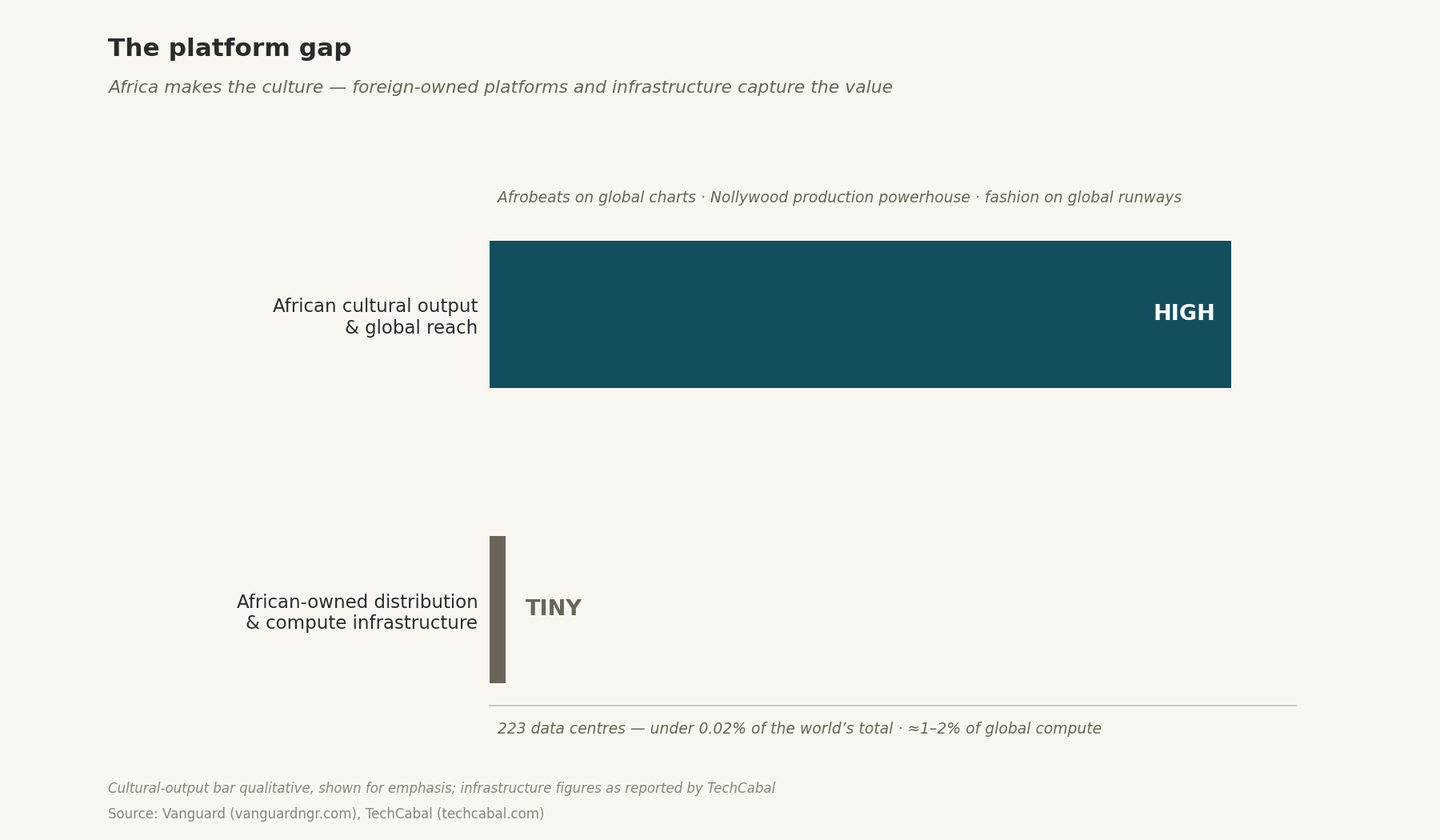
Here the creative economy runs into the same structural trap as minerals, oil and data: the raw value is African, but the platforms that distribute and monetise it are largely foreign-owned. As the Harvard research put it, "ownership, monetisation, and measurement systems are largely controlled outside the continent" (Vanguard). Africa's cultural products travel on global streaming, social and distribution networks headquartered elsewhere, meaning a significant share of the value — subscriptions, ad revenue, royalties, data — is captured abroad. This mirrors the football "two speeds" problem, where a world-class product is throttled by underdeveloped African distribution infrastructure (see Article 19) (The Standard (Zimbabwe)). Culture, like data, is an African raw material refined and monetised on other continents' rails.
The report's proposed remedies are instructive precisely because they target the platform rather than the product: developing regional creative-economy regulatory frameworks, strengthening local financial and business ecosystems, building robust African touring and live-performance markets, improving creative-economy data collection, and establishing African-centred intellectual property and contracting models (Vanguard). Every one of these is about capturing value at home — the same imperative that runs through refining minerals and hosting compute.
The digital dependency
The creative economy's dependence on foreign platforms is a subset of the broader data-sovereignty dilemma. Africa hosts just 223 data centres — less than 0.02% of the world's total — and 1–2% of global compute (see Article 15) (TechCabal). Cultural distribution, streaming analytics, and the AI models increasingly shaping content discovery all run on infrastructure that is overwhelmingly located outside Africa. When a Nigerian artist's streams are counted, monetised and algorithmically promoted on servers in another continent, the data and the revenue both flow outward. The fight to capture cultural value is therefore inseparable from the fight to build digital infrastructure and assert data sovereignty (Al Jazeera). Whoever controls the platform controls the economics of the culture.
The diaspora as strategic asset
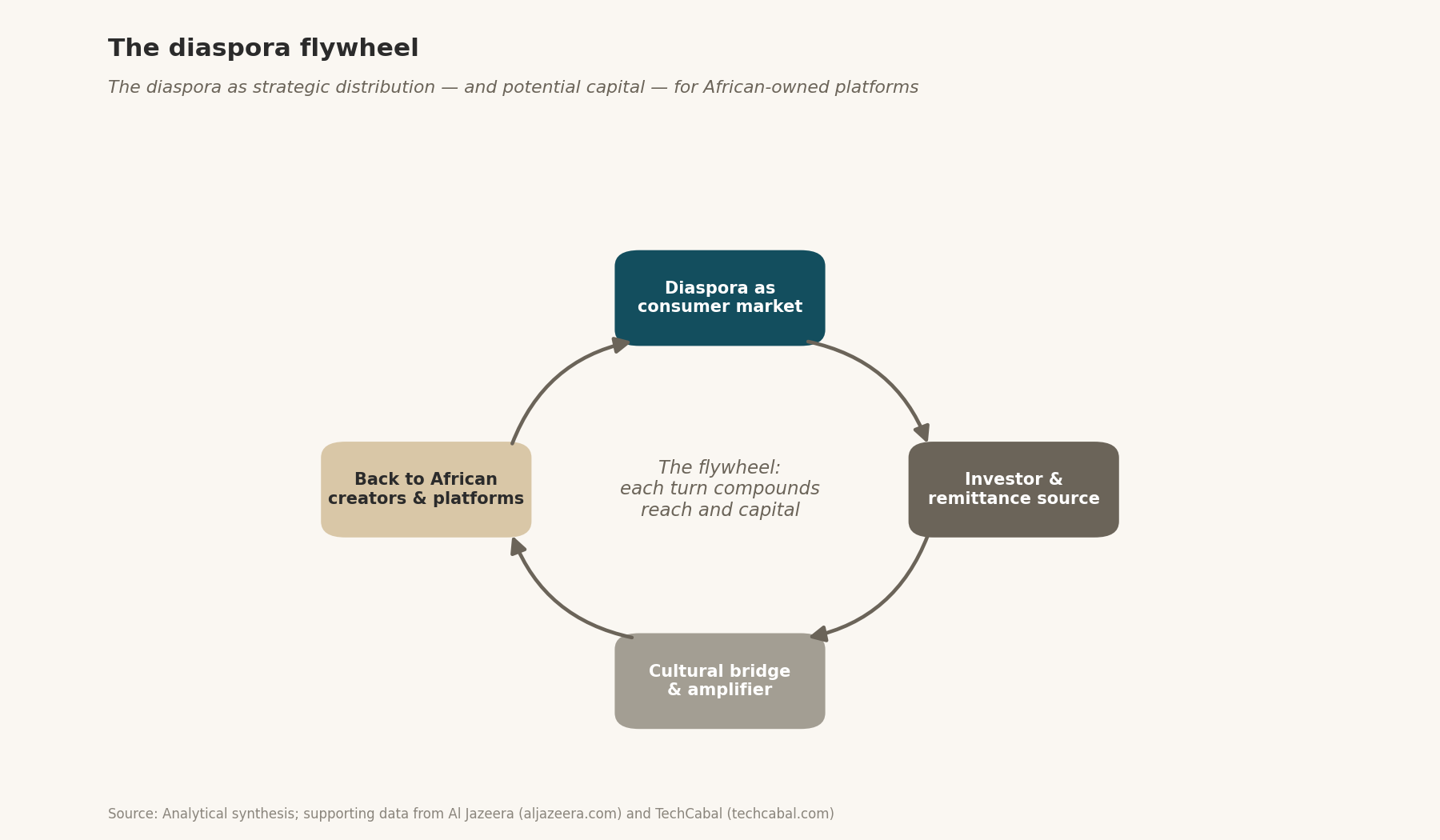
The African diaspora is the creative economy's built-in distribution network and demand base. It functions simultaneously as a consumer market that gives African culture immediate global reach, a source of investment and remittances, and a cultural bridge that normalises African aesthetics in Western markets. When Afrobeats fills a London arena or Nollywood streams to Atlanta, the diaspora is both the early audience and the amplifier that carries the culture into the mainstream. For a continent seeking to capture more of its cultural value, the diaspora is both the audience and, potentially, the investor class that could fund African-owned platforms — the labels, streaming services, touring circuits and IP structures the Harvard report calls for. Mobilising diaspora capital toward African-owned cultural infrastructure could be one of the most powerful levers for closing the value gap.
The New Axis read
African culture is one of the continent's few unambiguous global victories — a domain where Africa sets trends rather than following them, and where its soft power is genuine and rising. But the recurring pattern of this entire feature package applies here too: Africa is rich in the raw creative input and structurally weak in the platforms, infrastructure and value capture. Afrobeats conquering global charts is a triumph; the fact that Africa remains the world's lowest royalty-collecting region, with income "generated almost everywhere except Africa," is the unfinished business (Vanguard). The strategic imperative is the same as in minerals, energy and data: move up the value chain, build African-owned platforms and infrastructure, and ensure that when African culture becomes global infrastructure, Africans own a fair share of the rails. The talent has already won. The next battle is over the platform.
Charts & visuals
X: Afrobeats rules global charts (~$100m in 2023) — yet Africa is the world's LOWEST royalty-collecting region. Nollywood is a powerhouse. African design shapes runways. Culture is now infrastructure. But the platforms that monetise it are mostly owned elsewhere. The talent won. The platform battle hasn't. 🎶
LinkedIn: African culture has become global infrastructure — Afrobeats, Nollywood, fashion, and a vast diaspora projecting influence worldwide. But New Axis Media identifies the recurring trap, now quantified by Harvard research: Afrobeats generated ~$100m globally in 2023, yet Africa remains the world's lowest royalty-collecting region, with income "generated almost everywhere except Africa." The talent has already won. The next battle is over who owns the platform.
Author
Sign up for New Axis Media newsletters.
Stay up to date with curated collection of our top stories.