Dangote's 96% Quarter: The Refinery That Rewired West Africa's Fuel Trade
Nigeria's petrol import bill has collapsed, its refinery is selling jet fuel into a Hormuz-shocked Europe, and Angola is racing to escape the same crude-out, fuel-in trap. The revolution is real — but it is currently defended by import bans, not won on price.
The quarter the petrol trade broke
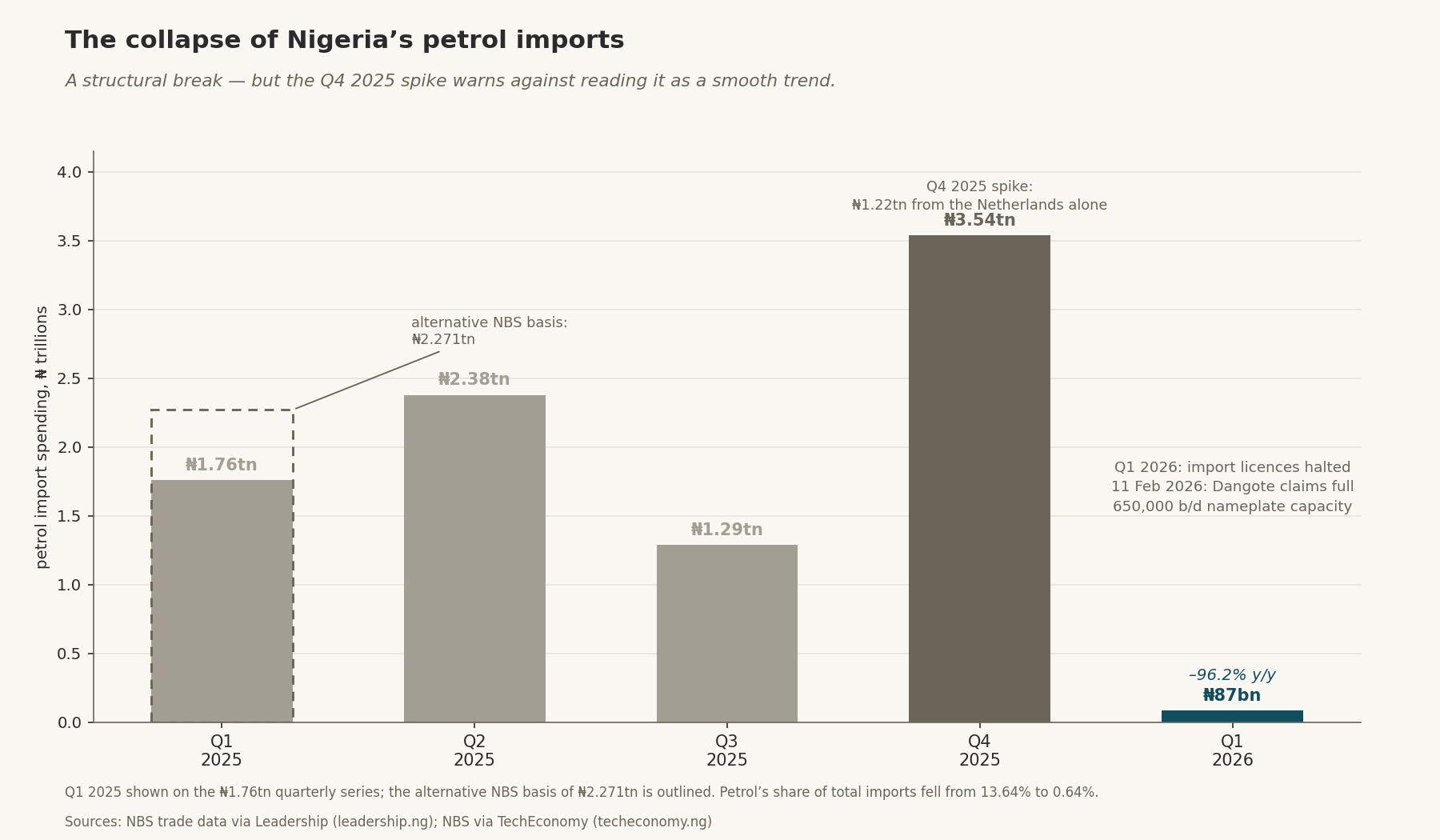
Nigeria spent ₦87.4 billion on imported petrol in the first quarter of 2026. A year earlier, the figure was ₦2.271 trillion. That is a 96.2 per cent collapse, according to the National Bureau of Statistics' trade data via Leadership — and it dragged petrol's share of total imports from 13.64 per cent to 0.64 per cent, out of the top ten entirely. For a country that has exported crude for half a century while queuing for imported fuel, this is the biggest structural break in West African energy trade in decades.
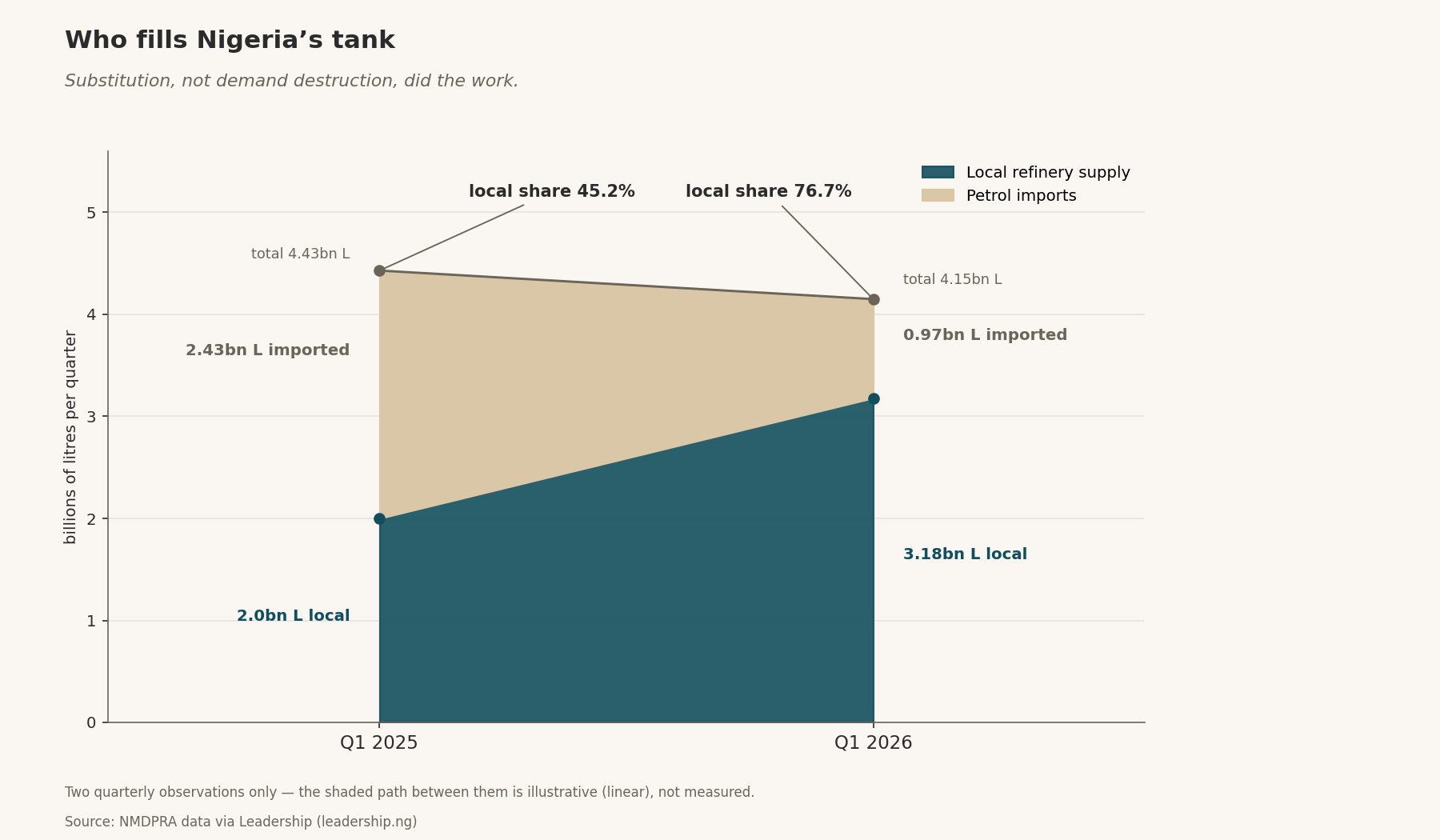
The honest chart is not a smooth line. Quarterly import spending ran ₦1.76 trillion in Q1 2025, ₦2.38 trillion in Q2, ₦1.29 trillion in Q3, then spiked to ₦3.54 trillion in Q4 — supplied, among others, by the Netherlands (₦1.22 trillion), Brazil and Togo, per TechEconomy's read of the NBS series. Over the full year 2025, petrol imports cost ₦8.96 trillion, down 41.9 per cent on 2024 but still above 2023, the year the subsidy was removed. In dollar terms, refined-product imports fell to US$10.0 billion in 2025 from US$14.06 billion — and imports still covered 62.47 per cent of national petrol consumption for the year, per CBN data via Ecofin. The step-change came later. In volume terms, the regulator NMDPRA counts petrol imports of 965.5 million litres in Q1 2026 against 2.43 billion a year earlier, while local refinery supply rose to 3.179 billion litres from 2.0 billion — domestic plants delivered 76.7 per cent of petrol, up from 45.2 per cent. Dangote alone supplied 40.1 million litres a day in January, up from 32 million in December. But the fine print matters: in mid-March, imported petrol's landing cost was ₦1,080.47 a litre — about ₦94.53 cheaper than Dangote's ₦1,175 gantry price — and the government stopped issuing new import licences for the quarter, per MEMAN/NMDPRA data via TechEconomy. National consumption runs near 56 million litres a day against domestic supply of 36.5 million. The new order is being defended by the licensing drawer.
The macro effect, at least, is measurable. Dangote exported US$5.85 billion of refined products in 2025, lifting Nigeria's goods surplus to US$14.51 billion; crude export earnings fell 14.4 per cent to US$31.54 billion, per the CBN balance of payments via Nairametrics. Value is being captured onshore — the stated point of the exercise.
A giant learning to walk
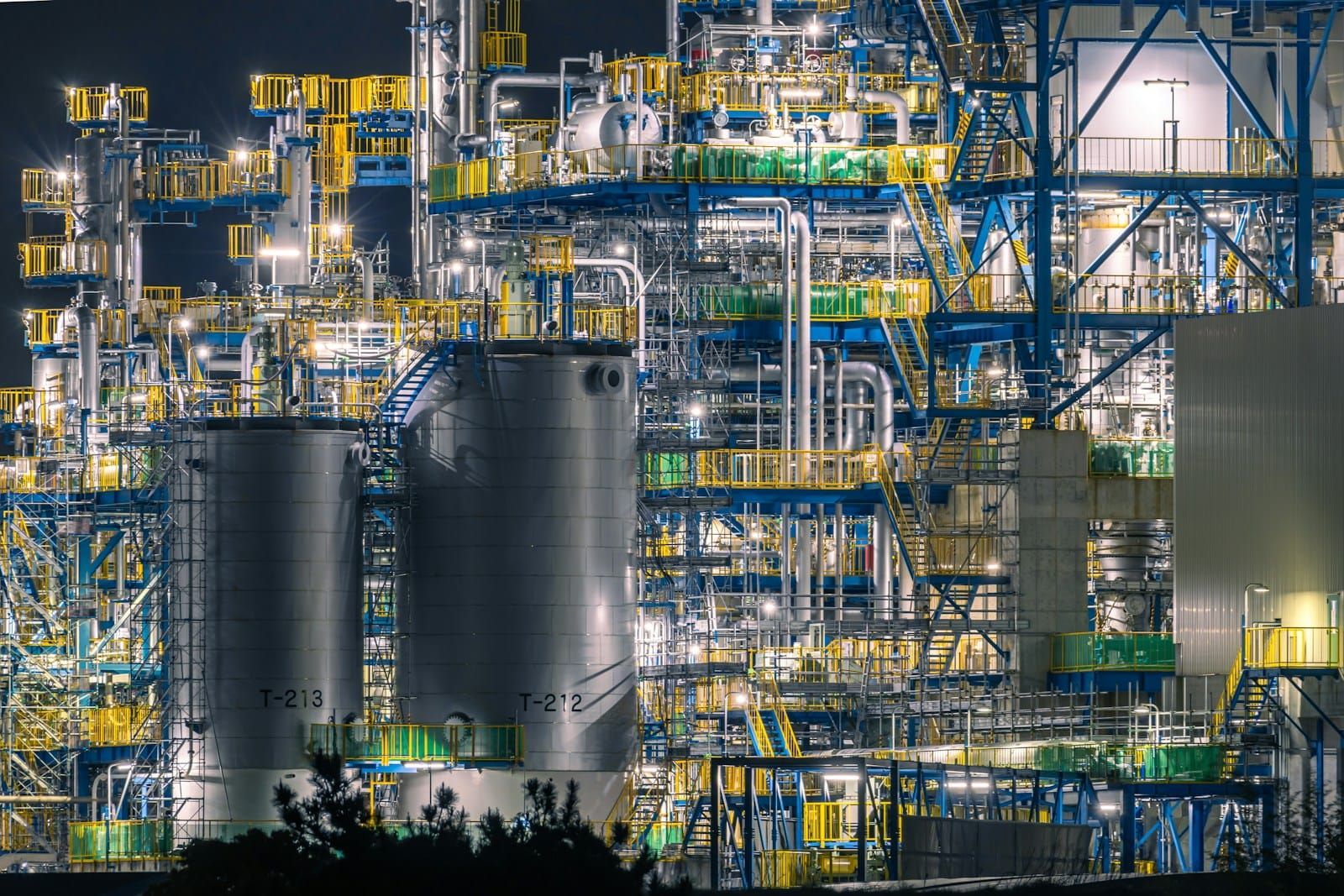
The 650,000-barrel-a-day Dangote Petroleum Refinery — the world's largest single-train plant, spread over 2,500 hectares of the Lekki Free Zone — announced on 11 February 2026 that it had reached full nameplate capacity, citing optimised crude units and 72-hour performance tests with its licensor UOP, per NGN Market. Independent trackers tell a messier story. Kpler estimates actual crude runs of 280,000–320,000 barrels a day in early 2026, with the 200,000 b/d gasoline unit — the RFCC — unreliable since April 2025 and repeatedly delayed restarts, per SaharaReporters' report of Kpler's outlook. Both numbers are real; they measure different things. One is what the units can do in a test. The other is what the plant did. January's actual output ran at roughly 95,000 barrels a day of petrol and 120,000 of middle distillates, topped up with some 45,000 of imported blending components, while about 120,000 barrels a day of low-sulphur fuel oil went for export; since late 2025 the plant has also shifted to lighter crude grades — a configuration that favours diesel over petrol.
The RFCC's chronology is the tempering fact of the boom: a full shutdown in August 2025, a restart at 60 per cent in October, a third disruption in under twelve months in late May 2026 that cut gasoline exports from about 81,000 to 10,000 barrels a day — an 88 per cent drop — before a projected mid-June recovery, per IIR Energy and Kpler data compiled by Discovery Alert. S&P Global reports management has acknowledged design challenges in the unit. A super-refinery, yes — and one still learning to walk.
Then there is the feedstock fight, which produces the strangest trade in world oil. NNPC allocated 82 million barrels to Dangote between October 2024 and October 2025, 60 per cent of it sold in naira under the federal crude-for-naira scheme; a two-year renewal was signed in August 2025, per BusinessDay. Dangote says it receives about five cargoes a month against the thirteen it needs — a 26.9 per cent supply performance between October 2025 and mid-March 2026, on Dangote and NUPRC figures via Economic Confidential. NNPC's rejoinder is structural: forward-sold barrels, past crude-backed loans, theft and years of upstream underinvestment. The result: Nigeria, which exported 485 million of the 592 million barrels it produced in 2025, spent US$3.74 billion importing crude for its own showpiece refinery — from the United States, Algeria and, pointedly, Angola, per CBN and NBS data via Channels TV and Legit. Even OPEC noticed: its monthly report observed that Dangote nearing capacity "should help stabilise" product supply, just as Nigeria finally met its 1.5 million b/d quota in January 2025, per The Cable.
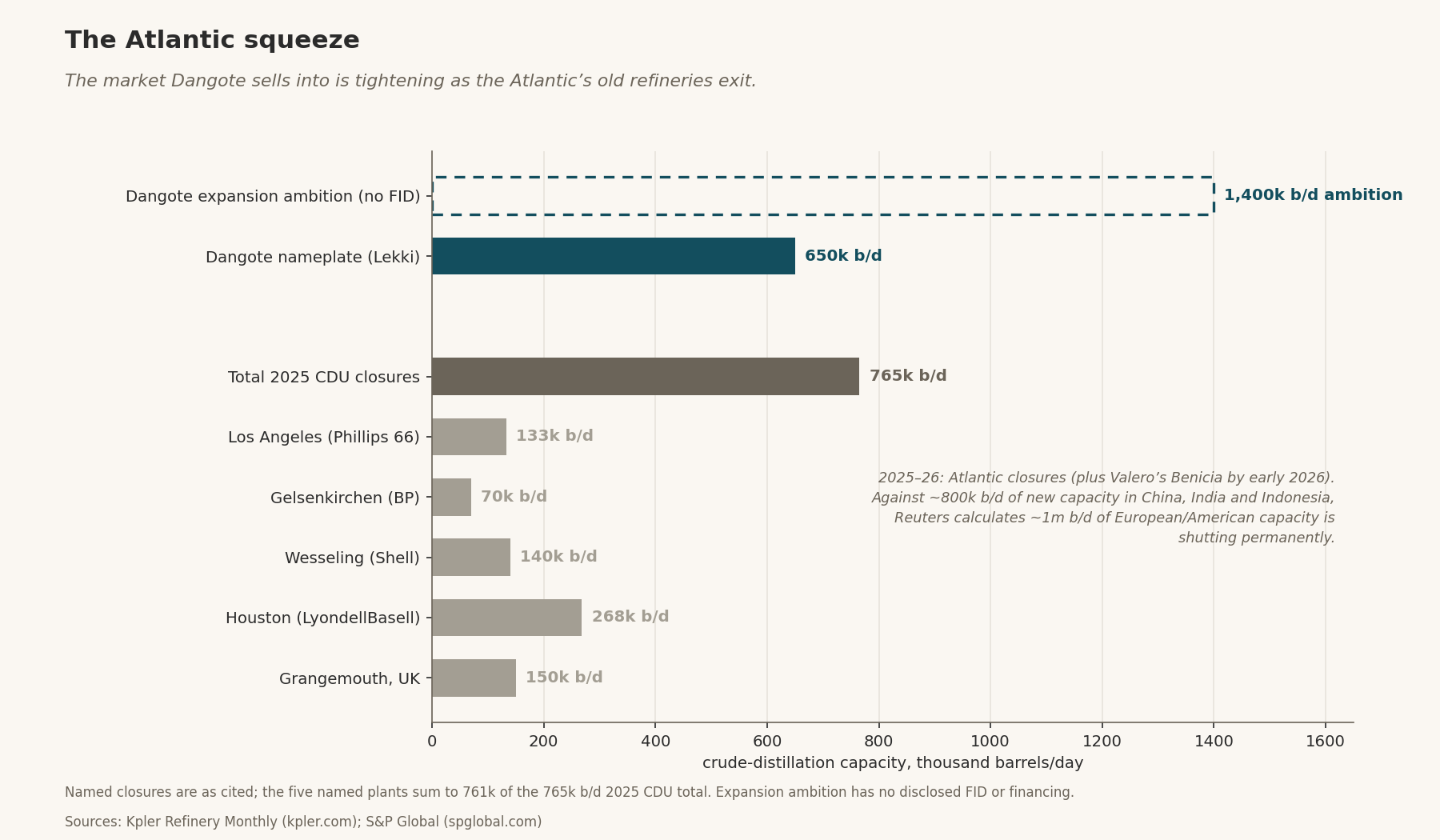
The ambition does not pause. Chief executive David Bird told an S&P Global conference in June 2026 that the plant will expand to 1.4 million barrels a day within 30 months — bigger than Jamnagar — with polypropylene rising to 1.5 million tonnes a year. No investment decision or financing has been disclosed; file it as intent, loudly signalled.
Europe's loss, Lagos's gain?
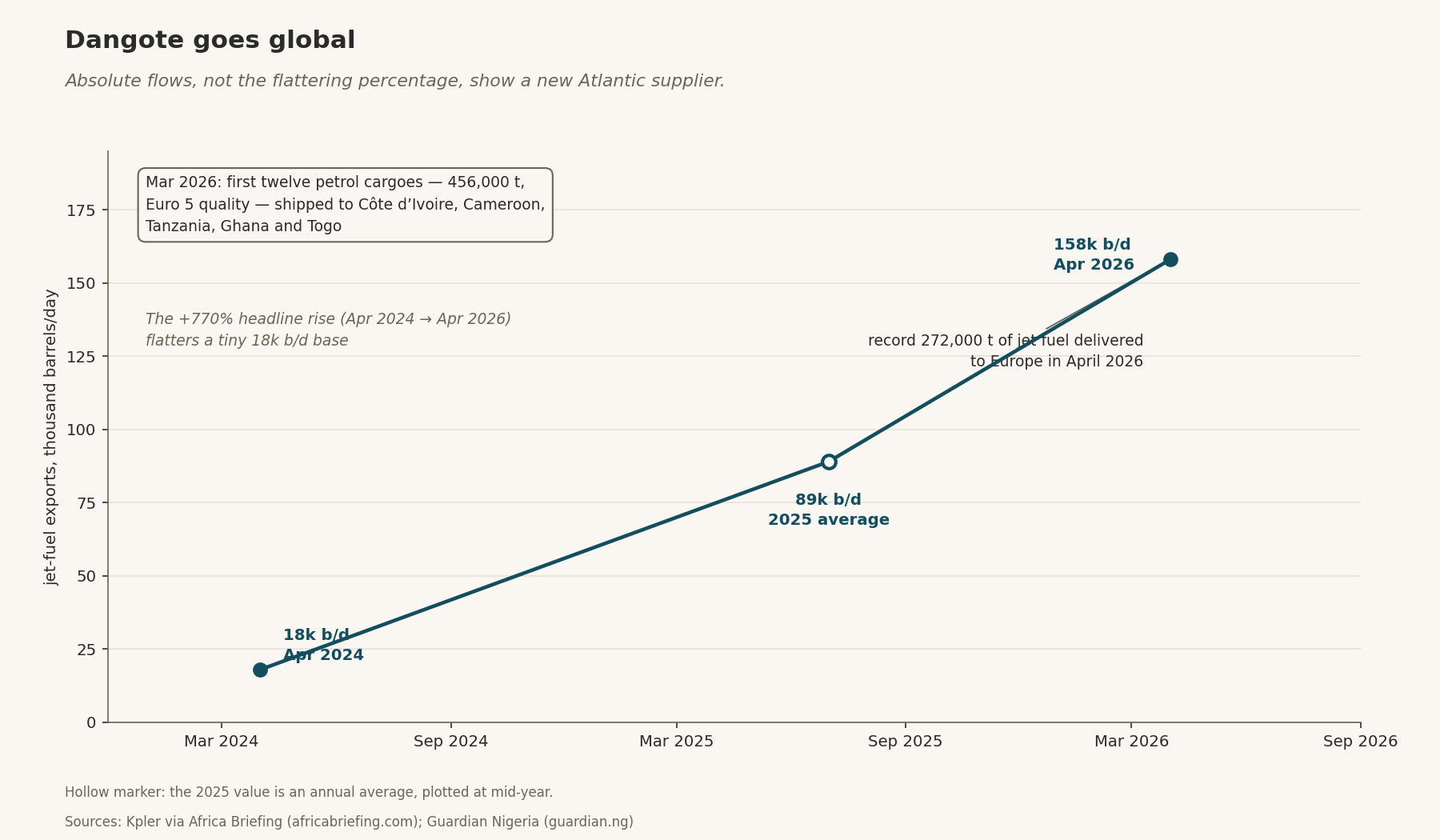
The export story is where the rewiring becomes visible. Dangote's jet-fuel exports ran at about 158,000 barrels a day in April 2026, against 89,000 on average in 2025 and a small 18,000-barrel base in April 2024 — a 770 per cent rise that flatters a tiny starting point, but the absolute barrels are real, per Kpler via Africa Briefing. Nigeria delivered a record 272,000 tonnes of jet fuel to Europe in the first 29 days of April alone, after roughly 456,000 tonnes in March, and its total petroleum-product exports exceeded 416,000 barrels a day, per the Guardian. The pull is geopolitical: roughly 300,000 of Europe's 550,000 b/d of jet-fuel imports arrived through the Strait of Hormuz in 2025 — about 75 per cent of them from Gulf producers — and disruption there cut seaborne availability by about a fifth, pushing buyers toward West Africa and the US Gulf.
Inside Africa, the reversal is sharper. By March 2026 Dangote had shipped its first twelve petrol cargoes — 456,000 tonnes, marketed as Euro 5 quality — to Côte d'Ivoire, Cameroon, Tanzania, Ghana and Togo, per BusinessDay, in a region long treated as a dumping ground for off-spec fuel. The old logistics chain — Rotterdam or Antwerp cargo to Lomé, thence to Ghana, Benin and Burkina Faso — is being compressed, with margins, freight premiums and trading spreads once captured by European and Swiss desks moving onshore, and Lomé eyeing a future as balancing hub rather than gateway, per the African Energy Council via Major Waves Energy Report.
The timing is not accidental. About 765,000 barrels a day of crude-distillation capacity closed in 2025 — Grangemouth, which at its height supplied some 15 per cent of UK diesel;
LyondellBasell's Houston plant; Shell's Wesseling; BP's Gelsenkirchen; Phillips 66 in Los Angeles — with Valero's Benicia refinery following by early 2026. Reuters calculates roughly a million barrels a day of European and American capacity is shutting permanently, against 800,000 of new capacity in China, India and Indonesia, per Kpler and S&P Global. A century-old flow — African crude out, European products in — is being reversed at exactly the moment Europe least needs the competition.
Angola's paradox, and the race to end it
No government watches this more closely than Luanda's. Angola is sub-Saharan Africa's second crude exporter, with oil supplying over 95 per cent of export earnings and 60 per cent of state revenue — yet it imports about 72 per cent of the fuel it consumes, some 3.3 million tonnes a year, according to Sonangol's figures via Hydrocarbon Processing. That paradox priced itself in blood in July 2025, when a 33 per cent diesel price rise — imposed partly because importing fuel was bankrupting a budget written for US$70 oil against market projections of US$60–65 — triggered protests in which at least 22 people died, per Credendo.
The response is a refinery race. The 30,000 b/d Cabinda plant — Gemcorp 90 per cent, Sonangol 10, and the first refinery built since independence — was inaugurated in September 2025 on crude from the Malongo field and began commercial production in April 2026, at a cost of US$500–550 million. It will cover 5–10 per cent of national needs; a US$700 million Phase 2 would double capacity and add a hydrocracker for diesel and jet fuel, with construction targeted for the first half of 2027, per Africa Oil+Gas Report. The 200,000 b/d Lobito refinery is to restart after "thorough review and significant cost reduction", with a US$4.8 billion funding gap unresolved; the 100,000 b/d Soyo project is under review. Dangote, meanwhile, is reported to be planning a 1.6-million-barrel storage hub at Walvis Bay in Namibia aimed at Botswana, Zambia, Zimbabwe and southern DRC — a single-source report, unconfirmed, but indicative of the southern-African market now in play, per Sovereign Africa Ratings. AfCFTA's promise of regional value chains, and SADC's fuel security, converge on the same question: who refines Africa's crude.
New Axis read
The paradox is not dead; it has moved upstream. Nigeria now imports crude to avoid importing petrol, and its import bill is falling because the licensing drawer says so — not because Dangote's gantry beats Rotterdam on price. The swing variables are mechanical: RFCC uptime, the naira-for-crude allocation, and whether Q2 2026 data hold the Q1 collapse once licences reopen. If they do, West Africa's fuel map is permanently redrawn, Lomé and Rotterdam adjust, and Angola's race acquires a working template. If the gasoline unit fails a fourth time, the paradox returns — with higher stakes attached, and a 1.4-million-barrel expansion plan hunting for crude that Nigeria has, in large part, already sold forward.
Charts & visuals
X: Nigeria's petrol import bill just fell 96% in a year — ₦2.27tn to ₦87bn. The refinery behind it sells jet fuel to Europe and petrol to five African states. But the revolution is defended by import bans, not won on price.
LinkedIn: In Q1 2026 Nigeria's petrol imports collapsed 96.2% year-on-year, and domestic refineries supplied 76.7% of the market — the biggest structural break in West African energy trade in decades. Our analysis separates the milestone from the marketing: RFCC outages, a US$3.74bn crude-import bill (some of it Angolan), and import petrol that still undercuts Dangote's gantry by ₦94 a litre. Plus: why Angola, importer of 72% of its fuel, is now racing to follow — and what a closing Europe means for the Atlantic products trade.
Author
Sign up for New Axis Media newsletters.
Stay up to date with curated collection of our top stories.