Mission 300 at halfway: 50m connections, one hard problem
The World Bank and AfDB have connected over 50 million people in two years. Reaching 300 million depends on utilities that can bill.
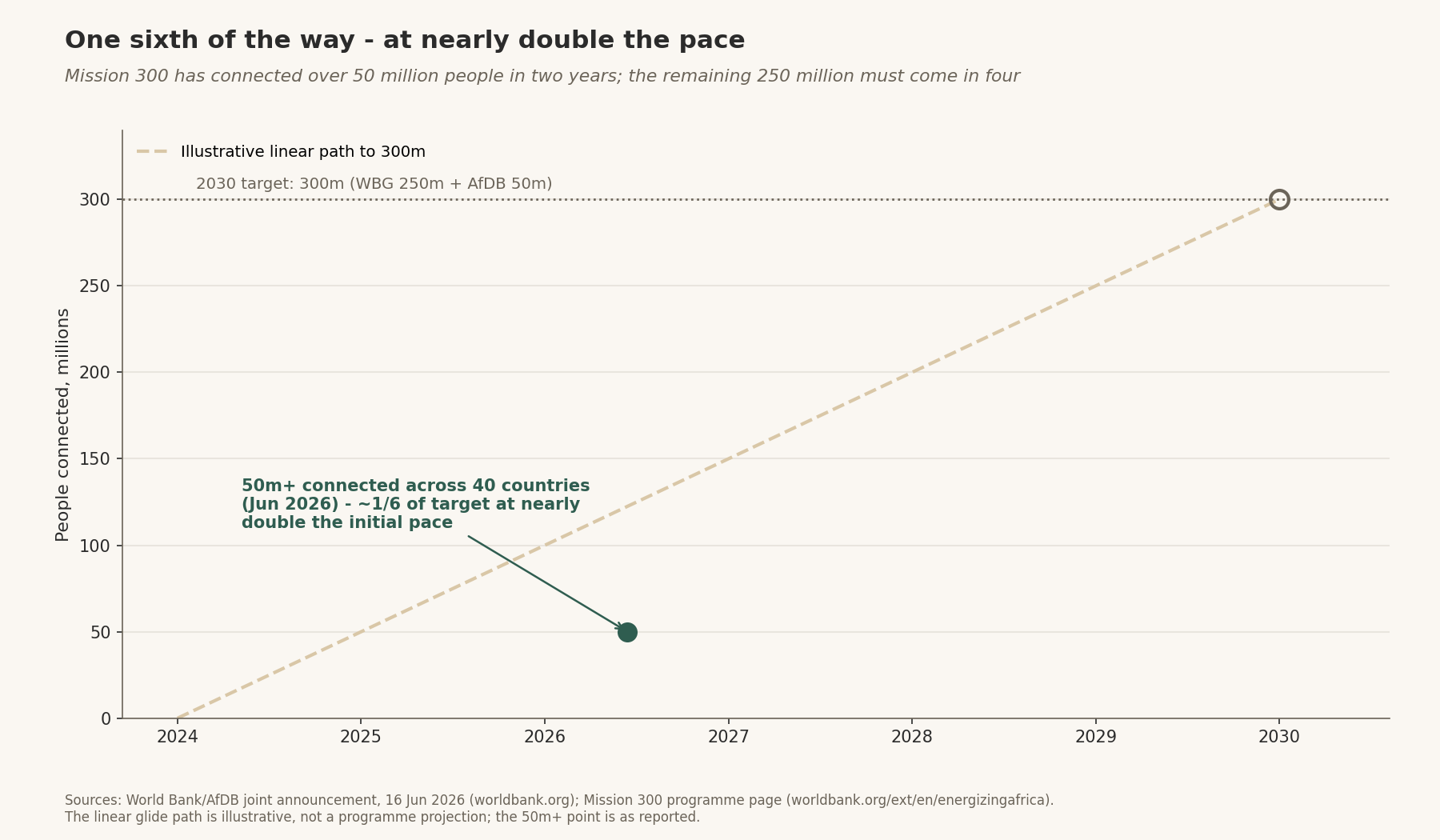
Executive summary. Mission 300 has connected more than 50 million people across 40 countries within two years of launch and is running at nearly double its initial pace, per the World Bank and AfDB joint announcement of 16 June 2026. That is roughly one sixth of the 2030 target of 300 million, split between a World Bank Group commitment of 250 million and an AfDB commitment of 50 million, per the World Bank's Mission 300 programme page. The pace is real; the binding constraint is the fifth pillar of the programme's own design — financially sustainable utilities.
Key judgments.
1. Delivery is ahead of the historical baseline, driven by financing volume plus
connection-cost reform, not by technology alone.
2. Concentration is high: a handful of countries account for a large share of results, so national reform quality determines continental totals.
3. The last-mile share will get harder and more expensive as programmes move from grid-dense to remote populations.
4. Private capital participation is now the explicit gating factor, which is why a private sector council was created in 2026.
5. Access counts are not consumption counts. Connections without affordable, reliable supply and creditworthy utilities will not convert into the productive-use gains the programme promises.
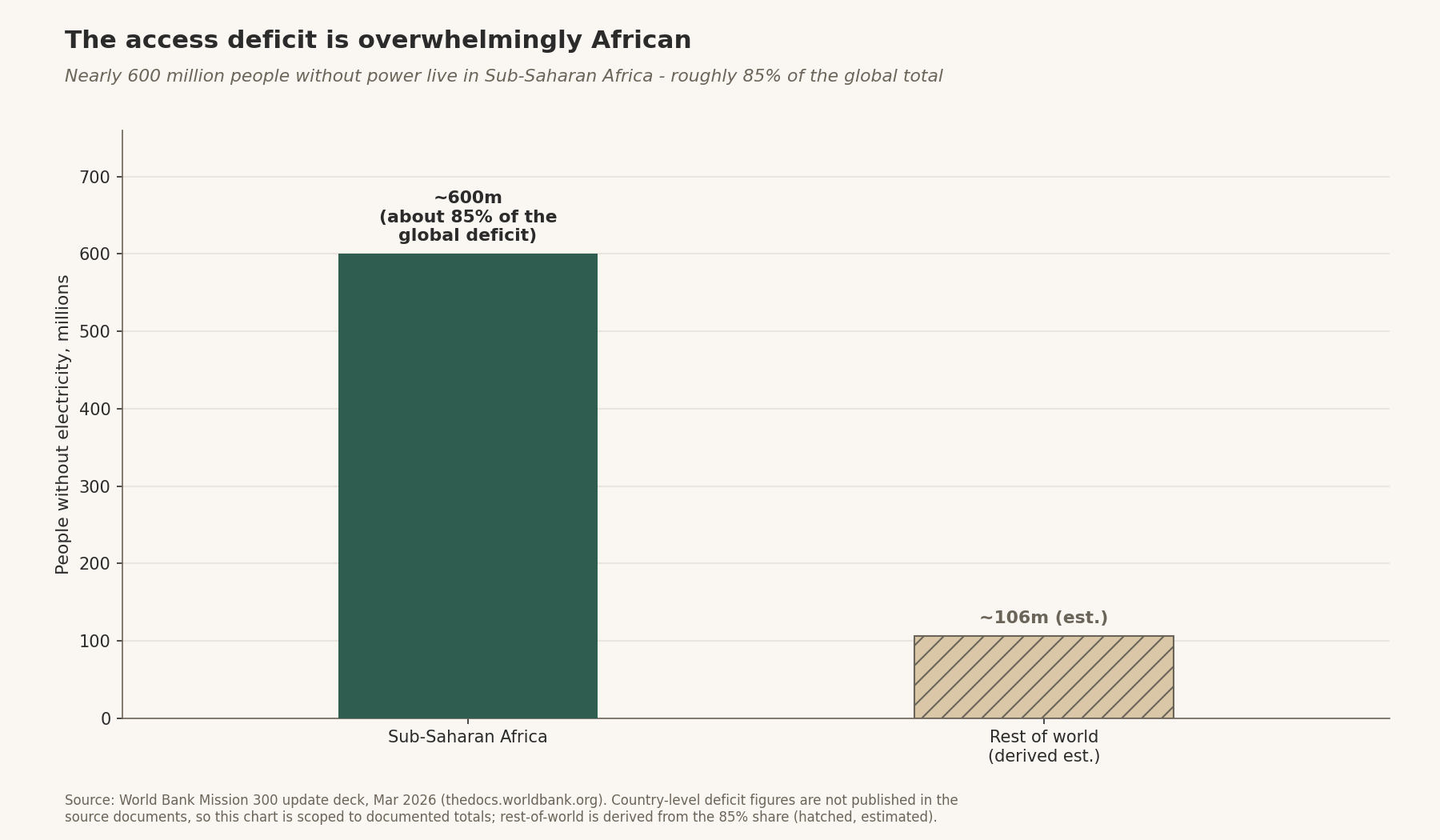
Background. Sub-Saharan Africa is home to nearly 600 million people without electricity, about 85% of the global access deficit, per the World Bank's March 2026 Mission 300 update deck, which sets out five pillars ending in financially sustainable utilities and tracks a path to 250 million connections. Mission 300 was launched in 2024 by the World Bank Group and AfDB with partners, and is organised around National Energy Compacts.
Evidence.
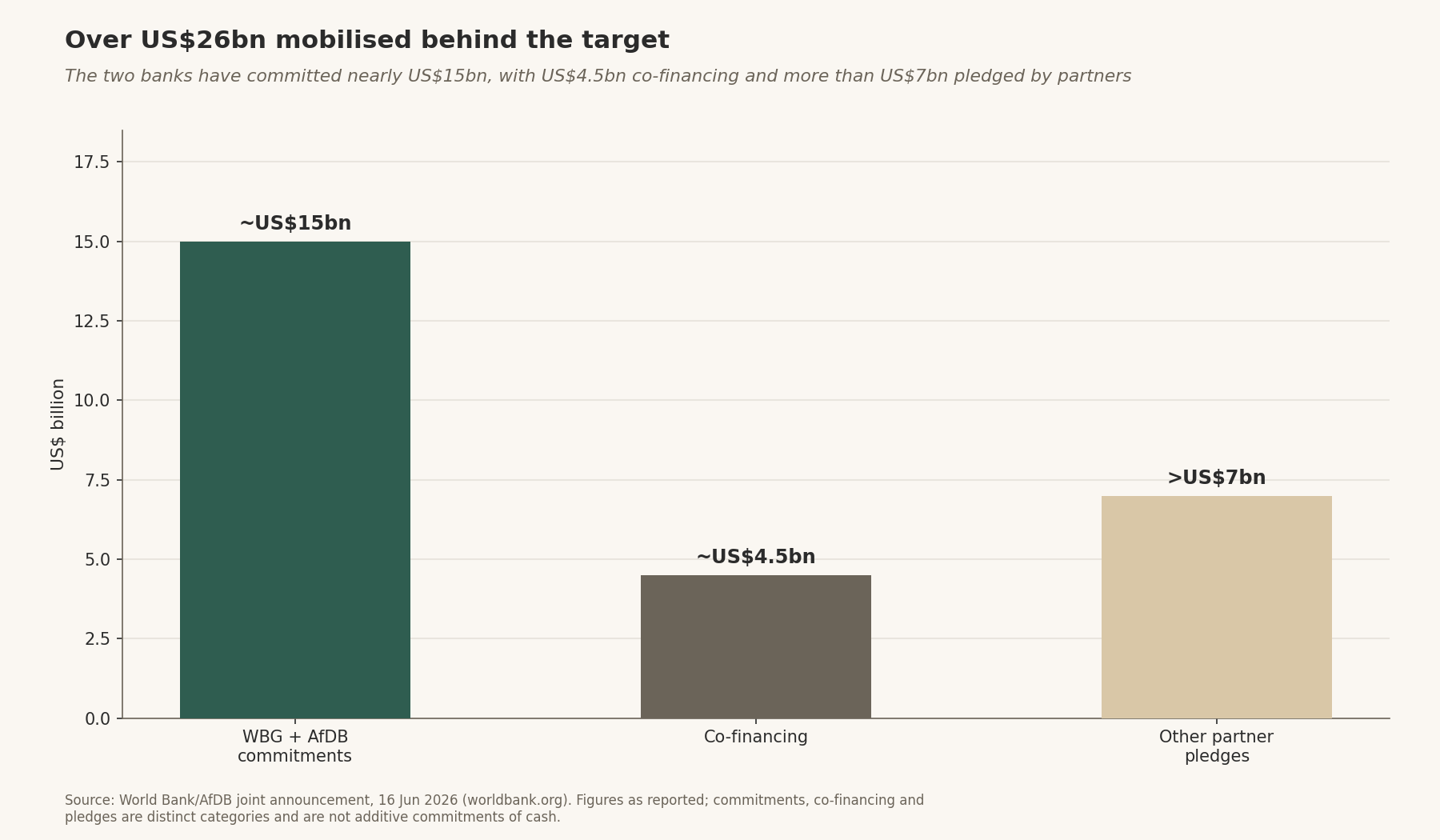
Aggregate: over 50 million people connected across 40 countries; nearly US$15 billion committed by the two banks with about US$4.5 billion in co-financing and more than US$7 billion pledged by other partners — World Bank/AfDB announcement.
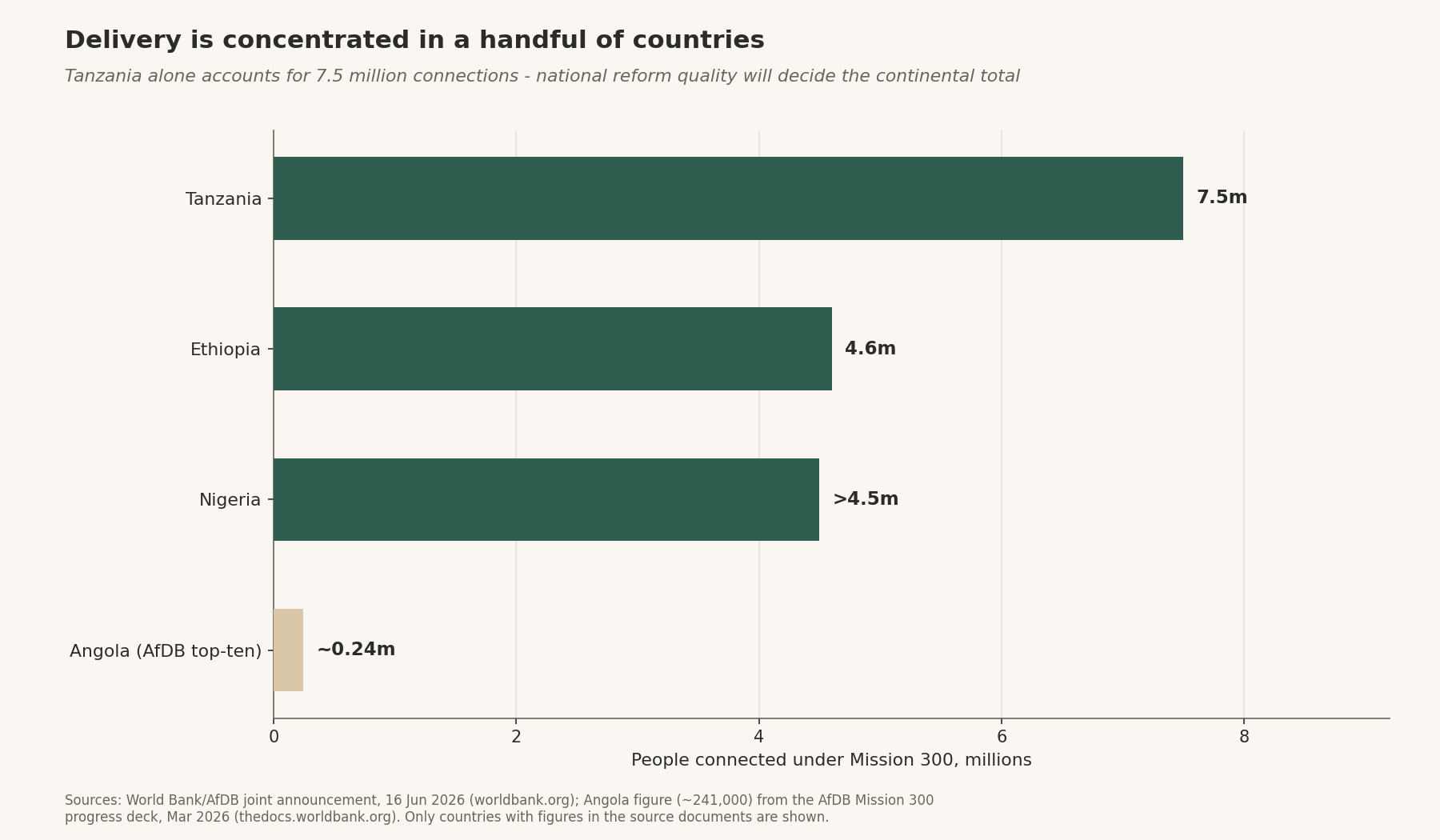
Country concentration: Tanzania 7.5 million people connected, a five-fold increase on its prior annual pace; Ethiopia 4.6 million on the back of cheaper grid connections; Nigeria more than 4.5 million through private-sector-led initiatives — same announcement.
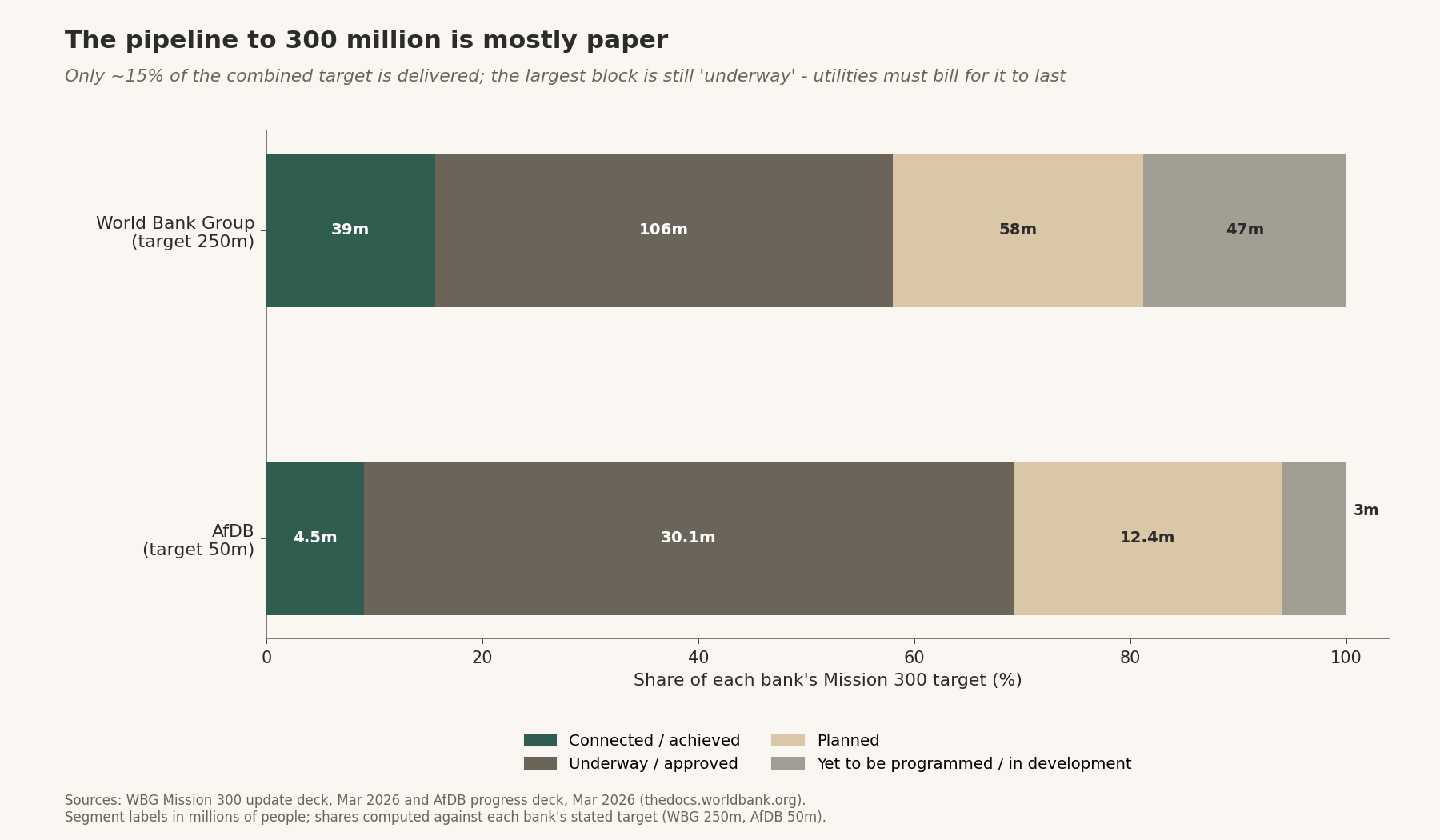
AfDB pipeline: 4.5 million achieved, 30.1 million in approved operations, 12.4 million planned and 3.0 million under development toward its 50 million target, with Angola among its top ten contributors at about 241,000 people connected — AfDB Mission 300 progress deck, March 2026.
World Bank pipeline: 39 million connected to date under WBG-financed operations, with 106 million underway, 58 million planned and 47 million yet to be programmed — WBG update deck.
Private capital: a Mission 300 Private Sector Council was launched on 31 March 2026 with the Rockefeller Foundation to mobilise private investment — World Bank press release.
Scenarios (to 2030).
Base — "reform-led acceleration". Compacts hold, tariff and connection-cost reforms continue, and totals reach the low-to-mid 200 millions. Shortfall concentrated in fragile states and remote last-mile populations.
Upside — "private capital crowds in". The council converts pledges into balance-sheet investment in distribution and mini-grids; 300 million becomes achievable with productive-use gains attached.
Downside — "connections without utilities". Fiscal stress and unreformed tariffs leave utilities unable to bill or maintain, arrears grow, and connection counts rise while reliability and collections deteriorate.
Indicators to monitor. Monthly and annual connection additions versus the 300 million glide path; number of compacts with executed tariff reform; utility collection rates and arrears; private capital committed versus pledged; off-grid versus grid share of new connections; and consumption per connection.
Risks. Utility insolvency; currency depreciation raising the local cost of dollar-financed assets; fiscal crowd-out in high debt-service countries; security constraints in fragile regions; and measurement risk if household-to-population conversion factors overstate reach.
Charts & visuals
X: Mission 300 has connected 50m+ people in 40 countries in two years — about a sixth of its 2030 target. Tanzania alone: 7.5m. The hard part is not connections. It is utilities that can bill. Our report →
LinkedIn: New Axis Report: Mission 300 at the halfway mark. Two years in, the World Bank and AfDB have connected more than 50 million people across 40 countries, at nearly double the initial pace, backed by about $15bn of their own financing plus $4.5bn co-financing. Tanzania has added 7.5 million, Ethiopia 4.6 million, Nigeria 4.5 million. Angola is among the AfDB's top ten contributors. The 2030 target now depends on the programme's fifth pillar: financially sustainable utilities. Three scenarios, with the indicators that will show which one is happening.
Author
Sign up for New Axis Media newsletters.
Stay up to date with curated collection of our top stories.