The Plumbing of Sovereignty: PAPSS and the Quiet De-Dollarisation of Intra-African Trade
A Lagos trader paying a supplier in Accra still sends the money through New York. Africa's central banks have built a system to end that absurdity — 28 countries and counting — but the gap between membership and usage is where the honest story lives.

The 9,000-mile round trip, shortened
For decades, a Nigerian importer paying a Ghanaian supplier sent the money on a 9,000-mile round trip: naira into US dollars, dollars through a correspondent bank in New York or London, dollars back into cedis. The goods moved 300 miles along the coast. The money crossed the Atlantic twice, paying tolls in both directions. The Pan-African Payment and Settlement System — PAPSS — exists to delete that journey. Built by Afreximbank with the African Union Commission and the AfCFTA Secretariat, it was commercially launched in Accra on 13 January 2022, connecting national real-time gross-settlement systems so that intra-African trade can be paid in local currencies, with net positions settled at the end of each day, per MonieRate's explainer.
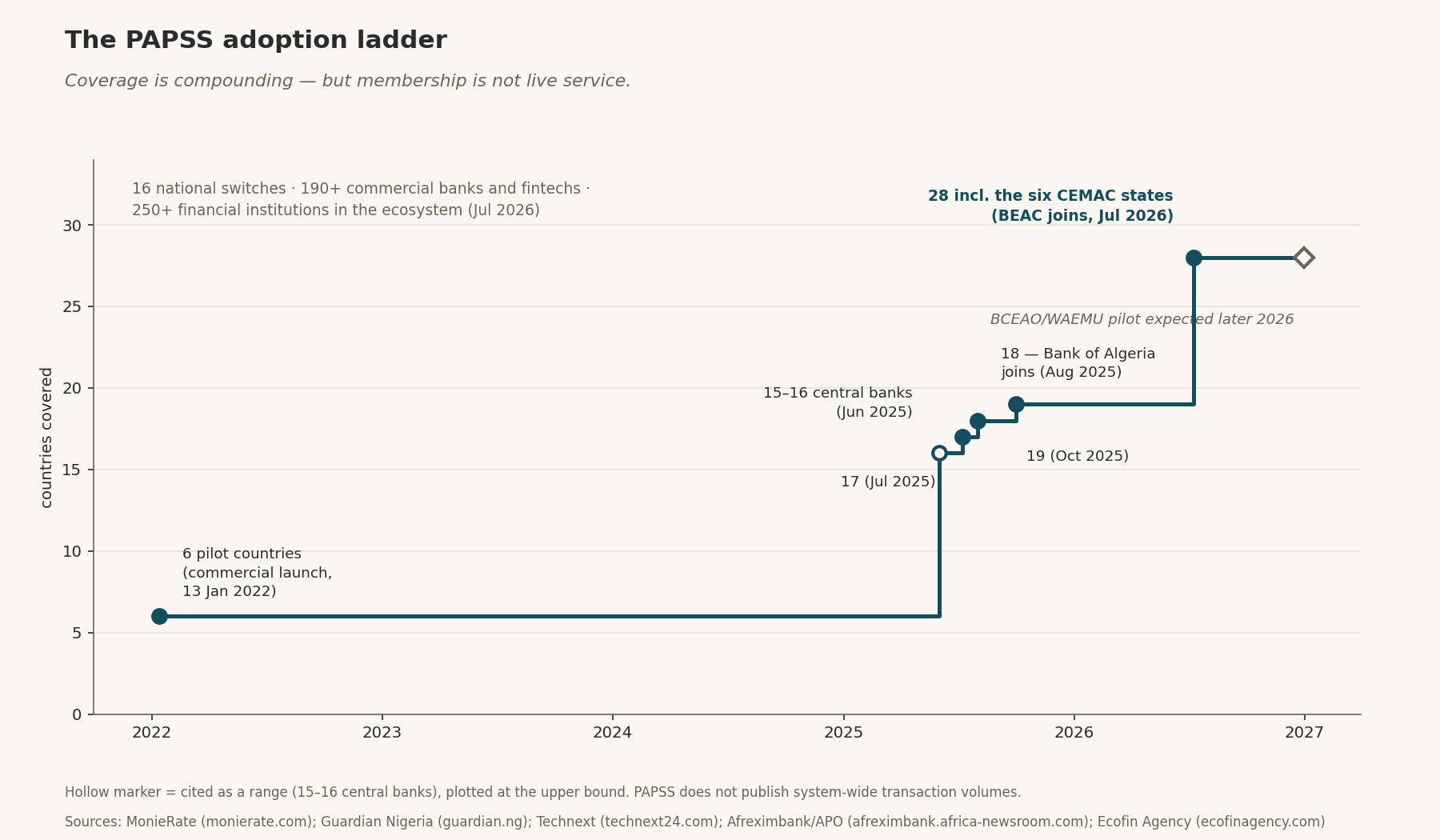
The membership ladder has climbed fast. From a pilot in the six West African Monetary Zone countries, PAPSS counted 15–16 central banks by June 2025, 17 countries by July, 18 after the Bank of Algeria joined in August — with Tunisia, Egypt and Morocco already inside — and a reported 19 by October, per The Guardian Nigeria, Technext and Afreximbank. In July 2026 came the biggest step: the Bank of Central African States joined, extending coverage to a cited 28 countries including the six CEMAC states, with 16 national switches, more than 190 commercial banks and fintechs, and 250-plus financial institutions in the ecosystem, per Ecofin Agency. The West African BCEAO — the WAEMU central bank — is expected to pilot later this year. Nigeria shows what commitment looks like in practice. A Central Bank circular of April 2025 stripped documentation down to basic KYC for monthly transactions under US$2,000 for individuals and US$5,000 for companies, and lets banks source foreign exchange through the official market; 22 Nigerian commercial banks are live on the system, per Nairametrics. But a caution runs through the whole ladder: membership is not usage. PAPSS does not publish system-wide transaction volumes, and independent payments-industry analysis — FXC
Intelligence, in early 2025 — suggests live service availability lags the headline country counts. CEMAC integration was still under way when the BEAC announcement landed. A central bank signing up is a door installed, not traffic through it.
The US$5 billion question
The headline claim is that PAPSS will save Africa more than US$5 billion a year in payment transaction costs, per African Business. Read it carefully: it is an Afreximbank/PAPSS projection, not a measured outcome, and no audited basis has been published. The system's own chief executive, Mike Ogbalu III, claims transaction costs have fallen "by up to 27 per cent" for end users and that banks have seen "transaction volume surges of over 1,000 per cent" through digital integration — figures issued in an Afreximbank press release, and best treated as the builder's testimony. None of this makes the savings imaginary — correspondent banking genuinely costs African traders dear. It makes them unverified, which is a different and fixable problem. Afreximbank's chief economist, Yemi Kale, says adoption has cut dollar reliance for intra-African transactions, "cutting transaction costs by as much as 50 per cent", per The Guardian Nigeria.
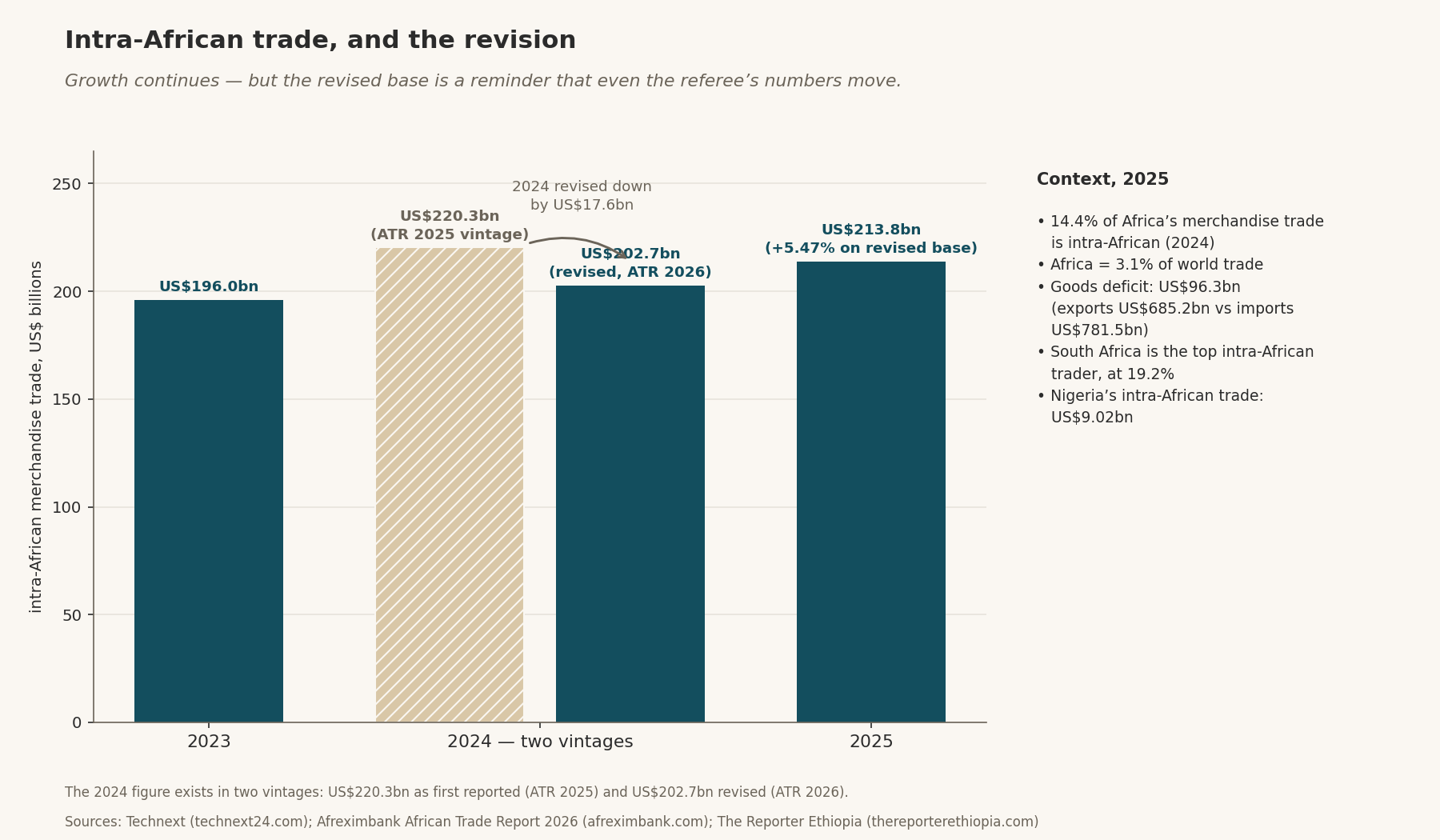
The market at stake is real but specific. Intra-African trade reached US$213.8 billion in 2025, up 5.47 per cent — on a revised 2024 base of US$202.7 billion, where Afreximbank's previous report had said US$220.3 billion; the revision matters more than the growth rate — according to the bank's 2026 African Trade Report. That is 14.4 per cent of the continent's merchandise trade, in an Africa that accounts for 3.1 per cent of world trade, exported US$685.2 billion of goods against US$781.5 billion of imports last year, runs a US$96.3 billion goods deficit, and counts South Africa as its top intra-African trader at 19.2 per cent — Nigeria's own intra-African trade was just US$9.02 billion — per The Reporter Ethiopia. The trade-finance gap the system also targets is put at roughly US$74 billion for 2025 — or US$100–120 billion in Kale's earlier framing; methodologies differ. One widely cited study sizes Africa's cross-border payments market at US$329 billion in 2025, heading for US$1 trillion by 2035. The dollar's grip here is partly habit with a balance sheet behind it: traders invoice in dollars because hedging naira-cedi risk is expensive, and hedging is expensive because volumes are thin — a circle that only sustained corridor traffic can break. What would count as proof that the savings are arriving? Published corridor volumes, audited fee data, and traders who stop asking for dollars without being told to. Until those data exist, the honest position is suspended judgement with a stopwatch running.
The convertibility trap
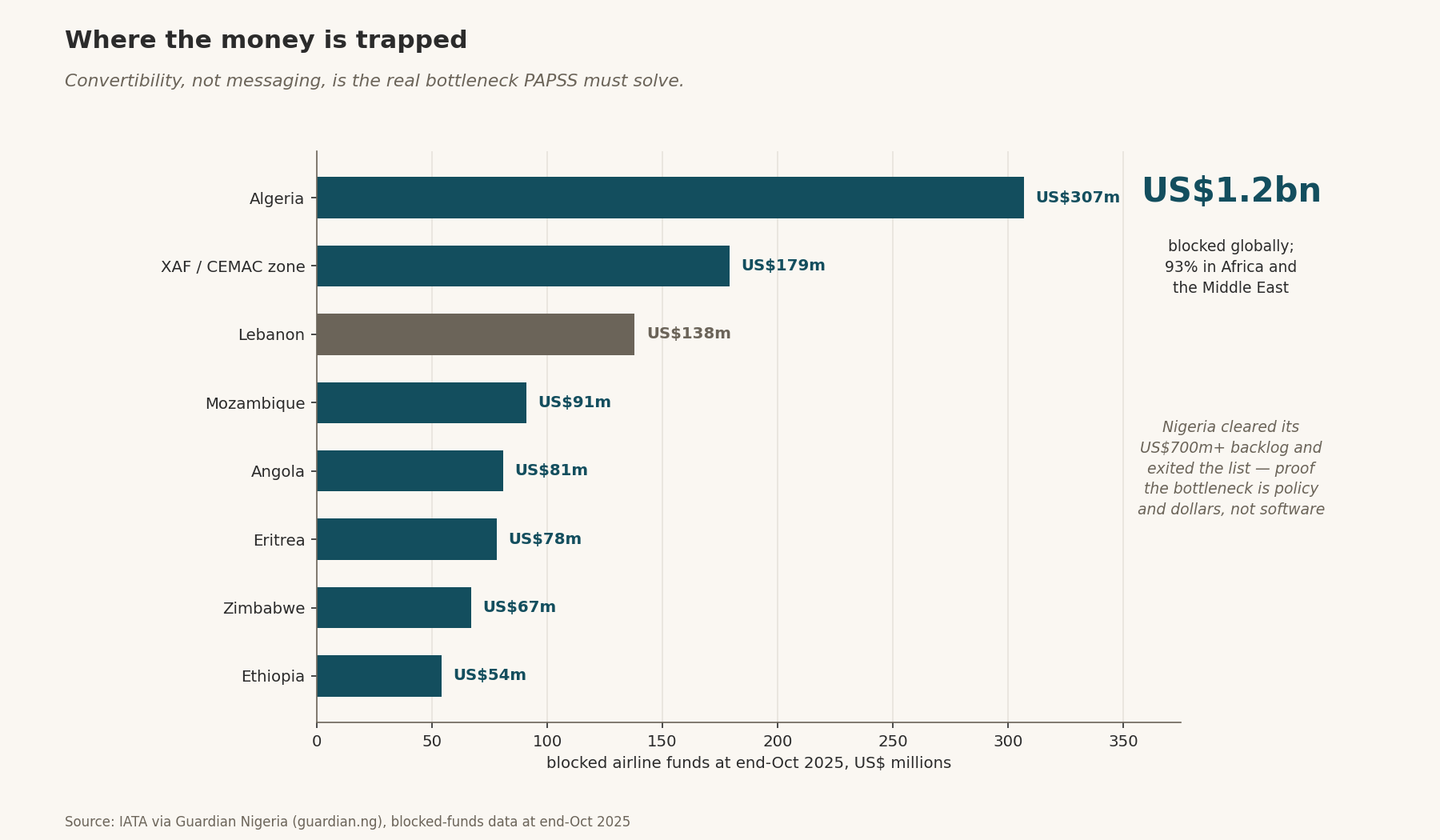
Here is the structural problem the cheerleading skips: PAPSS can settle a payment, but it cannot manufacture hard currency. If a CEMAC importer pays in CFA francs and the Zambian exporter wants kwacha she can actually use, someone must hold the other side of that trade — and Africa's currency markets are thin. Central banks guarding scarce dollars ration them, and the evidence is on file at the International Air Transport Association: US$1.2 billion of airline revenues were blocked globally at the end of October 2025, 93 per cent of it in Africa and the Middle East — Algeria holding US$307 million, the XAF zone US$179 million, Lebanon US$138 million, Mozambique US$91 million, Angola US$81 million, Eritrea US$78 million, Zimbabwe US$67 million, Ethiopia US$54 million, per IATA via The Guardian Nigeria. Nigeria, notably, cleared its backlog of more than US$700 million and left the list — proof that the bottleneck is policy and dollars, not software. Until a supplier paid in local currency can be sure of converting or spending it, the rational exporter keeps invoicing in dollars; blocked funds are simply the visible tip of that rationing.
The system's answer is to build the missing market. The PAPSS African Currency Marketplace, launched with Interstellar in June 2025, is designed to make African currencies convertible against each other and to drain what promoters call the multi-billion-dollar bottleneck of trapped funds, per Technext. PAPSSCARD, the first pan-African card scheme, followed in June 2025 as a joint venture of Afreximbank, PAPSS and Mercury Payment Services, with early partners from the Bank of Kigali to Nigeria's Unified Payments, per Daba Finance and Ecofin. The test for both is the same: whether they trade, not whether they exist. A card scheme succeeds at the point of sale; a currency marketplace succeeds only when someone is willing to make a market in kwacha-naira on a quiet Tuesday.
History supplies the humility. The CFA franc — 14 countries, two unions, pegged to the euro under a French Treasury guarantee since 1945 — survived a December 2019 reform that promised to end the 50 per cent reserve deposit in Paris, remove French representatives from BCEAO bodies and rename the WAEMU currency the "eco"; the peg and the guarantee stayed, and implementation has stalled, with 2027 now cited as the horizon, per the Harvard International Review. The WAMZ's own eco never launched at all. Both projects assumed politics would follow economics; the politics had other ideas. PAPSS is the third generation of African monetary-sovereignty projects, with two advantages its predecessors lacked: it is software rather than a new currency, and it rides an AfCFTA that needs it to work. Those are tailwinds, not guarantees.
The sanctions-era hedge
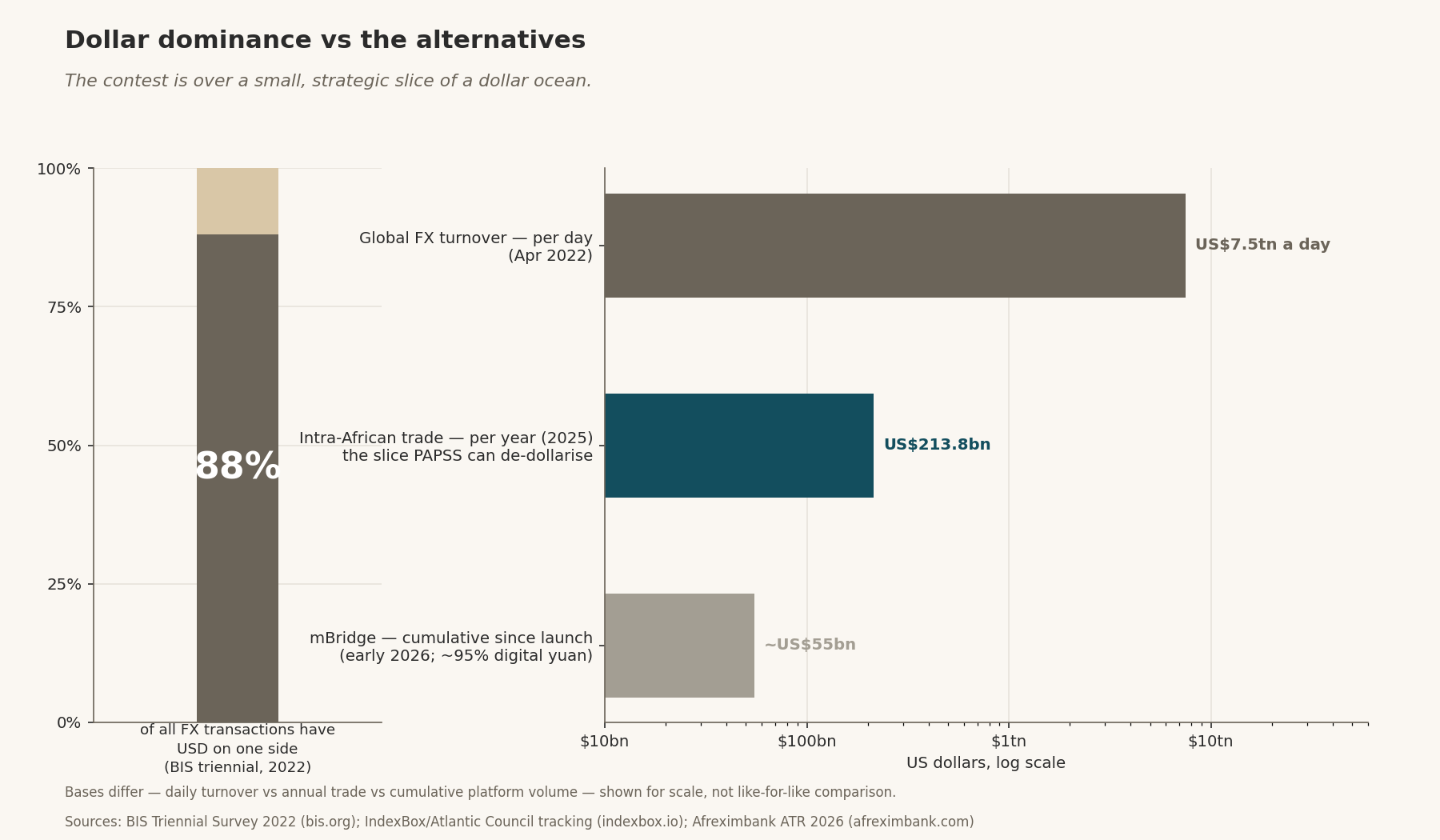
Zoom out, and PAPSS is one rail in a global relay. The US dollar sits on one side of 88 per cent of all foreign-exchange transactions, in a market turning over US$7.5 trillion a day, per the BIS triennial survey; roughly half of global cross-border lending is dollar-denominated, and more than three-quarters of world trade outside the EU is invoiced in dollars, as Federal Reserve governor Christopher Waller has noted, per BIS/Fed data summarised by Canterbury Consulting. Against that, the alternatives are advancing: mBridge, the multi-central-bank digital-currency platform of China, Hong Kong, Thailand, the UAE and Saudi Arabia, reportedly passed US$55 billion in cumulative cross-border transactions by early 2026 — about 95 per cent of it in digital yuan, and growing after the BIS's late-2024 exit, per trade-press aggregation of Atlantic Council tracking by IndexBox. Russia and China now settle more than 95 per cent of their US$237 billion bilateral trade in yuan and roubles, according to Russian officials via CGTN. Egypt and Ethiopia joined BRICS in January 2024, giving Africa three seats in the bloc most vocal about local-currency trade; Nigeria and China renewed a roughly US$2 billion currency swap in December 2024, with Chinese traders reportedly beginning to accept naira, per Business Insider Africa — a single-source report, to be held lightly.
Afreximbank's own 2026 trade report frames continental payment infrastructure as insulation from external financial disruption, sanctions included. Read strategically, PAPSS is optionality: African central banks building a rail they control, in a world where access to dollar plumbing has become a lever of foreign policy. The structural limit is equally clear. Oil, cocoa and copper are invoiced in dollars; the hard currency Africa earns comes from outside Africa. De-dollarising the 14 per cent of trade that is intra-African changes the wiring of the house, not the power source — and that distinction should discipline every headline about the dollar's decline.
New Axis read
Treat the US$5 billion as a hypothesis with a deadline. The three tests to watch are concrete: whether the BCEAO pilot goes live on schedule and brings WAEMU's eight economies real traffic; whether the currency marketplace posts genuine volumes rather than launch-day press; and whether PAPSS begins publishing audited system data — the single step that would convert advocacy into evidence. If, by 2030, these rails carry even a fifth of the continent's US$213.8 billion in intra-African trade in local currencies, the correspondent-banking map of Africa is redrawn and the dollar loses a toll booth, not a throne. If the membership ladder keeps climbing while the volumes stay secret, PAPSS will join the eco on the shelf of elegant African architecture that never got tenants. The plumbing of sovereignty is being laid; the water pressure is the story to watch.
Charts & visuals
X: African trade still pays its tolls in dollars — routed through New York. PAPSS has signed up 28 countries to change that, with a projected US$5bn a year at stake. The catch? It won't publish the volumes.
LinkedIn: Africa's central banks are quietly building an exit from the dollar's toll booth: PAPSS now covers 28 countries after the BEAC joined in July 2026, promising to settle intra-African trade — US$213.8bn last year — in local currencies. The projected savings exceed US$5bn a year, but the system publishes no transaction volumes, blocked airline funds still total US$1.2bn, and membership is not the same as usage. Our analysis examines the plumbing of sovereignty: what's real, what's projection, and the three tests that will decide it.
Author
Sign up for New Axis Media newsletters.
Stay up to date with curated collection of our top stories.