Angola's diamond paradox: record carats, falling value
Endiama hit its production targets and missed its revenue targets. The gap between carats and dollars is the real story of Angola's diversification bet.
Why it matters. Diamonds are the most advanced part of Angola's non-oil export story. If volume growth cannot deliver revenue growth, the diversification arithmetic changes.
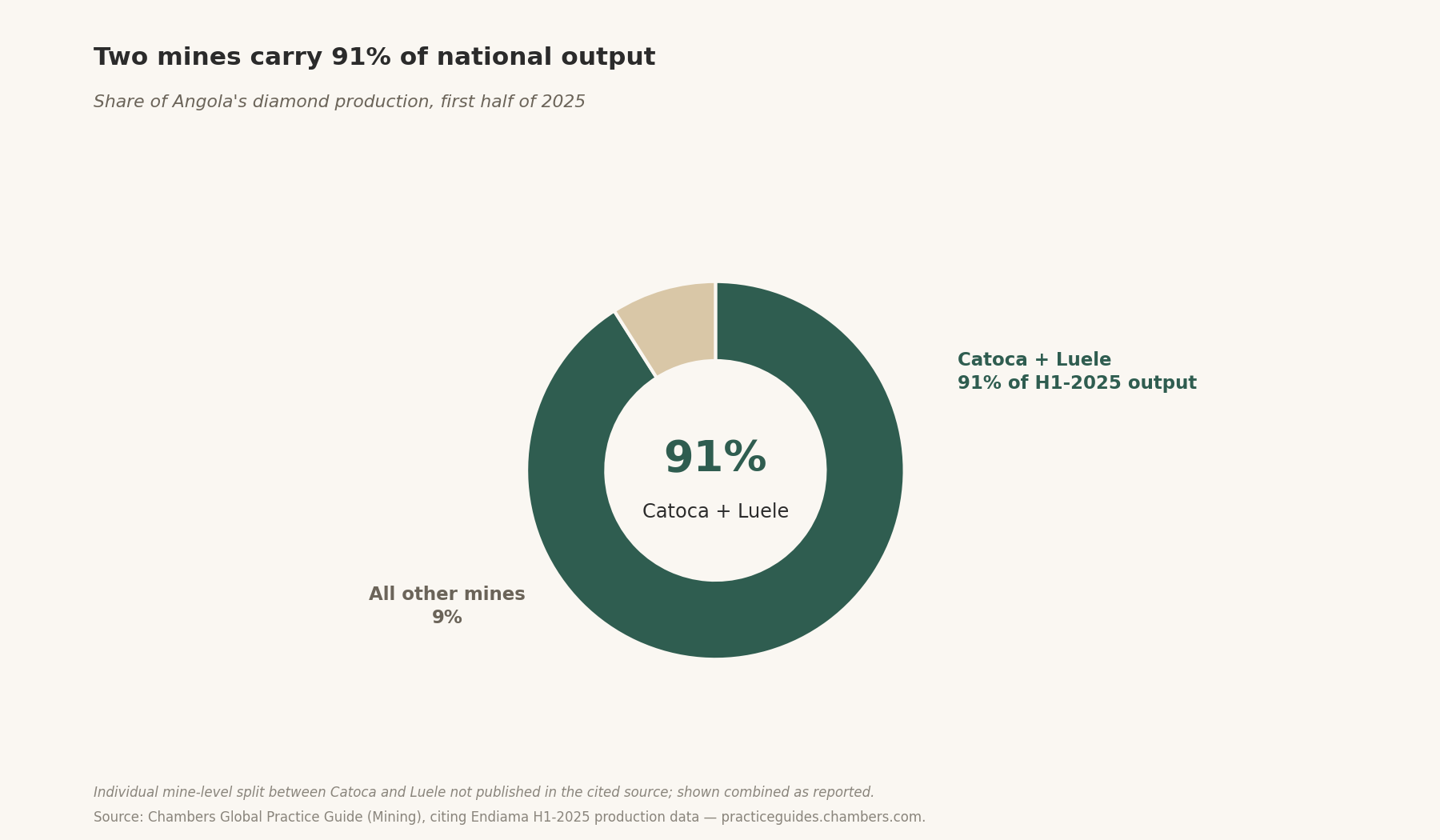
The facts. Endiama's own investor material reports production rising from 9.77 million carats in 2023 to 15.17 million carats in 2025, with 17.17 million carats sold and US$1.8 billion of revenue in 2025, per the state company's investment roadshow deck published on a government portal. That revenue undershot the company's own guidance: Endiama's chairman had told a Luanda press conference it expected 14.8 million carats and a US$2.1 billion turnover in 2025, reported by Club of Mozambique. Price is the reason. Between January and September 2025 Angola exported 8.18 million carats for US$790.43 million — an average of US$96.7 per carat, according to the Chambers Global Practice Guide on Mining, which also records that Catoca and Luele together supplied 91% of national output in the first half of 2025 and that roughly US$216 million was invested in the sector over nine months. On the exploration side, De Beers and Endiama announced a new kimberlite field discovery after intersecting kimberlite in July 2025 — the first new field De Beers has found in more than three decades.
Context. Angola's plan has two legs: volume from Luele's ramp-up, and value capture from domestic cutting and polishing capacity. The volume leg is delivering. The value leg depends on a global rough-diamond price environment that has been weak, and on downstream capacity that is still being built.
Between the lines. A production-target culture rewards carats, because carats are countable and announceable. Revenue is the harder metric and the one that funds the budget. The Luele-plus-Catoca concentration also means Angola's diamond revenue now carries single-asset risk: an operational problem at two mines is a national export problem.
What to watch. Whether realised price per carat recovers above the roughly US$97 average; whether the De Beers–Endiama joint venture converts kimberlite intersection into a defined resource; progress and utilisation of domestic cutting capacity; and whether Endiama's next guidance is set on revenue rather than carats.
Method and sources. Endiama's own roadshow figures, Kimberley Process-derived export values compiled in the Chambers mining guide, company statements from De Beers, and Lusa-sourced reporting via Club of Mozambique.
Related reading: Angola country brief: the arithmetic of one million barrels; Power Map: who decides Angola's money.
Charts & visuals
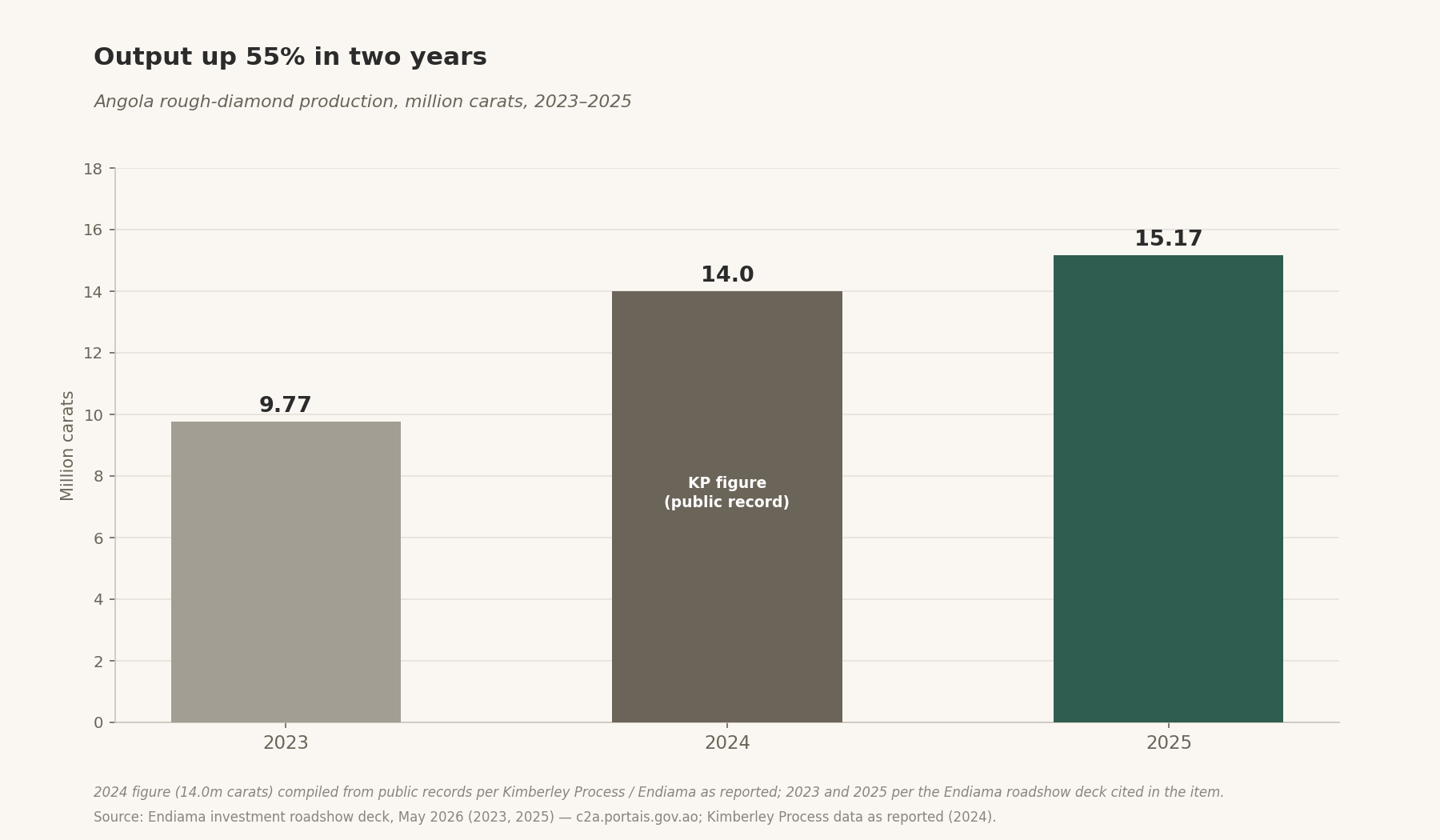
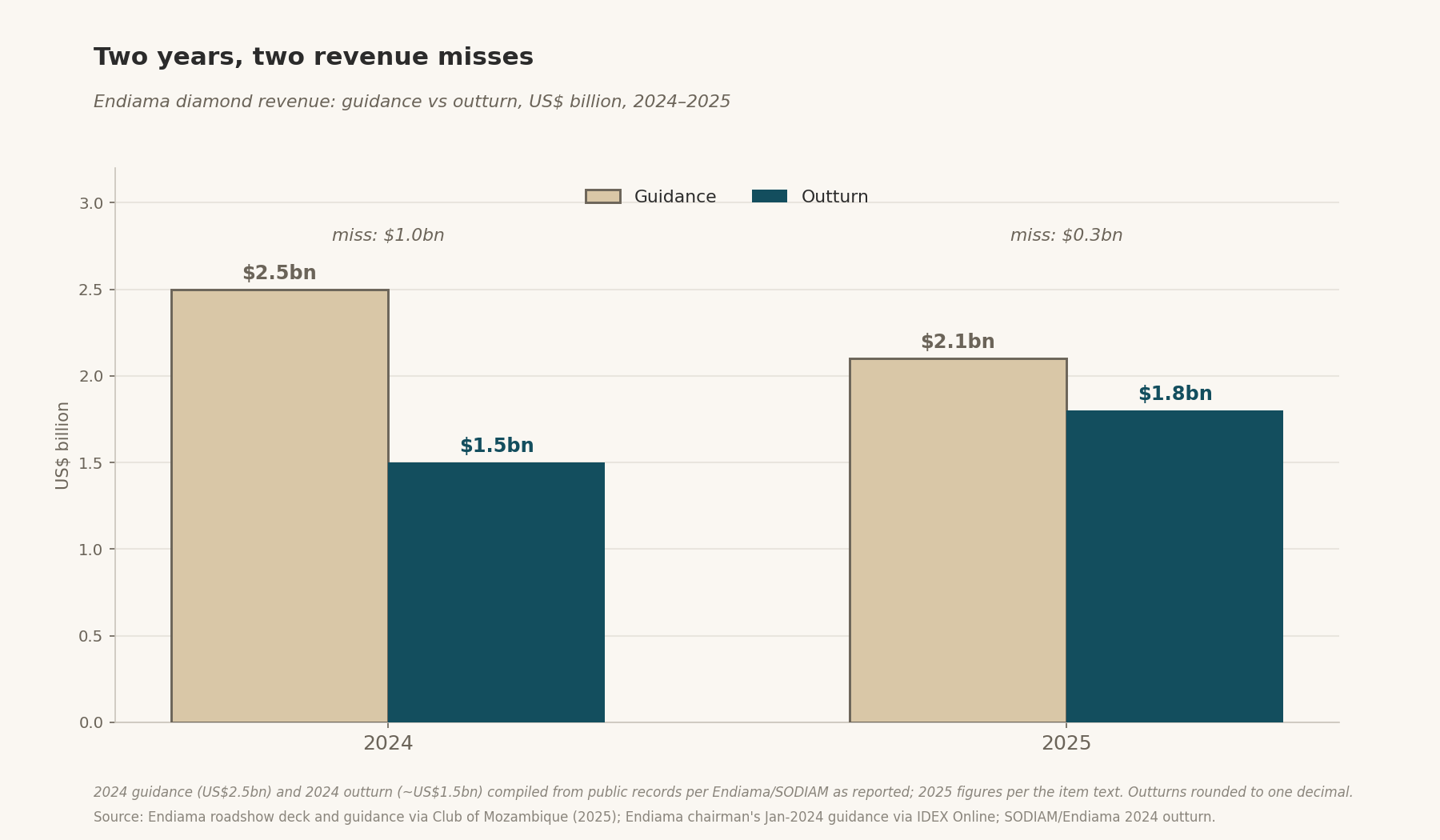
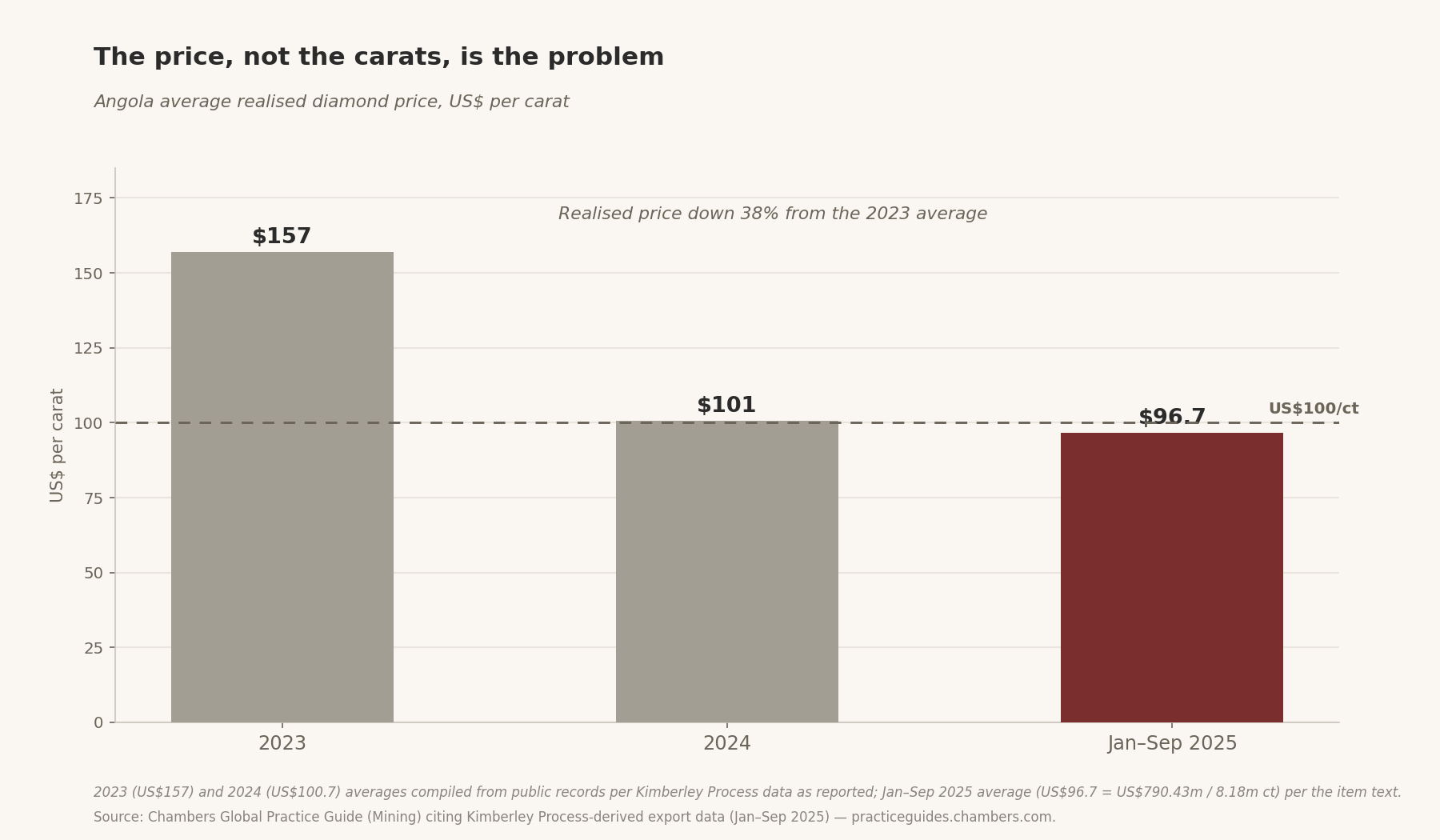
X: Angola produced 15.17m carats in 2025 — a record. Revenue came in at $1.8bn against $2.1bn guided. Average realised price Jan–Sep: $96.7 a carat. Volume is not the constraint. Price is →
LinkedIn: Angola's diamond sector delivered its production target in 2025 and missed its revenue target. Output reached 15.17 million carats; revenue landed at $1.8bn against $2.1bn guided, with an average realised price of about $97 per carat across the first nine months. Two mines supplied 91% of output. That is a concentration risk and a pricing problem at once — and it is the clearest test yet of whether mining can carry Angola's diversification story.
Author
Sign up for New Axis Media newsletters.
Stay up to date with curated collection of our top stories.