Africa's US$96 Billion Lifeline: Remittances Are the Last Stable Flow — and Everyone Wants a Cut
In 2024 Africans abroad sent home about US$96.4 billion — roughly three times what bilateral aid now delivers. A flow that shrugged off COVID-19 faces a different order of threat: exchange-rate mismanagement at home, immigration politics abroad, a new 1 per cent tax in the world's largest sending…
The quiet inversion
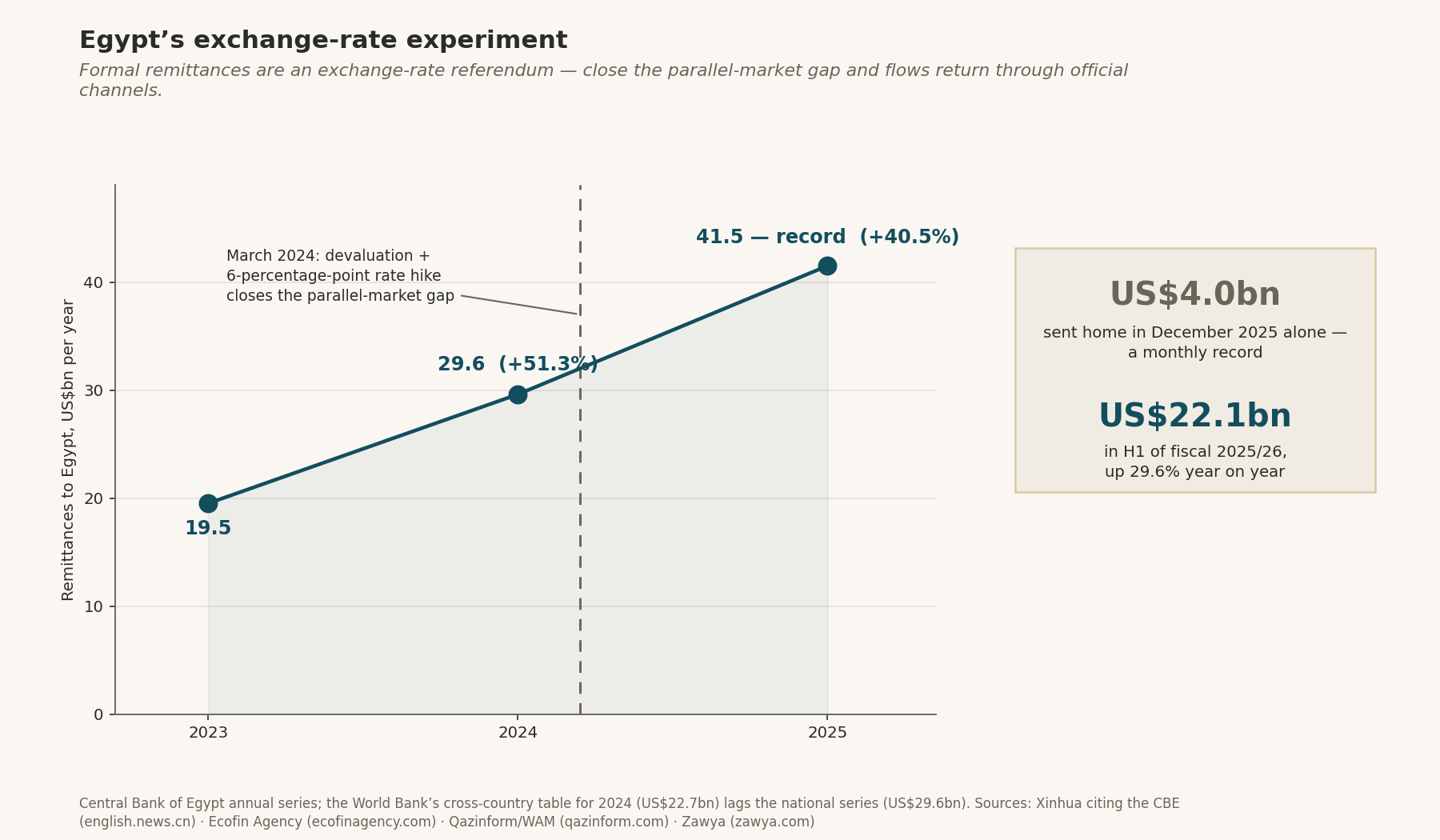
In December 2025, Egyptians working abroad sent home US$4.0 billion in a single month — a record, and the capstone of a year in which remittances to Egypt reached US$41.5 billion, up 40.5 per cent on 2024, per central bank data reported by Xinhua and Ecofin Agency. Three years earlier, the same flow had been collapsing. The diaspora had not changed. The exchange rate had.
The Egyptian surge sits atop a structural shift in how the developing world is financed. Remittances to low- and middle-income countries reached an estimated US$685 billion in 2024 — larger than foreign direct investment and official development assistance combined — per the World Bank's migration team. India led with roughly US$129 billion, followed by Mexico, China, the Philippines and Pakistan; the United States is the largest source country globally, then Saudi Arabia and Switzerland.
Africa received about US$96.4 billion in 2024 on World Bank estimates, with Egypt (US$22.7 billion) and Nigeria (US$19.8 billion) together accounting for roughly half, per Intelpoint's rendering of the Bank's data. Two accounting warnings apply throughout this article. The World Bank's cross-country tables lag national series — Egypt's own central bank counted US$29.6 billion for 2024 — and the continental figure must never be blended with the separate sub-Saharan series: US$53 billion in 2022, US$54 billion in 2023 and a forecast US$55 billion for 2024, a flow that "significantly exceeded" FDI to the region in 2023 and has been far less volatile than investment over two decades, per KNOMAD's Migration and Development Brief 39.
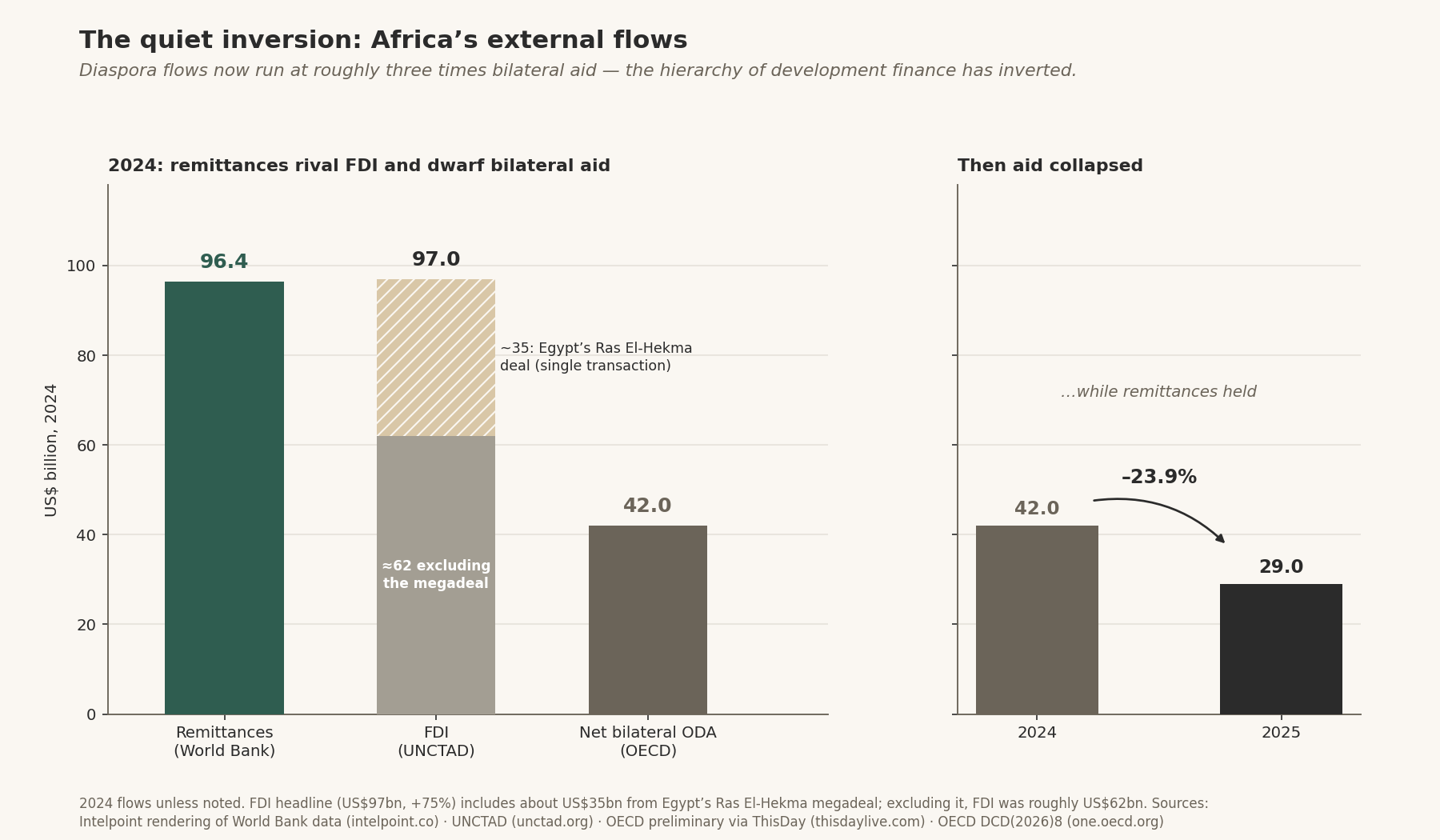
The inversion is easiest to see against the rivals. FDI to Africa hit a record US$97 billion in 2024 — up 75 per cent — but about US$35 billion of that was a single transaction, Egypt's Ras El-Hekma megadeal; excluding it, FDI was roughly US$62 billion, per UNCTAD. Net bilateral aid from DAC donors to Africa was US$42 billion in 2024, then crashed 23.9 per cent to US$29.0 billion in 2025, per the OECD's preliminary figures and OECD DCD(2026)8. Diaspora money is now roughly three times bilateral aid. The hierarchy of development finance has quietly inverted, and official rhetoric has not caught up.
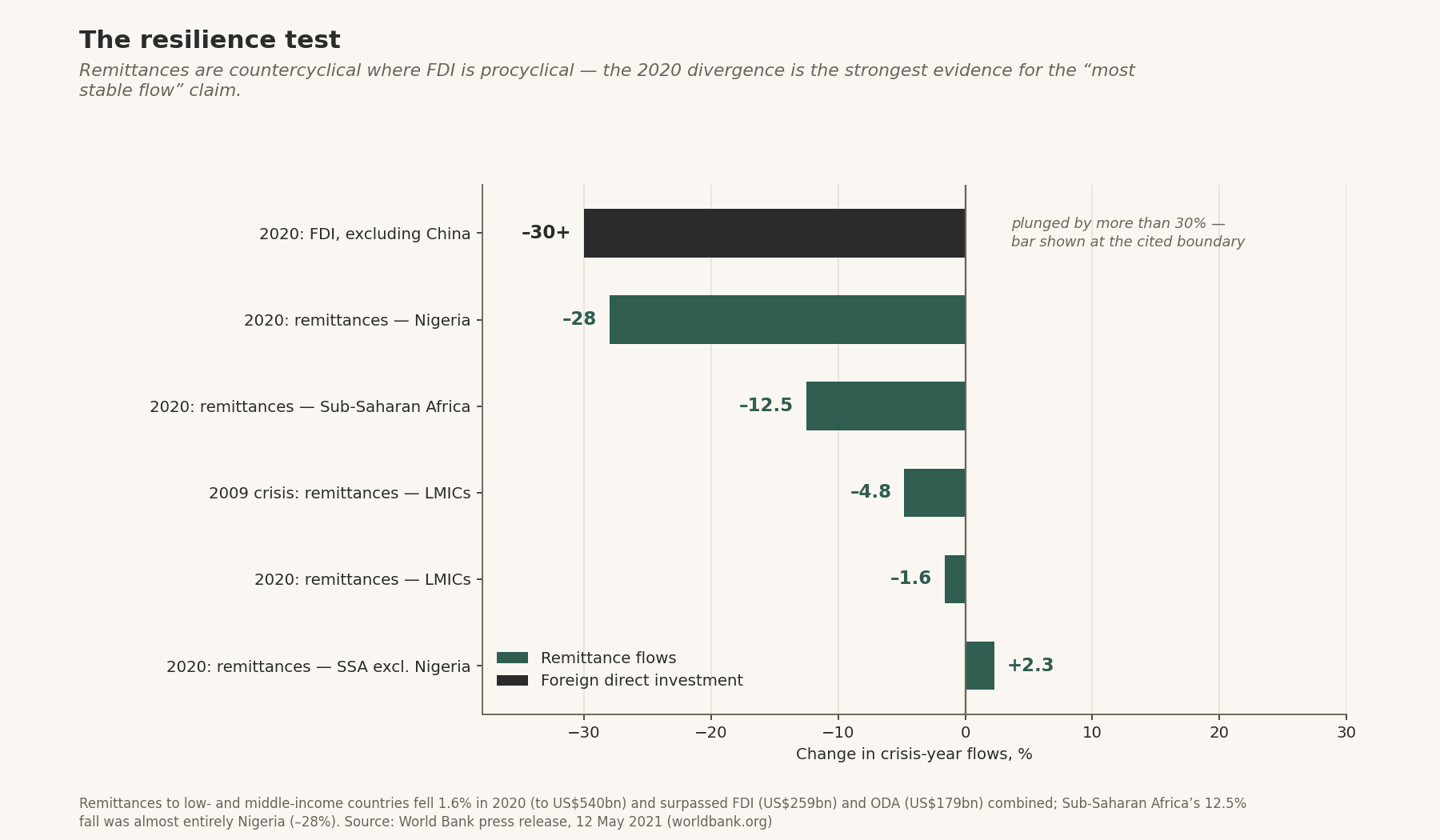
The resilience is documented, not asserted. In the COVID year of 2020, remittances to low- and middle-income countries fell just 1.6 per cent, to US$540 billion, while FDI excluding China plunged by more than 30 per cent; remittances surpassed FDI (US$259 billion) and ODA (US$179 billion) combined, per the World Bank. Sub-Saharan Africa's 12.5 per cent fall was almost entirely a Nigeria story — down 28 per cent as oil and the naira cracked; excluding Nigeria, regional inflows actually rose 2.3 per cent. In the 2009 crisis, the decline was 4.8 per cent. Families, it turns out, are countercyclical lenders of last resort.
The most honest poll of an exchange rate
Egypt's collapse and rebound is the cleanest natural experiment in development finance. In 2022–23 an overvalued peg pushed senders toward the parallel market, where the gap exceeded 70 Egyptian pounds to the dollar, and formal inflows shrivelled. In March 2024 the central bank devalued and raised rates by six percentage points, closing the gap; formal flows roared back — US$19.5 billion in 2023 became US$29.6 billion in 2024 (up 51.3 per cent) and a record US$41.5 billion in 2025, with the first half of fiscal 2025/26 alone at US$22.1 billion, up 29.6 per cent, per Qazinform/WAM, citing the central bank, Xinhua and Zawya. Remittances now rank with Suez receipts, tourism and exports as Egypt's largest and most stable source of foreign exchange. The lesson generalises: remittances are the most honest poll of an exchange-rate regime. When official rates lie, flows go informal; fix the rate and they flood back through the front door. Nigeria offers the plateau version. The Central Bank of Nigeria's data show inflows of US$19.27 billion in 2023 rising to US$21.81 billion in 2024 and holding exactly there in 2025 — flat amid global pressure, though the quarterly run-rate improved from US$5.12 billion in the first quarter of 2025 to US$5.72 billion in the fourth, per Vanguard's analysis of the CBN's Quarterly Statistical Bulletin. The World Bank's series reads lower — US$19.5 billion in 2023, about 35 per cent of sub-Saharan inflows, and US$19.8 billion in 2024 — a reminder that methodology, not just money, differs between sources; informal flows are believed large on any measure. Elsewhere the picture is granular. Morocco received more than 117 billion dirhams — about US$11.4 billion — in 2024, per Daba Finance and AllAfrica. Ghana's central bank recorded US$6.6 billion in 2024, up 43 per cent and the highest since 2014 — roughly four times the country's FDI — per Tech Labari; the World Bank's own series for Ghana runs far lower, because the Bank of Ghana counts inflows through banks including some investment transfers, so the two belong side by side, never merged. Kenya hit a record US$4.94 billion in 2024, up 18 per cent, with the United States supplying 51 per cent of inflows, per The Star — and then, in 2025, growth slowed to 1.9 per cent, the softest since 2009, per Business Daily.
The 8.46 per cent problem
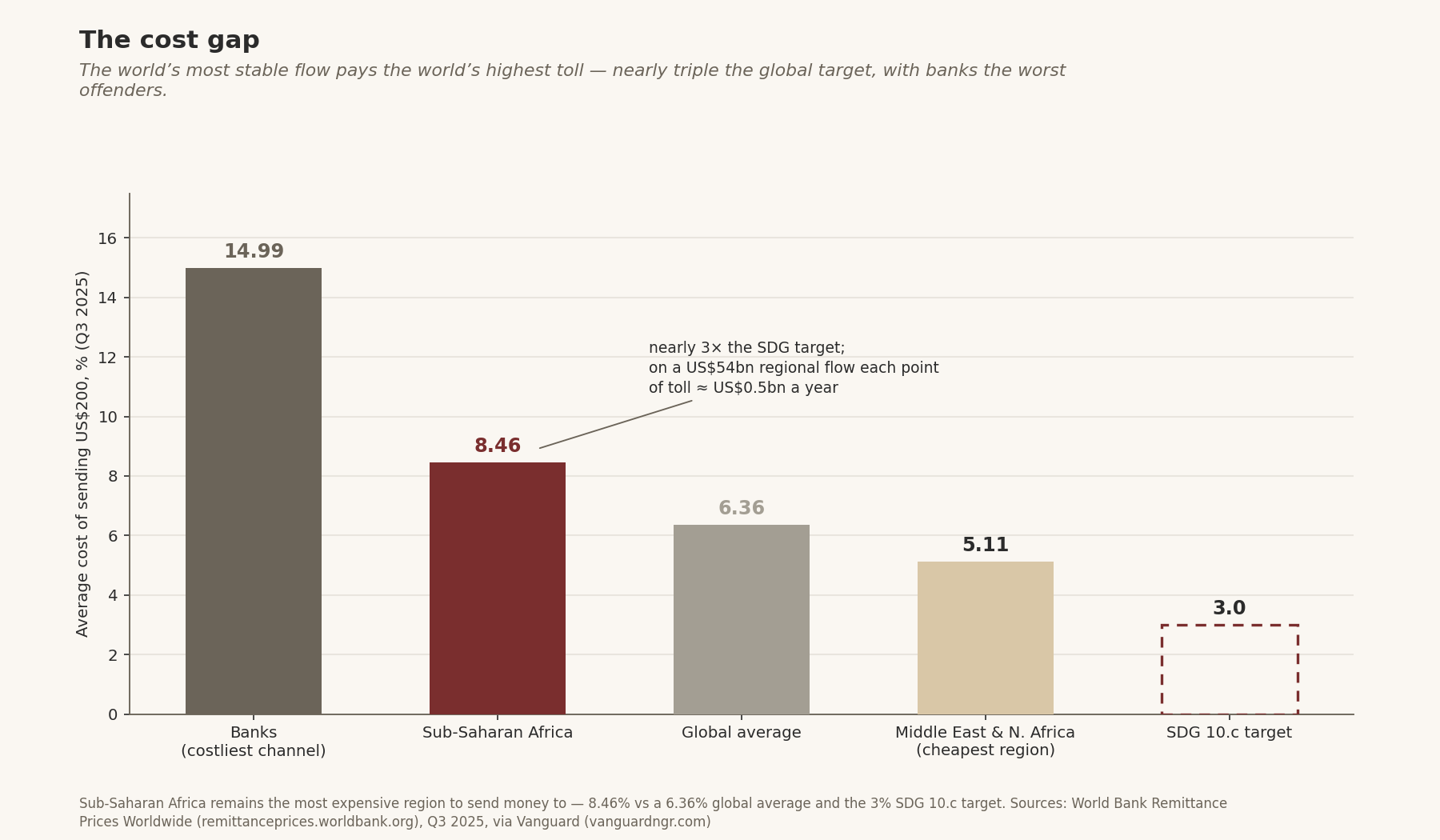
Sending US$200 to sub-Saharan Africa cost 8.46 per cent on average in the third quarter of 2025, against a global average of 6.36 per cent; banks are the costliest channel at 14.99 per cent, while the cheapest region to serve, the Middle East and North Africa, pays 5.11 per cent, per the World Bank's Remittance Prices Worldwide database via Vanguard. Sub-Saharan Africa remains the most expensive region on earth to send money to — nearly three times the 3 per cent target the world set itself under Sustainable Development Goal 10.c. On a US$54 billion regional flow, every percentage point of toll is roughly half a billion dollars a year diverted from recipients to intermediaries.
Part of the toll is plumbing. A 2015 World Bank fact-finding exercise found that 28 per cent of money-transfer-operator principals and 45 per cent of agents had lost banking access, with MTOs and Somalia singled out; correspondent banking relationships fell by about 20 per cent globally between 2011 and 2018, raising costs and pushing flows informal, per the Bank's de-risking surveys and Dilip Ratha's IMF Finance & Development essay. Those remain the canonical numbers — they are dated, and no comparable survey has been run since — but the anti-money-laundering pressure that produced them, shaped by FATF standards, has not reversed. The cost-cutters are digital rails. In March 2026 Vodafone Egypt and TapTap Send launched direct transfers from more than 30 countries into Vodafone Cash wallets, per TechAfrica News; M-Pesa has signed a UAE stablecoin-payments deal, per Business Daily. Mobile money turns a corner shop into a receiving agent and shaves points off the toll. The regulatory question is whether authorities will license the savings — or the incumbents.
The politics of the sending end
The newest variable is legislation. The "One Big Beautiful Bill Act", signed on 4 July 2025, created a 1 per cent excise tax — Internal Revenue Code section 4475 — on remittance transfers funded by cash, money orders or cashier's checks, effective 1 January 2026. Transfers funded from bank accounts, cards, digital wallets and cryptocurrency are exempt; providers collect the tax; the Joint Committee on Taxation estimates roughly US$10 billion of revenue over ten years, and the IRS has granted penalty relief for the first three quarters of 2026, per TaxesForExpats, Western Union's customer guide and Remitly. Earlier drafts proposed rates of 5 and 3.5 per cent; the enacted law taxes only cash-funded transfers, at 1 per cent.
The design is a live experiment in behavioural economics, run on the world's poorest senders. The largest remittance source country has taxed the channel used by its least-banked migrants while exempting banks and crypto, and analysts expect channel-switching toward digital and stablecoin rails — which African fintechs are already positioning to capture. Kenya offers an early, contested signal: Business Daily links the 2025 slowdown in Kenyan inflows to Trump-era immigration enforcement and the approaching tax, which it estimates will cost Kenya-linked transfers about US$131.5 million a year. The caution matters: the tax took effect only on 1 January 2026 and cash-funded transfers are a minority of flows, so that causality is best read as reported interpretation, not established fact.
Some corridors are simply dark. Angola is a small recipient and net sender, and no reliable recent series exists for its flows with Portugal or Brazil; what is documented is foreign-exchange scarcity — Angola sits on IATA's blocked-funds list with US$81 million of airline revenue trapped as of October 2025, per the Guardian. Absence of data, here, is itself the finding.
Diaspora bonds: patriotism is not a product
If remittances are the flow, diaspora bonds were meant to be the stock. Nigeria showed it can work — once. Its 27 June 2017 diaspora bond raised US$300 million for five years at a 5.625 per cent coupon, was 130 per cent oversubscribed with about US$690 million of orders, and became the first sub-Saharan sovereign diaspora bond registered with the US Securities and Exchange Commission and listed in London. It was fully repaid at maturity on 27 June 2022, per Ownkey and DMarketForces. No follow-up has been issued; a new bond is reported to be "launching soon", which remains unconfirmed.
Ethiopia showed the limits. Its 2018 diaspora bond sale for the Grand Ethiopian Renaissance Dam raised only about US$56 million from Ethiopians abroad; total diaspora contribution to the dam came to roughly 1.6 billion birr, against 20.1 billion birr from domestic publics and 223 billion birr — 91 per cent of the cost — financed by the state-owned Commercial Bank of Ethiopia, per The East African, Fana and Birr Metrics. The US$5 billion, 5,150-megawatt dam was inaugurated on 9 September 2025 — a story of patriotic donations and salary deductions, not market instruments.
The gap between the two cases is the lesson. Sending money to family is not an asset-allocation decision; it survives crises precisely because it ignores yield. A bond asks the same diaspora to become creditors of a state they may not trust, in a currency they may not want, at a return they can beat elsewhere. Nigeria's bond worked because it was registered, listed, modest and redeemed on time. Patriotism filled a dam; only product design fills an order book.
New Axis read
Remittances have quietly become the senior claim on African development finance — bigger than aid, steadier than investment, and now roughly triple the bilateral ODA that once dominated policy debates. But 2024–26 has rewritten the risk map. The threats are no longer macroeconomic cycles, which diasporas shrug off; they are policy. Egypt proved flows follow the exchange rate. Kenya suggests they follow host-country immigration politics. The US tax shows they follow tax codes. And the 8.46 per cent toll shows the plumbing still punishes African corridors hardest. The fight of the next five years is over the rails: whether mobile money and stablecoins can route around de-risked banks faster than regulators respond, and whether African states can convert affection into capital with instruments designed for creditors rather than patriots. Watch the 2026 channel data out of the United States. It is a live experiment in how policy moves money — and Africa, for once, is not the variable being tested.
Charts & visuals
X: Diaspora money is now ~3x bilateral aid to Africa — US$96.4bn in 2024, and Egypt alone pulled a record US$41.5bn in 2025. But sending US$200 still costs 8.46%, and the US just taxed its cash senders 1%.
LinkedIn: Remittances to Africa reached about US$96.4 billion in 2024 — roughly triple the bilateral aid the continent now receives after ODA's record 2025 collapse. The flow shrugged off COVID (–1.6% while FDI fell 30%+), but the new risks are policy, not cycles: Egypt proved flows follow the exchange rate, the United States has imposed a 1% tax on cash-funded transfers, and Sub-Saharan Africa still pays the world's highest sending costs at 8.46%. Our analysis maps the winners, the toll-takers and the rails racing to replace them.
Author
Sign up for New Axis Media newsletters.
Stay up to date with curated collection of our top stories.