After Zambia, Ghana and Ethiopia: What African Debt Restructuring Actually Taught the Continent
The G20 Common Framework was supposed to fix sovereign debt for the poorest countries. Its record is "very mixed." As Angola manages its own overhang outside the framework, the continent is drawing hard lessons — and demanding reform.

When the G20 launched the Common Framework in 2020, the promise was a timely, orderly, coordinated way to restructure the debts of the world's poorest countries, with "broad creditors' participation including the private sector" (G20 Note). The framework was born of a specific problem the pandemic exposed: the old Paris Club of Western creditors no longer represented the reality of sovereign lending, in which China, private bondholders and commercial banks now held large shares of poor-country debt. Restructuring required getting all of them to the table at once. Five years and four country cases later — Chad, Zambia, Ghana and Ethiopia — the framework's record is, in the IMF's diplomatic phrasing, "very mixed" (Ecofin Agency).
The numbers behind the "mixed" verdict
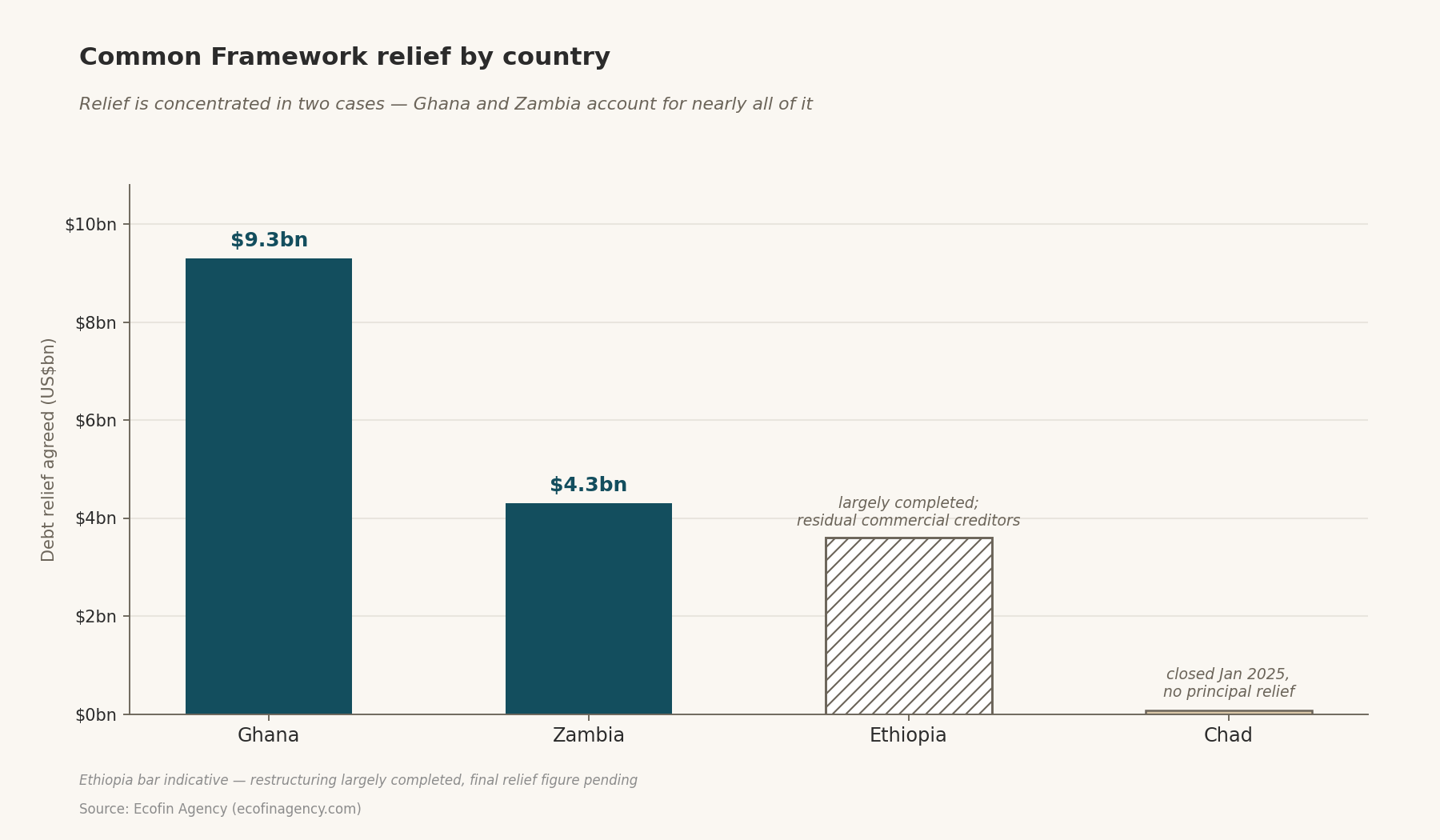
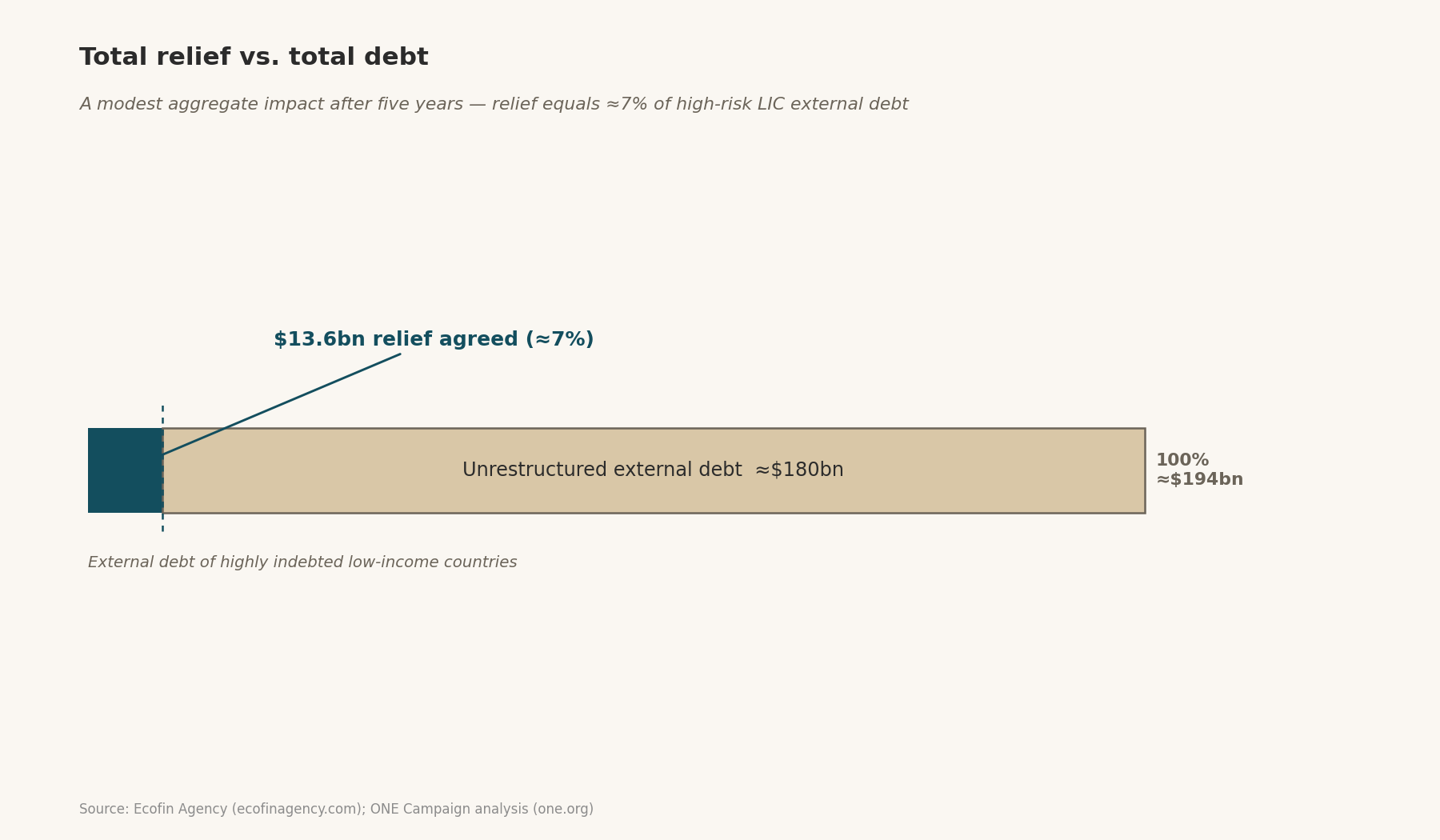
A ONE Campaign analysis found the Common Framework reduced the total external debt of highly indebted low-income countries by only 7% — about $13.6 billion — and that only two of the four applicants, Ghana ($9.3 billion of relief) and Zambia ($4.3 billion), secured effective relief (Ecofin Agency). A 7% reduction, five years and four cases in, is a modest return for a mechanism billed as the answer to the developing world's debt crisis. Chad's case was closed in January 2025 with the IMF reporting no further need for debt treatment — a technical success that delivered little principal relief (G20 lessons-learned note). Chad illustrates a recurring pattern: a case can be declared "resolved" on paper while the underlying debt burden barely moves.
By early-to-mid 2026, most restructuring cases that began in 2021–22 were "largely completed," including Ethiopia, Ghana and Zambia, now involving only residual commercial creditors (IMF GSDR Progress Report). Completion, though, is not the same as cure: an independent case study characterised Zambia's outcome as "short-term relief, long-term dependency" (Erlassjahr/Jubilee). Zambia — the very country now projected to grow 5.8% in 2026 (see Article 7) — remains at high risk of debt distress even after its restructuring, the clearest possible evidence that closing a case is not the same as fixing a fiscal problem.
The core lessons
Three lessons have hardened into consensus. First, the process is too slow. The framework has been widely criticised as "slow, creditor-driven and no longer fit for purpose," prompting African policymakers at the first-ever African Union Conference on Debt in Lomé, Togo, to resolve to reform it (African Business). Zambia's restructuring took years to finalise — years during which the country was locked out of markets, growth stalled, and the human cost mounted. Speed is not a technicality; for a country in default, every month of delay compounds the damage.
Second, coordination among a fragmented creditor base — bilateral, multilateral, and increasingly private and Chinese lenders — is the binding constraint. Getting Paris Club governments, Chinese state banks and private bondholders to agree on comparable treatment has proven extraordinarily difficult, with each class fearing it will subsidise the others' recovery. Third, restructuring restores solvency on paper without necessarily restoring growth, leaving countries vulnerable to the next shock. A debt treatment that lowers the burden but does nothing to build the productive economy simply resets the clock until the next crisis.
Where Angola fits
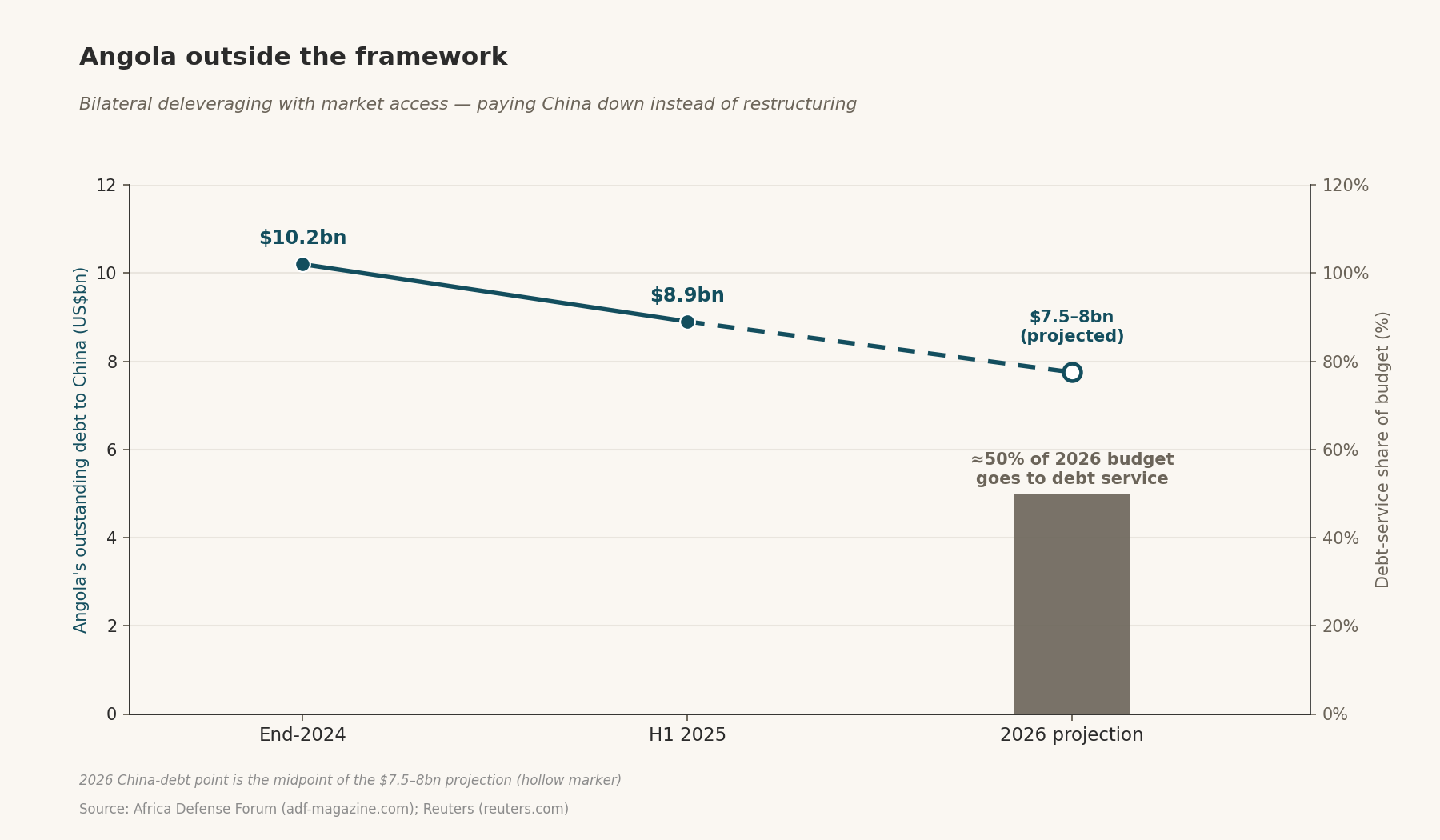
Angola's situation is instructive precisely because it is being handled outside the Common Framework. Rather than seeking a G20 restructuring, Angola is deleveraging directly — paying down Chinese debt from $10.2 billion to $8.9 billion in the first half of 2025, and projecting oil-backed loans to fall to $7.5–8 billion by year-end (Africa Defense Forum; Reuters). Yet Angola still plans to spend almost half its 2026 budget on debt payments, and the IMF has warned about excess debt and risks to its repayment capacity (Reuters).
The distinction matters: a country with oil collateral and market access can restructure bilaterally, on its own timetable, without submitting to the framework's slow multilateral machinery; a country without those options is at the mercy of that machinery. Angola's path is not open to everyone — it depends on having assets creditors want and a credible macro story that preserves market access. But it demonstrates the strategic value of never needing the framework at all, which is why the rest of the continent watches Angola's approach as closely as it watches Zambia's ordeal.
The reform push
Africa is no longer a passive recipient of the debt architecture — it is trying to rewrite it. The Lomé conference resolved to reform the Common Framework, and the Global Sovereign Debt Roundtable — co-chaired by the IMF, World Bank and the G20's South African presidency — has been working to accelerate restructuring and clarify sequencing between debt treatment and IMF programmes (African Business; IMF GSDR Progress Report). South Africa's turn in the G20 presidency gave the continent a rare seat at the table where the rules are made — and African negotiators used it to push for faster timelines, clearer creditor obligations, and mechanisms to bring private and Chinese lenders into line. Whether these reforms materialise in the next cases will be the real test of African agency in the global financial system.
The New Axis read
The lesson of Zambia, Ghana and Ethiopia is not that debt restructuring failed — it is that the current architecture delivers too little, too slowly, and leaves countries dependent. For Angola, the takeaway is defensive: keep market access, keep diversifying creditors (see Article 5), and avoid ever needing the framework at all. For the continent, it is offensive: with South Africa having chaired the G20 and African states organising around debt reform, Africa is beginning to negotiate as a bloc rather than as a queue of supplicants. Whether that translates into a faster, fairer system — one that restores growth and not just paper solvency — will be one of the defining financial stories of the decade, and a genuine test of whether the Global South can reshape institutions built without it in mind.
Charts & visuals
X: The G20 Common Framework was meant to fix poor-country debt. Verdict: it cut high-risk debt by just 7% ($13.6bn), with real relief only for Ghana & Zambia. Angola is deleveraging OUTSIDE it. Here's what Africa learned. 🧵
LinkedIn: After Zambia, Ghana and Ethiopia, the verdict on the G20 Common Framework is in — and it's "very mixed": only ~7% of high-risk debt cut, real relief for just two countries, and one case study calling Zambia's outcome "short-term relief, long-term dependency." Angola, tellingly, is deleveraging on its own terms. New Axis Media on what African debt restructuring actually taught the continent.
Author
Sign up for New Axis Media newsletters.
Stay up to date with curated collection of our top stories.