The Stranded Surplus: Grand Inga, Power Pools and Africa's Test of Electrifying Itself
Angola is months from switching on one of Africa's biggest dams and already holds power it cannot sell; Zambia, a few hundred kilometres away, recently endured blackouts of up to 21 hours. Africa's electrification problem is no longer resource scarcity — it is grids, governance and the price of…
The paradox of the pool
On 10 November 2025, the Kariba reservoir — the battery of the Zambian and Zimbabwean economies — held 8.09 per cent of its usable storage, per SADC's Agromet bulletin via ReliefWeb. In 2024 the worst El Niño drought in more than 40 years had cut output at Kariba, Itezhi-Tezhi and Kafue Gorge; about 85 per cent of Zambia's generation is hydro, and daily outages ran to as much as 21 hours at the peak of the hardship, per a UNDP-cited analysis. By August 2024 the state utility ZESCO was applying for an emergency tariff increase of up to 156 per cent, warning that Kariba's water allocation for the year would be depleted by end-September, per Bloomberg via Energy Connects.
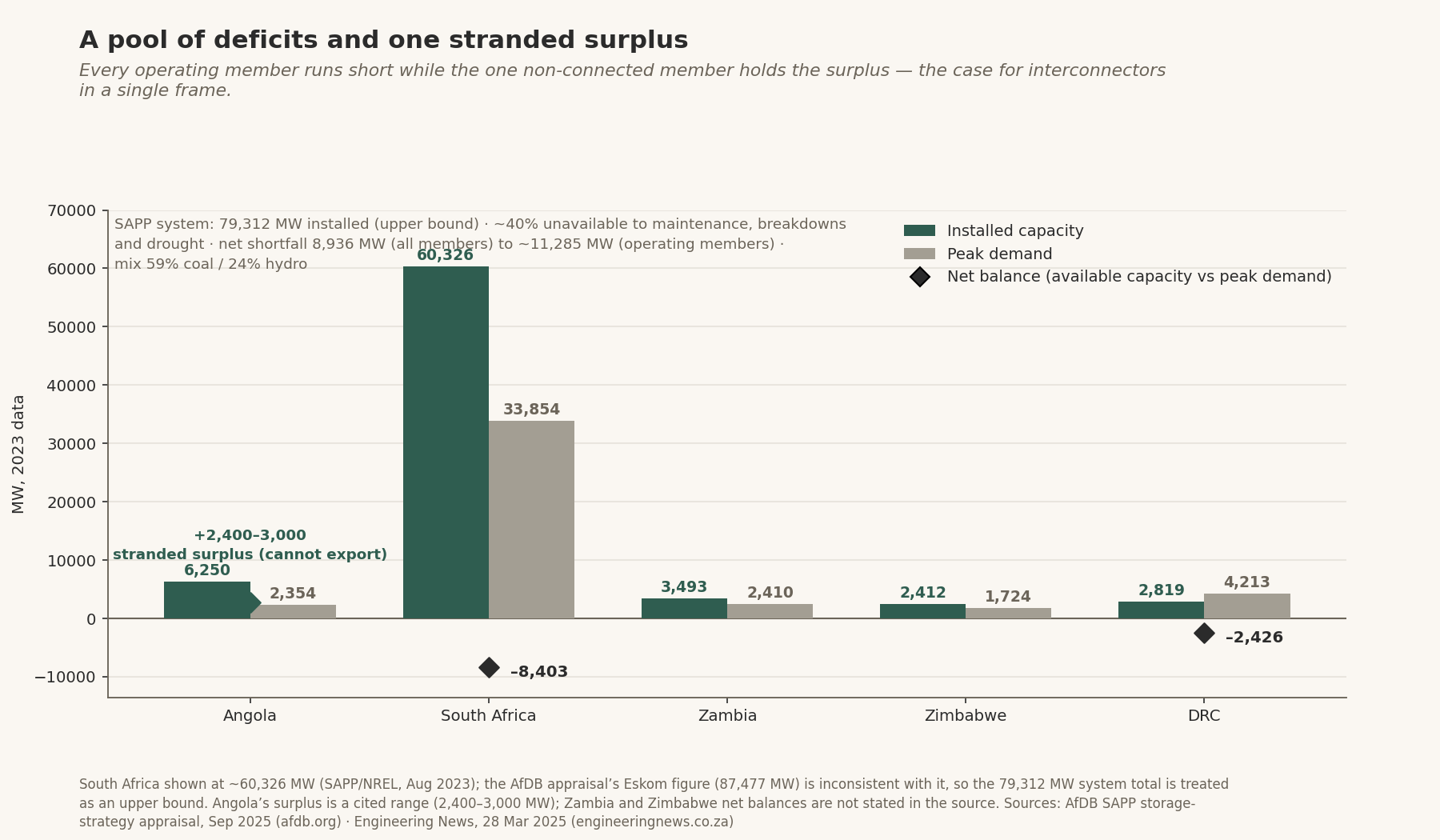
Roughly a thousand kilometres northwest, Angola was sitting on the opposite problem: some 6,250 MW of installed capacity against peak demand of about 2,354 MW — a surplus of 2,400– 3,000 MW it cannot export, because as a non-operating member of the Southern African Power Pool (SAPP) it has no grid interconnection with its neighbours, per SAPP data in an African Development Bank appraisal and Engineering News. One climate system, two crises: a drought-emptied south-east and a water-rich, wire-poor west.
That paradox — deficits beside a stranded surplus — is the sharpest way into the question of whether Africa can electrify itself. The answer turns less on resources than on grids, governance and the price of capital.
A deficit that has become African
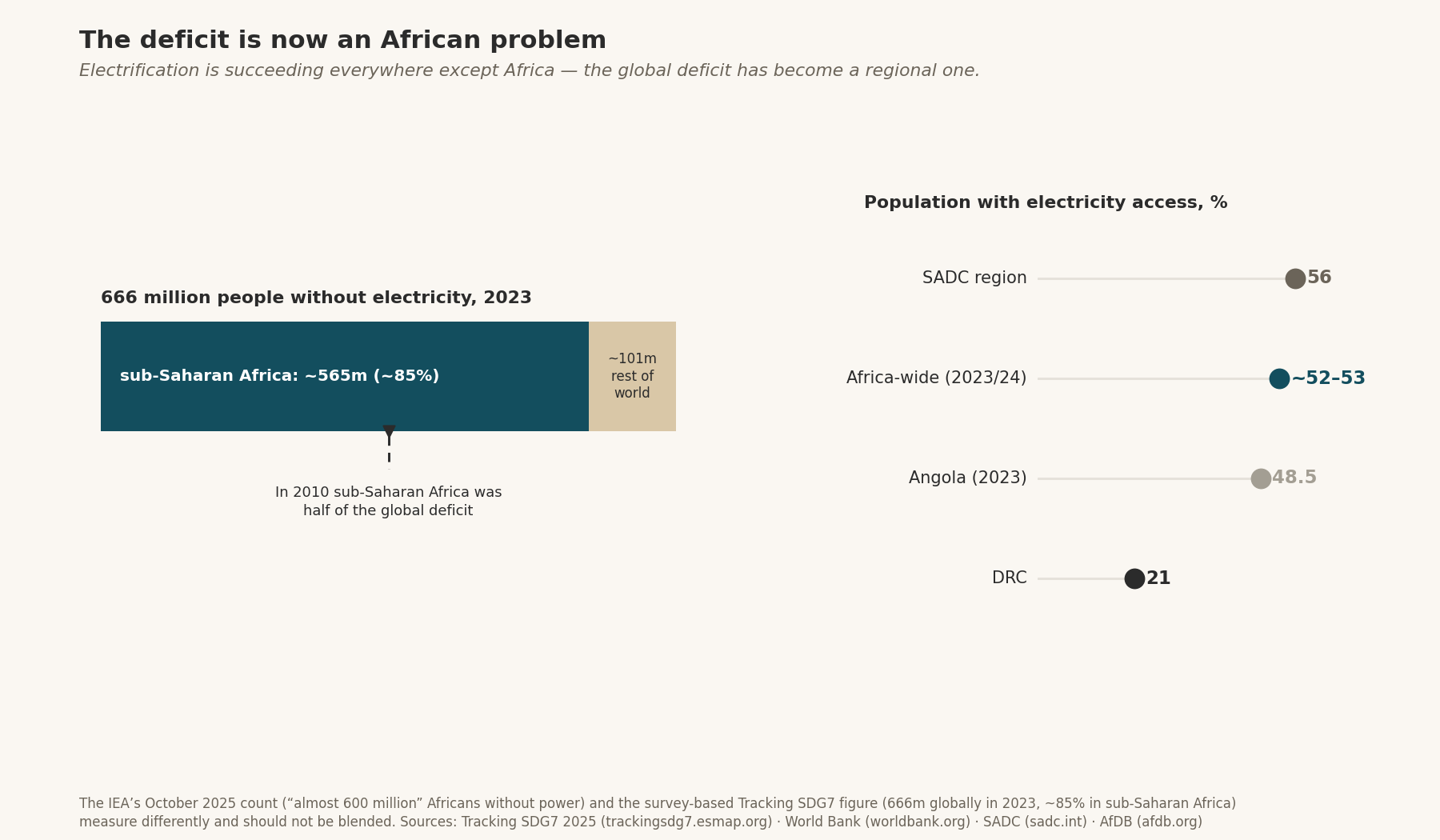
Start with scale. The International Energy Agency's flagship October 2025 report puts the number of Africans without electricity at almost 600 million, and estimates universal access requires investment to scale up to US$15 billion a year, per the IEA. The more rigorous survey-based count is global: 666 million people lacked electricity in 2023, of whom about 85 per cent — some 565 million — are in sub-Saharan Africa, up from half of the global deficit in 2010, per Tracking SDG7. The two figures measure differently and should not be blended; both say the same thing. Electricity poverty is becoming an almost exclusively African problem.
Progress is real but slow. Africa's access rate rose from 39 per cent in 2015 to roughly 52–53 per cent by 2023/24, and the African Development Bank says it connected 28 million people directly over a decade, per the AfDB. In the SADC region, 56 per cent have power and some 172 million do not, in a system running about 60 per cent coal, 24 per cent hydro and a tenth renewables, per the SADC secretariat.
The money is moving, but unevenly. Private clean-energy investment in Africa nearly tripled, from about US$17 billion in 2019 to almost US$40 billion in 2024, while public and development-finance energy funding fell by a third over a decade to US$20 billion — and Chinese development-finance energy spending in Africa fell by more than 85 per cent, per the IEA's World Energy Investment 2025. Africa attracted only about 2 per cent of global clean-energy investment in 2024, per the Independent High-Level Expert Group on Climate Finance. The choke is the cost of capital. Financing costs for energy projects in emerging markets run at least two to three times those in advanced economies or China, per the IEA; one 48-country analysis puts the average weighted cost of capital across Africa at 15.6 per cent, more than three times the 2–5 per cent typical of Western Europe and the United States, per the Clean Air Task Force. Utility-scale solar carries a cost of capital of 8.5–9 per cent in Kenya and Senegal against 4.7–6.4 per cent in North America and Europe, per the IEA's Cost of Capital Observatory. The same electron costs three times more to finance in Lagos than in London. Whoever cracks that equation cracks electrification.
Angola's surplus, and the first stitch
The Southern African Power Pool is the region's answer on paper — and, so far, mostly on paper. The system held 79,312 MW of installed capacity on 2023 peak data — a figure best treated as an upper bound — 59 per cent coal and 24 per cent hydro; about 40 per cent of installed capacity was unavailable to maintenance, breakdowns and drought, leaving a net shortfall of 8,936 MW across all members and about 11,285 MW among operating members, per the AfDB's SAPP storage-strategy appraisal, September 2025. SADC members added 2,885 MW in 2024/25, taking the total above 85,000 MW, yet a 4,210 MW shortfall remains; more than 28,000 MW of projects are expected by 2027, and ministers have directed the secretariat to develop a programme on the Congo River Water Transfer and Grand Inga, per ESI Africa.
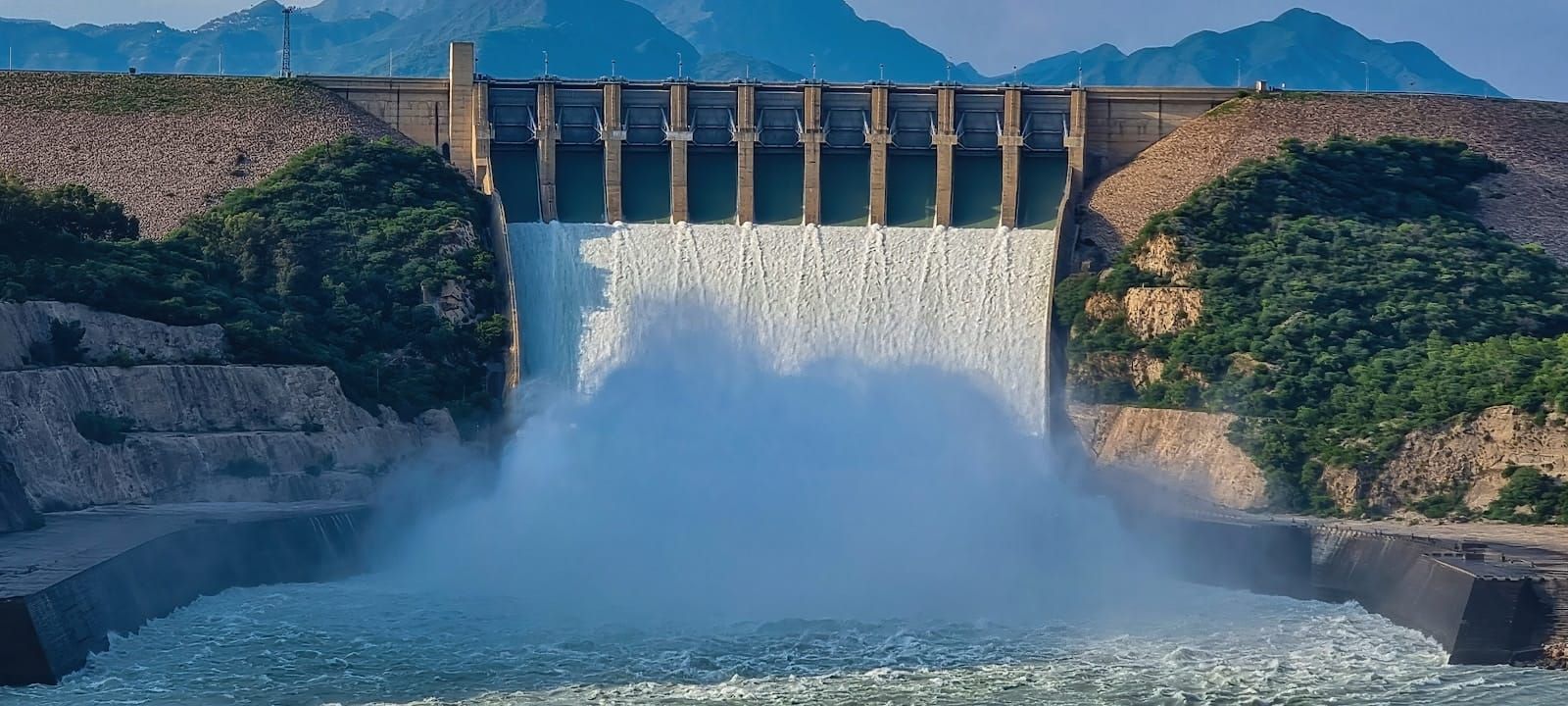
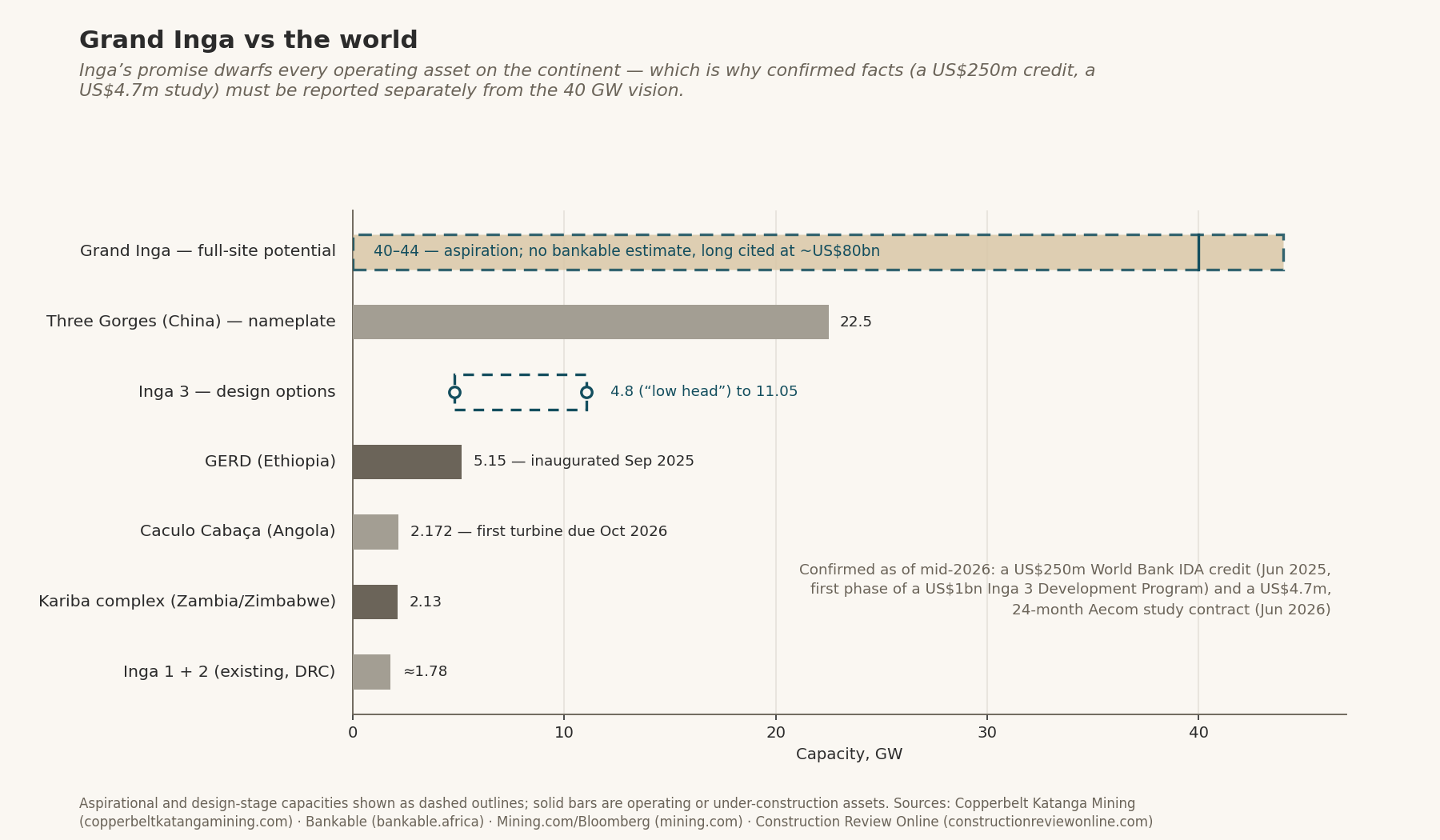
Angola is the pool's odd man out — a hydro-rich, oil-funded state that built generation faster than it could connect wires. Laúca (2.07 GW) has been operational since 2023. Caculo Cabaça, at 2,172 MW the country's largest dam, is due to start its first turbine in October 2026, with full capacity phased in to end-2028: four 530 MW Francis turbines plus a 52 MW auxiliary unit, an average 8,566 GWh a year, an estimated 7.2 million tonnes of CO2 avoided annually, and a projected two-thirds cut in Angola's electricity-consumption deficit, per Macao News/Xinhua, Energy Capital & Power and the energy ministry. Its financing maps the new infrastructure geometry: a roughly US$4.5 billion contract about 85 per cent financed by the Industrial and Commercial Bank of China and other Chinese banks, built by China Gezhouba since August 2017, with Germany's Voith Hydro supplying electromechanical equipment under a separate US$1.16 billion German-backed package in 2020; costs were revised to about US$5.2 billion in 2020 once grid works were included, per The Electricity Hub.
Then, in April 2026, came the first stitch. On 14 April, in Luanda, Namibia's NamPower and Angola's RNT-EP signed a Joint Development Agreement and power purchase agreement for the ANNA interconnector: a 166 km, 400 kV line from Cahama in Angola to Kunene in Namibia, plus 270 km of Namibian reinforcement, carrying 300 MW of firm power to Namibia — with up to 500 MW possible, the remainder for the wider SADC market — and completion targeted for 2029, per the Namibian and Ecofin Agency. Namibia is financing N$4 billion (about US$220–244 million) through its National Energy Fund; the interconnector component itself is N$941 million, the rest being domestic lines — a distinction headlines have blurred. It is the first link between Angola and the pool: small against an 8,936 MW shortfall, but proof of concept that stranded surplus can be sold.
The caveats are Angolan. About half the population — 48.5 per cent on 2023 World Bank data — has electricity; grid technical and commercial losses have historically run at 40–55 per cent; and installed capacity of 6.2–6.3 GW still trails the 9.9 GW targeted by the "Angola Energia 2025" strategy, per the World Bank and Agence Ecofin. A surplus on the national balance sheet is not power in Angolan homes — but it is, for the first time, power that could be sold across a border.
The Inga question, again
Eighty kilometres of rapids west of Kinshasa hold the continent's largest single energy prize — and its longest record of failure. The confirmed facts, as of mid-2026, are modest and deliberate. On 3 June 2025 the World Bank's board approved a US$250 million IDA credit — the first phase of a US$1 billion Inga 3 Development Program — starting with community investment in Kongo Central (about 100 communities, 1.2 million people), per the World Bank. The DRC's access rate is 21 per cent; its National Energy Compact targets 62 per cent by 2030. In June 2026 ADPI, the DRC's Inga delivery agency, selected Aecom for a US$4.7 million, 24-month update of Inga 3's preparatory studies, Bank-financed after a conflict-of-interest review, per Bankable. Inga 3 itself remains a design question — 4,800 MW ("low head") to 11,050 MW — with earlier Aecom–EDF studies putting domestic infrastructure at US$17.9 billion and South Africa (2,500– 5,000 MW) and Congolese miners (3,000–5,000 MW) as anchor markets. Grand Inga is an aspiration, and should be reported as one: a full-site potential of 40–44 GW — "eventually… Inga 8… 42 gigawatts… twice the output of the Three Gorges Dam", in the words of the Bank's DRC director Albert Zeufack, per Copperbelt Katanga Mining and Mongabay. The oft-quoted US$80 billion total is a dated planning figure with no current owner, per Construction Review Online; the existing Inga 1 and 2 make about 1.8 GW, much of it sent 1,600 km to the copper and cobalt mines, per Bloomberg via Mining.com.
History argues for humility. The previous Inga III attempt — US$14 billion, 11 GW, Chinese and Spanish consortia — collapsed by about 2020; the Bank cancelled a US$73.1 million technical grant in 2016 over governance concerns, and AfDB support lapsed in 2019. In May 2024 the presidency dropped Fortescue — which had envisaged up to 40 GW for green-hydrogen export — for Nigeria's Natural Oilfield Services, whose preliminary deal covers a 7 GW scheme plus an aluminium complex; its Indian owners face accusations in India of defrauding public banks of about US$1.7 billion, per International Rivers and Mining.com.
Opposition is organised; the backdrop is war. Civil-society groups say Inga 3 could displace more than 30,000 people — many never compensated for the first two dams — and that its power would flow to mines and export markets, not the roughly 80 per cent of Congolese without electricity, per International Rivers and the Bretton Woods Project. M23 — Rwanda-backed, per UN experts — seized Goma in January 2025; a US-brokered peace framework remains fragile, with 400,000-plus displaced in the Kivus since the start of 2026, even as Washington's Development Finance Corporation announced US$2 billion, per IPIS and Afrewatch. The Bank's return is deliberately small and community-first: governance before concrete. Whether that breaks the curse — and whether the power serves 100 million Congolese or the mines 1,600 km away — is the story of the decade.
Hydro's climate trap, and the distributed wager
Kariba's slow refill is the region's climate ledger: usable storage of 8.09 per cent on 10 November 2025 and 11.83 per cent on 9 February 2026; a lake level of 480.84 metres on 4 May 2026, up from 477.65 a year earlier, far from the 484.97 of a good year like 2018 and barely above the 475.50-metre operating minimum, per ReliefWeb, Zambezi River Authority data via NASA and Equity Axis. Mozambique's Cahora Bassa was at 26.8 per cent in November 2025 — a snapshot, not a trend, but the stress is regional, per ReliefWeb. The trap is conceptual as much as hydrological: mega-hydro as the answer to a deficit caused partly by hydro's drought vulnerability.
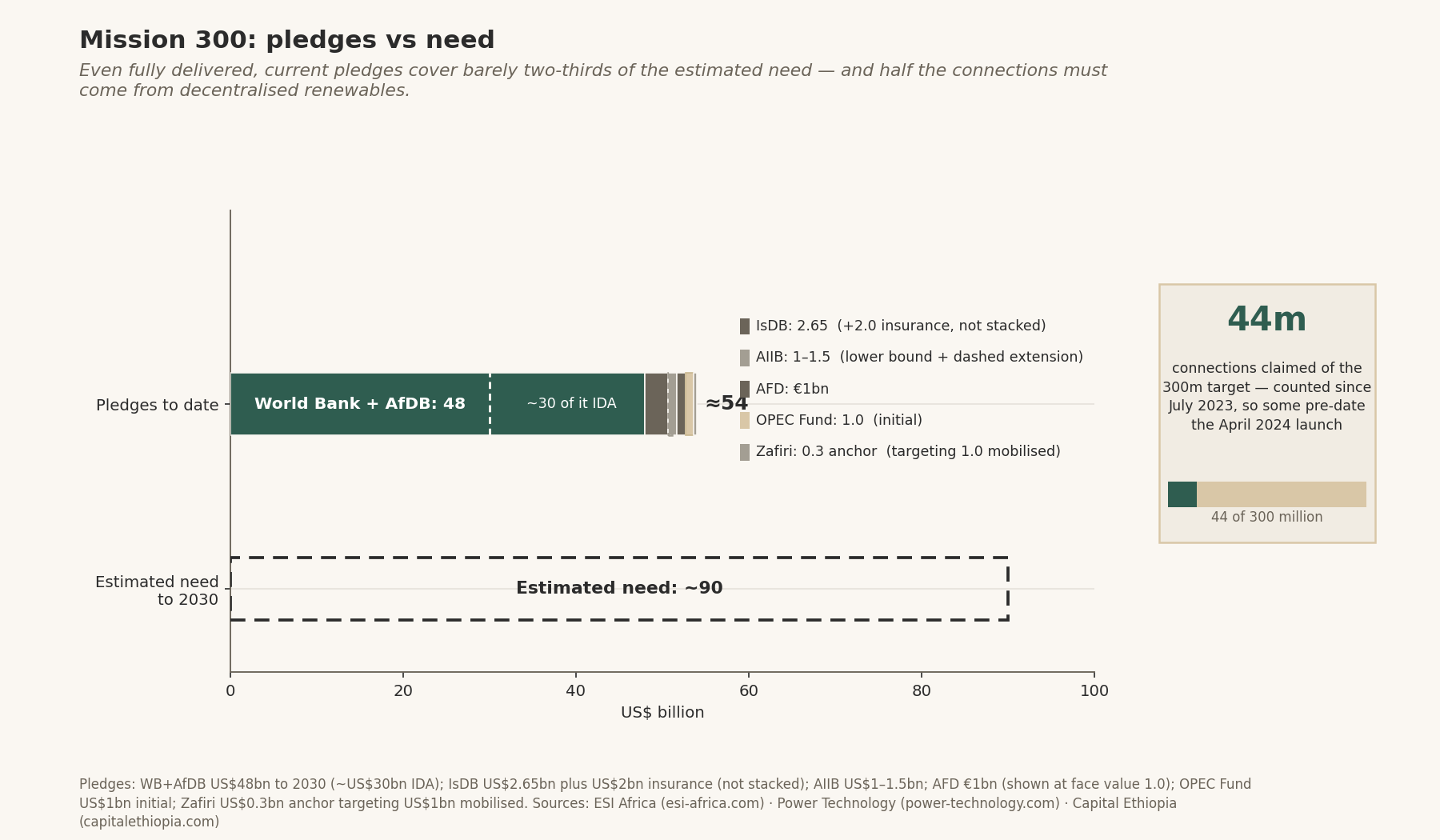
The counter-current is distributed. Mission 300 — the World Bank–AfDB drive to connect 300 million Africans by 2030 (Bank: 250 million; AfDB: 50 million) — was launched in April 2024 and formalised at the Dar es Salaam summit of 27–28 January 2025, with twelve first-cohort National Energy Compacts, per Power Technology and T&D World. The two banks plan to allocate US$48 billion to 2030 — about US$30 billion of it IDA — against an estimated need of roughly US$90 billion; pledges add the Islamic Development Bank (US$2.65 billion plus US$2 billion of insurance), the Asian Infrastructure Investment Bank (US$1–1.5 billion), Agence Française de Développement (€1 billion) and the OPEC Fund (US$1 billion initially), while Zafiri, a new Bank– AfDB investment company for mini-grids and solar home systems, holds a US$300 million anchor targeting US$1 billion mobilised, per ESI Africa.
Progress is claimed at about 44 million connections — counted since July 2023, so some pre-date the launch, per the methodology reported by Capital Ethiopia. Half of all connections are meant to come from decentralised renewables, and mini-grids alone need about US$46 billion by 2030, per Ecofin/Bloomberg. The honest question is not dams or solar, but what mix actually connects 600 million people by 2030–2035 — and at whose cost of capital.
New Axis read
Can Africa electrify itself? The resources say yes; the arithmetic of capital says not yet; the grids say not alone. The honest reading of mid-2026 is that the continent's energy geography is being stitched piecemeal — 300 MW here, 2,172 MW there — by a multipolar cast of Chinese
contractors, German turbine-makers, Namibian energy funds and MDB credits, rather than by any grand design. Grand Inga remains an aspiration with a US$4.7 million study contract; Caculo Cabaça, ANNA and the World Bank's US$250 million credit are the confirmed facts. The binding constraint is not water, sun or ambition; it is transmission lines, utility governance and a cost of capital three times the rich world's. Watch three dates: Caculo Cabaça's first turbine in October 2026, Aecom's Inga studies in 2028, and Angola's conversion of surplus into SAPP membership and sales. If those hold, "Africa electrifying itself" stops being a slogan and starts being a grid.
Charts & visuals
X: Angola holds a 3,000 MW hydro surplus it can't sell. Zambia, next door, endured 21-hour blackouts. In April they finally signed the line that connects them — 300 MW by 2029. Grand Inga? Still a US$4.7m study.
LinkedIn: Africa's electricity map contains an absurdity: Angola has built a 2,400–3,000 MW hydropower surplus it cannot export, while the Southern African Power Pool runs a shortfall of nearly 9,000 MW. April's ANNA interconnector deal with Namibia is the first stitch in a regional grid — just as the World Bank makes a cautious, community-first return to Inga 3 and Mission 300 tries to connect 300 million people by 2030. Our analysis separates the confirmed projects from the 40 GW aspirations, and follows the real constraint: a cost of capital three times the rich world's.
Author
Sign up for New Axis Media newsletters.
Stay up to date with curated collection of our top stories.