What FATF grey-listing does to an African bank
Grey-listing is not a sanction and does not require enhanced due diligence by itself. It still raises the cost of every dollar that crosses a border.

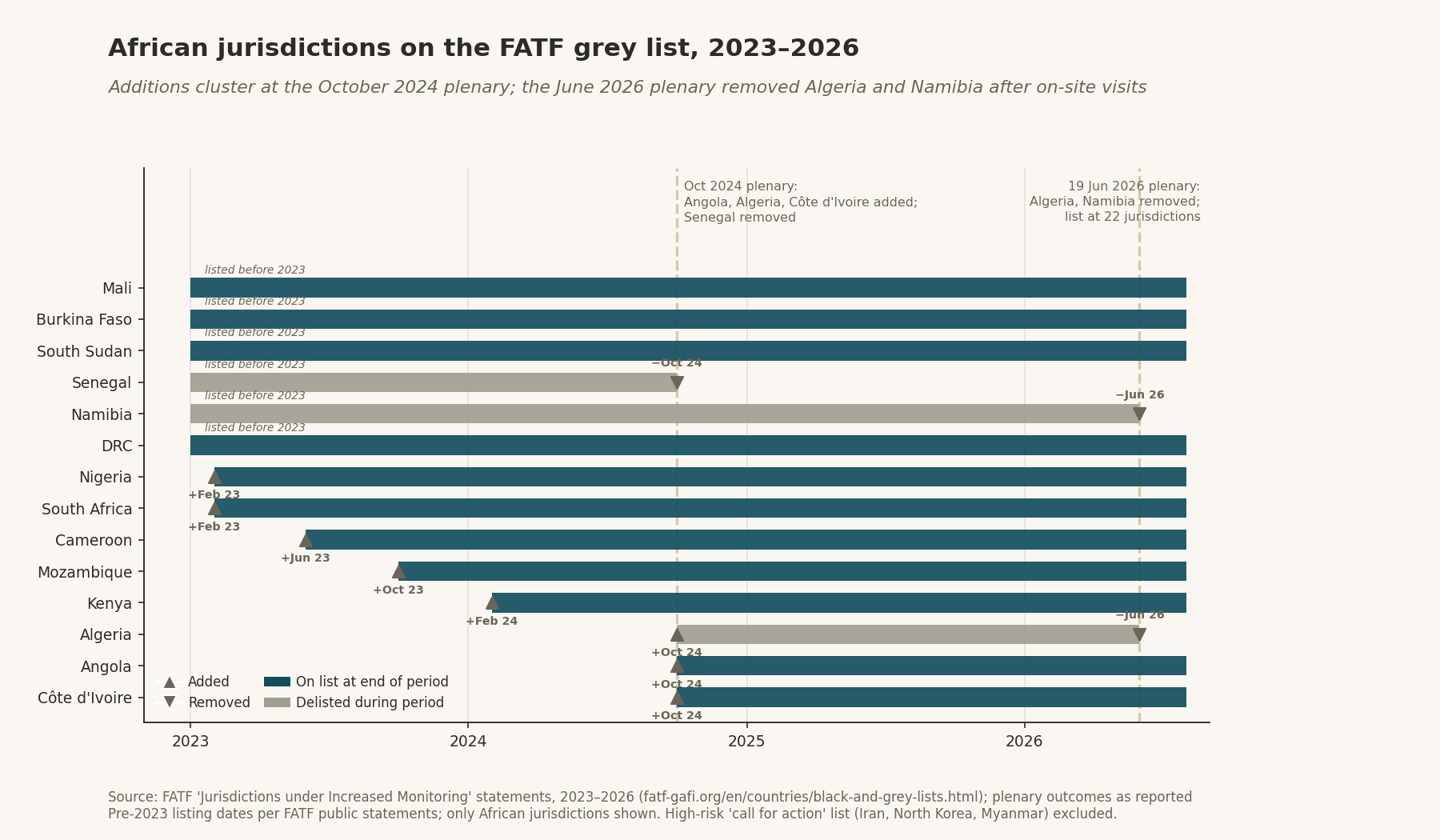
Why it matters. A third of the FATF's increased-monitoring list is African. The listing mechanism shapes correspondent banking access, transaction costs, and investment paperwork across the continent — and it is widely misdescribed.
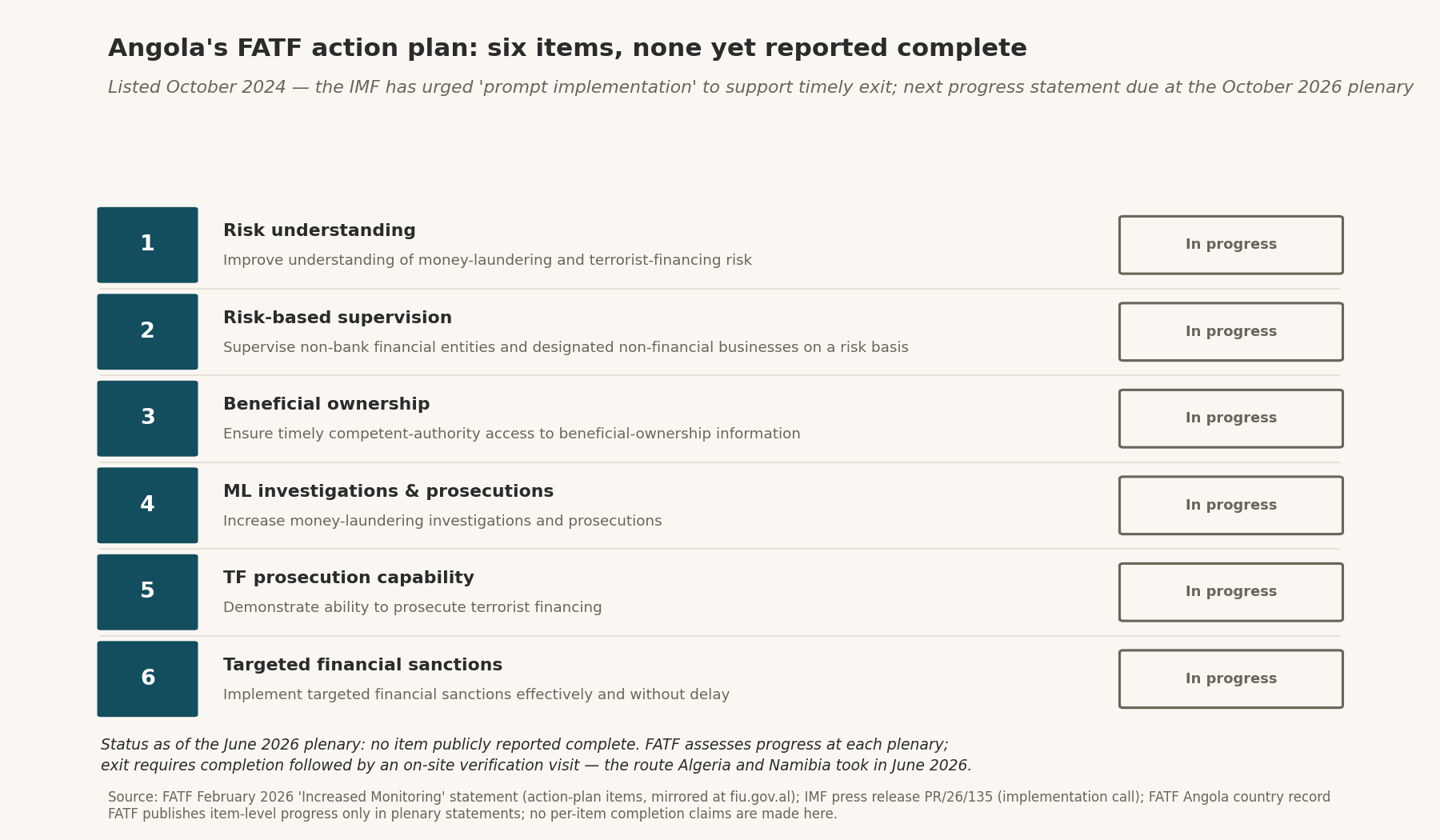
The facts. The grey list is formally the FATF's Jurisdictions under Increased Monitoring — countries that have made a high-level political commitment to fix identified strategic anti-money-laundering and counter-terrorist-financing deficiencies under an agreed action plan, published on the FATF's black and grey lists page. It is distinct from the high-risk list subject to a call for action, which comprised Iran, North Korea and Myanmar. Angola was added in October 2024 alongside Algeria, Côte d'Ivoire and Lebanon, with Senegal removed, per Hogan Lovells' summary of that plenary; its country record is maintained on the FATF Angola page. Angola's action plan has six components: improving understanding of money-laundering and terrorist-financing risk; risk-based supervision of non-bank financial entities and designated non-financial businesses; timely competent-authority access to beneficial ownership information; more money-laundering investigations and prosecutions; demonstrated ability to prosecute terrorist financing; and effective implementation of targeted financial sanctions without delay — as set out in the FATF's February 2026 increased-monitoring statement, mirrored by Albania's financial intelligence unit. After the 19 June 2026 plenary the list stood at 22 jurisdictions, with Bosnia and Herzegovina and Iraq added and Algeria and Namibia removed following successful on-site visits — a compliance-industry summary of the plenary outcome is available from AML UAE, which also notes that FATF does not call for enhanced due diligence solely because a jurisdiction is grey-listed and actively discourages indiscriminate de-risking.
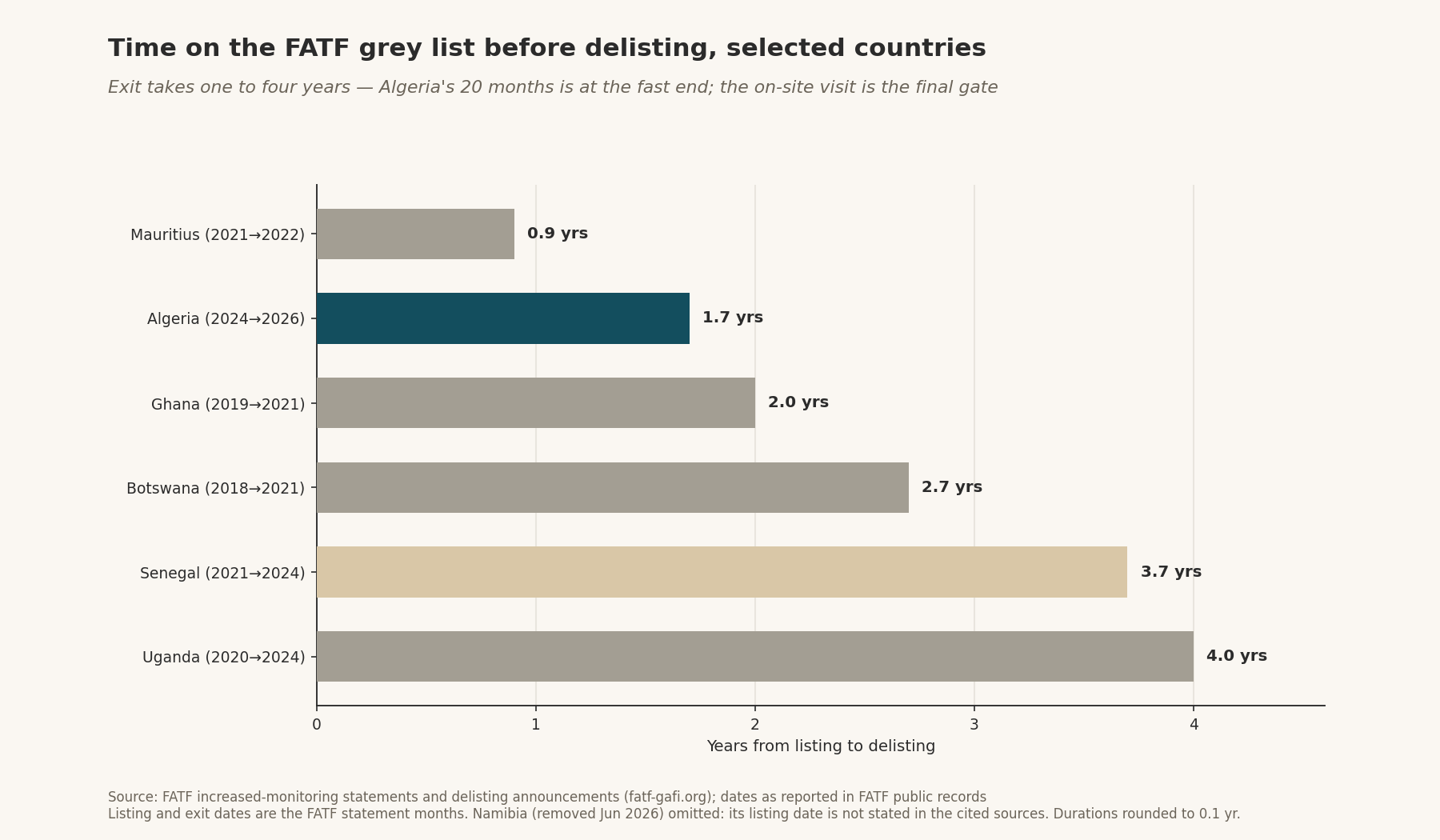
What it changes in practice. Three things. Correspondent banks re-underwrite country risk, which lengthens onboarding and can cut relationships entirely — the de-risking FATF says it opposes. Compliance costs rise as counterparties add documentation requirements. And listing becomes an input into investment committee and lender risk scoring regardless of what FATF intended. Exit is the reward mechanism: Algeria and Namibia's June 2026 removals show the on-site verification path works when action plans are actually completed.
The Angola link. IMF Executive Directors in May 2026 "underscored the need for prompt implementation of the FATF Action Plan to support timely exit from the grey list", per the IMF Executive Board press release, and the 2026 FSAP identified AML/CFT framework vulnerabilities to be addressed for that purpose, per the FSAP stability assessment.
Between the lines. The gap between what FATF says grey-listing means and how markets treat it is the whole story. FATF designed a remediation label; the financial system reads it as a risk flag. That gap is why listed governments spend heavily on legal reform and lightly on the enforcement statistics — investigations, prosecutions, sanctions implementation — that actually determine exit.
What to watch. The October 2026 plenary for Angola's progress statement; whether beneficial ownership registries become operational and accessible; prosecution counts; and whether correspondent banking relationships measurably contract in listed African markets.
Method and sources. FATF primary lists and country records, the February 2026 increased-monitoring statement, law firm and compliance-industry summaries of plenary outcomes, and IMF surveillance documents for the Angola-specific commitments.
Related reading: What an IMF Article IV consultation actually is; Power Map: who decides Angola's money.
Charts & visuals
X: FATF grey-listing is not a sanction, and FATF explicitly says it should not trigger blanket enhanced due diligence. Markets treat it as a risk flag anyway. What it actually does to an African bank →
LinkedIn: After the June 2026 plenary, 22 jurisdictions sit on the FATF grey list — a large share of them African. FATF says listing is a remediation status and explicitly discourages indiscriminate de-risking. Correspondent banks read it differently. Angola, listed in October 2024, has a six-item action plan the IMF has urged it to complete for "timely exit". Algeria and Namibia exited in June after on-site verification. Our explainer on the mechanism, the cost, and the exit route.
Author
Sign up for New Axis Media newsletters.
Stay up to date with curated collection of our top stories.