Football Is African Soft Power — And AFCON 2025 Proved It's a Business, Too
Morocco's Africa Cup of Nations turned a football tournament into a nation-branding and economic engine. From record prize money to record player valuations, African football is finally being run — and valued — like the global asset it is.
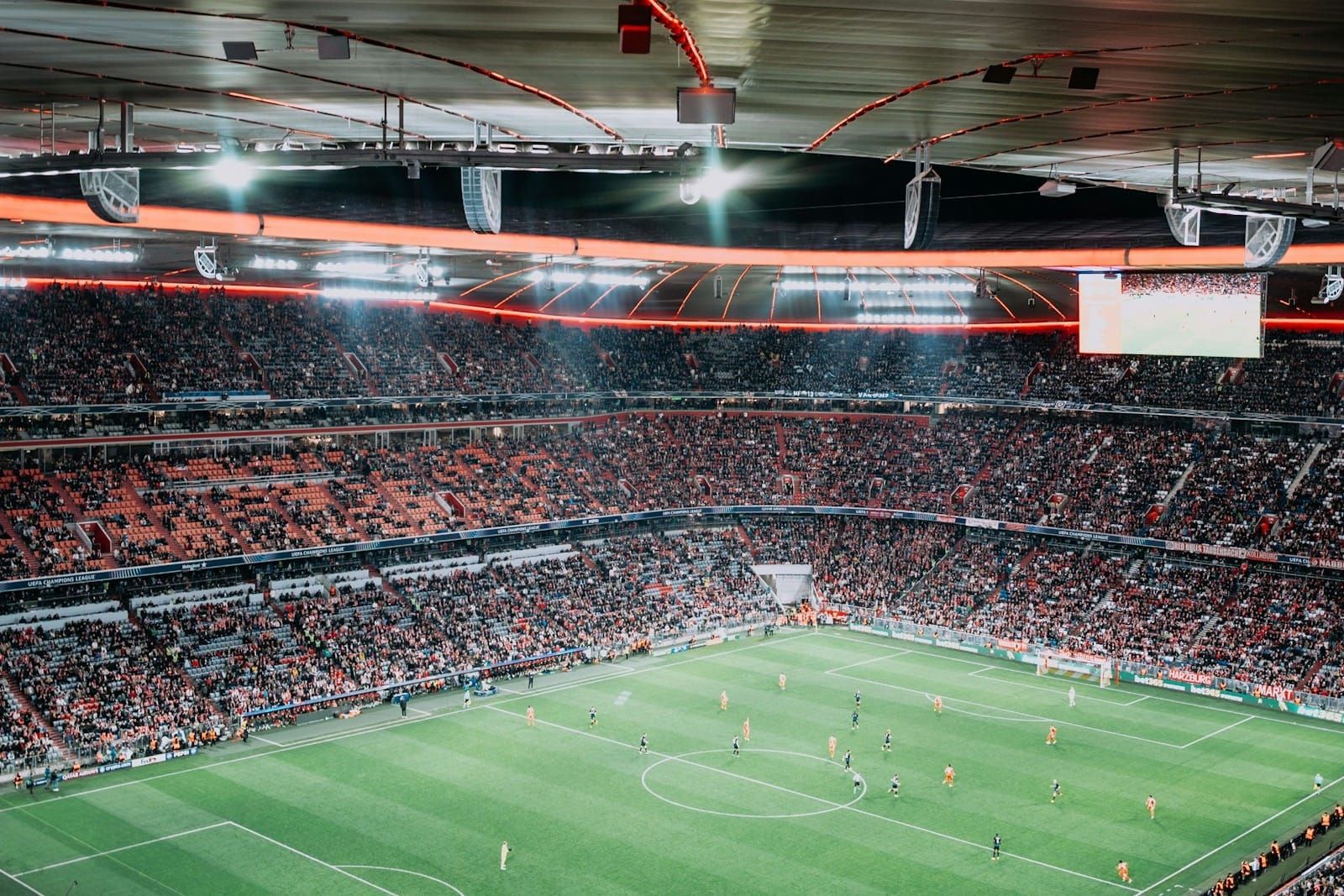
For decades, African football was a paradox: it produced world-class talent that starred in Europe while the continent's own football economy remained underdeveloped and underfunded. The best African players were, in effect, an export commodity — trained on the continent, monetised abroad, with the value captured by European clubs and leagues. AFCON 2025, hosted by Morocco from December 2025 into January 2026, was the moment that paradox began to close — and it did so as a business story, not just a sporting one. It is the sporting analogue of the value-capture theme running through this entire package (see Articles 15, 16 and 20): the talent was always African; the challenge was building the platform to capture its value at home.
AFCON as an economic engine
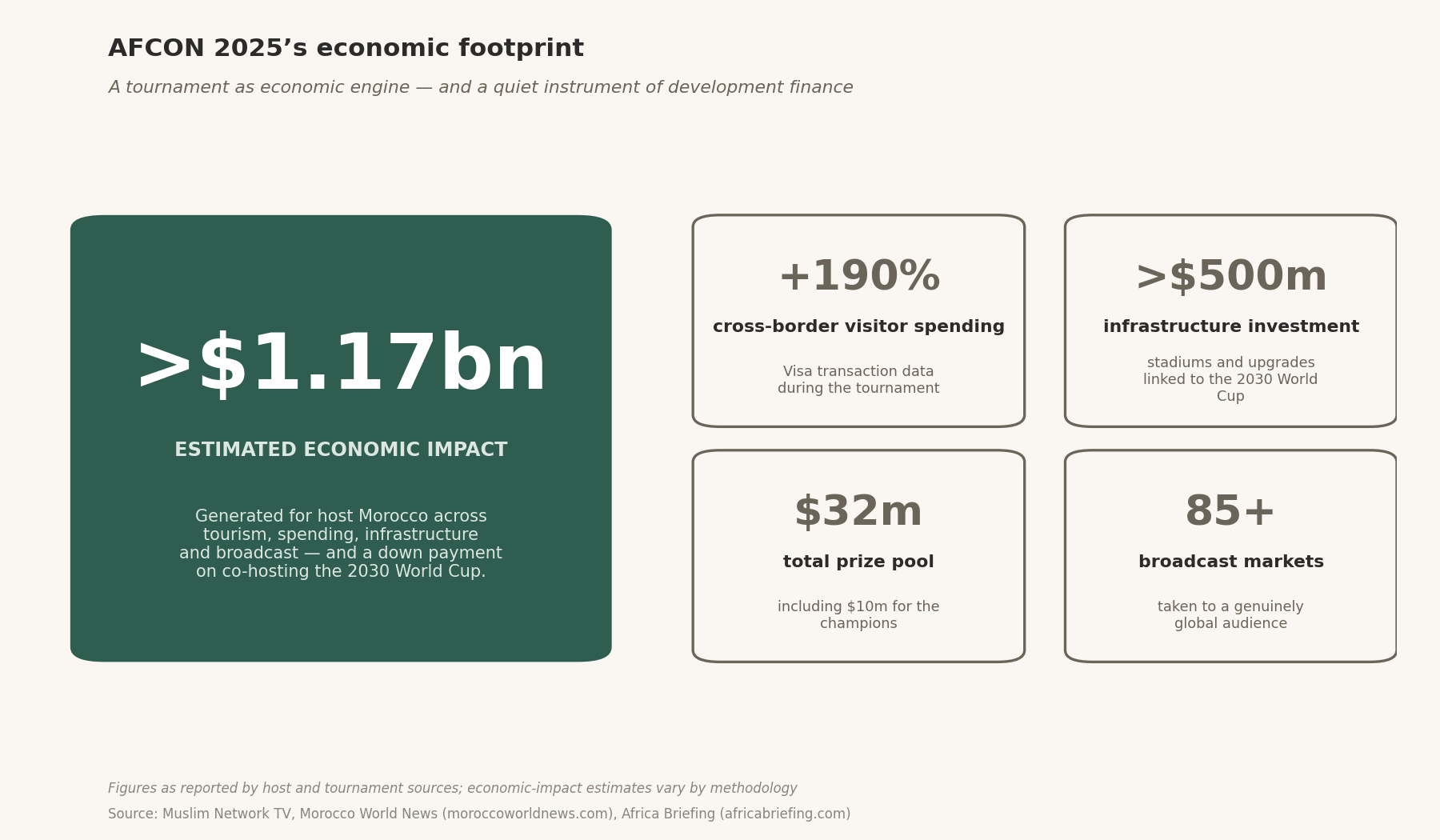
Morocco's tournament — which ended with Senegal beating the host nation 1-0 in the final at Prince Moulay Abdellah Stadium — generated a reported €1 billion-plus (around $1.17 billion) in economic gains, described in international assessments as the most financially successful edition in the competition's history (Muslim Network TV; en.assahafa.com). Visa data showed cross-border transaction spending from participating countries jumped over 190% during the tournament period versus the prior year (Morocco World News) — a direct measure of how a sporting event converts into tourism, hospitality and retail revenue across an entire host economy.
Crucially, much of the spending was investment, not consumption. More than $500 million was committed to upgrading stadiums, transport and connectivity — long-term assets, not one-off expenses, and explicitly linked to Morocco's co-hosting of the 2030 World Cup (LinkedIn / Zakaria Bouhadejb; Africa Briefing). Morocco is treating football as development finance: using a tournament to build infrastructure that will serve the country long after the final whistle, and to stage a rehearsal for the far larger World Cup to come. That is a sophisticated use of soft power — sport as a lever for national modernisation.
The commercial reset
The tournament reset the economics of the sport itself. AFCON 2025 awarded a record $10 million to the champions from a total prize pool of $32 million — more than doubling the financial scale of previous editions — and was broadcast in more than 85 international markets, airing free-to-air on Channel 4 in the UK for its widest-ever mainstream exposure (Africa Briefing). The free-to-air distribution matters as much as the prize money: reach builds the audience that commercial partners pay for, and the widest-ever mainstream exposure signals a tournament moving from the margins toward the centre of the global sporting calendar. Analysts said the revised model strengthened CAF's leverage with commercial partners and moved AFCON "closer to the world's top-tier sporting properties" (Africa Briefing).
Institutional investment is rising
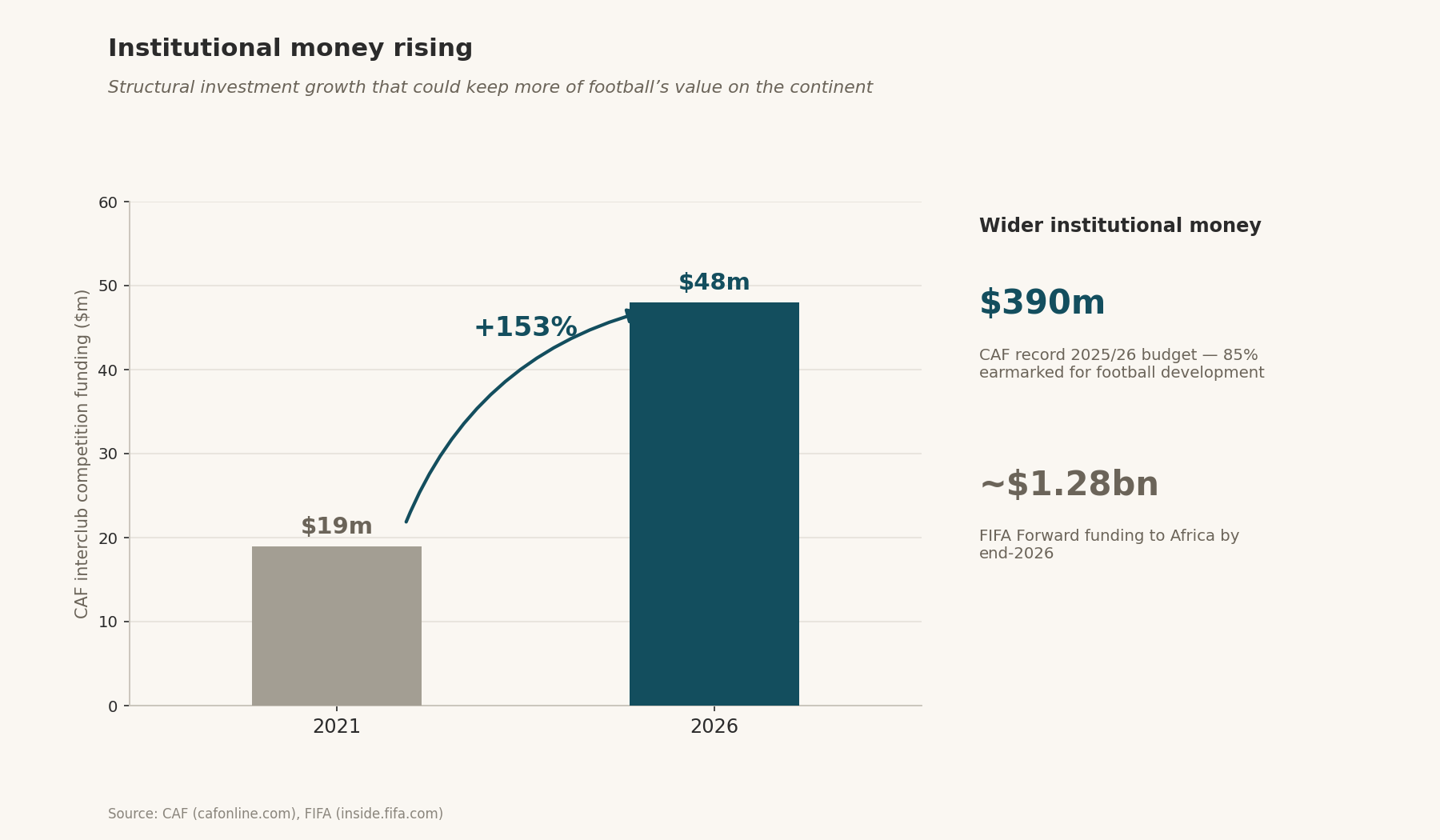
The money is not only in tournaments. The Confederation of African Football unveiled a record $390 million budget for the 2025/26 season, with 85% earmarked for football development, drawing on sponsorship, TV rights and marketing revenue (CAF via YouTube). Funding for CAF's interclub competitions rose from $19 million in 2021 to $48 million in 2026 — a 153% increase under President Patrice Motsepe (CAF). FIFA's Forward Programme was projected to provide an estimated $1.28 billion in support to Africa by the end of 2026 (FIFA). This is the structural investment that could, over time, keep more of African football's value on the continent — funding club competitions, youth development, and the domestic leagues that have historically lost their best players to Europe before they could generate value at home.
The talent as a global asset
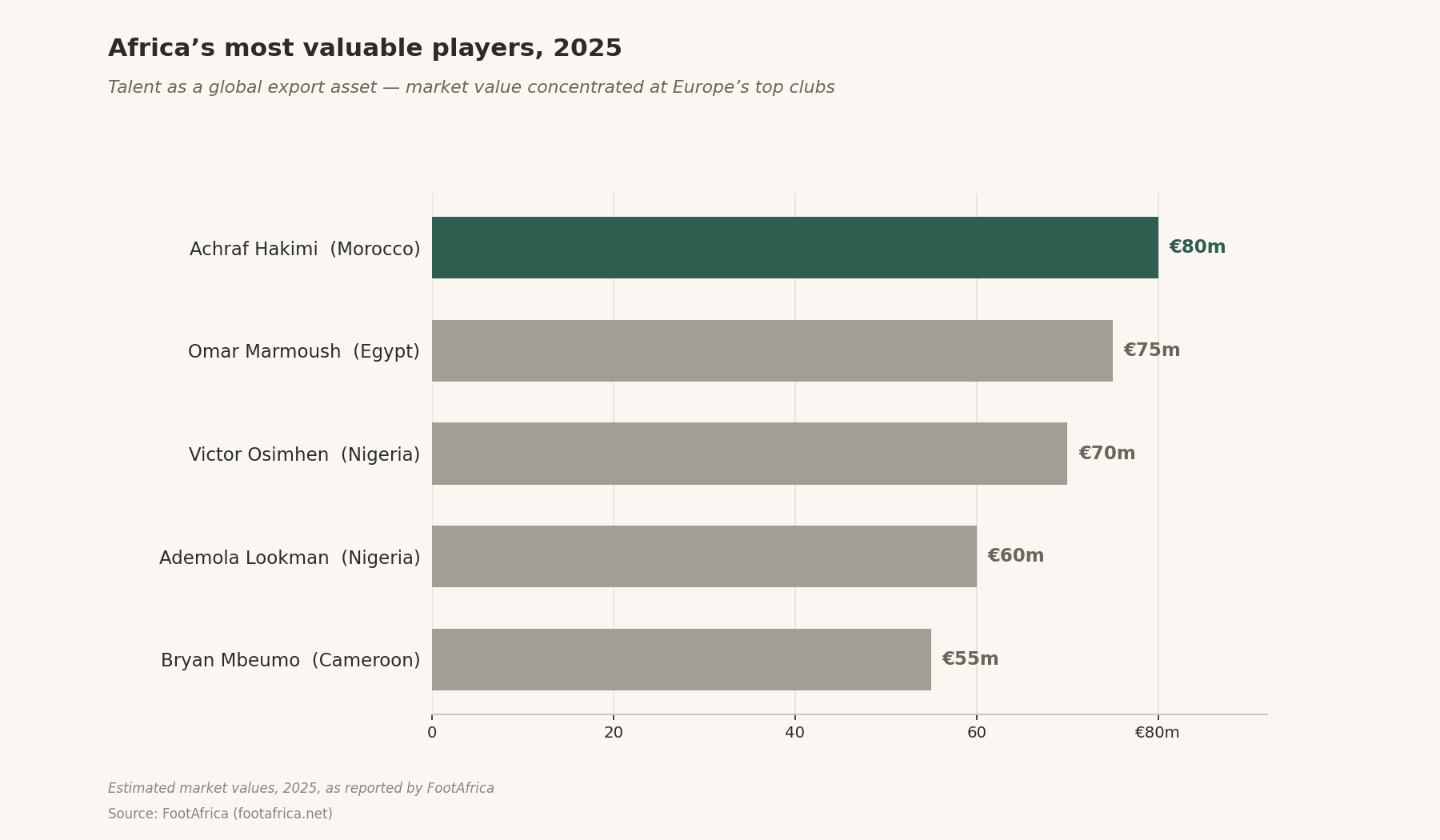
The clearest measure of African football's value is the transfer market. In 2025, the most valuable African players carried valuations rivalling any region's stars: Achraf Hakimi (Morocco) at €80m, Omar Marmoush (Egypt) €75m, Victor Osimhen (Nigeria) €70m, Ademola Lookman (Nigeria) €60m, and Bryan Mbeumo (Cameroon) €55m (FootAfrica). These are not just athletes — they are exports, brand assets, and diplomatic ambassadors whose profiles shape global perceptions of their countries. Hakimi lifting a trophy in Morocco is, in soft-power terms, a national advertisement seen by hundreds of millions. The question, as with every value chain in this package, is how much of the wealth these players generate flows back to the leagues, academies and communities that produced them.
The "two speeds" problem
The honest caveat is a gap between product and platform. African football is projecting revenues exceeding $300 million while "the digital infrastructure required to deliver this content to the fans remains caught in stagnation," creating an era of "two speeds" — a world-class sporting product held back by underdeveloped distribution (The Standard (Zimbabwe)). This is the identical trap that shadows the creative economy (see Article 20) and the digital stack (see Article 15): the value is real, but capturing it fully requires solving an infrastructure problem — here, the streaming and broadcast rails that turn matches into monetisable content. A brilliant product on a broken platform leaks value at every step.
The New Axis read
Football is Africa's most potent and underexploited soft-power asset — a domain where the continent is unambiguously world-class and globally beloved. AFCON 2025 showed what happens when that asset is run professionally: over $1 billion in impact, a 190% spending surge, and a tournament that funded a significant share of a World Cup's infrastructure. For Morocco, football is nation-branding and development finance rolled into one — a template other African nations are studying closely. The lesson for the rest of the continent is that the talent was never the problem — the business model was. Fix the platform, capture the value, and African football becomes not just a source of pride but a genuine economic system, and a soft-power instrument to rival any in the Global South.
Charts & visuals
X: AFCON 2025 (won by Senegal in Morocco) generated $1bn+, a 190% spending surge, and funded much of a World Cup's infrastructure. Prize pool doubled to $32m. African football's talent was never the problem — the business model was. 🏆
LinkedIn: African football has always exported world-class talent — Hakimi (€80m), Osimhen (€70m) — while its own economy lagged. AFCON 2025 in Morocco changed the story: $1bn+ in impact, record prize money, CAF's biggest-ever budget, and a 190% spending surge. New Axis Media on football as African soft power — and as a business finally being run like the global asset it is.
Author
Sign up for New Axis Media newsletters.
Stay up to date with curated collection of our top stories.