Angola After Lourenço: Why the 2027 Election May Be Decided Inside the MPLA First
João Lourenço is barred from a third term and has confirmed he will step down in 2027. But by keeping his grip on the ruling party, he has turned the succession into a controlled — and potentially destabilising — internal contest.

The most important vote in Angola may not be the general election scheduled for 2027. It may be the internal election of the ruling MPLA at its party congress in December 2026 (allAfrica). The logic is structural: in Angola, the head of the winning party’s national list becomes president, and the MPLA has governed continuously since independence in 1975 — so its internal choices routinely become state decisions (allAfrica). There is no separate direct presidential ballot; the party list is the presidency. That constitutional design is precisely why the succession contest is being fought inside the MPLA before it is fought at the ballot box.
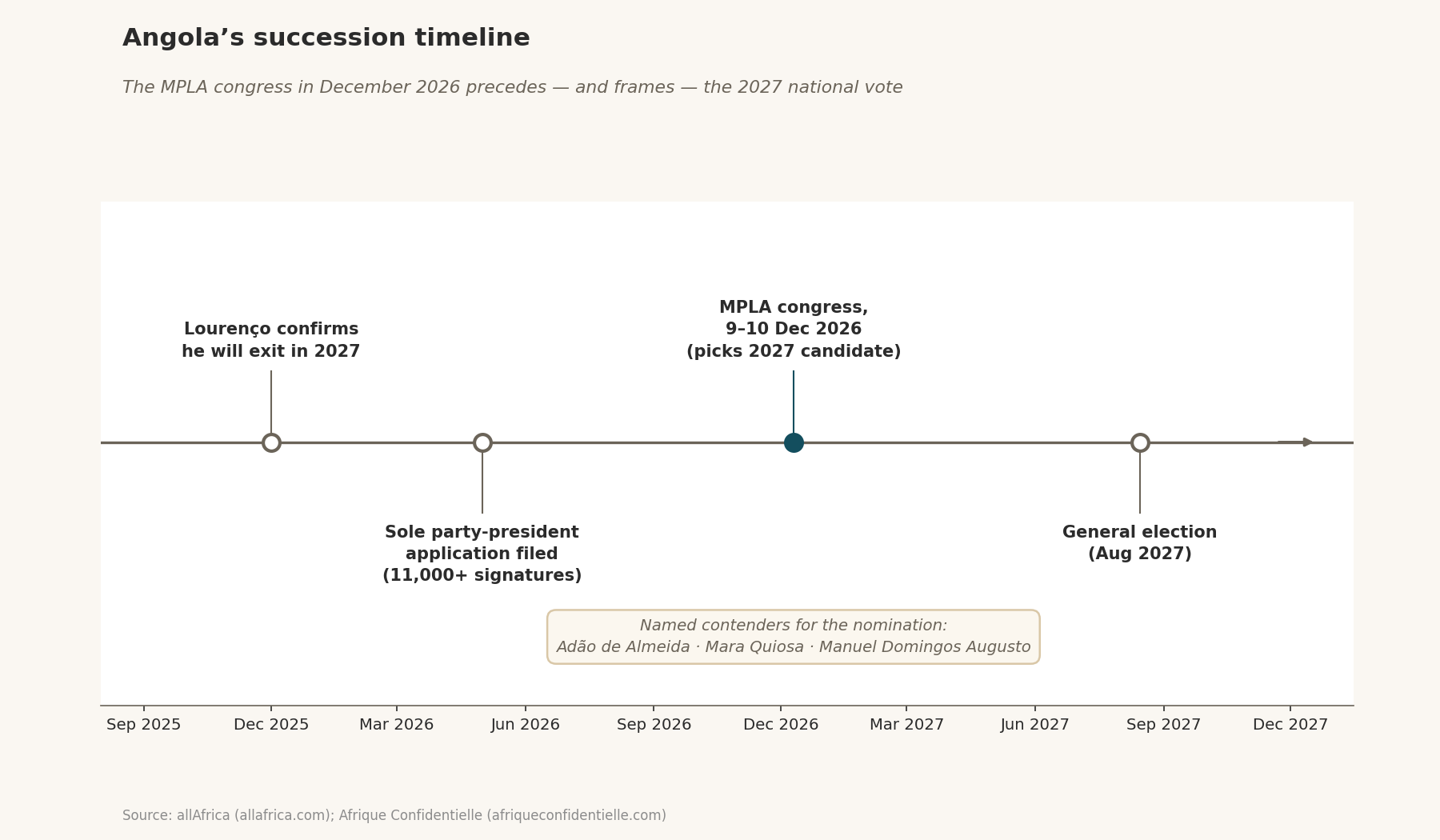
João Lourenço, elected in 2017 as the unexpected reformer who moved against the Dos Santos family and prosecuted corruption figures — earning the nickname “JLo” — is constitutionally barred from a third term (FARA filing: Angola Background Briefing). His first term was defined by an anti-corruption drive that dismantled the patronage network of his predecessor, José Eduardo dos Santos, and by an opening to Western capital and the IMF. That reformist reputation is now colliding with the more familiar instinct of the incumbent who does not want to let go. In December 2025 he confirmed he will leave power in 2027, telling an MPLA rally: “I am only leaving power because the Constitution does not allow me to continue leading the country” and adding, bluntly, “If the Constitution allowed it, I would prefer to continue the race” (360 Mozambique).
The succession he controls but will not name
What Lourenço has not done is name a successor. Instead, he is entrenching his hold on the party. By May 2026 the MPLA’s candidature sub-commission had received a single application for party president — his own — backed by more than 11,000 militant signatures across all 21 provinces, far above the 5,000-signature threshold (Afrique Confidentielle). The ninth ordinary congress is set for 9–10 December 2026 (Afrique Confidentielle). By securing an uncontested re-election as party leader while stepping down as head of state, Lourenço is engineering a split between the presidency and the party — an arrangement that keeps him at the centre of decision-making even after his term ends.
The strategic reading is that whoever controls the MPLA holds the key to designating the 2027 presidential candidate — making Lourenço a kingmaker even after his own term ends (Afrique Confidentielle). Three names circulate: Adão Francisco de Almeida, the loyalist appointed National Assembly president in late 2025; Mara Quiosa, elected MPLA vice-president in a deliberate gesture toward generational renewal; and Manuel Domingos Augusto, valued for diplomatic credibility abroad (allAfrica). Each represents a different theory of what the MPLA needs to survive: continuity and control (Almeida), youth appeal to blunt the opposition’s generational advantage (Quiosa), or international credibility to reassure the investors and partners Angola is courting (Augusto).
The alarm bell some analysts are ringing
One widely-read commentary framed the silence itself as the message: “It keeps the party dependent on his timetable, his will and his appetite for survival” (allAfrica). By refusing to anoint a successor, Lourenço prevents any rival from consolidating a power base of their own — a classic tactic for extending influence, but one that risks a disorderly scramble if his health, judgement or grip should fail.
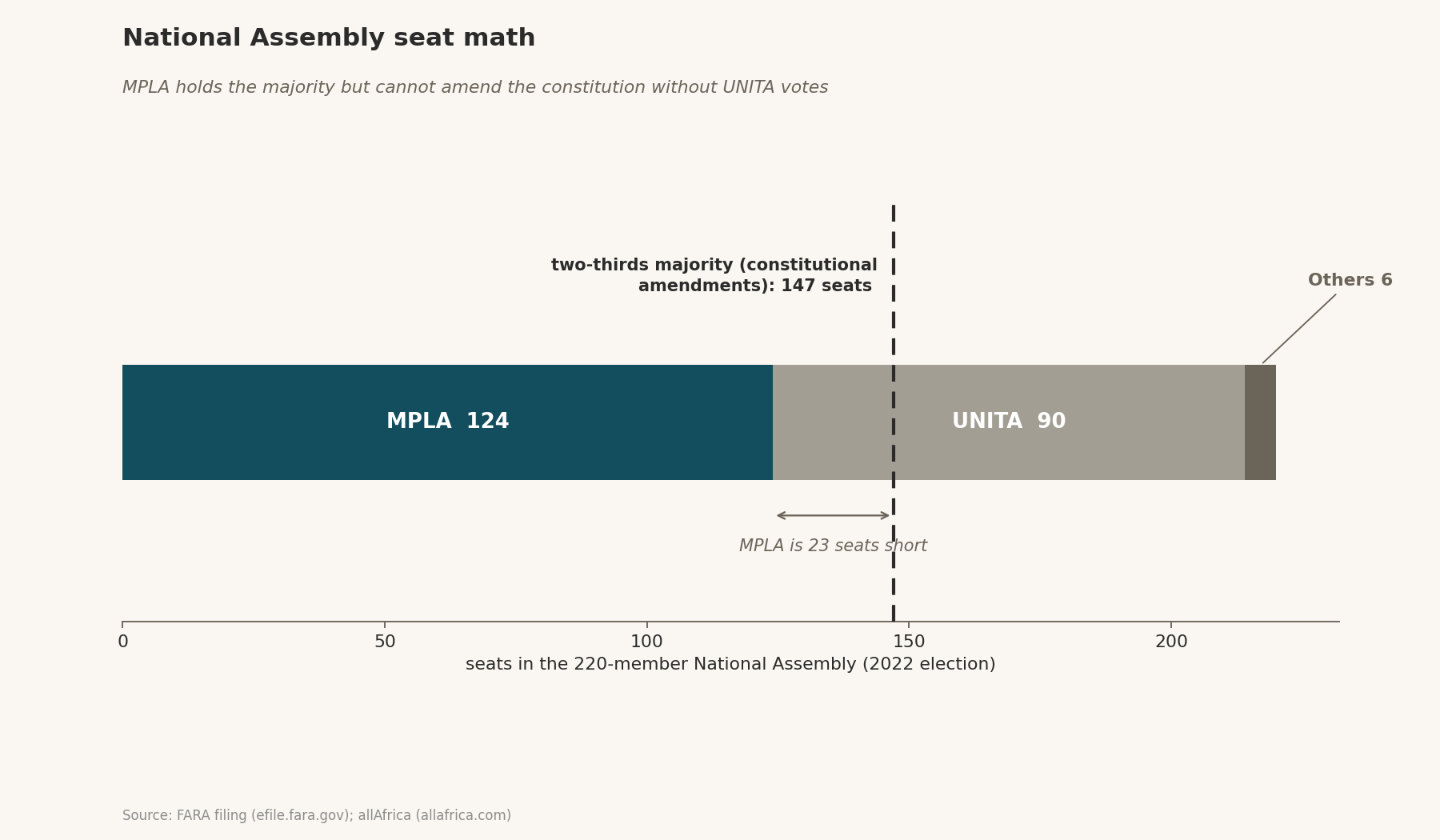
The same analysis flagged a constitutional risk: the MPLA holds 124 of 220 National Assembly seats, short of the 147 votes needed for a two-thirds constitutional revision — but any attempt to change the rules to enable a third mandate would require support beyond the ruling bench, and the piece warned of “a constitutional alarm bell” (allAfrica). Analysts have also warned of internal disputes, factional tensions, and the risk of intensified repression amid an unclear succession (ISS Africa). A controlled succession is stable only as long as the controller stays in control; the same design that concentrates power also concentrates risk.
A weakened incumbent and a rising opposition
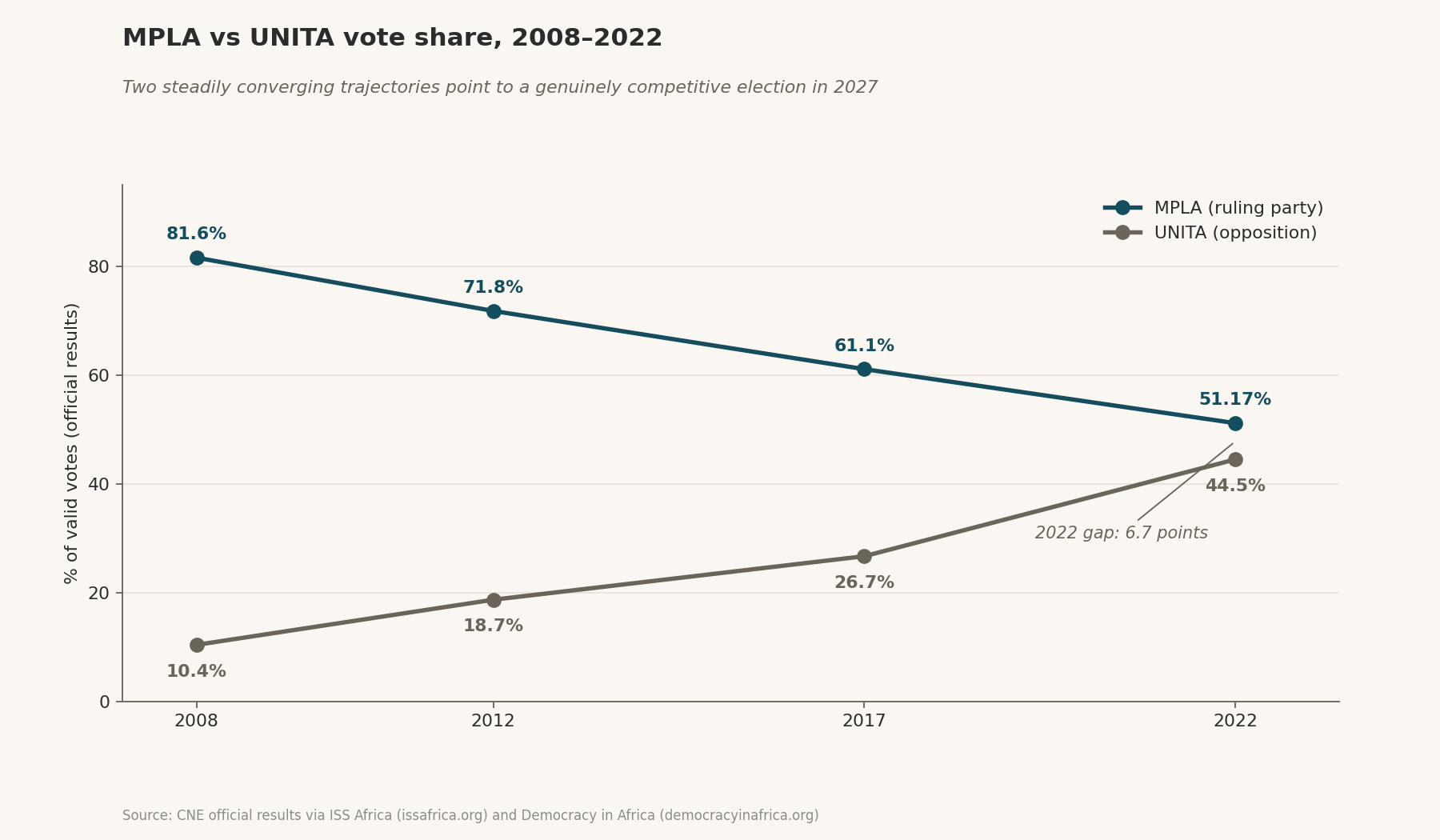
The backdrop is a ruling party at “historic lows in popularity” (ISS Africa). In 2022 — Angola’s most contested election ever — the MPLA won just 51.17% to UNITA’s 44.5%, and critically lost Luanda, where UNITA took 62.59% (ISS Africa). Losing the capital — the country’s largest, youngest and most media-connected electorate — was a psychological as much as a numerical blow. The result stripped the MPLA of the two-thirds majority needed to amend the constitution unilaterally, a structural shift of lasting importance (FARA filing). UNITA’s vote share has climbed roughly ten points per election since 2002 (Democracy in Africa). If that trajectory holds into 2027, the arithmetic points toward a genuine toss-up — the first in Angola’s post-independence history.
UNITA, having re-elected Adalberto Costa Júnior with 91% at its November 2025 congress, has declared its intent to win outright in 2027 (FARA filing). Its secretary-general Liberty Chiyaka insisted the party “will win the general elections scheduled for 2027” and would form an inclusive government (Angola24Horas). Yet the opposition remains divided in its tactics: UNITA reportedly proposed a national-unity government to Lourenço, who declined (DW radar via YouTube transcript). The opposition’s challenge is not only to win votes but to convince a sceptical electorate — and international observers — that a genuine transfer of power is possible in a system the MPLA has run for half a century.
The stakes beyond Angola
Every one of Southern Africa’s “big five” liberation parties remains in power, meaning there is no regional precedent for an MPLA exit — and a change of party in Angola would offer “useful pointers” for the whole region (Democracy in Africa). The liberation-movement-as-permanent-government model — the ANC in South Africa, ZANU-PF in Zimbabwe, SWAPO in Namibia, FRELIMO in Mozambique, and the MPLA in Angola — has defined Southern African politics since the end of colonialism and apartheid. Its erosion, where it is happening, is one of the region’s defining slow-motion stories.
Angola’s succession is not just a Luanda story. It is a test case for whether Southern Africa’s liberation-era dominance can end at the ballot box rather than in the streets — and, given the 2025 unrest, whether a weakened but still-powerful ruling party can manage a genuinely competitive transition without reaching for repression. For diplomats, investors and the region’s own democrats, few questions on the continent matter more.
Charts & visuals
X: Angola’s 2027 election may be decided in Dec 2026 — inside the MPLA. Lourenço is barred from a third term but won’t name a successor, and is locking down the party instead. Whoever runs the MPLA picks the next president. 🇦🇴
LinkedIn: João Lourenço has confirmed he’ll leave power in 2027 — yet he’s tightening, not loosening, his grip on the ruling MPLA. With the party congress in December 2026 effectively framing the presidential ticket, and UNITA closing the gap, Angola faces its most consequential transition since 2002. New Axis Media maps the succession.
Author
Sign up for New Axis Media newsletters.
Stay up to date with curated collection of our top stories.