Angola's Economy in 2026: An 11-Year Inflation Low, a Rate-Cutting Central Bank, and Households Still Under Strain
Disinflation is the good-news story of the year in Luanda. But behind the falling headline rate lies a harder question: whether ordinary Angolans feel a recovery that the data can now measure.
For most of 2024 and 2025, the story of the Angolan economy was one number climbing the wrong way: inflation. It peaked at nearly 30% in mid-2024, hammering real incomes and eroding the kwanza's purchasing power (The Rio Times). By June 2026 the picture had inverted dramatically. Annual inflation fell to 10.11% — an 11-year low — down from 19.73% a year earlier (Serrari Group; 360 Mozambique). Monthly inflation was just 0.52% in June (360 Mozambique). Halving the annual rate in a single year is an unusually fast disinflation by any standard — the kind of move that resets expectations across an entire economy.
That turn gave the Banco Nacional de Angola room to pivot. On 14 July 2026, at its 130th Monetary Policy Committee meeting in Malanje, the central bank cut its benchmark rate by 125 basis points to 15.75% — the second cut of the year and its most aggressive single move since 2023 (The Rio Times; Trading Economics). Governor Manuel Tiago Dias also slashed the year-end inflation forecast to 8.6% from 11.5% and nudged the 2026 growth forecast up to 3.6% (360 Mozambique). Holding the MPC in Malanje rather than Luanda was itself a signal — a central bank trying to project that stability is a national story, not just a capital-city one.
What actually drove the disinflation
Three forces converged. First, tight monetary policy — the IMF credited the "tight monetary policy" with helping bring inflation down (IMF, June 2026). Even after July's cut, the policy rate sits comfortably above the 10.11% inflation reading, preserving a positive real rate of roughly five to six percentage points (The Rio Times). A positive real rate matters: it rewards holding kwanza rather than dollars, supports the currency, and gives the central bank credibility to keep easing without reigniting price growth.
Second, exchange-rate stabilisation and easing supply constraints (PwC Worldwide Tax Summaries). For an import-dependent economy, the exchange rate is often the single biggest driver of the price level; a steadier kwanza feeds directly into cheaper imported goods. Third, a broadening non-oil recovery: GDP grew 5.32% year-on-year in Q1 2026, led by non-oil activity up 6.22% (Jornal de Negócios). Growth that comes with disinflation — rather than at the cost of it — is the combination policymakers dream of, because it suggests supply is expanding, not just demand being crushed.
The household reality behind the average
Here the New Axis Media lens matters: a falling national average is not the same as relief in the market. The June disinflation came "notwithstanding adjustments to diesel prices of 5%, electricity tariffs of 10%, and urban and suburban rail public transport services of 50%" (360 Mozambique). Those are precisely the administered prices that hit poorer households hardest, because energy and transport consume a larger share of low-income budgets. A headline inflation rate can fall even as the specific costs that dominate a poor family's month keep rising — and that divergence is where macro triumphalism loses touch with lived experience.
The disinflation itself is partly the aftershock of subsidy cuts that sparked deadly protests in 2025 (BBC). In other words, some of the price stability being celebrated in 2026 was purchased at real political and human cost the year before. A 2024 Afrobarometer survey found 63% of Angolans believed the economic situation had worsened over the prior year (BBC) — a reminder that sentiment lags data, and that a population burned by a cost-of-living crisis does not immediately trust a chart showing improvement.
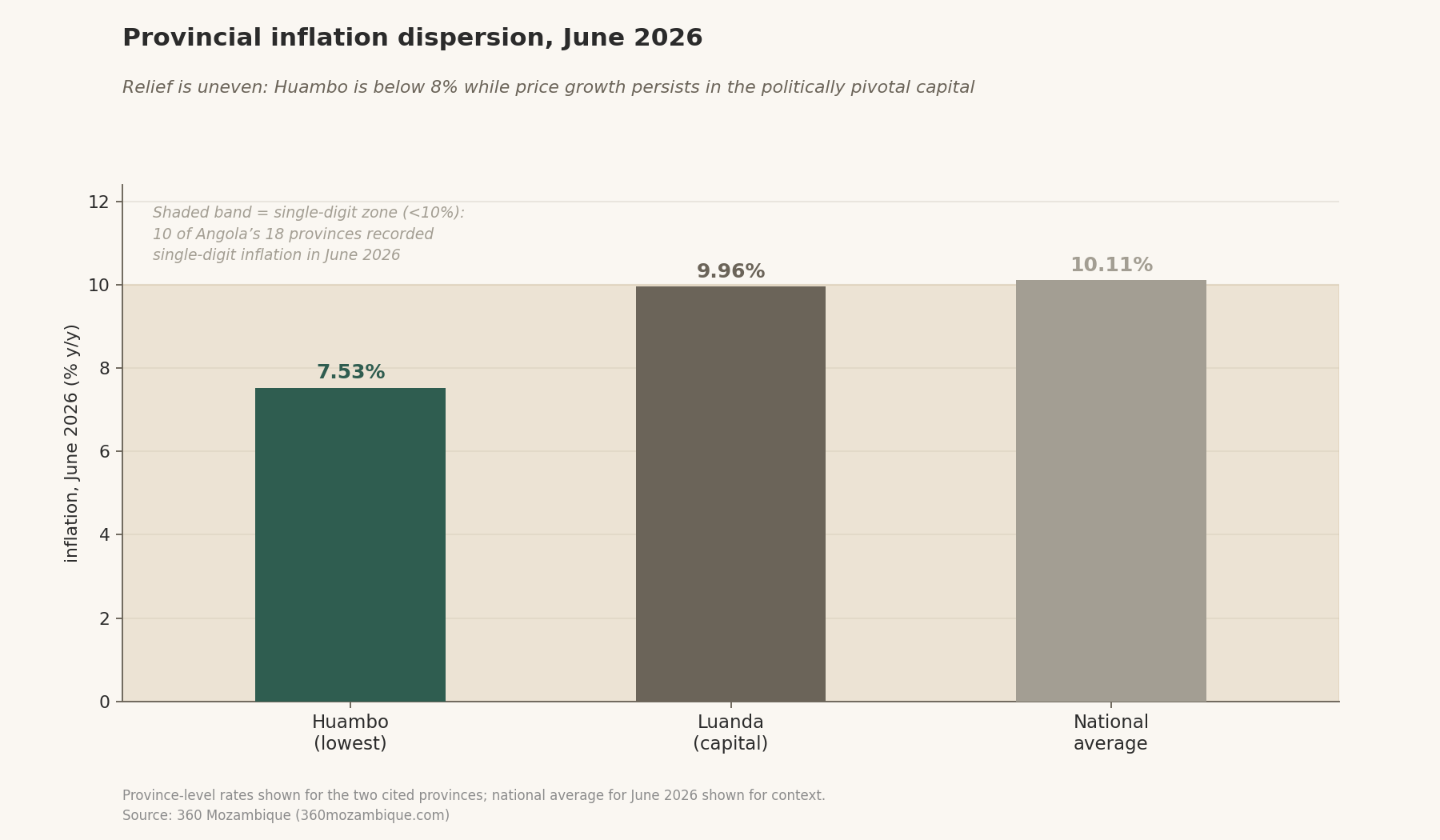
Regional dispersion tells its own story: ten provinces recorded single-digit annual inflation in June 2026, with Huambo at 7.53% and Luanda at 9.96%, but the very fact that the capital only just dipped below 10% shows how uneven the relief remains (360 Mozambique). Luanda is where the largest concentration of urban poor lives, where UNITA's support is strongest, and where the 2025 unrest was most intense — so the fact that inflation is highest exactly where political pressure is greatest is not a coincidence a government can afford to ignore.
The debt overhang that shapes everything
Angola's macro turn is real, but it is being achieved under fiscal constraint. Public debt is projected to fall to 48.1% of GDP by end-2026, and the primary balance is expected to stay positive at around 1% (Allianz Trade). A positive primary balance — spending less than revenue before interest — is the fiscal discipline that reassures creditors, but it also means austerity is the default setting. Yet Angola plans to spend almost half its 2026 budget on debt payments, and its 2026 debt strategy envisions raising roughly $1.7 billion on international capital markets, plus $1.4 billion in commercial financing and $500 million from World Bank development policy operations (Reuters via Miguel Gomes author page; The Rio Times). The IMF has warned about excess debt and flagged risks to Angola's capacity to service it (Reuters).
The debt strategy is telling in its own right: by tapping capital markets, commercial lenders and the World Bank simultaneously, Angola is deliberately spreading its funding across creditor classes rather than leaning on any single patron — the same diversification logic that governs its shift away from Chinese oil-backed loans (see Article 5). Market access is the prize a positive macro story buys; lose it, and the only options are painful.
Divergent forecasts, one honest conclusion
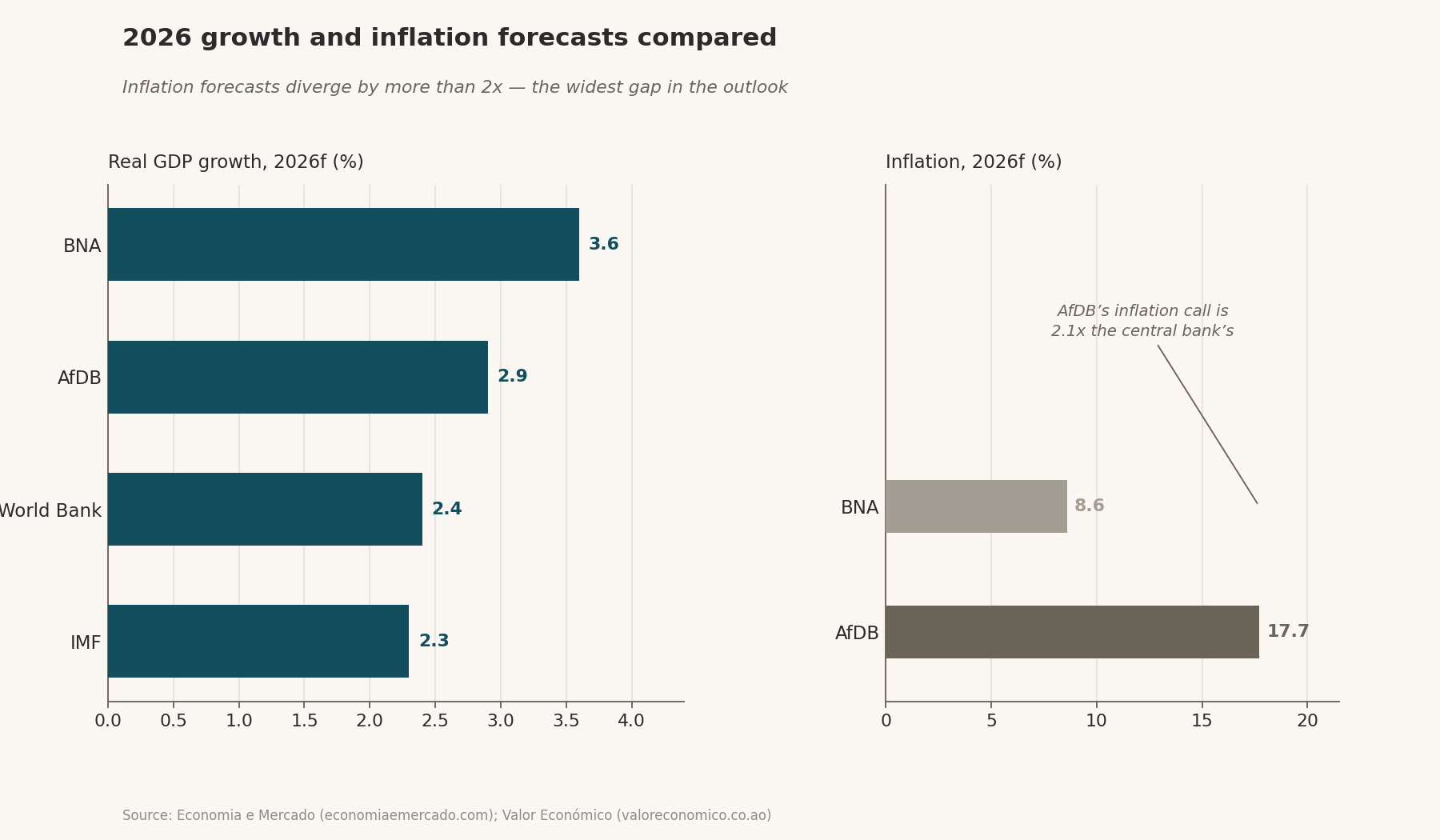
The forecasters disagree by design. The BNA sees 3.6% growth and 8.6% inflation; the World Bank 2.4% growth; the IMF 2.3%; and the AfDB warns inflation may stay "firmly above 15%," projecting 17.7% for 2026 (Economia e Mercado; Valor Económico). The gap between the central bank's 8.6% inflation target and the AfDB's 17.7% projection is enormous — more than double — and it is the single most important uncertainty in Angola's 2026 outlook. Editors should treat any single figure with caution and refresh against the next IMF World Economic Outlook and BNA MPC release before print.
The honest reading: Angola has bought macroeconomic stability, but it has not yet bought broad-based prosperity — and the two are not the same thing. Stability is the precondition for recovery; it is not recovery itself. The test of 2026–27 is whether disinflation and rate cuts translate into cheaper credit, new jobs and rising real incomes fast enough for households to feel the turn the data has already recorded.
Charts & visuals
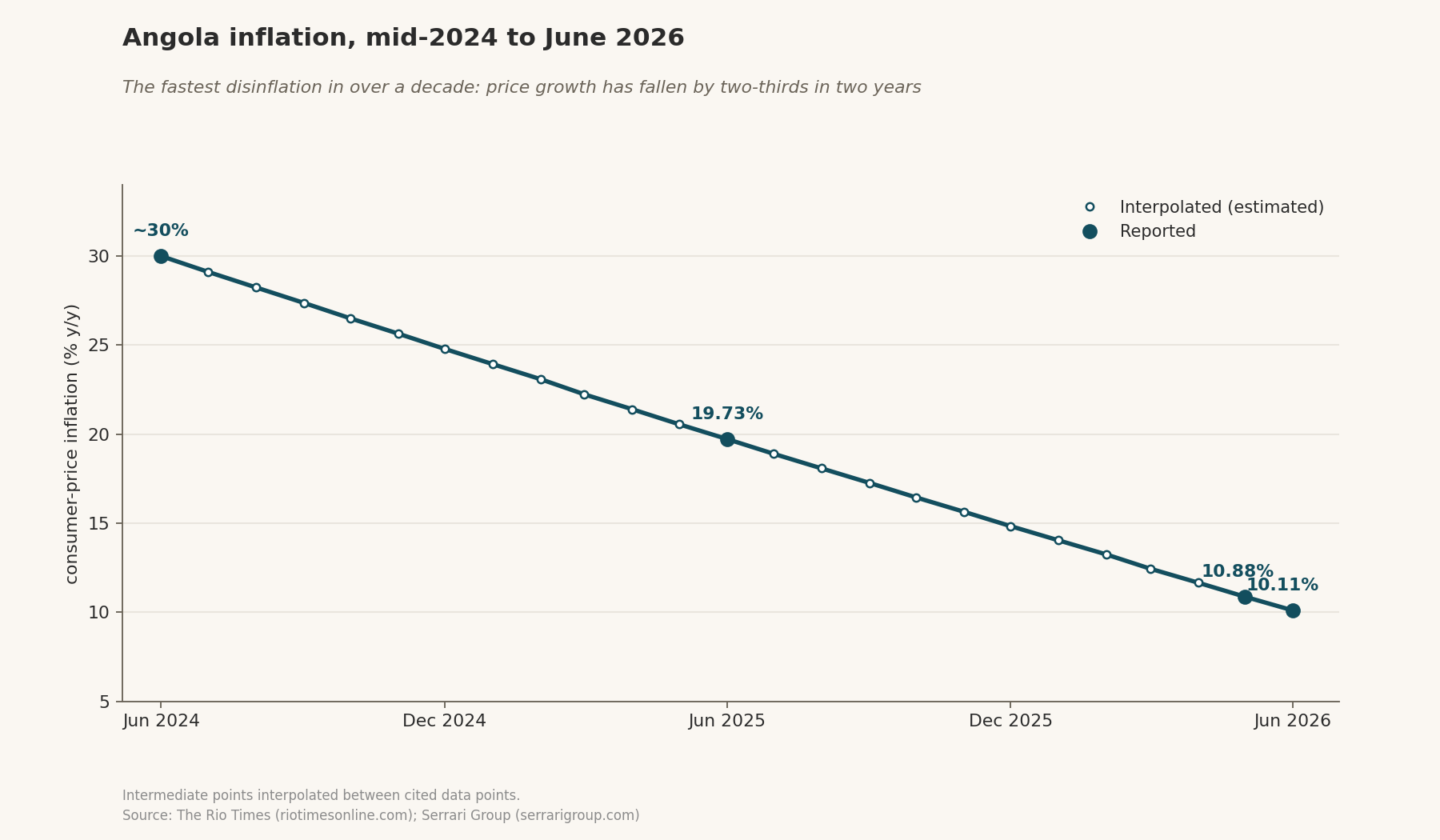
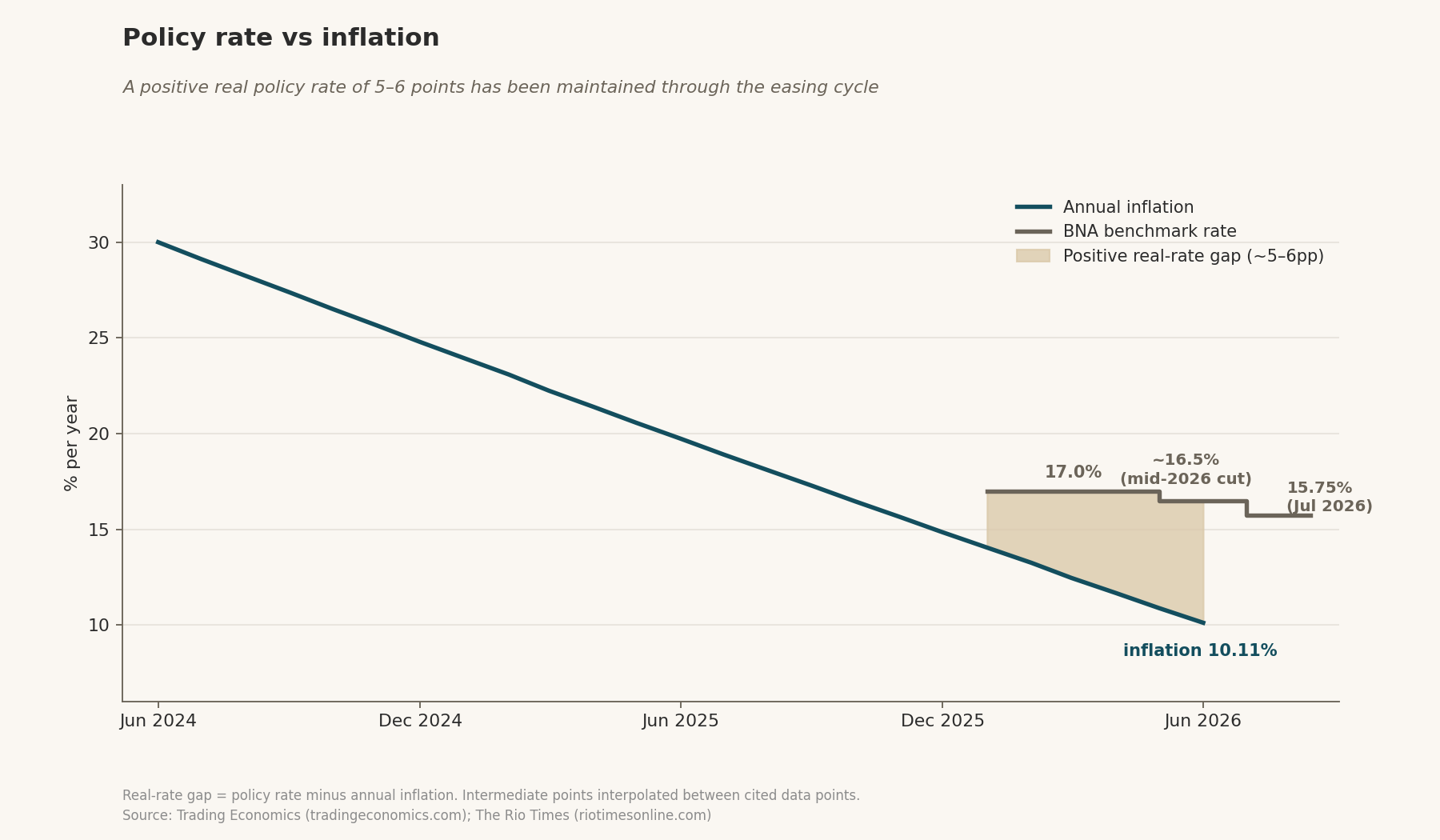
X: Angola just hit an 11-year inflation low (10.11%) and cut rates to 15.75%. But diesel is up 5%, electricity 10%, and rail fares 50%. Disinflation on paper ≠ relief in the market. Here's the gap. 📉
LinkedIn: Angola's central bank is winning the disinflation fight — inflation at an 11-year low, a bold 125bp rate cut, growth forecasts revised up. Yet the World Bank, IMF and AfDB remain far more cautious, and households still face rising administered prices. New Axis Media unpacks the distance between macro stability and lived recovery.
Author
Sign up for New Axis Media newsletters.
Stay up to date with curated collection of our top stories.