Angola's Second Diversification: The US$2 Billion Fight to Feed an Oil State
Angola imports more than half its food while farming barely a tenth of its arable land. A US$5.7 billion grain plan, a fertiliser gamble at Soyo and a coffee revival are testing whether the petrostate can relearn how to feed itself — before the next oil shock does the teaching.
The shopping basket
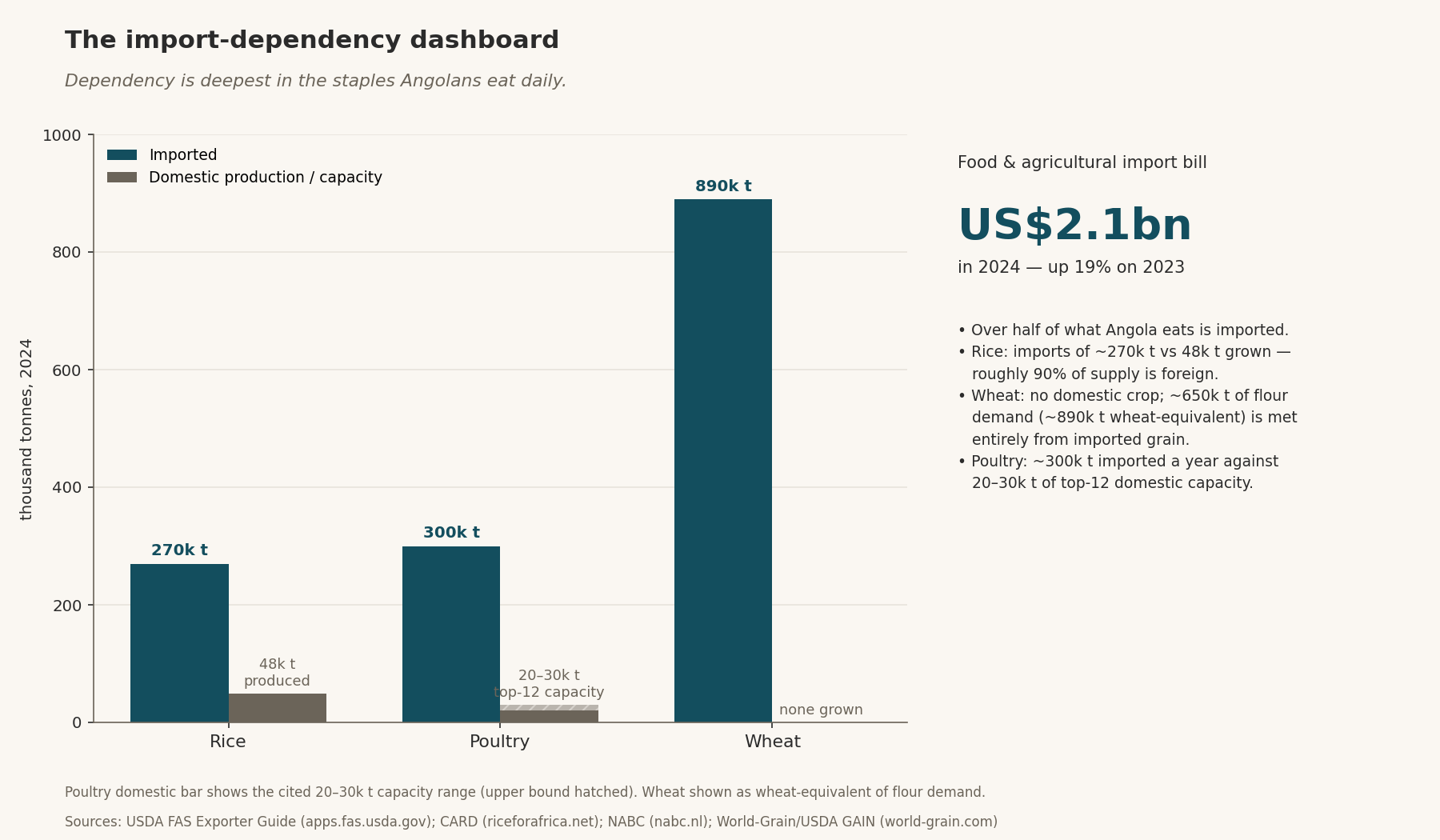
The chicken in a Luanda freezer has travelled further than most Angolans ever will. Some 300,000 tonnes of frozen poultry arrive each year, alongside rice from Asia and flour milled from imported wheat, in a food and agricultural import bill that topped US$2.1 billion in 2024 — up 19 per cent on 2023, sourced from more than 60 countries, according to the USDA Foreign Agricultural Service. The country imports over half of what it eats.
Definitions vary, and the honest figure is a range. A government presentation to the FAO Hand-in-Hand Investment Forum put food imports at US$2.9 billion in 2022, roughly 17 per cent of all imports, and counted US$3.5 billion of poultry imports over 2017–2021 alone. US$2–3 billion a year, depending on what is counted, is real money for an economy where oil still supplies about 95 per cent of exports and more than 60 per cent of fiscal revenue, per the IMF's Article IV review. Consumer-oriented products — the processed goods on supermarket shelves — added another US$870 million in 2024, with the United States the third-largest supplier at a 16 per cent share.
The dependency is granular, and it sits in the staples:
Rice. Angola produced 48,340 tonnes in 2024 — 13,302 from smallholders, 35,038 from
commercial farms — and imported about 270,000 tonnes of white rice, leaving roughly 90 per cent of supply foreign, per the Coalition for African Rice Development. Government figures have cited up to 600,000 tonnes of annual rice imports on a broader basis; the basis differs, the direction does not. The second phase of the National Rice Development Strategy, ENDA 2, targets 100,000 tonnes of paddy by 2030 — a quadrupling, from a standing start. Wheat. Angola grows none. It consumes about 650,000 tonnes of flour a year, all milled from imported grain. Five new mills since 2017 — Grandes Moagens de Angola, Carrinho, Induve, Kikolo and AP Foods — have lifted capacity to about a million tonnes, World-Grain reports, citing USDA. The milling boom is real; so is the imported wheat inside it.
Poultry. The twelve largest domestic producers can supply 20,000–30,000 tonnes a year — about a tenth of demand — the Netherlands African Business Council heard in September 2025. High feed costs, built on imported maize and soya, keep output below even that modest capacity.
Angola is not alone at the checkout. Sub-Saharan Africa's food import bill is heading for US$65 billion in 2025, up from US$62.8 billion in 2024, with cereals a third of the total, per FAO data. But few importers sit on resources like Angola's.
Land of plenty, mostly idle
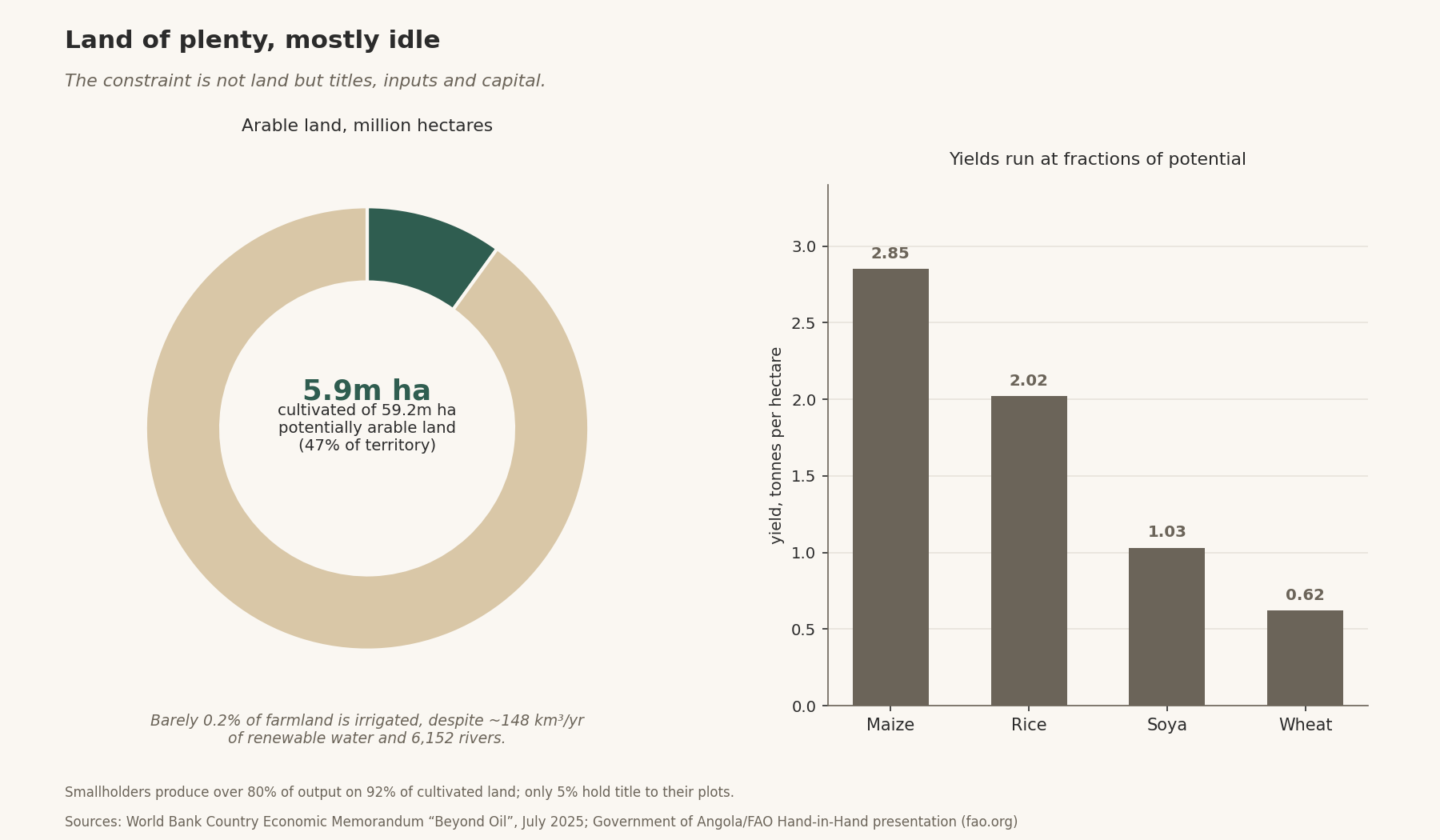
The World Bank's Country Economic Memorandum for Angola, "Beyond Oil" (July 2025), counts 59.2 million hectares of potentially arable land — 47 per cent of the territory — of which just 5.9 million hectares is cultivated. Barely 0.2 per cent of farmland is irrigated, despite renewable water of some 148 cubic kilometres a year and 6,152 rivers. The Ministry of Agriculture's own framing is similar: 35 million hectares arable, perhaps 15 per cent of it farmed, according to the US International Trade Administration.
Yields tell the story of what is missing. Maize runs at 2.85 tonnes per hectare, rice at 2.02, soya at 1.03, wheat at 0.62 — fractions of potential. Smallholders produce more than 80 per cent of output on 92 per cent of cultivated land; only 5 per cent hold title to their plots, per the government/FAO deck. Agriculture employs 55 per cent of workers, yet with fisheries
contributed 15.2 per cent of GDP in 2022. And the land itself carries a war legacy: Washington has spent more than US$150 million on mine clearance in Angola since 2000. The central-highland corridors to Luanda — prime country for maize, soya, beans and coffee — are farmed today by hoe and rain, not by tractor and pivot.
The state bets big
Luanda's answer is industrial policy with a chequebook attached. PLANAGRÃO, the 2023–2027 national grain plan, targets 6.1 million tonnes of maize, wheat, soya and rice on a US$5.7 billion financing requirement — US$2.4 billion from the state, US$3.3 billion from private capital through the BDA development bank and FACRA credit fund. Sister plans commit US$300 million each to livestock (PLANAPECUÁRIA) and fisheries (PLANAPESCA). PRODESI, the import-substitution and export-diversification programme, financed about 6,000 projects worth more than a trillion kwanzas between 2019 and 2024, generating roughly 104,000 jobs, according to national director Alan Varela, quoted by Gira Notícias.
Outcomes are arriving, unevenly. National production exceeded 30 million tonnes in the 2024/25 campaign, up 8.5 per cent, and the state has launched a "Nosso Grão" strategic food reserve, ANGOP reports. In the first half of 2026, PRODESI claimed wheat-flour output up 76 per cent, bread up 138 per cent and cooking oil up 150 per cent; fisheries landed 350,000 tonnes; and non-oil exports doubled to 259,000 tonnes, from steel rebar to maize flour, cement and bananas, per ANGOP. An earlier African Development Bank project saw business start-ups rise from 2,700 in 2012 to 38,715 in 2022, per the bank's completion report. The government says agriculture's share of GDP climbed from 6.2 per cent in 2010 to 14.9 per cent in 2023 — a figure from the state's own Angola 2050 strategy portal, to be read as the official account rather than an audited one.
The state also allocated 105 billion kwanzas to roughly 1.5 million family-farming households in the 2024–25 campaign, according to the strategy portal, and officials claim self-sufficiency in maize, fruit, vegetables, tubers, cement and beverages — a boast that sits awkwardly beside an import bill still rising at 19 per cent a year. Salt output rose 43 per cent in early 2026; food processing, for now, accounts for only about 6 per cent of economic activity, per the USDA guide. The habit to watch is the distance between target and outcome: every plan cites financing secured, few cite hectares planted.
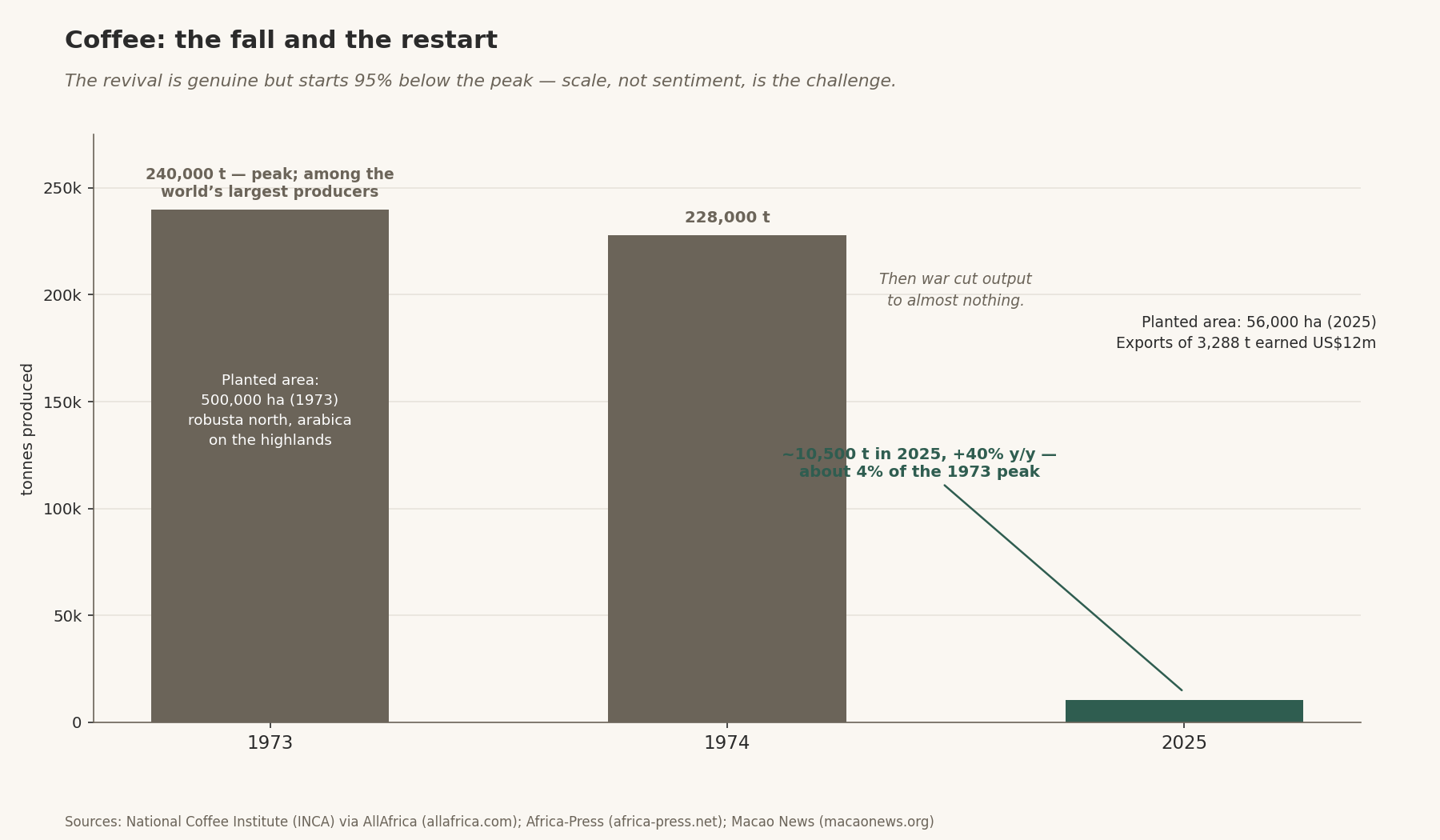
Coffee is the parable. In 1973 Angola was among the world's largest producers — the industry says third-largest — harvesting about 240,000 tonnes on half a million hectares: robusta in Uíge, the Cuanza valleys, Bengo, Malanje and Cabinda; arabica on the Benguela, Huíla, Bié and Huambo highlands. War cut that to almost nothing. Output in 2025 reached roughly 10,500 tonnes, up 40 per cent on the year, across 56,000 hectares; exports of 3,288 tonnes recently earned US$12 million, according to the National Coffee Institute, INCA, via AllAfrica, whose revival programme is replanting both belts. A revival, yes — but from a base 95 per cent below the peak, in a market now governed by the EU's deforestation rules, a premium for traceability, and buyers who long ago found other suppliers.
Fertiliser before farmland
The boldest move sits upstream of the farm gate. At Soyo, Amufert — backed by the OPAIA Group — is building a US$2 billion ammonia-urea plant designed to make 1.5 million tonnes a year from 2027, with Afreximbank arranging US$1.4 billion of the debt. Its feedstock is anchored by a US$4 billion gas processing plant that President João Lourenço inaugurated on 27 November 2025, handling 400 million cubic feet a day from the New Gas Consortium of Azule Energy, Sonangol E&P, Chevron and TotalEnergies, per AFRIQOM. The logic is import
substitution one level up the chain: stop buying the inputs for the food you want to grow. Some 4,700 jobs ride on it.
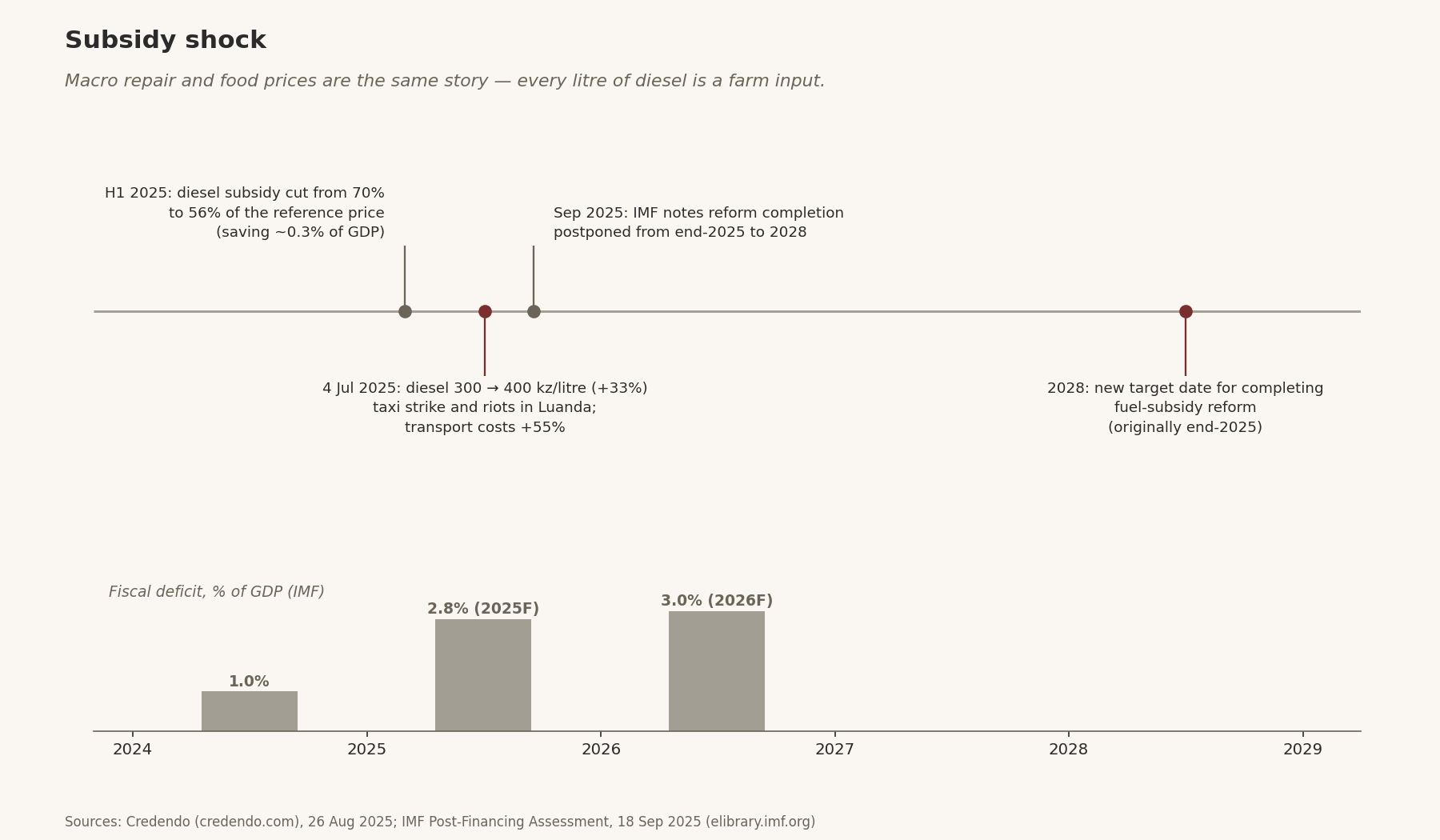
Yet subsidy politics cut straight across the fields. A 33 per cent diesel price rise in July 2025 — part of an IMF-backed reform whose completion has slipped from end-2025 to 2028, per the IMF's post-financing assessment — triggered a taxi strike and riots in Luanda in which at least 22 people died by Credendo's count; Human Rights Watch puts the toll at at least 30, with hundreds arrested, per the Bretton Woods Project. Diesel is farm fuel and freight fuel; transport costs rose 55 per cent. The 44 per cent kwanza depreciation of June 2023 raised seed, feed and fertiliser costs the same way, and inflation near 27.5 per cent in late 2025 keeps food prices where macro policy meets the street.
Two Angolas, and the world at the gate
The cruellest divide is hydrological. The centre-north holds the water and the idle land. The south — Cunene, Cuando Cubango, Moxico, Namibe, Huíla — is enduring its worst drought in 40 years after six consecutive below-average rainfall seasons. Some 2.2 million people need assistance under a SADC humanitarian appeal, with 1.8 million food-insecure and stunting affecting 40 per cent of children under five, according to the World Food Programme; FEWS NET had earlier projected 1.0–1.5 million people in crisis by January 2025 on a different method. A strategic reserve stocked in Moxico will be tested first in Cunene.
Meanwhile, the world's food powers are taking positions. Russia and Ukraine together supplied about 30 per cent of Angola's wheat imports in 2021 — the last firm data point, and one that predates the wartime trade shifts. The collapse of the Black Sea Grain Initiative in July 2023, which had moved about 33 million tonnes of grain, showed how exposed that supply line is, per the EU Council; Russia's wheat exports are forecast at 45 million tonnes for 2025/26 against Ukraine's 16.5 million, per the USDA. Gulf capital is buying position on the ground: Dubai Investments and E20 Investments have secured Angolan farmland, and AD Ports holds a 20-year, US$250 million concession on Luanda's container terminal, per Modern Diplomacy and Global Business Outlook. The alternative future is written in AfCFTA and the Lobito Corridor: Angola as supplier, not customer — and a central highlands "avocado cluster" pitching an October–February harvest straight into Europe's supply gap.
New Axis read
Angola's farm push is real, but its scoreboard is slippery: the production figures are government claims, the import bill is still rising faster than self-sufficiency, and the land under cultivation has barely moved. Watch three hard numbers — paddy output against the 100,000-tonne ENDA 2 target, Amufert's 2027 start-up, and the cultivated-hectare count in the next World Bank update. If those shift, Angola becomes AfCFTA's sleeper breadbasket, with Gulf and Atlantic buyers competing for its harvests. If the oil price falls first, the shopping basket wins — and the south goes hungry while it does.
Charts & visuals
X: Angola imports half its food — yet farms barely a tenth of its arable land. Now it is spending US$5.7bn to buy back its own table. 🌾 The oil state's second diversification, examined.
LinkedIn: Angola's food and agricultural import bill topped US$2.1 billion in 2024, up 19% — while roughly 90% of its rice and all of its wheat came from abroad. Between a US$5.7bn grain plan, an Afreximbank-financed fertiliser complex at Soyo and a coffee sector clawing back from 95% below its 1973 peak, Luanda is placing its most serious non-oil bet yet. Our analysis separates the outcomes from the strategy papers — and explains why the drought-hit south is the stress test that matters.
Author
Sign up for New Axis Media newsletters.
Stay up to date with curated collection of our top stories.