Angola's Oil Transition Is Already Here — The Question Is What Comes After the Barrel
Angola's crude output is in structural decline even as new deepwater money pours in. The country is being forced to build a post-oil state in real time — and the way it manages that squeeze will shape Southern Africa's economic map.
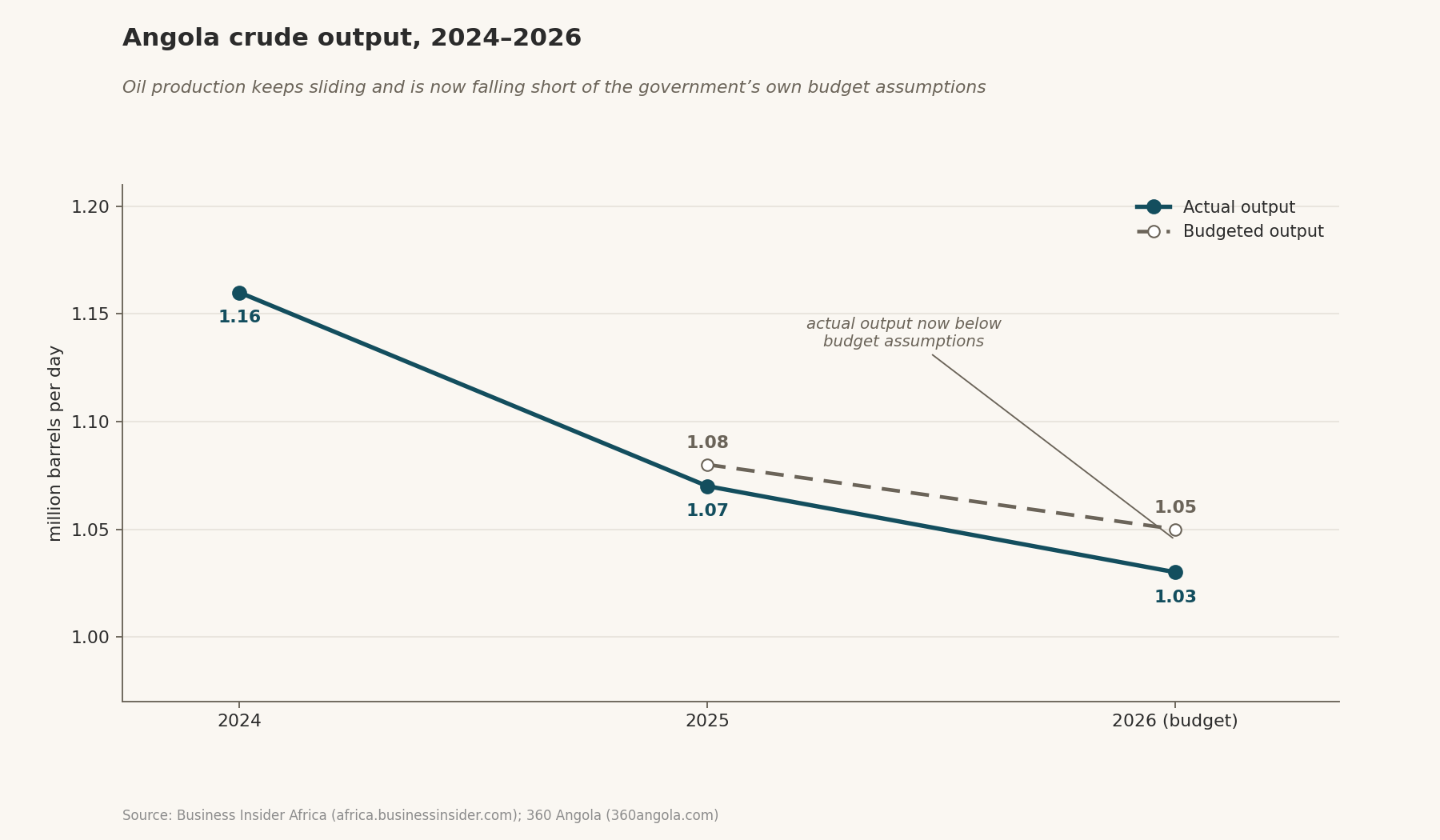
For two decades, Angola's political economy could be summarised in one word: crude. Oil still accounts for roughly 90% of exports and about 30% of GDP, a concentration that leaves the treasury exposed to every swing in the Brent price (Allianz Trade). That single dependency is the inheritance of a particular history: an oil sector that boomed through the 2000s as Angola rebuilt after a 27-year civil war, financed a construction spree largely on Chinese credit, and made Luanda for a period one of the most expensive cities in the world for expatriates — all while the non-oil economy stayed thin. What has changed is the direction of the barrel. Output fell from 1.16 million barrels per day in 2024 to 1.07 million in 2025, and the IMF has described a "significant decline in oil production" as the defining feature of Angola's 2025 macro story (Business Insider Africa; IMF press briefing, 25 June 2026).
The IMF's Julie Kozack put it plainly after the 2026 Article IV consultation: the "structural decline in oil production means that the medium-term growth outlook, at the moment, it looks subdued," and it "highlights the need for Angola to continue on the path of economic diversification" (IMF, June 2026). This is the paradox at the centre of Angolan policy in 2026: the state needs oil revenue to fund the diversification that is supposed to reduce its dependence on oil. It is a race against the depletion curve — the government must extract enough value from a declining resource, fast enough, to build the economy that will outlast it.
The deepwater counter-narrative
Luanda is not surrendering the barrel without a fight. In mid-2026 Azule Energy — the BP–Eni joint venture and Angola's largest oil producer — anchored a $5.1 billion offshore investment aimed at slowing the decline, with crude trading near the level Angola needs to balance its budget (Africa Energy Pulse). The government has revised licensing terms, encouraged investment in mature and offshore assets, and set the explicit goal of keeping production near 1 million barrels per day (Business Insider Africa). The Greater PAJ development is expected to add barrels when first oil arrives in the first half of 2029 (Business Insider Africa).
The strategy here is not denial but managed extension. Angola's deepwater basins are technically demanding and expensive, which means the majors will only keep investing if the fiscal and regulatory terms make sense — hence the licensing reforms. Every year of delay in bringing new fields online is a year in which the depletion of existing wells outpaces new supply. The bet, in essence, is that a smaller, more efficient oil sector can plateau near a million barrels a day for long enough to bankroll the transition, rather than collapsing in a disorderly way that would blow a hole in the budget.
The 2026 budget crystallises the wager. It was built on an average oil price of $61 per barrel and daily production of 1.05 million barrels (360 Angola). With Brent opening around $76 in July 2026, the conservative price assumption gives Luanda breathing room this year — a rare instance of a commodity budget erring on the side of caution — but it also underscores how thin the margin is. Oil revenue contracted 24.7% year-on-year in nominal dollar terms in 2025, and output of 1.03 million barrels a day came in below the budgeted 1.08 million (Business Insider Africa). A budget that assumes production it may not achieve is a budget with a built-in vulnerability, even when the oil price cooperates.
The real transition is fiscal, not just geological
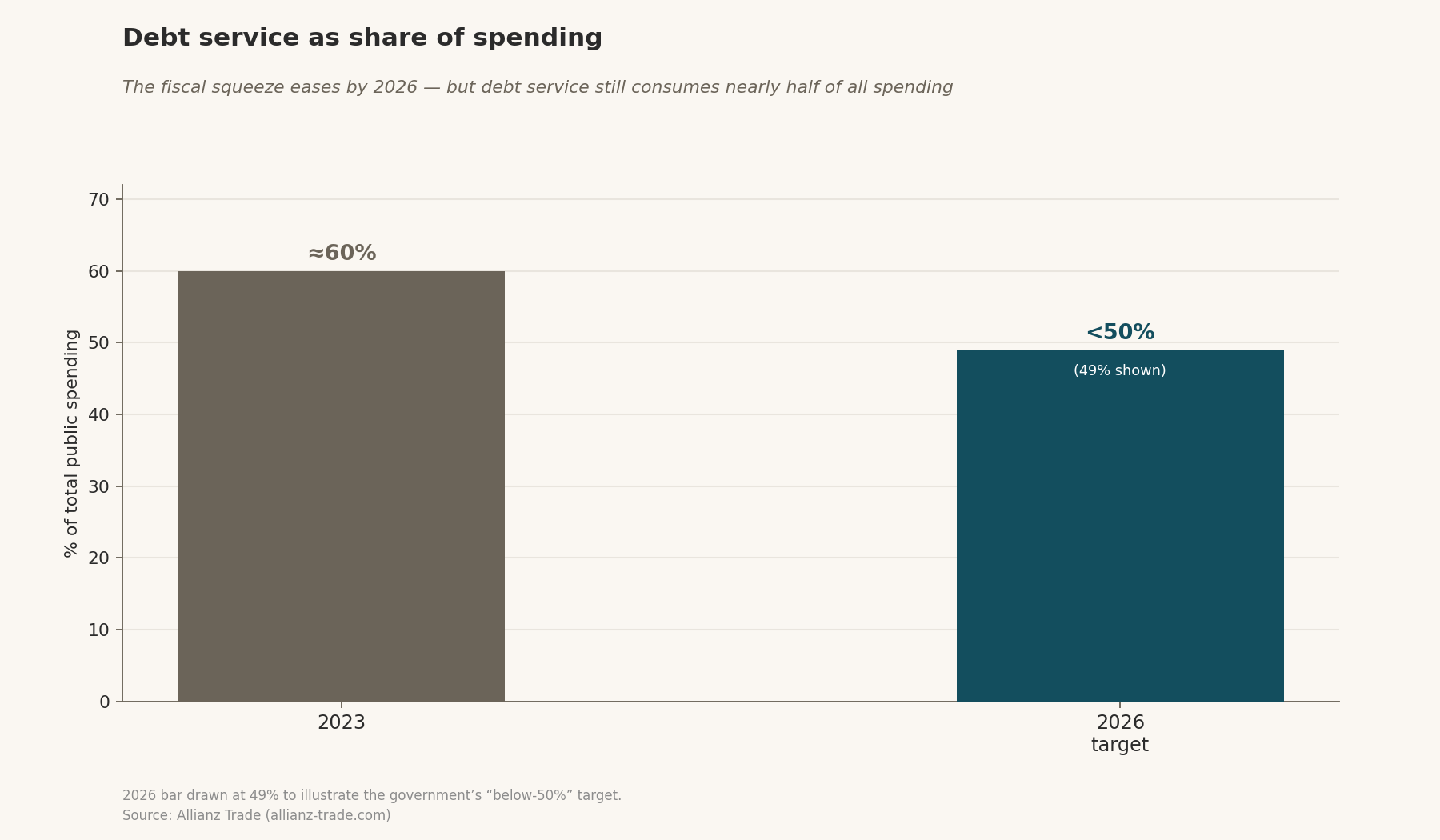
The most important number in Angola's oil transition is not a production figure — it is a spending figure. Servicing its debt cost Angola 16.2% of GDP in 2023 and 12.8% in 2024, and the government planned to cut spending by 5% in 2026, in part by reducing debt service from around 60% of all spending to just under 50% (Allianz Trade). Every barrel that fails to arrive tightens that vice. When roughly half the budget is pre-committed to creditors before a single school, clinic or road is funded, the room for the discretionary spending that diversification requires — subsidies for new industries, public investment, skills training — is correspondingly narrow.
That fiscal reality is why the transition is being felt on the street, not just in ministry spreadsheets. To meet its budget targets, the government cut fuel subsidies and raised diesel prices — the trigger for the deadliest civil unrest since the end of the civil war in 2002 (Wikipedia: July 2025 Angolan protests). Fuel subsidies had long functioned as the most visible way ordinary Angolans shared in the country's oil wealth; removing them severed that link at precisely the moment households were least able to absorb the shock. The post-oil state, in other words, is not a distant policy seminar. It is arriving through pump prices — and its politics are already combustible.
The non-oil economy is finally moving
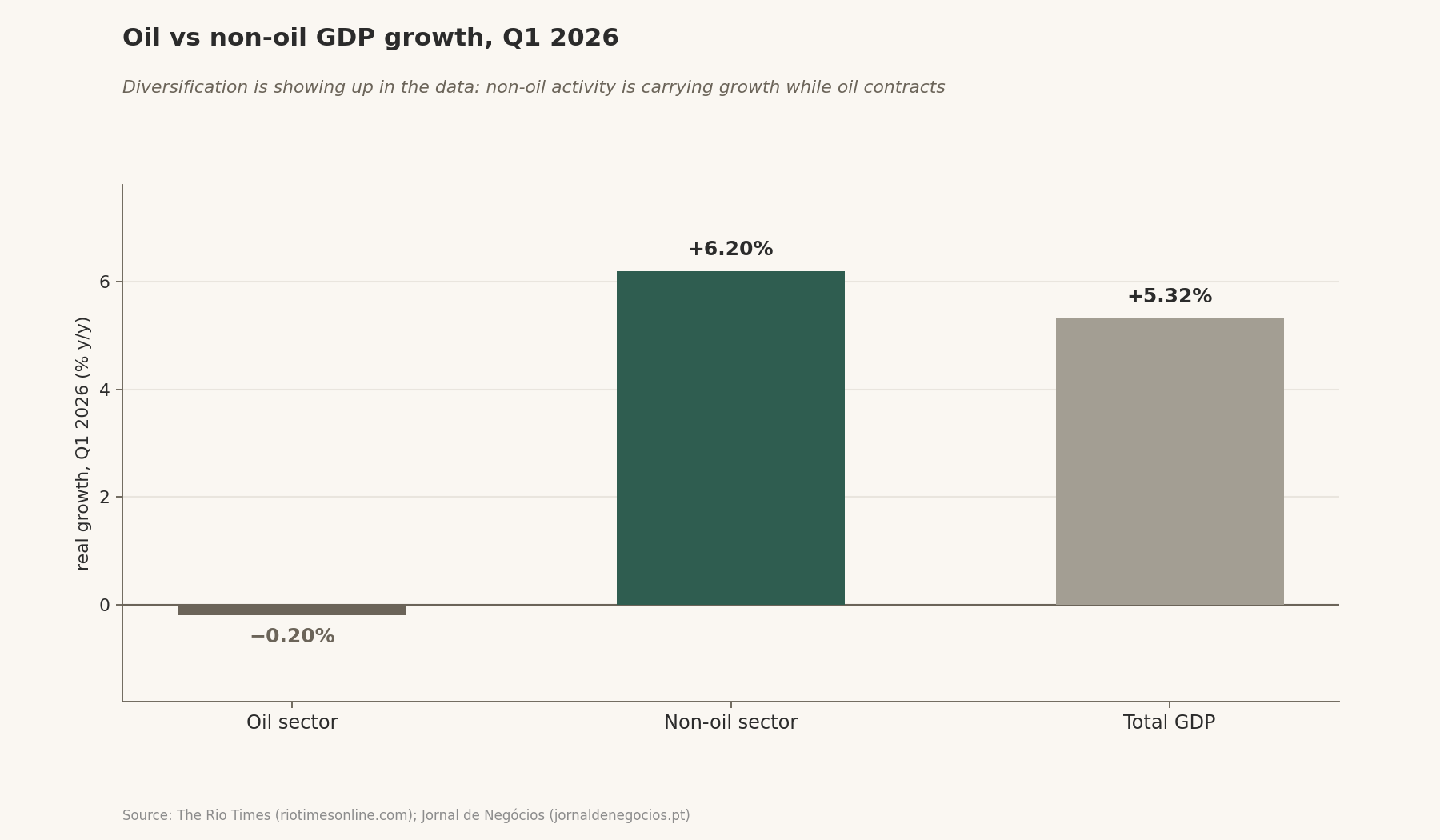
There is a genuinely encouraging counter-signal. In the first quarter of 2026, non-oil sectors grew 6.2% while the oil sector actually contracted 0.2%, and the National Bank of Angola (BNA) explicitly cited non-oil momentum when it raised its 2026 growth forecast to 3.6% (The Rio Times; 360 Mozambique). For the first time in a generation, the sentence "Angola grew because of something other than oil" is factually defensible.
The obvious next question is where that growth is coming from and whether it can be sustained without oil revenue quietly subsidising it. Agriculture, fisheries, construction and services have all been targets of diversification rhetoric for years; the Q1 2026 data suggests some of that rhetoric is finally translating into output. But a single strong quarter is not a structural break. The durability test is whether non-oil growth can survive the fiscal squeeze — whether these sectors can attract private capital and credit at the 15.75% policy rate now prevailing, rather than depending on state spending funded, ultimately, by the barrel.
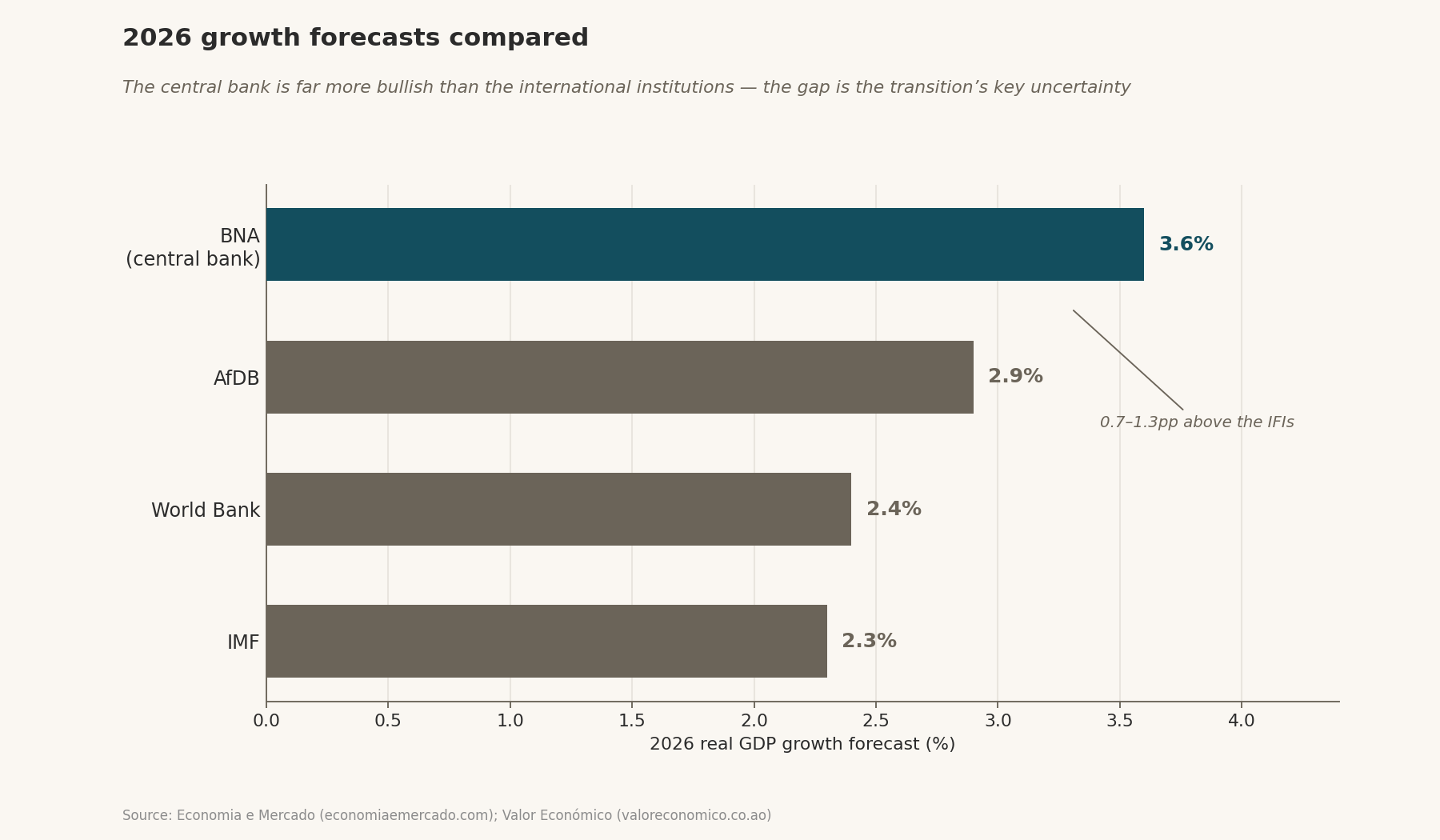
The caution: international lenders are more sober. The World Bank projects 2.4% growth for 2026 and the IMF 2.3%, both below the BNA's 3.6% (Economia e Mercado). The African Development Bank sees 2.9% in 2026 rising to 3.3% in 2027 — still below the continental average of above 4% (Valor Económico). The dispersion is itself information: forecasters closest to the government see the transition working; those with no stake in the political narrative see a slower grind. Editors and investors should treat the gap as the honest range, not pick the number that flatters their thesis.
Why the world should care
Angola sits at the intersection of three global systems. It is Africa's second-largest oil producer after Nigeria, a swing factor in OPEC+ dynamics, and — via the Lobito Corridor — a proposed Atlantic gateway for the copper and cobalt the energy transition depends on. Each of those roles ties Angola's domestic transition to a larger contest. Its OPEC+ quota decisions ripple into global oil prices; its ability to build a logistics economy around Lobito determines whether the United States, China and the Gulf see it as a durable partner or a resource stop; and its success or failure in diversifying will be read across the continent as a verdict on whether petrostates can escape the resource curse without a crisis.
How Angola manages the decline of the old economy while standing up the new one is, in miniature, the question facing every hydrocarbon-dependent state on the continent — from Nigeria to the Republic of Congo to the newer gas producers of Mozambique and Tanzania. The barrel is not the future. What Angola builds with the last of it might be.
Charts & visuals
X: Angola's oil is in structural decline — output fell to 1.03m b/d in 2025, below budget. Yet its non-oil economy just grew 6.2%. The post-oil state isn't a forecast. It's happening now. 🧵
LinkedIn: Angola built a state on crude that still supplies ~90% of exports. Now production is falling and debt service has eaten up to 60% of spending. But Q1 2026 delivered a surprise: non-oil growth of 6.2%. New Axis Media examines whether Angola can build a post-oil economy fast enough — and why it matters far beyond Luanda.
Author
Sign up for New Axis Media newsletters.
Stay up to date with curated collection of our top stories.