Angola's Youth Found Their Voice in 2025. The 2027 Election Will Test What It Becomes.
A generation born after the civil war took to the streets over fuel prices, jobs and dignity — in the deadliest unrest since 2002. Their political awakening is the most important social force in Angola, and no one, including the opposition, fully controls it.

The most important political actor in Angola is not a party or a president. It is a generation. Angola marked 50 years of independence on 11 November 2025, and the young people who took to its streets that year were born after the civil war ended in 2002 — a cohort with no memory of the conflict the ruling party invokes to justify its dominance, and no patience for the poverty and inequality that have outlived it (BBC). For half a century the MPLA has drawn legitimacy from having won independence and ended the war; to a generation that experienced neither, that story is history, not a mandate. That generational disconnect is the fault line running through Angolan politics as it approaches the 2027 election (see Article 3).
What actually happened
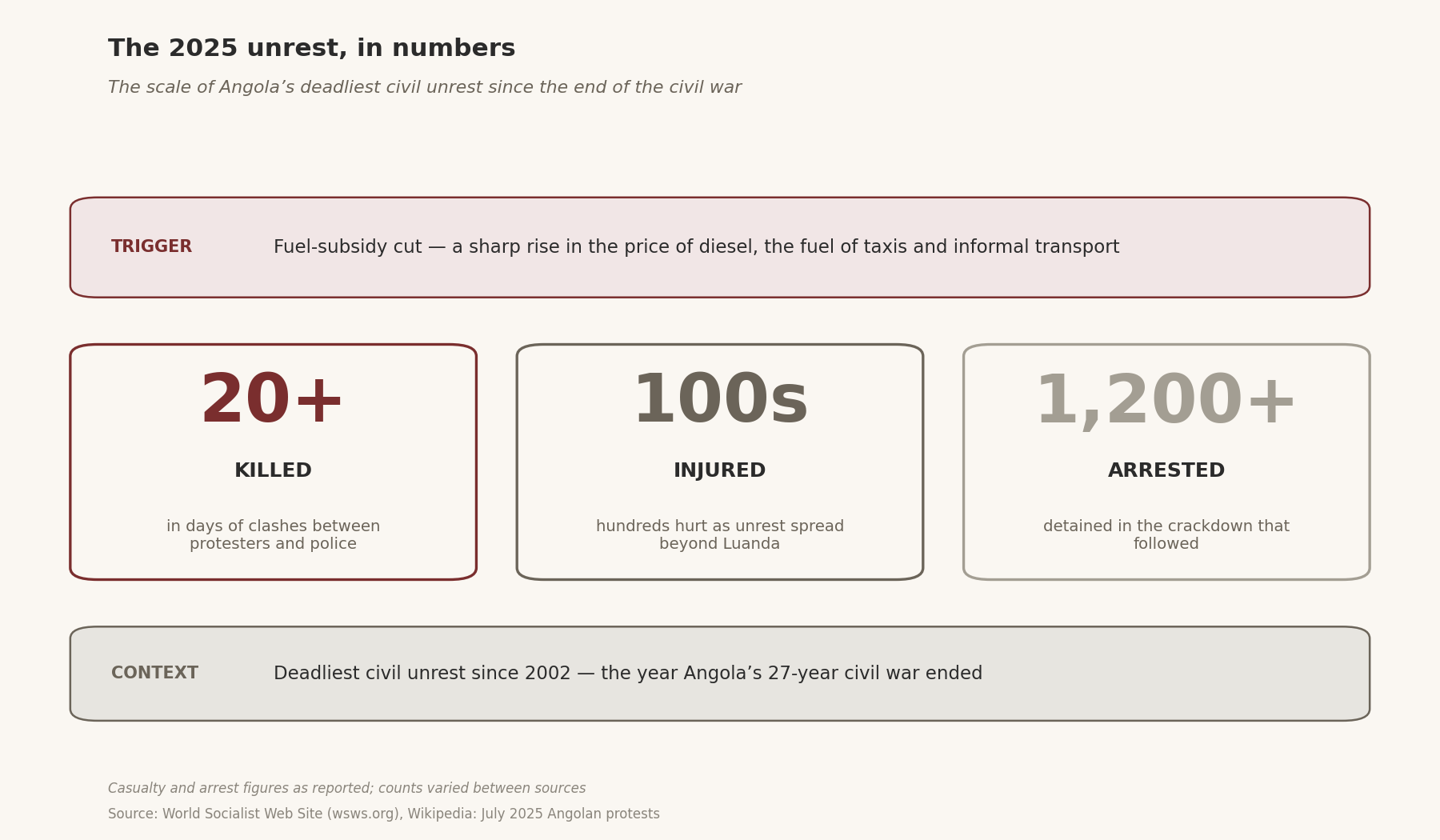
The 2025 unrest was, in the BBC's words, "one of the most notable protest movements since Angola's civil war concluded in 2002" (BBC). The trigger was economic: a government decision to cut fuel subsidies and raise diesel prices — part of IMF-linked fiscal reforms — sparked a taxi-driver strike in Luanda that spread into nationwide strikes, marches and riots (Wikipedia: July 2025 Angolan protests). It became the deadliest civil unrest since the end of the war (Wikipedia). Reporting cited more than 20 people killed, hundreds injured, and over 1,200 arrested (World Socialist Web Site). The subsidy cut was, in a sense, the spark to dry tinder: the removal of one of the few tangible ways ordinary Angolans shared in the country's oil wealth, at a moment of acute cost-of-living strain (see Articles 1 and 2).
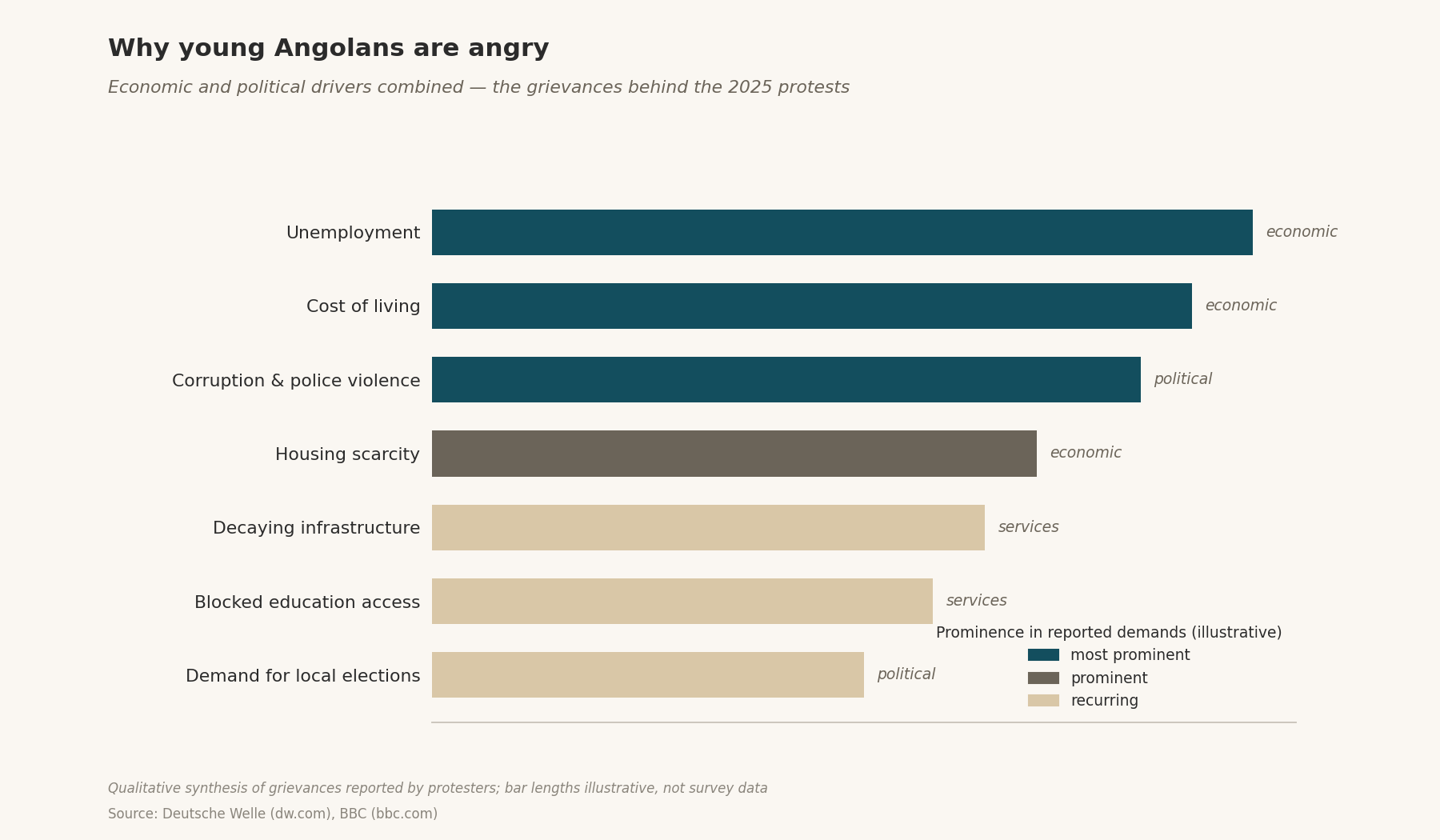
But civil-society groups insisted the protests were "about more than just high fuel prices" — they reflected unemployment, poor public services and inequality (Wikipedia). As one observer told the BBC, "the looting was simply the method young people chose to attract attention from those in power" (BBC). The fuel price was the occasion; the underlying grievance was a generation's sense that the state was not working for it.
The grievances behind the anger
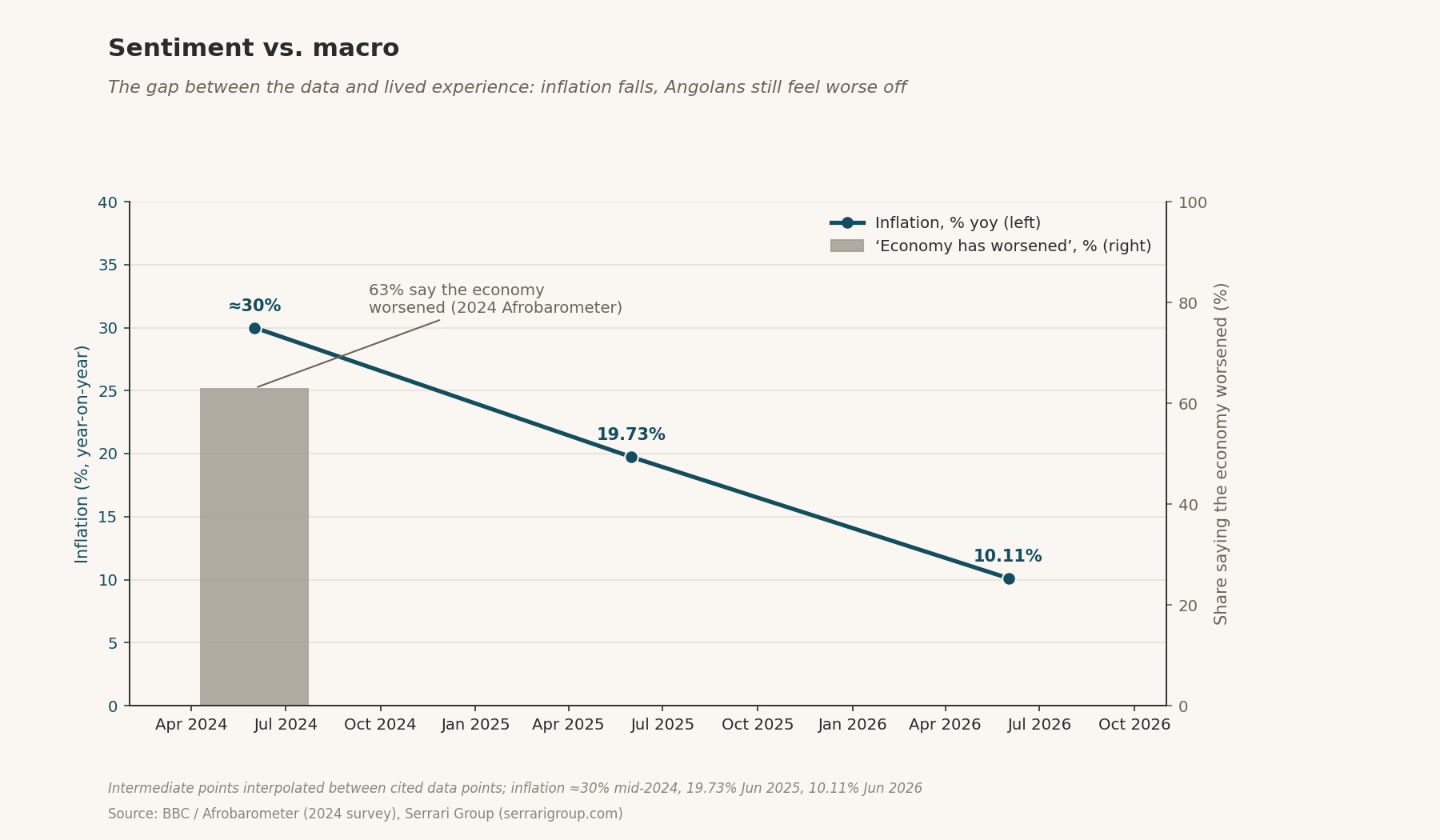
Young Angolans face a stacked set of obstacles: high unemployment, a shortage of adequate housing, decaying infrastructure and blocked access to education (Deutsche Welle). Each of these is a facet of the broader jobs-and-cities crisis explored elsewhere in this package (see Articles 14 and 17) — but in Angola they converge on a single generation at a single political moment. The sentiment is broad-based: a 2024 Afrobarometer survey found 63% of Angolans believed the economic situation had worsened over the previous year (BBC). Youth have been "at the forefront of anti-government protests," raising issues "from corruption and police violence to demands for local elections" (BBC). The demand for local elections is telling: it is a call not just for relief but for a greater voice — for the political inclusion a half-century of one-party dominance has withheld.
The government's response — and its risk
The state's reaction has been to delegitimise rather than engage. President Lourenço denounced the protests as "acts of irresponsible citizens manipulated by unpatriotic national and foreign organizations through social media" (BBC); the MPLA labelled the unrest "unpatriotic" and a threat to "unity, reconciliation, peace and progress" — framing that "prevents any genuine engagement with the public's grievances" (ISS Africa). This is the reflex of a liberation movement that equates opposition with betrayal — but it is a dangerous reflex when the people being dismissed are a majority-young population with rising expectations. Analysts warn of a "high risk of further violent protests until elections" and of possible increased repression amid the uncertainty of Lourenço's political cycle (ISS Africa). A government that treats grievance as sedition risks pushing legitimate discontent toward confrontation.
A movement no party owns
Crucially, this is not a movement captured by the opposition. UNITA supported the demonstrations, but the youth organisations behind the April 2025 protests convened without the youth wings of either the MPLA or UNITA present — a signal that the generation's political energy runs ahead of, and partly outside, the existing party structures (Deutsche Welle). This is a decisive feature. A movement owned by an opposition party can be co-opted, negotiated with, or defeated at the ballot box; a movement that belongs to no party is harder for anyone — government or opposition — to channel or contain. As one activist put it, "political awareness is rising in Angola, and elections are viewed as a pivotal moment for genuine change," predicting more protests through 2027 (BBC). The energy exists; the question is what institutional form, if any, it will take.
The New Axis read
Angola's youth are not a passive victim group to be pitied; they are the country's most consequential strategic actor, and they are reshaping the terms of politics faster than any party can absorb. The disinflation and rate cuts of 2026 may stabilise the macroeconomy (see Article 2), but they do not, by themselves, deliver jobs, housing or dignity — the things the streets demanded. Macroeconomic stability and lived recovery are not the same, and a generation that feels the gap will not be pacified by a falling inflation rate.
The 2027 election is the test: whether this awakening channels into ballots and institutional change — a peaceful realignment of Angolan politics — or whether a government that treats grievance as sedition pushes it back into the streets. The outcome matters far beyond Angola, as a signal of whether Southern Africa's liberation-era order can accommodate a generation that never lived under it (see Article 3). Either way, the generation born in peace has served notice that it will not inherit its parents' silence.
Charts & visuals
X: In 2025, Angola's post-war generation took to the streets — the deadliest unrest since 2002. Trigger: fuel prices. Real cause: jobs, housing, dignity. And no party fully controls it, not even the opposition. 2027 is the test. 🇦🇴
LinkedIn: The most important political actor in Angola isn't a party — it's a generation born after the civil war. New Axis Media examines the 2025 protests, the deadliest unrest since 2002, sparked by fuel-price hikes but driven by unemployment, housing and corruption. Crucially, this awakening runs ahead of the existing parties. The 2027 election will test what it becomes.
Author
Sign up for New Axis Media newsletters.
Stay up to date with curated collection of our top stories.