What an IMF Article IV consultation actually is
It is surveillance, not a loan. Understanding the difference explains why "the IMF said" headlines are so often wrong.

Why it matters. African policy debate routinely treats every IMF document as a bailout condition. Most are not. Article IV is the single most common IMF interaction with African governments and the least accurately reported.
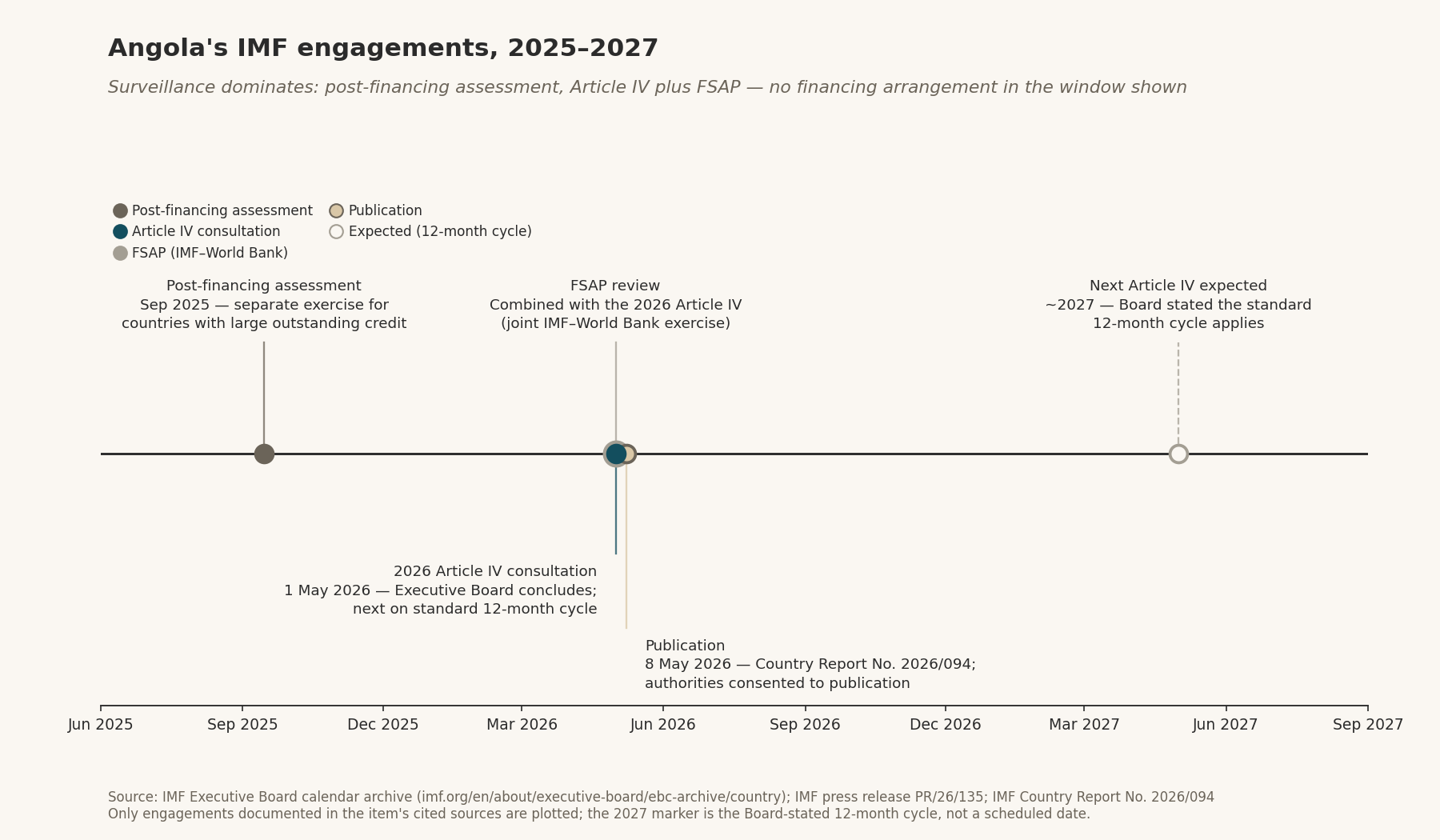
The facts. An Article IV consultation is a periodic health check the IMF conducts with essentially every member country under Article IV of its Articles of Agreement, normally on a 12-month cycle. A staff team visits, collects data, meets officials and often private-sector and civil-society interlocutors, and writes a staff report. The Executive Board then discusses it and issues conclusions. Publication requires the member's consent — Angola's authorities consented to publication of the staff report prepared for their 2026 consultation, and the Board explicitly stated the next consultation would be on the standard 12-month cycle, per the IMF Executive Board press release. The resulting document is published in the Fund's country report series — Angola's appeared as Country Report No. 2026/094 — and the series itself is catalogued on the IMF's Article IV staff reports page. Board dates are publicly logged: Angola's consultations appear in the Executive Board calendar archive alongside separate exercises such as its September 2025 post-financing assessment.
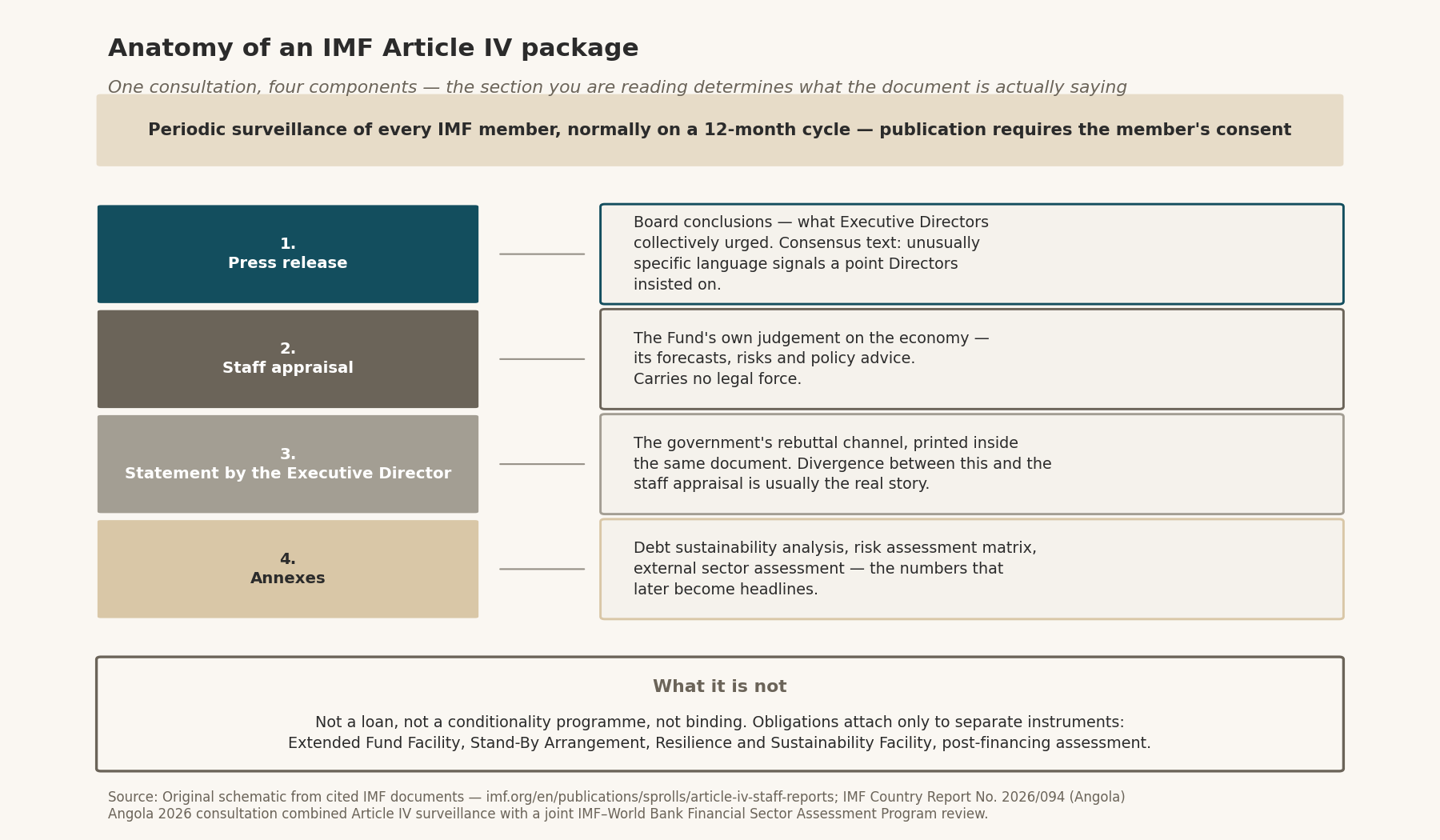
How to read one. Four components repay attention. The press release carries Board
conclusions — what Directors collectively urged. The staff appraisal is the Fund's own judgement. The statement by the Executive Director for the country is the government's rebuttal channel, and divergences between it and the staff appraisal are usually the real story. Annexes — debt sustainability analysis, risk assessment matrix, external sector assessment — contain the numbers that later become headlines.
What it is not. It is not a loan, not a conditionality programme, and not binding. Article IV recommendations carry no legal force. Separate instruments — Extended Fund Facility, Stand-By Arrangement, Resilience and Sustainability Facility, or post-financing assessment for countries with large outstanding credit — do carry obligations. Angola's 2026 exercise combined Article IV surveillance with a Financial Sector Assessment Program review, a joint IMF–World Bank exercise, documented in the FSAP financial system stability assessment.
Between the lines. The consent-to-publish rule creates an incentive: governments that expect harsh findings can delay or withhold publication, so an unpublished consultation is itself information. And because Board conclusions are consensus text, unusually specific language — such as the 2026 instruction that Angola apply any oil windfall to debt reduction rather than spending — signals a point Directors insisted on.
What to watch. Publication dates versus Board dates; whether a country moves from Article IV-only to a financing arrangement; and whether staff appraisals and government statements diverge over consecutive years.
Method and sources. IMF institutional documentation and the Angola 2026 consultation record, used as a worked example.
Related reading: The IMF's Angola verdict; What FATF grey-listing does to an African bank; Angola's 2026–2029 debt wall.
Charts & visuals
X: "The IMF said" — but which document? Article IV is surveillance, not a loan, publication needs the government's consent, and the government's own rebuttal is printed inside. How to read one properly →
LinkedIn: Most reporting on IMF documents conflates surveillance with conditionality. An Article IV consultation is a routine annual health check with no binding force; publication requires the member's consent; and the government's rebuttal is printed inside the same document as a statement by its Executive Director. Knowing which section you are reading changes the conclusion. Our explainer, worked through Angola's May 2026 consultation.
Author
Sign up for New Axis Media newsletters.
Stay up to date with curated collection of our top stories.