Who chairs the African Union, and what the chair can do
There are two chairs, not one. Confusing them is why AU decisions are so often misattributed.
Why it matters. Almost every misreading of AU decision-making starts with treating the rotating head-of-state chair and the AU Commission chairperson as the same office. They have different powers, different terms, and different constituencies.
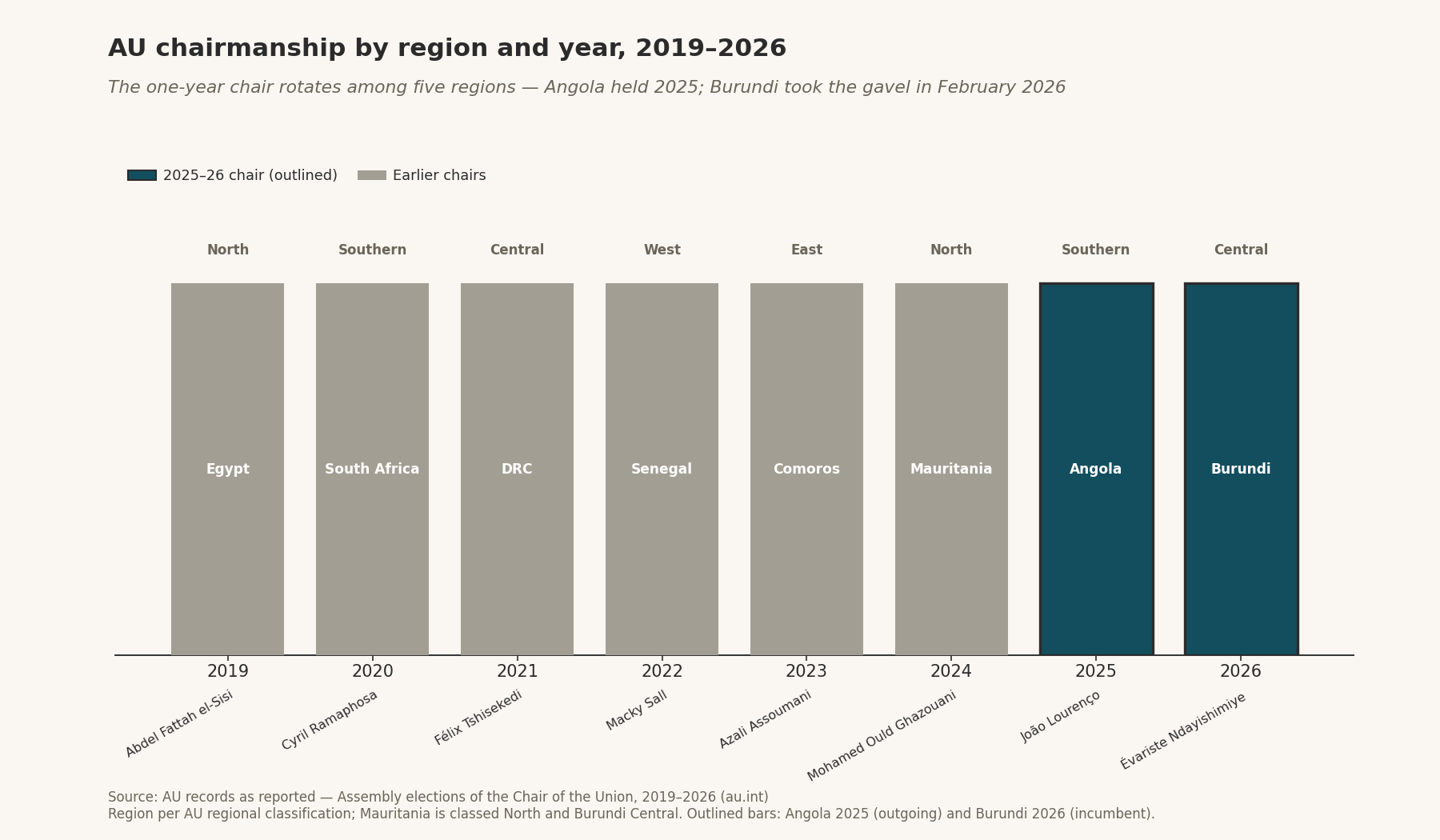
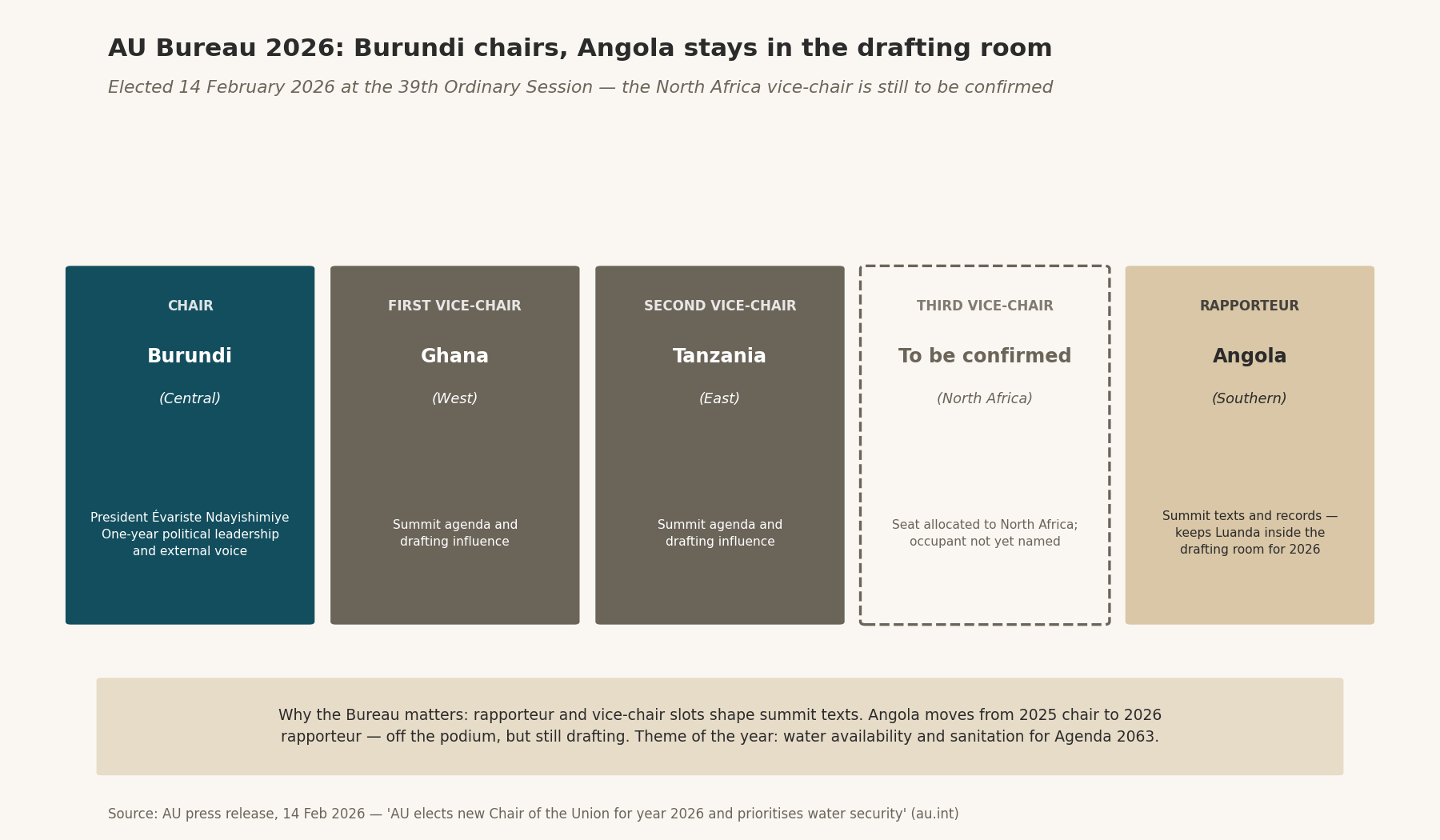
The facts. The Chair of the Union is a serving head of state elected by the Assembly of Heads of State and Government for a one-year term, rotating between the continent's five regions. On 14 February 2026 Burundi's President Évariste Ndayishimiye was formally elected chair for 2026, taking over from Angola's João Lourenço at the 39th Ordinary Session in Addis Ababa, per the African Union's own press release. The same release records the 2026 Bureau: Burundi as chair (Central), Ghana first vice-chair (West), Tanzania second vice-chair (East), North Africa to be confirmed, and Angola as rapporteur (South), and the summit theme, "Assuring
Sustainable Water Availability and Safe Sanitation Systems to Achieve the Goals of Agenda 2063". The Chairperson of the African Union Commission is a different office: an elected executive running the AU's day-to-day machinery for a four-year term, renewable once. Mahmoud Ali Youssouf of Djibouti holds it, deputised by Selma Malika Haddadi of Algeria, both elected in February 2025 and sworn in with the new Commission leadership on 13 March 2025, per the AU's announcement of the new senior leadership. The Commission's portfolios were allocated at the same time: Bankole Adeoye (Political Affairs, Peace and Security), Moses Vilakati (Agriculture, Rural Development, Blue Economy and Environment), Lerato Mataboge
(Infrastructure and Energy) and Amma Twum-Amoah (Health, Humanitarian Affairs and Social Development), with two commissioner posts postponed, per the AU's election announcement. Youssouf's statement to the 39th Assembly confirms the water and sanitation focus and the 2024–2028 five-year plan.
What the chair can and cannot do. The rotating chair sets tone, convenes, and carries the AU's voice into external forums — Lourenço used the 2025 chairmanship heavily for Great Lakes mediation. It cannot direct the Commission's budget or staff, and it does not decide suspensions. Those come from the Assembly and the Peace and Security Council, which suspended Guinea-Bissau from all AU activities after determining the November 2025 takeover was an unconstitutional change of government — documented in Amani Africa's PSC reporting, following the Commission chairperson's own condemnation of the coup. The Assembly also appoints PSC members — ten were slated for appointment at the 2026 summit.
Between the lines. Continuity sits with the Commission, not the chair. A one-year rotating chairmanship cannot sustain a multi-year initiative, which is why the AU's most durable work runs through commissioner portfolios and the PSC. The Bureau matters more than it appears: rapporteur and vice-chair slots determine who shapes summit texts, and Angola's move from chair to rapporteur keeps Luanda inside the drafting room for 2026.
What to watch. Confirmation of the North Africa vice-chair; whether the two vacant commissioner posts are filled; how the water and sanitation theme converts into financing decisions; and PSC handling of the Guinea-Bissau and Sudan files.
Method and sources. African Union primary press releases, the Commission chairperson's summit statement, and Amani Africa's PSC-focused analysis.
Related reading: Power Map: the African Union's 2026 decision chain; Guinea-Bissau's calendar coup.
Charts & visuals
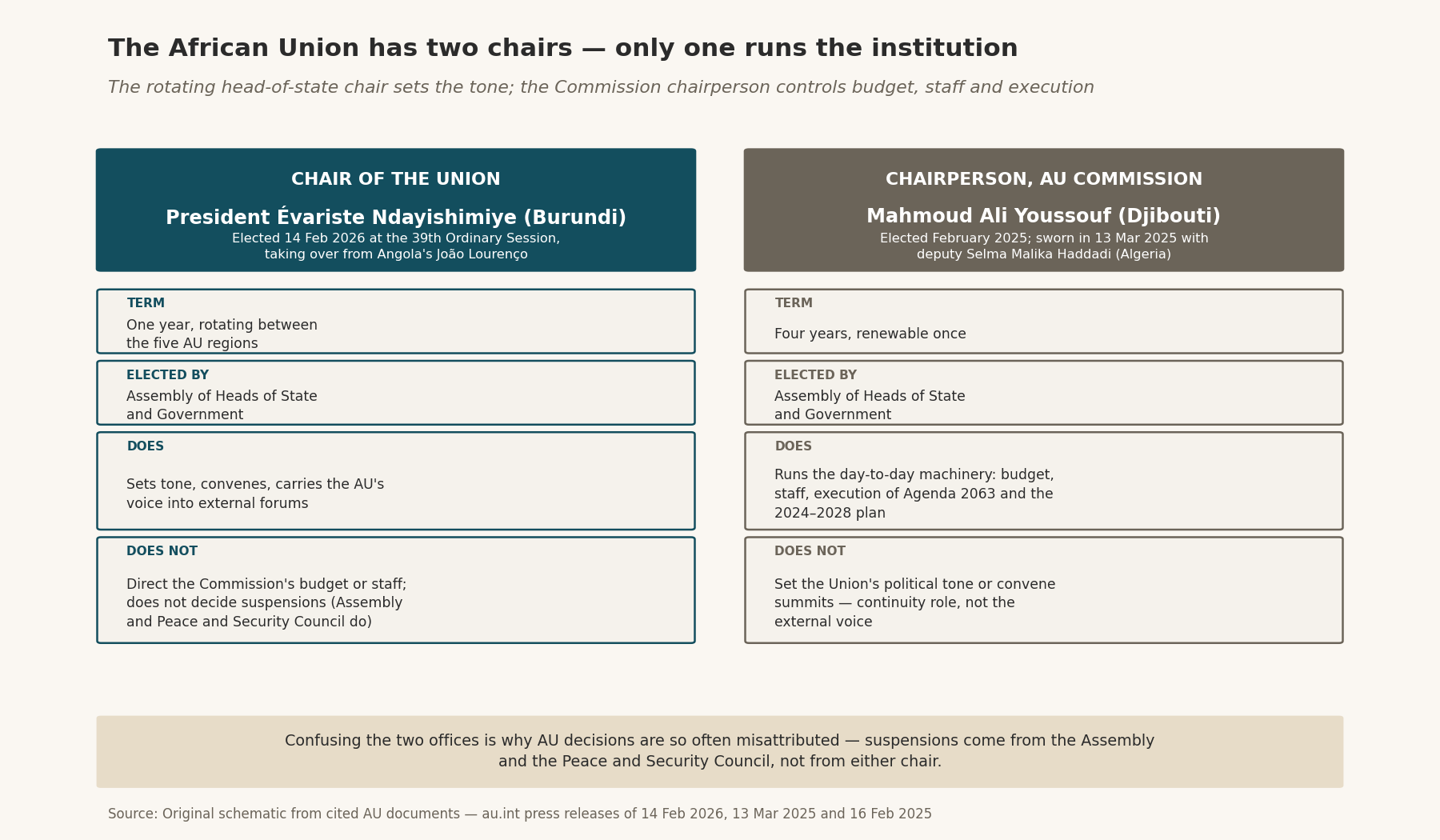
X: The African Union has two chairs. One rotates annually between heads of state (Burundi, 2026). One runs the institution for four years (Djibouti's Youssouf). Only one can direct staff and budget. Which does what →
LinkedIn: If you have ever seen "the AU chair" cited for a decision the AU chair cannot make, this explainer is for you. Burundi's President Ndayishimiye took the rotating one-year chairmanship in February 2026 from Angola's João Lourenço. Mahmoud Ali Youssouf of Djibouti holds the separate four-year Commission chairpersonship and runs the institution. Suspensions come from the Assembly and the Peace and Security Council, not from either chair. Continuity lives in commissioner portfolios — which is where to look for actual AU capacity.
Author
Sign up for New Axis Media newsletters.
Stay up to date with curated collection of our top stories.