Africa's Energy Transition Trilemma: Oil, Gas, Minerals — and the Right to Develop
Africa holds the minerals the world needs to decarbonise, and produces oil and gas it may need to develop. The continent's energy debate isn't "fossil vs. renewable." It's about who captures the value — and who decides the pace.
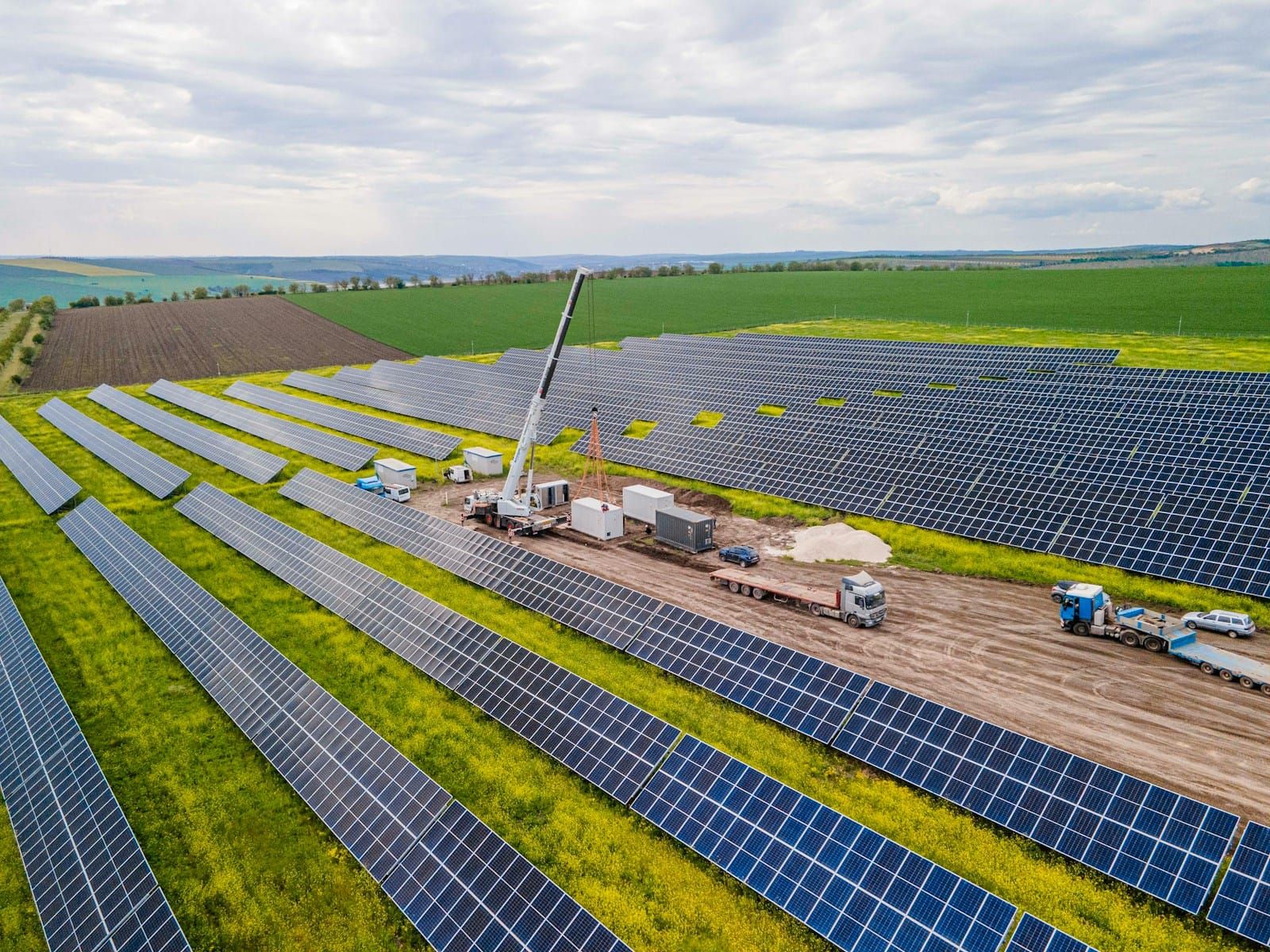
Africa faces an energy trilemma unlike any other region's. It sits atop the minerals the global energy transition cannot proceed without — cobalt, lithium, copper and platinum-group metals (African Energy Chamber). It also holds hydrocarbon reserves that some governments argue they have the right to develop. And it must supply electricity to hundreds of millions who lack it — a continent where energy poverty remains a daily reality even as it is asked to power the world's decarbonisation. Reconciling these three imperatives — value capture, development, and decarbonisation — is the defining energy-policy question on the continent, and it cannot be resolved by importing a template designed for wealthy, already-electrified economies.
The mineral crown, and its catch
The African Energy Chamber's State of African Energy 2026 Outlook positions the continent's mineral reserves "at the heart of global supply chains essential for renewable energy deployment and electric vehicle adoption" (African Energy Chamber). On paper, this is extraordinary leverage: the world cannot build enough batteries, grids and electric vehicles without African cobalt, copper and lithium. But raw reserves are not the same as economic power. The IEA's 2026 critical-minerals analysis exposes the catch: mineral sovereignty "depends not only on what is beneath the ground but on control over industrial inputs" — that is, on refining and processing capacity, which Africa largely lacks (Energy Transition Africa on IEA 2026). The continent's minerals rise; its refining lags. That gap is where value leaks out — and where the strategic contest is really being fought.
This is the same structural trap seen in oil: extract the raw material, export it, and import the finished product at a markup. A country that mines cobalt but cannot refine it captures a fraction of the value of the battery that cobalt ends up in. The Lobito Corridor, for all its promise, risks reproducing the pattern if it simply moves unprocessed copper and cobalt to the Atlantic faster (see Articles 4 and 7) (RTL Today / AFP). The strategic prize is not exporting minerals — it is refining them on African soil, building the smelters, processing plants and battery-precursor facilities that capture the value the ore represents. That is why African governments increasingly attach local-processing conditions to mining deals with the US, EU, China and the Gulf.
The Angola case: managing decline
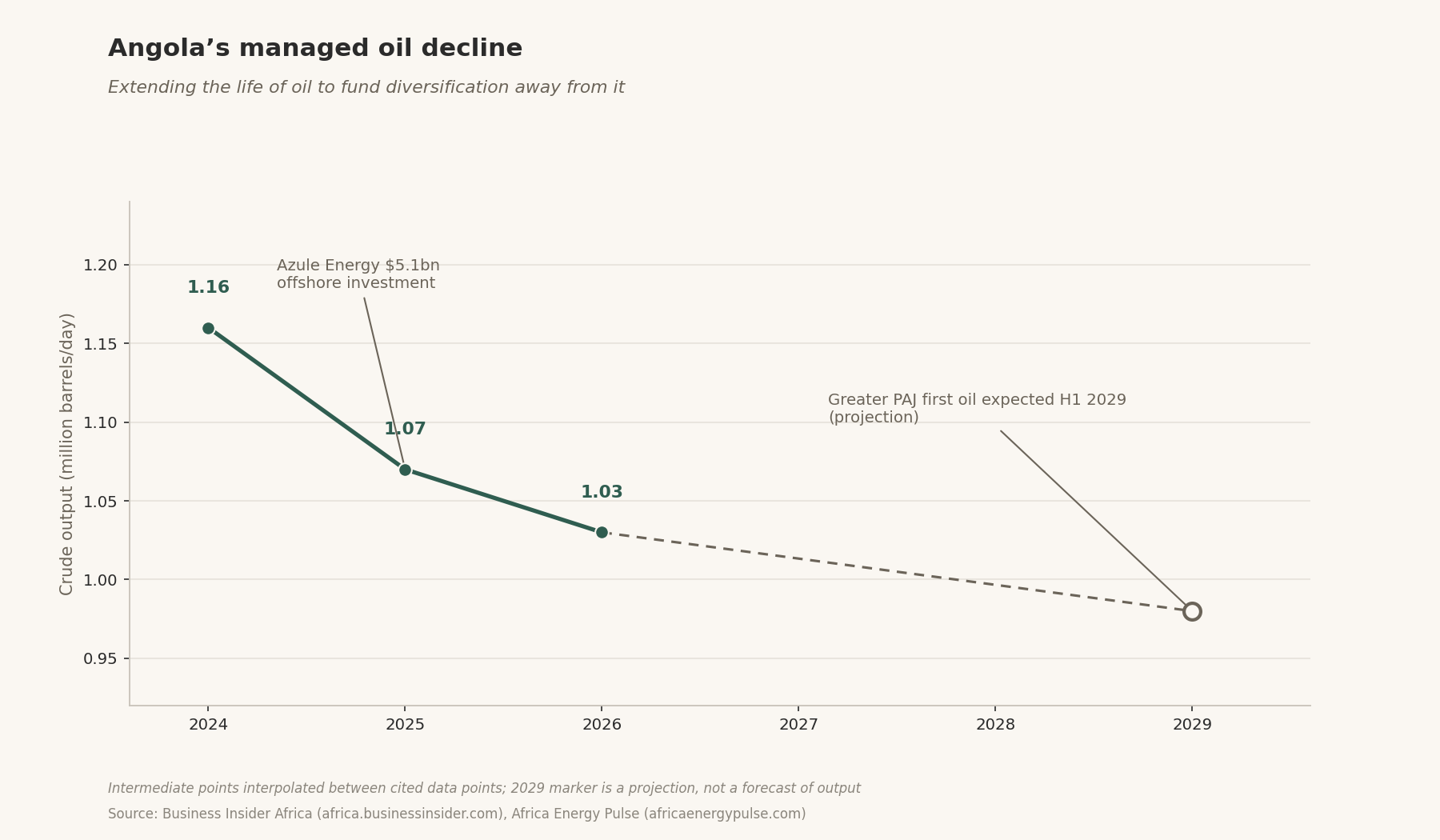
Angola embodies the hydrocarbon side of the trilemma. Oil still supplies roughly 90% of exports and 30% of GDP, but production is in structural decline, from 1.16m barrels/day in 2024 to 1.03m in 2025 (see Article 1) (Allianz Trade; Business Insider Africa). Rather than abandoning oil, Angola is trying to extend it — Azule Energy's $5.1bn offshore investment aims to slow the decline (Africa Energy Pulse) — while using the revenue to fund diversification. It is a live experiment in whether a petrostate can manage its own energy transition without a hard landing: extracting enough value from a declining resource to build the economy that will replace it, without the fiscal shock that toppled other oil-dependent governments. Angola's answer to the trilemma is pragmatic rather than ideological — keep pumping, but invest the proceeds in what comes next.
The renewables surge, from an unexpected source
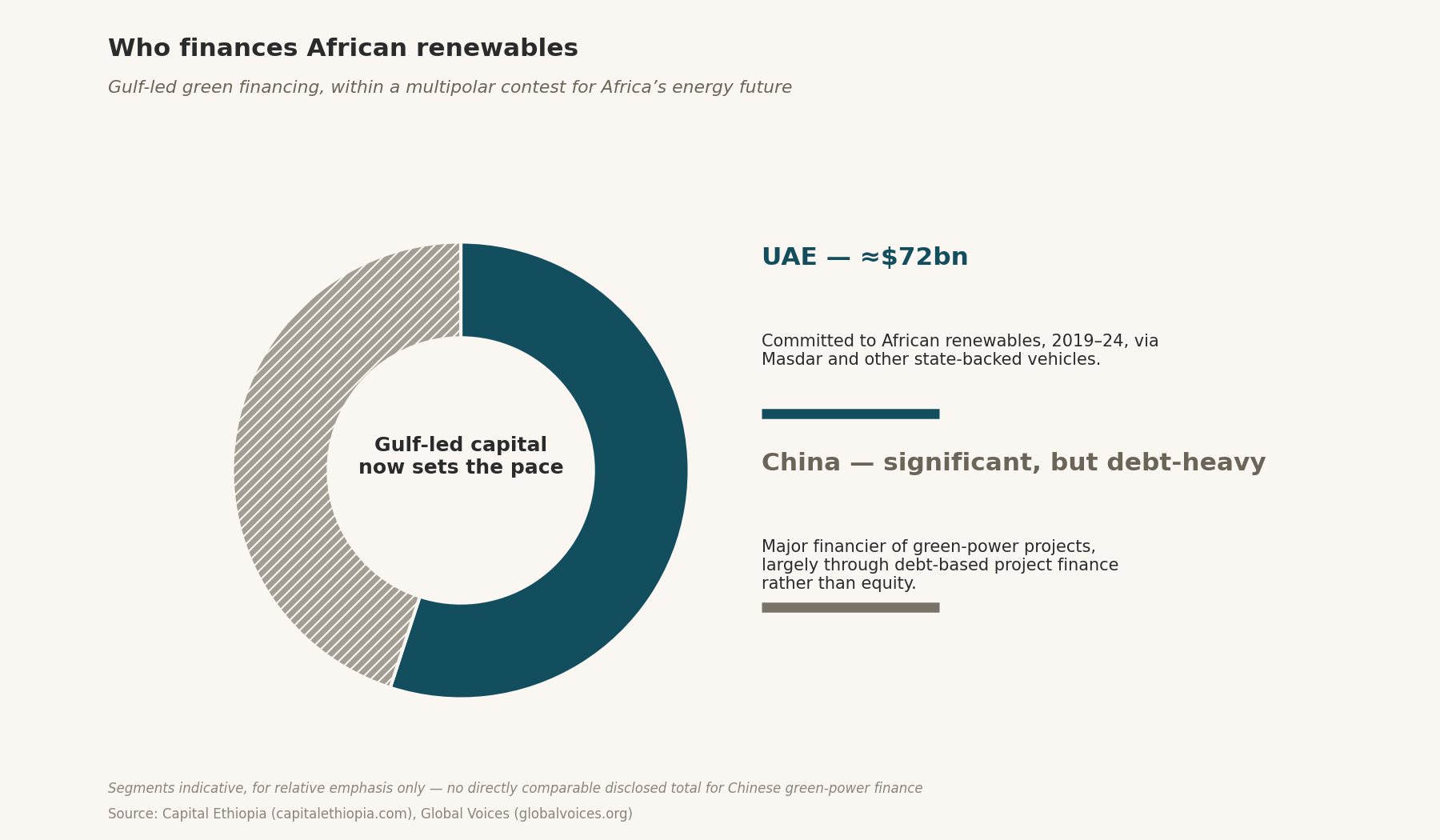
Africa's renewable build-out is being financed heavily by the Gulf — a striking irony, given that the financiers are themselves petrostates diversifying beyond oil. Of the UAE's ~$110bn invested in Africa from 2019–2024, roughly $72bn went to renewable energy alone — via companies like Masdar (see Article 10) (Capital Ethiopia; AGBI). China, too, remains active in African clean power, though some projects have arrived "with heavy debt" (Global Voices). The renewable transition is real, and the capital is flowing — but its financing map shows the same multipolar competition seen everywhere else on the continent. Whoever finances and builds Africa's solar farms, wind arrays and grids will hold influence over the continent's energy future, which is precisely why the Gulf, China and the West are all competing to do so.
The "right to develop" argument
Underlying the technical debate is a moral and political one. African governments increasingly reject a framing in which the continent — a negligible historical emitter of the greenhouse gases driving climate change — is asked to forgo hydrocarbon development while wealthy economies transitioned on fossil fuels over the past two centuries. The African position, articulated across energy forums, is that the transition must be "just": one that allows development, captures value locally, and does not simply lock Africa into supplying raw materials for others' green economies (African Energy Chamber). The trilemma, in this light, is not Africa's problem to solve alone — it is a shared global responsibility in which the wealthy economies that caused the problem, and that need African minerals to solve it, bear an obligation to finance the transition and permit the development.
This is not climate denial; it is a demand for fairness and sequencing. Many African leaders accept the need to decarbonise but insist on the right to use gas as a transition fuel, to electrify their populations, and to industrialise — rather than being asked to leapfrog straight to a zero-carbon economy that wealthier nations themselves have not achieved.
The New Axis read
The lazy framing pits African oil against global climate goals. The honest framing is about value and agency. Africa can be the mine and the refinery, the extraction site and the manufacturing base — or it can remain, as with oil, a supplier of raw inputs whose value is captured downstream. The energy transition is the largest reallocation of industrial value in a generation, and Africa holds essential cards: the cobalt, copper and lithium without which the transition stalls. Whether it plays them for processing, jobs and development — or merely for faster extraction — is the continent's central economic decision of the decade. The minerals are the leverage. Refining is the goal. And the pace, Africa insists, is its own to set.
Charts & visuals
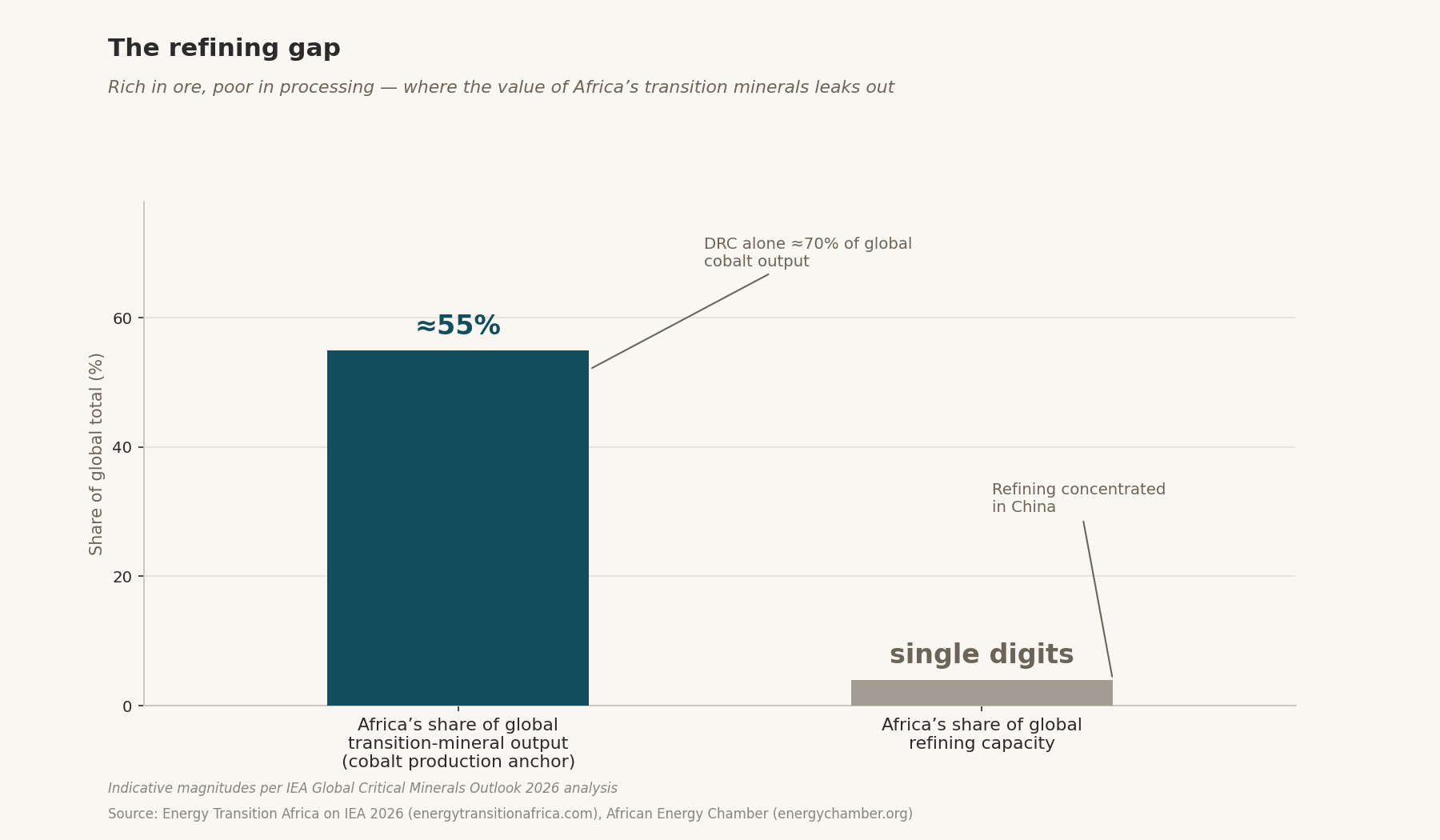
X: Africa's energy debate isn't "fossil vs renewable." It's about value. The continent holds the transition's minerals but almost none of the refining. Mineral sovereignty depends on "control over industrial inputs," not just what's underground. 🧵
LinkedIn: Africa faces an energy trilemma: it holds the minerals the world needs to decarbonise, produces oil it argues it has the right to develop, and must electrify hundreds of millions. New Axis Media reframes the debate away from "fossil vs. renewable" toward the real question — who captures the value, and who sets the pace. Rich in ore, poor in refining, Africa's central economic decision of the decade.
Author
Sign up for New Axis Media newsletters.
Stay up to date with curated collection of our top stories.