The African City Is the Future — If It Can House and Move Its People
Africa is urbanising faster than any region in history, and its cities are engines of growth and a rising middle class. But the housing and transport deficits are enormous, and the policy answer isn't demolition — it's incremental upgrading.
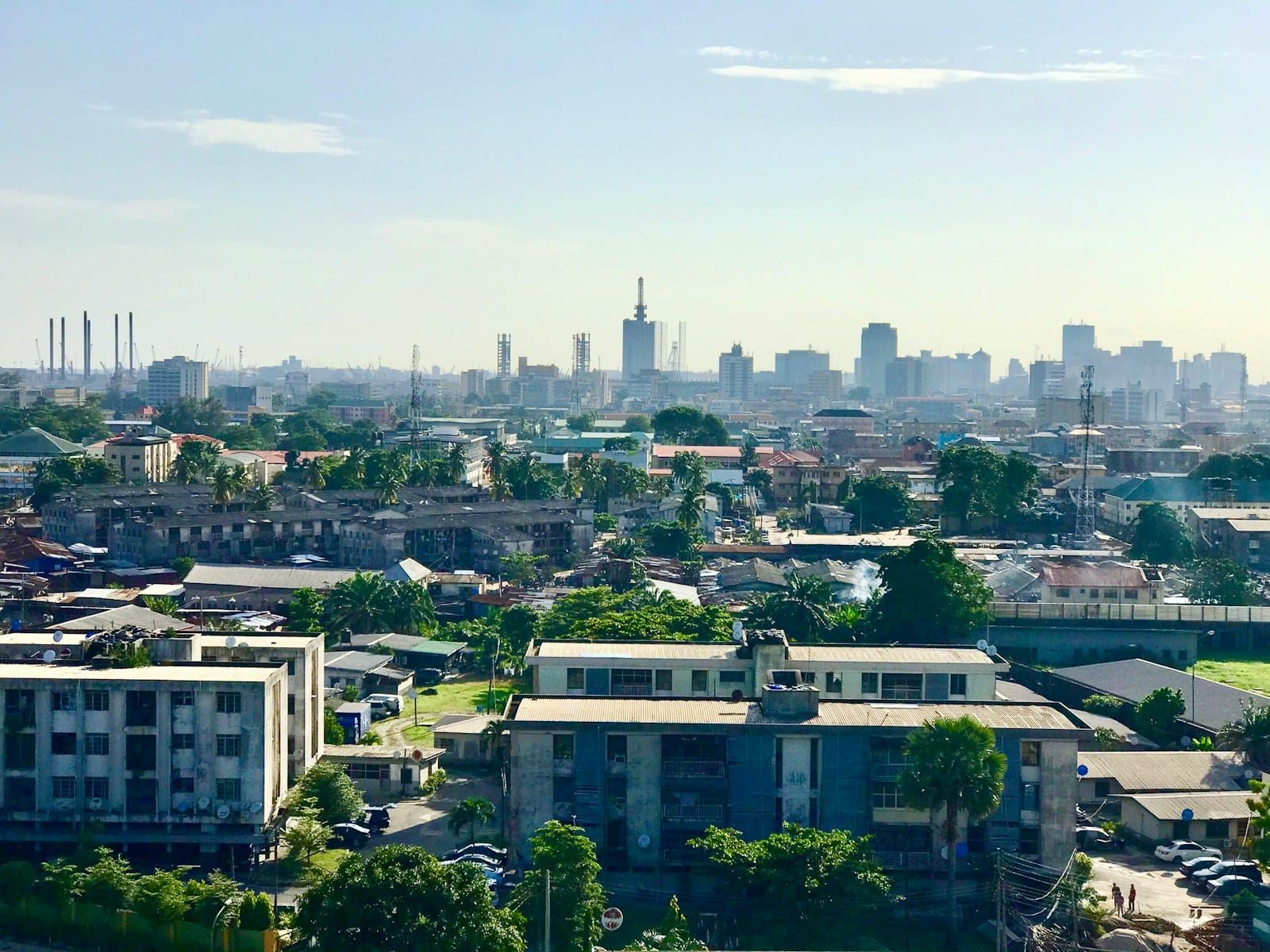
The 21st century will be, demographically, an African urban century. The continent is urbanising at a pace and scale without historical precedent, and its cities are simultaneously the great generators of economic value and the sites of its most acute social pressures. Cities concentrate talent, markets, and productivity — but also inequality, informality and unrest. How Africa houses, moves and employs its exploding urban populations is a question with global stakes — for migration, for climate, and for the world economy (UN-Habitat, State of African Cities 2026; AfDB, Africa's Urbanisation Dynamics 2025). The scale connects directly to the demographic surge examined in Article 14: the hundreds of millions entering the workforce by 2050 will be overwhelmingly urban, and the cities that cannot absorb them will export instability.
The housing deficit and a policy rethink
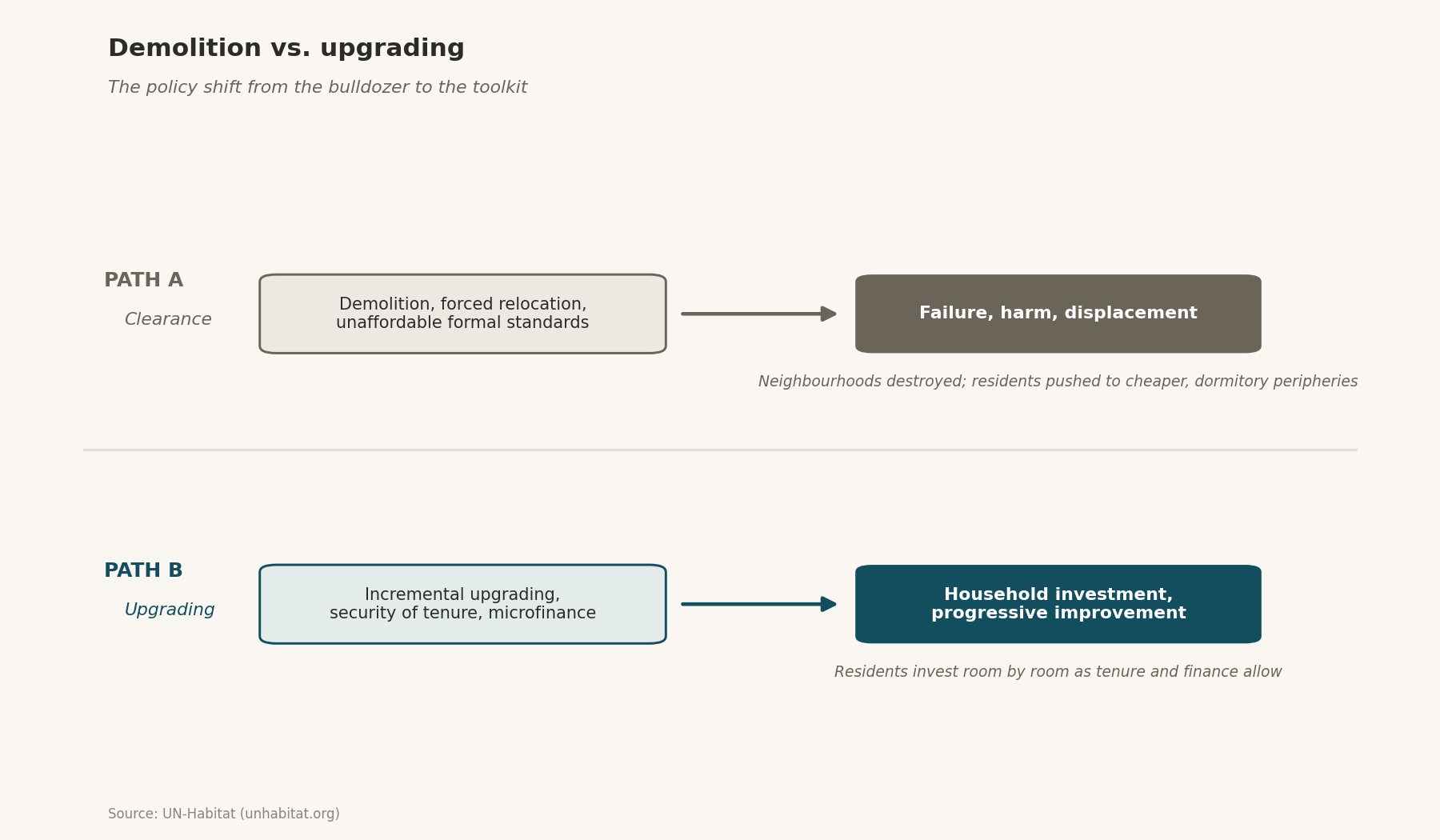
The scale of the housing challenge has forced a fundamental rethink in how African governments and their partners approach the problem. For decades, the default response to informal settlements was the bulldozer — clearing "slums" and replacing them with formal housing most residents could never afford. UN-Habitat's guidance is now explicit that this failed: policies aimed at "eradicating informality — through demolition, relocation, or the imposition of formal standards that the majority cannot meet — have consistently failed and often caused harm" (UN-Habitat, Adequate Housing for All). The alternative is "progressive improvement": supporting incremental upgrading of existing settlements, extending security of tenure as a foundation for household investment, and connecting informal housing to formal support systems (UN-Habitat).
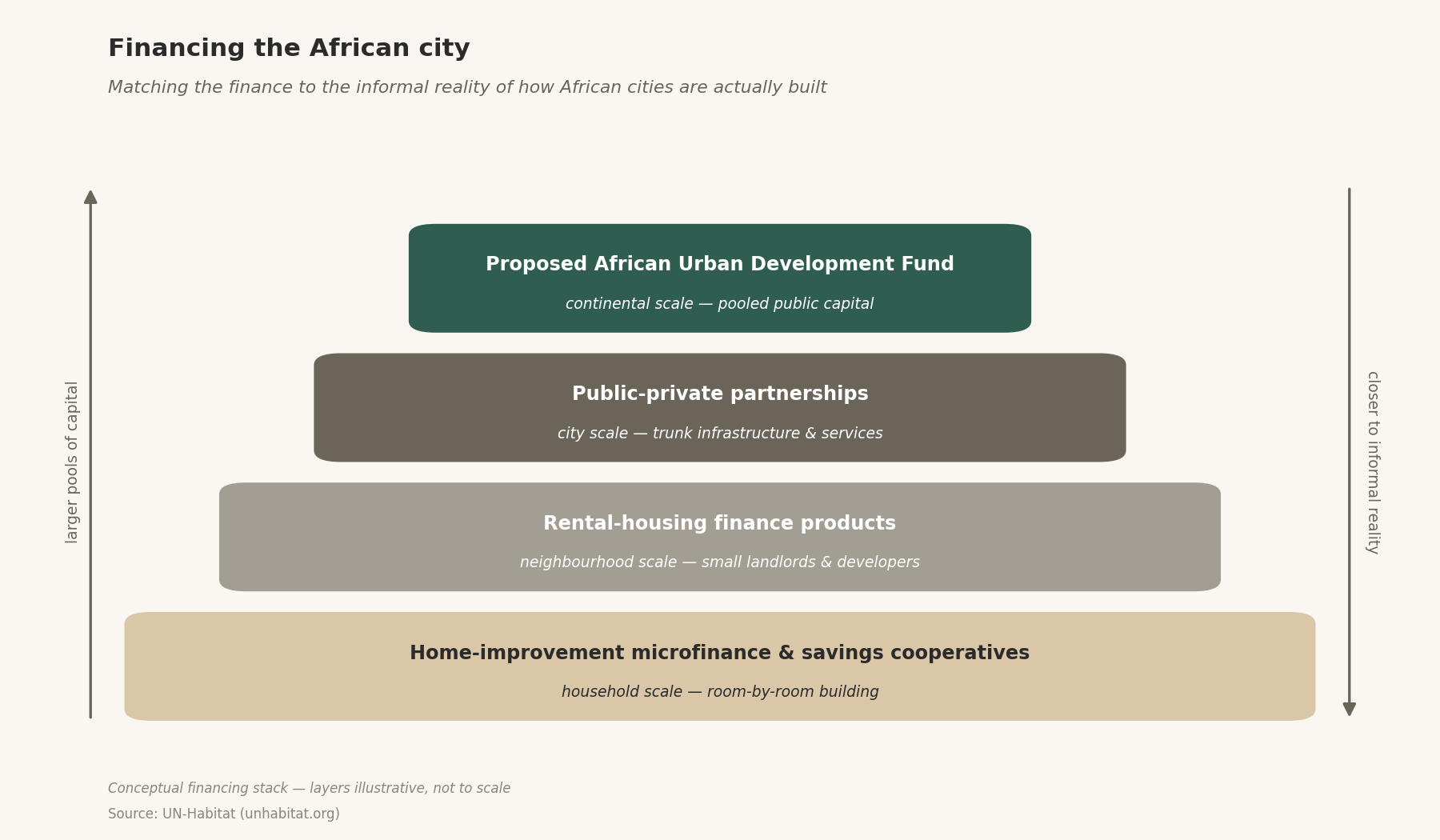
This is a profound shift from the bulldozer to the toolkit — from treating informal cities as problems to be erased to treating them as assets to be improved. The logic is grounded in evidence: give a household secure tenure and it will invest its own capital in improving its home, brick by brick, in a way no top-down mega-project can match. Financing follows the same logic: UN-Habitat emphasises home-improvement lending through microfinance and savings cooperatives already embedded in communities, and rental-housing finance products, rather than only large formal developments (UN-Habitat). Meeting people where they already live, with finance they can actually access, is the emerging consensus.
The transport tax
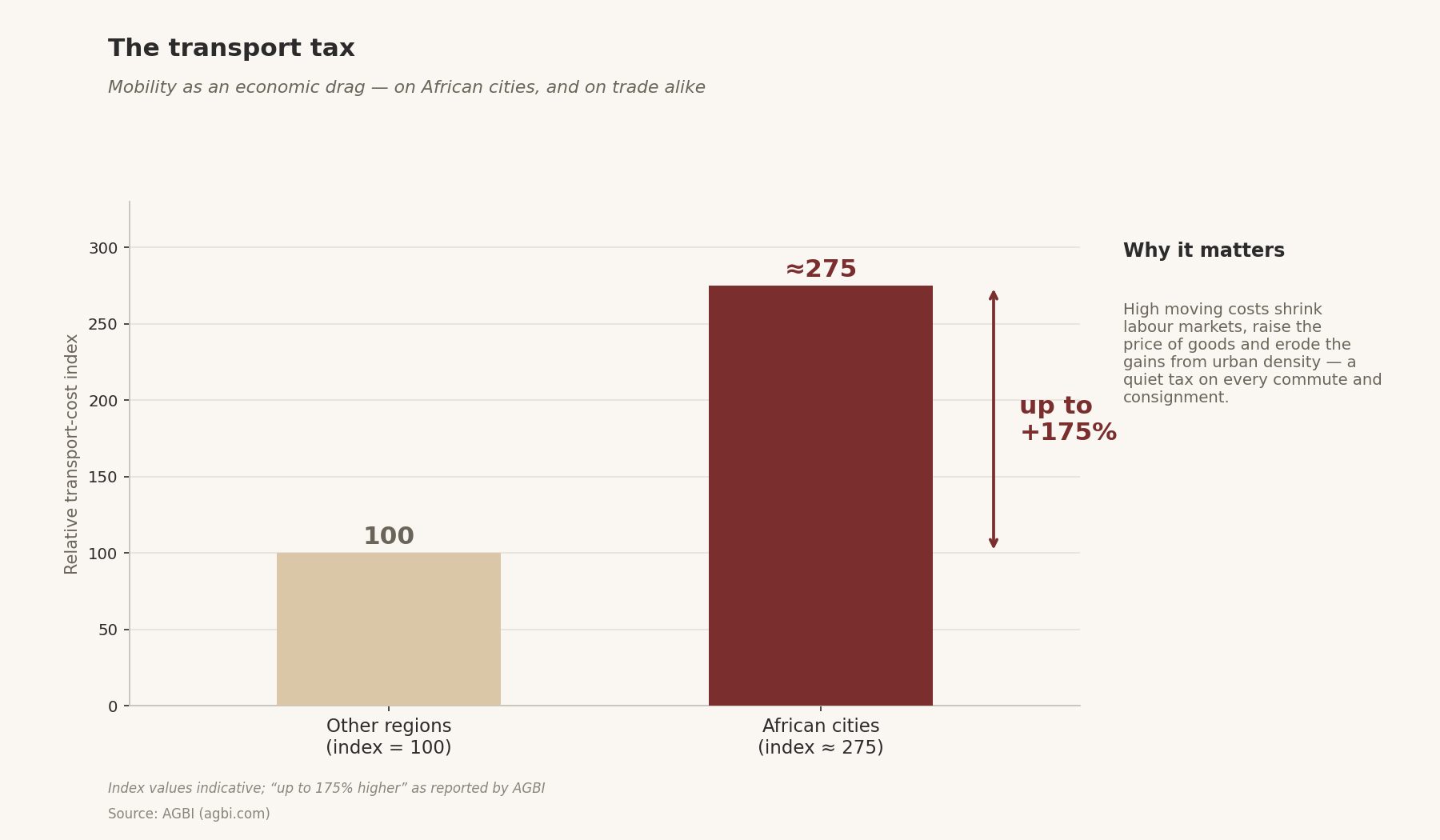
Movement is as much a crisis as shelter. African transport costs run up to 175% higher than in other parts of the world — a burden that raises the price of everything, strangles intra-city commerce, and traps workers far from jobs (AGBI). The same figure that constrains intra-African trade (see Article 13) also shapes daily urban life: a worker who spends hours and a large share of income commuting is a worker whose productivity and wellbeing are taxed by the built environment. Angola's own 2026 fiscal adjustments included a 50% increase in urban and suburban rail transport fares — a reminder that transport affordability is a live, politically charged issue at the household level, and one that fed directly into the grievances behind the 2025 unrest (see Articles 2 and 18) (360 Mozambique).
The municipal-capacity bottleneck
The binding constraint is often not money but governance. UN-Habitat identifies building municipal capacity — in planning, land administration, revenue collection and financial management — as "a national priority" and a national investment (UN-Habitat). Weak local government is why well-funded projects stall and why cities cannot capture the value their own growth generates: a city that cannot administer land titles, collect property taxes, or plan infrastructure cannot channel its own economic dynamism into public goods. The push for public-private partnerships and an African Urban Development Fund reflects the search for financing models that match the scale of need (UN-Habitat). But financing without capacity simply produces stalled projects and wasted money; the two must advance together.
Luanda as a case study
Angola's capital captures the pressures in miniature. Young Angolans cite "the scarcity of adequate housing" and decaying infrastructure among their central grievances (Deutsche Welle). Luanda is also politically pivotal — UNITA won 62.59% there in 2022 (see Article 3), and the city's inequality, poverty and unemployment have made it the epicentre of opposition sentiment (ISS Africa). The African city, in Luanda's case, is where the housing deficit becomes a political force — where the failure to house and move people converts directly into votes against the government and, in 2025, into unrest. The urban question and the political question are, in Luanda, the same question.
The New Axis read
African cities are the continent's most important economic and political laboratories. The old model — demolish the slums, build the formal city — has failed everywhere it was tried, at enormous human cost. The emerging consensus is humbler and more promising: upgrade incrementally, secure tenure, extend finance to where people already live, and build the municipal capacity to govern growth. The cities that get this right will convert urbanisation into a middle-class engine, capturing the productivity gains of density; those that don't will convert it into unrest, as young, jobless, poorly housed urban populations lose patience. There is no more consequential domestic-policy arena on the continent — and, given Africa's demographic weight and the fact that a third of the world's young people will soon be African, few more consequential anywhere in the world.
Charts & visuals
X: Africa is urbanising faster than any region in history. The old fix — demolish the slums — failed everywhere. UN-Habitat's new answer: upgrade incrementally, secure tenure, finance where people already live. And transport costs? Up to 175% higher than elsewhere. 🏙
LinkedIn: The 21st century is an African urban century. New Axis Media examines the shift transforming housing policy across the continent — from demolition to incremental upgrading, from formal mega-projects to microfinance and tenure security. With transport costs up to 175% higher than other regions and municipal capacity the real bottleneck, African cities are the continent's most consequential policy laboratory.
Author
Sign up for New Axis Media newsletters.
Stay up to date with curated collection of our top stories.