The price of standing forest: debt swaps, carbon and the Congo Basin's hard bargain
— Three years after Gabon's blue bond, African governments are converting debt distress and forest cover into financial leverage — while carbon markets nurse an integrity hangover and donors pledge faster than they pay.
--- On 14 August 2023, Gabon sold a US$500m "blue bond" and bought back a slice of its own expensive Eurobonds — Africa's first mainland debt-for-nature swap. Two weeks later, soldiers deposed the president who had signed it. The coupon payments continued regardless. That sequence — financial engineering, political rupture, contractual continuity — frames the question in African climate finance: can instruments built in Washington and New York survive the politics of the places they serve, and scale fast enough to matter for the world's last great carbon sink?
The swap playbook, and its limits
The Gabon structure is now the template. The bond, maturing in 2038 with a 6.097% coupon, refinanced US$436–500m of three Eurobonds — about 4% of sovereign debt — with Bank of America arranging and The Nature Conservancy (TNC) advising, according to Afronomicslaw's sovereign debt update and the US International Development Finance Corporation (DFC). The engine was insurance: the DFC's US$500m political-risk policy, sharing half the risk with eight private insurers, lifted the bond to a Moody's Aa2 rating against Gabon's Caa1/B- sovereign rating, per the DFC and Swiss Re.
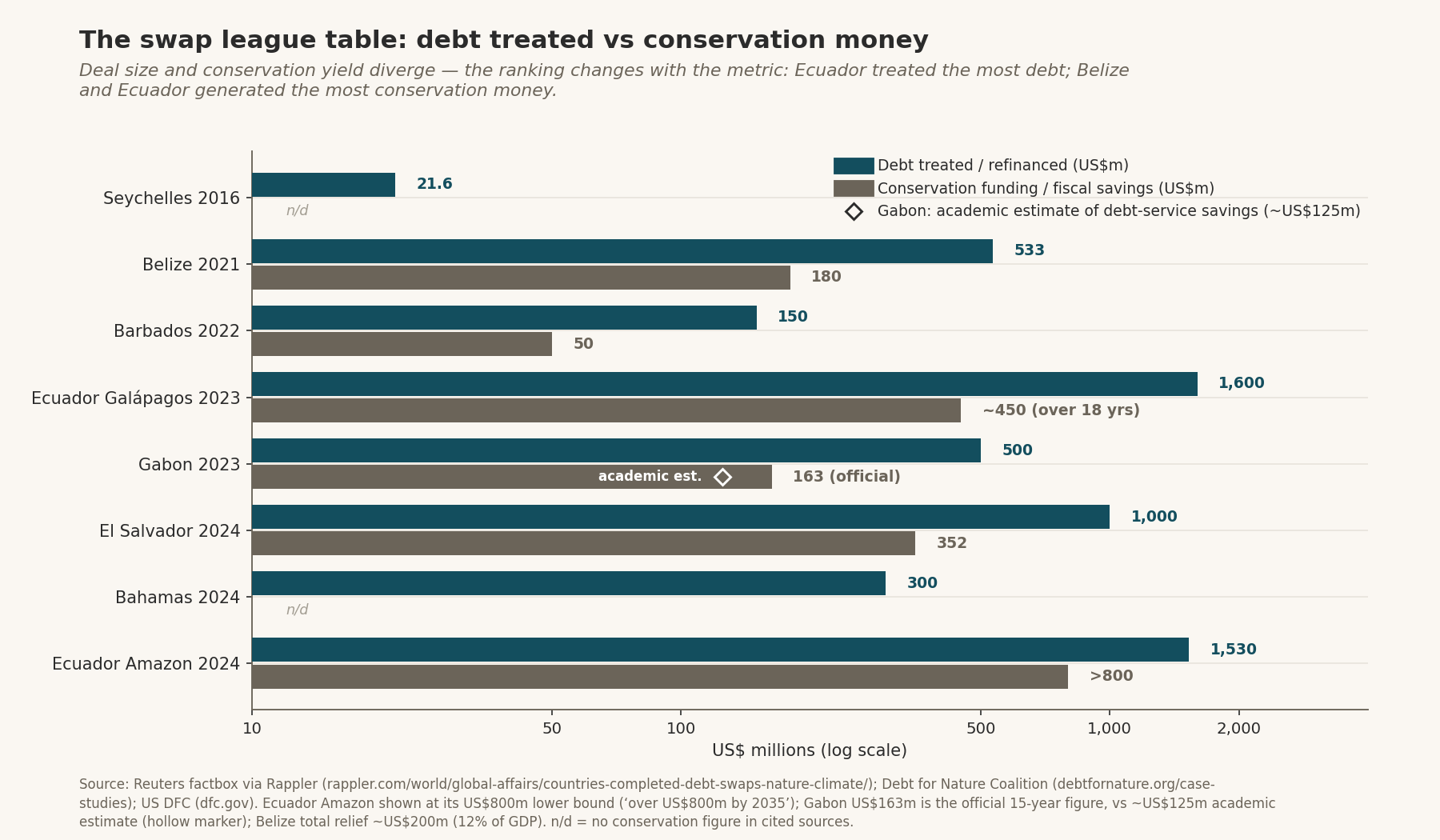
The official accounting says the deal generates US$163m for marine conservation over 15 years — US$5m a year plus an endowment growing to roughly US$88m by 2038 — in exchange for a marine spatial plan, fisheries reform and 30% of Gabon's ocean as protection zones, per the DFC and TNC. Academic reconstructions are less generous: ACET puts actual debt-service savings nearer US$125m, transaction costs are undisclosed and, as CRISIL notes, 26% of marine waters were already protected by 2017. The larger figure includes projected endowment growth. The league table is growing; precision about metrics matters, since "largest swap" claims depend on whether the measure is debt treated, new money raised or conservation funding generated:
Seychelles 2016: US$21.6m Paris Club buyback; a US$15m sovereign blue bond followed in 2018.
Belize 2021: US$533m bond retired; roughly US$200m of relief, 12% of GDP; US$180m for conservation.
Barbados 2022: US$150m conversion; US$50m for marine conservation.
Ecuador, Galápagos 2023: US$1.6bn of bonds repurchased at about 40 cents via an SPV, financed by a US$656m "Galápagos Marine Bond" with DFC and IDB guarantees; debt service cut by some US$1.1bn to 2041; about US$450m to conservation over 18 years, per an IMF Selected Issues Paper and Pew Bertarelli Ocean Legacy. Local groups criticised their exclusion, per Latindadd.
Ecuador, Amazon 2024: about US$1.53bn refinanced, generating over US$800m in net fiscal savings by 2035 for Amazon conservation, per the Debt for Nature Coalition.
El Salvador 2024: US$1bn JPMorgan loan plus US$1bn of DFC insurance; US$352m freed. Bahamas 2024: US$300m with Standard Chartered, TNC and the IDB, per a Reuters factbox and Finextra.
Three unnamed African countries are now negotiating swaps with TNC worth more than US$500m combined — one expected to close in 2026, two more by 2027 — Reuters reports via CNBC Africa. No African deal has closed since Gabon, and the central uncertainty is the loss of the American backstop: with the DFC constrained under the Trump administration, TNC is turning to multilateral banks, private insurers and funds. In January 2026 Enosis Capital partnered AXA XL to insure a US$3bn pipeline of swaps, per Afronomicslaw. The next two years will test whether debt-for-nature works as a market-plus-multilateral product, or dies without Washington.
Scale is the standing critique. Africa owes US$685.5bn in external debt, per UNECA figures in Ethical Business; debt service is projected at US$88.7bn in 2025 — more than the continent's total annual climate inflows — and African officials say the continent receives about 1% of global climate finance. Against those numbers, swaps shave basis points off the stock. The debt-justice question — bridge or sedative — hangs over every new term sheet.
The last sink standing
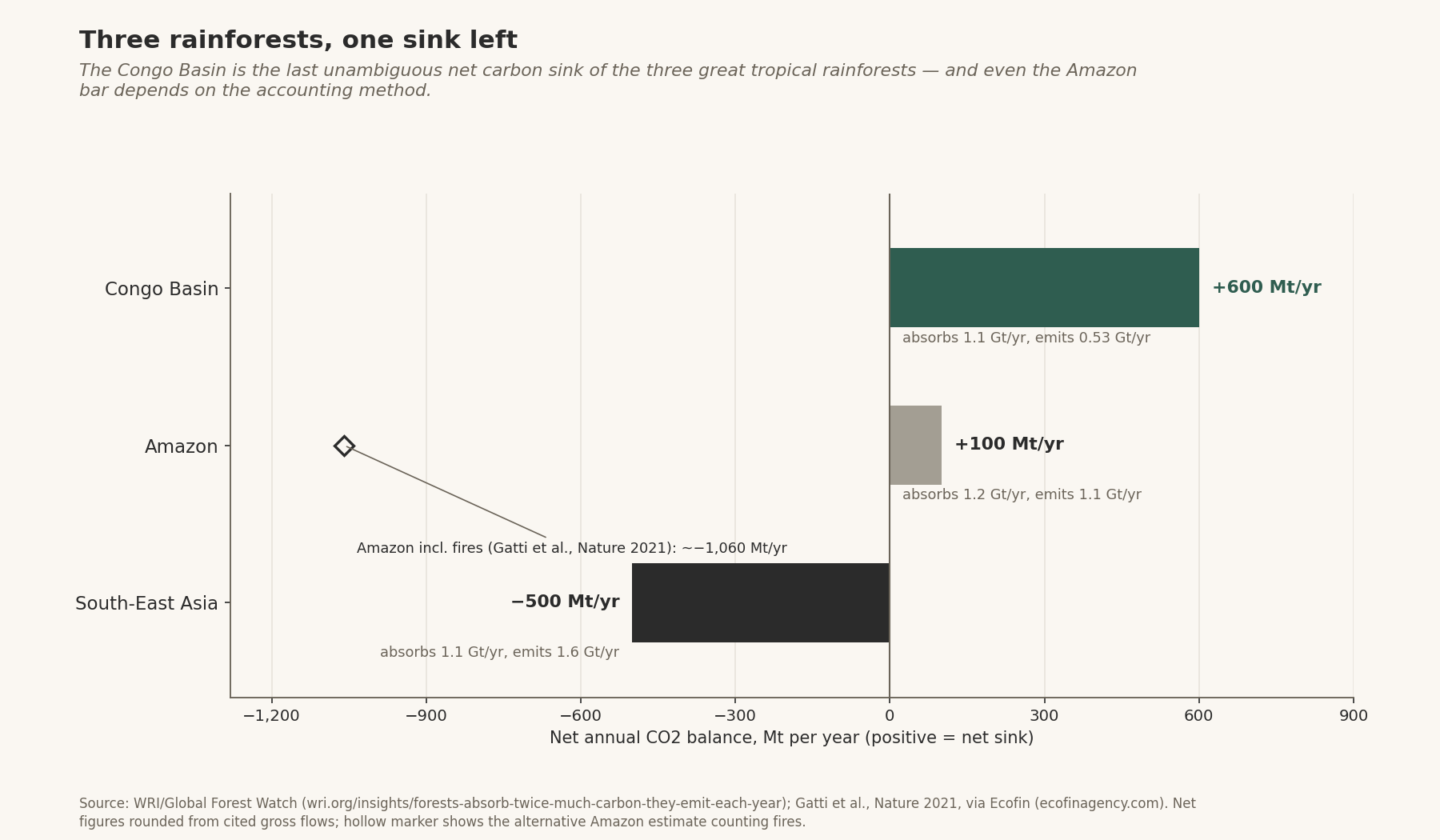
The asset beneath the argument is real. The Congo Basin is the only one of the three great tropical rainforests still acting as a strong net carbon sink, absorbing roughly 1.1bn tonnes of CO2 a year and emitting about 0.53bn — a net sink of some 600m tonnes, according to WRI/Global Forest Watch analysis. The Amazon hovers near balance in the same bookkeeping — 1.2bn tonnes absorbed, 1.1bn emitted — though a 2021 Nature study (Gatti et al.), counting fires, found the basin emitting about 1.06bn tonnes a year. The methodological dispute is the point: the Congo's sink status is the strongest of the three, and even it rests on contested accounting. South-East Asia's forests are a net source, absorbing 1.1bn tonnes and emitting 1.6bn.
Beneath the trees sits a second, quieter asset. The Cuvette Centrale peatlands, the world's largest tropical peatland complex at 145,500–167,600 km² depending on the survey, hold about 29bn tonnes of carbon — roughly three years of global greenhouse-gas emissions, and more than the above-ground biomass of the entire Democratic Republic of Congo (DRC) — per peer-reviewed work summarised in Quaternary Science Reviews. New science strengthens the case: swamp forests expanded about 14% between 2007 and 2024 (195,345 to 222,467 km²), reversing a reported drying trend, while net CO2-equivalent emissions from the swamps fell about 2m tonnes a year, per a 2026 peer-reviewed study.
The threat is real: the basin holds about 288m hectares of tree cover, 168m of them primary forest as of 2020; the DRC holds about 60% of the basin's primary forest, against 13% in Gabon, 12% in the Republic of Congo and 10% in Cameroon. More than 6m hectares of primary forest — 3.5% of the 2001 extent — were lost between 2002 and 2019, per Global Forest Watch data via Earth.org.
The money mismatch is stark. A 2022 report valued the Congo rainforest's sequestration at about US$30bn a year — its commissioning institution undisclosed, so treat the figure as indicative — while average annual aid for all African forests in 2011–2020 was US$170m, roughly 150 times lower, as Ecofin reported. Donor finance is rising but modest: the COP26 Congo Basin Pledge committed at least US$1.5bn for 2021–2025 from 12 donors, who reported US$1.94bn spent by end-2024, 29.45% above pledge, per the Congo Basin Pledge Report 2024; the Central African Forest Initiative is capitalised at US$718m, per a Springer chapter.
Kinshasa's sovereignty turn
The DRC has stopped waiting to be thanked. It promulgated a land-use planning law on 5 July 2025, per CAFI; at COP30 it launched a National Digital Carbon Credit Registry — Article 6-aligned, run by the ARMCA regulator — ESG News reports. In June 2025 it received the World Bank's first results-based payment of its kind — US$19.47m for 3.89m tonnes of verified CO2 reductions in Mai-Ndombe province — the first tranche of a deal worth up to US$55m for 11m tonnes, plus 1.7m credits the DRC can sell, per the World Bank, which calls the Congo Basin "the world's largest net carbon sink".
The market architecture is catching up. Article 6 was fully operationalised at COP29 in Baku in November 2024 — bilateral trading under 6.2, a new UN crediting mechanism under 6.4 — with claimed savings of up to US$250bn a year in national climate plans, per the COP29 Presidency, Carbon Direct and a Climate&Company debrief. First credits under the new mechanism are expected in late 2025 or 2026; host-government authorisation now carries market value — exactly what Kinshasa's registry is built to sell.
A frontier idea points further: the DRC is exploring a "debt-for-industrialisation swap", leveraging cobalt, copper and lithium into battery and electric-vehicle value chains while cutting debt, according to Boston University research cited by Ethical Business. A proposal, not a live transaction — but a sign of where governments want the conversation to move: from offsets to industrial strategy.
The negotiating context has hardened. At COP29, developed countries agreed to lead on at least US$300bn a year by 2035, within a US$1.3tn aspiration replacing the old US$100bn goal, met only in 2022. India called the figure "a paltry sum", Nigeria's envoy "an insult", per The Climate Watch and Afripoli. Forest states now arrive at every negotiation with the same arithmetic: our sink, your shortfall.
The integrity hangover
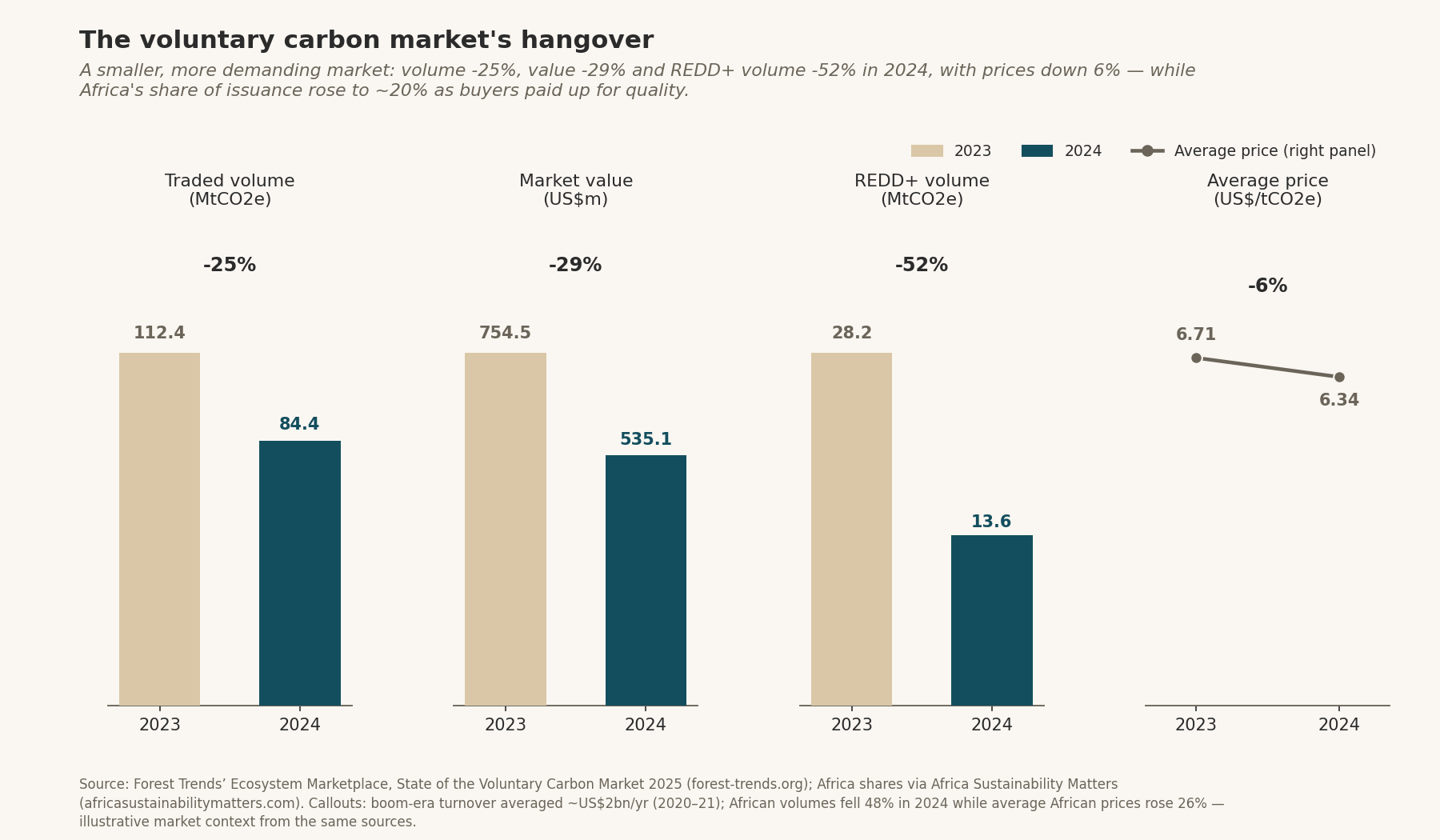
Demand is the weak leg. The voluntary carbon market shrank again in 2024: volume fell 25% to 84.4m tonnes and value 29% to US$535.1m, with average prices down 6% to US$6.34 — against 112.4m tonnes, US$754.5m and US$6.71 in 2023, and a boom averaging roughly US$2bn a year in 2020–21, per Forest Trends' State of the Voluntary Carbon Market 2025. REDD+ volume halved, from 28.2m to 13.6m tonnes. Against that trend, Africa's position improved: volumes fell 48% but average prices rose 26%, and African projects issued roughly 20% of global credits in 2024 — more than double the 2020 share, per MSCI and Integrity Council data reported by Africa Sustainability Matters. Buyers, burned once, now pay for quality and state authorisation. The burn was severe. A January 2023 investigation by the Guardian, Die Zeit and
SourceMaterial found more than 90% of Verra-certified rainforest credits were likely "phantom", as summarised by the Oakland Institute; Verra disputes the methodology; later academic work found substantial but lower failure rates. Then came Kariba. Verra's own two-year review of the Zimbabwe megaproject, completed in September 2025, found 57% of its roughly 27 million credits — over 15 million — were issued in excess because forecast deforestation was overstated, Climate Home News reports. South Pole had exited in October 2023 after a New Yorker investigation; the project generated over US$100m from buyers including Gucci, Volkswagen and Nestlé. Verra asked the developer to buy and cancel equivalent credits and urged holders of about 5 million sold-but-unretired credits to cancel voluntarily — it requested, rather than forced, compensation, per Carbon Herald. Independent analysts alleged over-crediting of up to 30 times; the excess credits remain valid.
Enforcement has begun: in October 2024 the US Commodity Futures Trading Commission brought its first carbon-credit fraud action, against C-Quest Capital's cookstove projects, where claimed reductions were inflated about twofold and roughly 6 million excess credits issued; a secondary tracker reports a US$1m fine (per Sustainable Atlas and Unpopular Truth. ). The Africa Carbon Markets Initiative, launched at COP27 in Sharm el-Sheikh, targets some 300m tonnes a year of African issuance by 2030 and about US$6bn a year of revenue — its own aspirations, not observed outcomes, via Africa Sustainability Matters. One account holds that Africa issues a fifth of the world's credits but captures about 5% of the proceeds — a single-source figure that remains unconfirmed, yet frames the accountability question for the next market cycle.
Beyond offsets
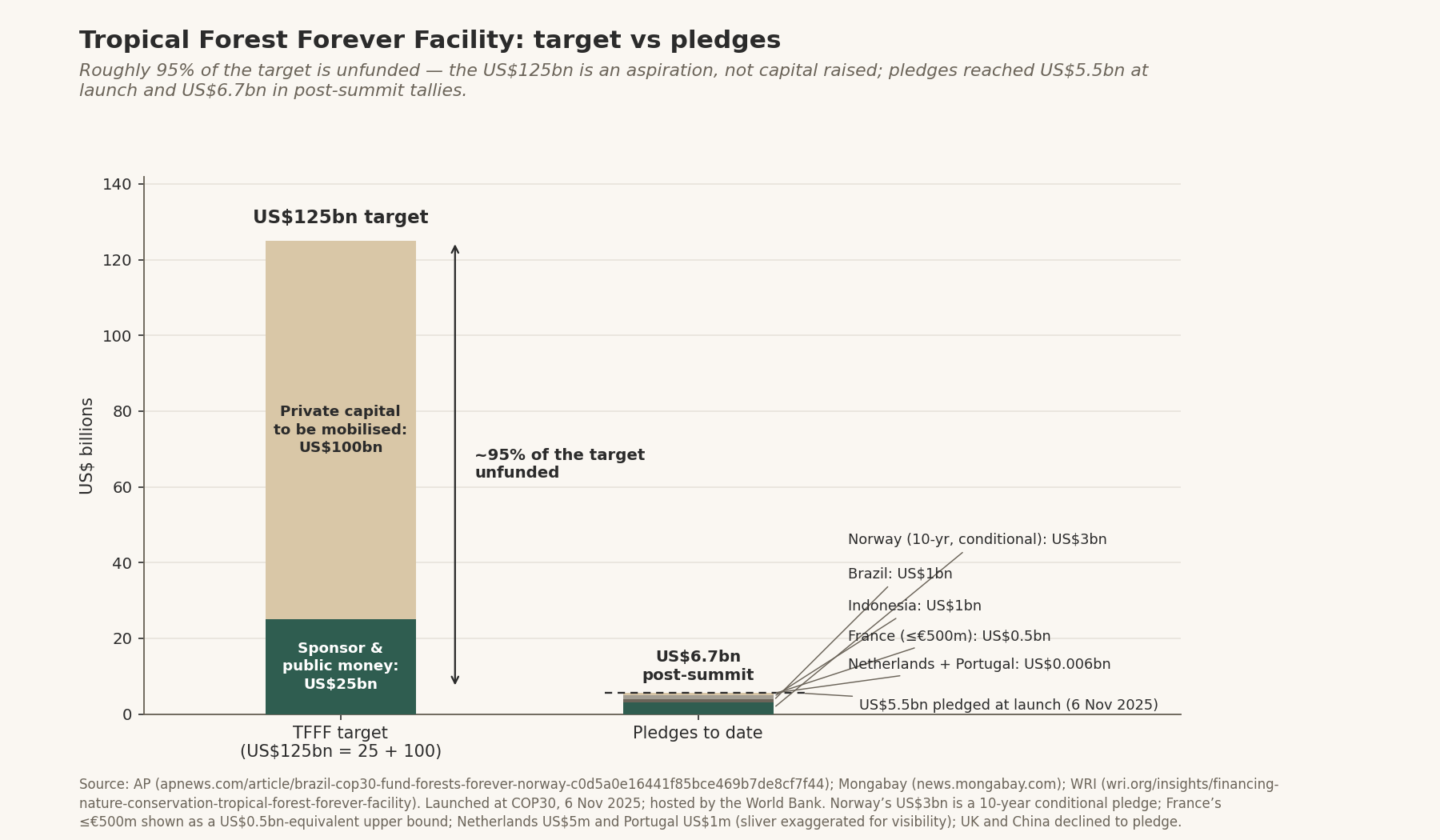
The most-watched experiment is not an offset at all. The Tropical Forest Forever Facility (TFFF), launched at COP30 on 6 November 2025, aims to raise US$125bn — US$25bn of sponsor and public money mobilising US$100bn of private capital — and pay countries roughly US$4 per hectare per year for keeping deforestation below 0.5%, satellite-verified, with at least 20% flowing to Indigenous Peoples and local communities, per AP and WRI. The World Bank hosts the fund; 53 countries endorsed it, 34 of them tropical-forest nations; the DRC would be among the biggest beneficiaries.
Pledges reached only about US$5.5bn at launch and US$6.7bn in post-summit tallies — Norway US$3bn over ten years, Brazil and Indonesia US$1bn each, France up to €500m — while the UK and China declined, per AP and Mongabay. The US$125bn is a target, not capital raised; Norway's pledge is conditional and stretched over a decade. The pattern repeated with the "Belém Call for the Forests of the Congo Basin": US$2.5bn from France and Gabon with Germany, Norway, Belgium, the UK and the European Commission, aiming to end Congo Basin
deforestation by 2030 — announcement-stage money, pledged rather than committed, per Integrity Next and African Climate Wire.
Europe's trade rules are becoming de facto climate policy. The EU deforestation regulation — covering cattle, cocoa, coffee, palm oil, rubber, soya and wood — applies from 30 December 2026 for large and medium operators and 30 June 2027 for small and micro ones, under Regulation (EU) 2025/2650, per WRI. Compliance costs will land on Congo Basin smallholders even as Europe's forest-fund pledges lag. COP30 also called for tripling adaptation finance to about US$120bn a year by 2035, produced a land-tenure commitment recognising 160m hectares for Indigenous and local communities, and renewed a US$1.8bn Forest Tenure Pledge for 2026– 2030, per France24 and WRI.
New Axis read
The Congo Basin's custodians have reframed the transaction: less gratitude, more price discovery. Each instrument answers a different failure — swaps answer debt distress, jurisdictional credits answer the integrity collapse, the TFFF answers offset fatigue — but none yet answers scale. Debt service of US$88.7bn a year and a 1% share of global climate finance cannot be arbitraged away US$500m at a time. Three tests will decide whether this is a market being born or a promise being recycled: whether one of TNC's three African swaps closes without the American backstop; whether TFFF pledges convert into disbursements that honour the 20% community floor; and whether the DRC's registry turns Article 6 authorisation into revenue that arrives, verifiably, in places like Mai-Ndombe. The last rainforest still paying its climatic rent is asking to be paid. The honest answer so far is a term sheet, not a transfer. ---
Charts & visuals
X: The Congo Basin absorbs ~600m tonnes more CO₂ than it emits each year — the last rainforest still doing so. Its custodians get ~1% of global climate finance. Now they're writing term sheets.
LinkedIn: Three years after Gabon's US$500m blue bond, debt-for-nature swaps face their hardest test: surviving without the American insurance backstop. Our new feature traces the Congo Basin carbon economy — from Mai-Ndombe's first World Bank carbon payment to the US$125bn Tropical Forest Forever Facility, which has attracted barely 5% of its target — and asks what a standing forest is actually worth. The answer, so far: a term sheet, not a transfer.
Author
Sign up for New Axis Media newsletters.
Stay up to date with curated collection of our top stories.