The Gulf’s African Decade: Ports, Capital and Food Security From Luanda to the Red Sea
The UAE has quietly become Africa’s largest source of new foreign investment. Behind the deals lies a coherent strategy — ports, renewables, food security and diplomatic reach — that is reshaping the continent’s logistics map, including in Angola.
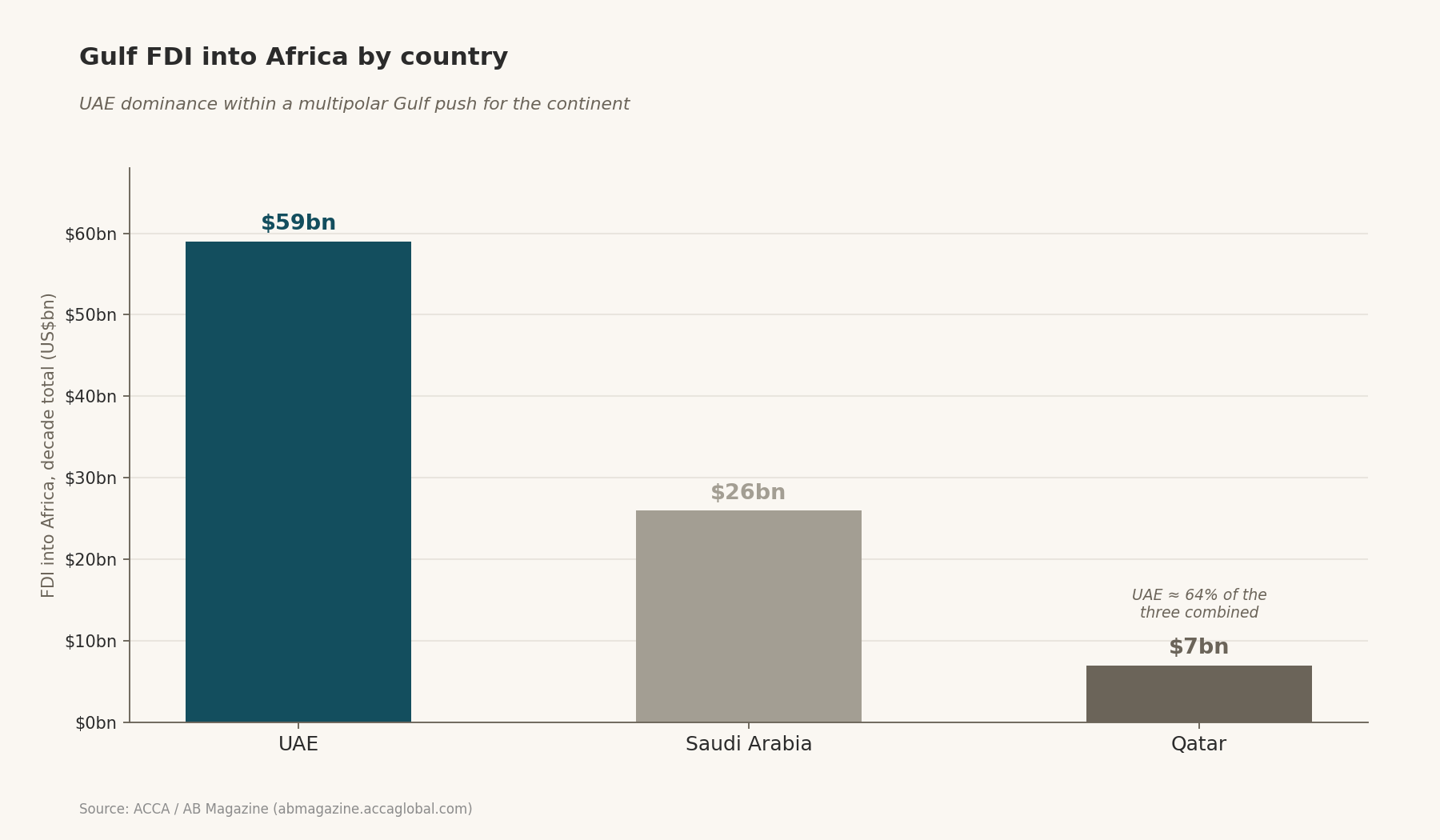
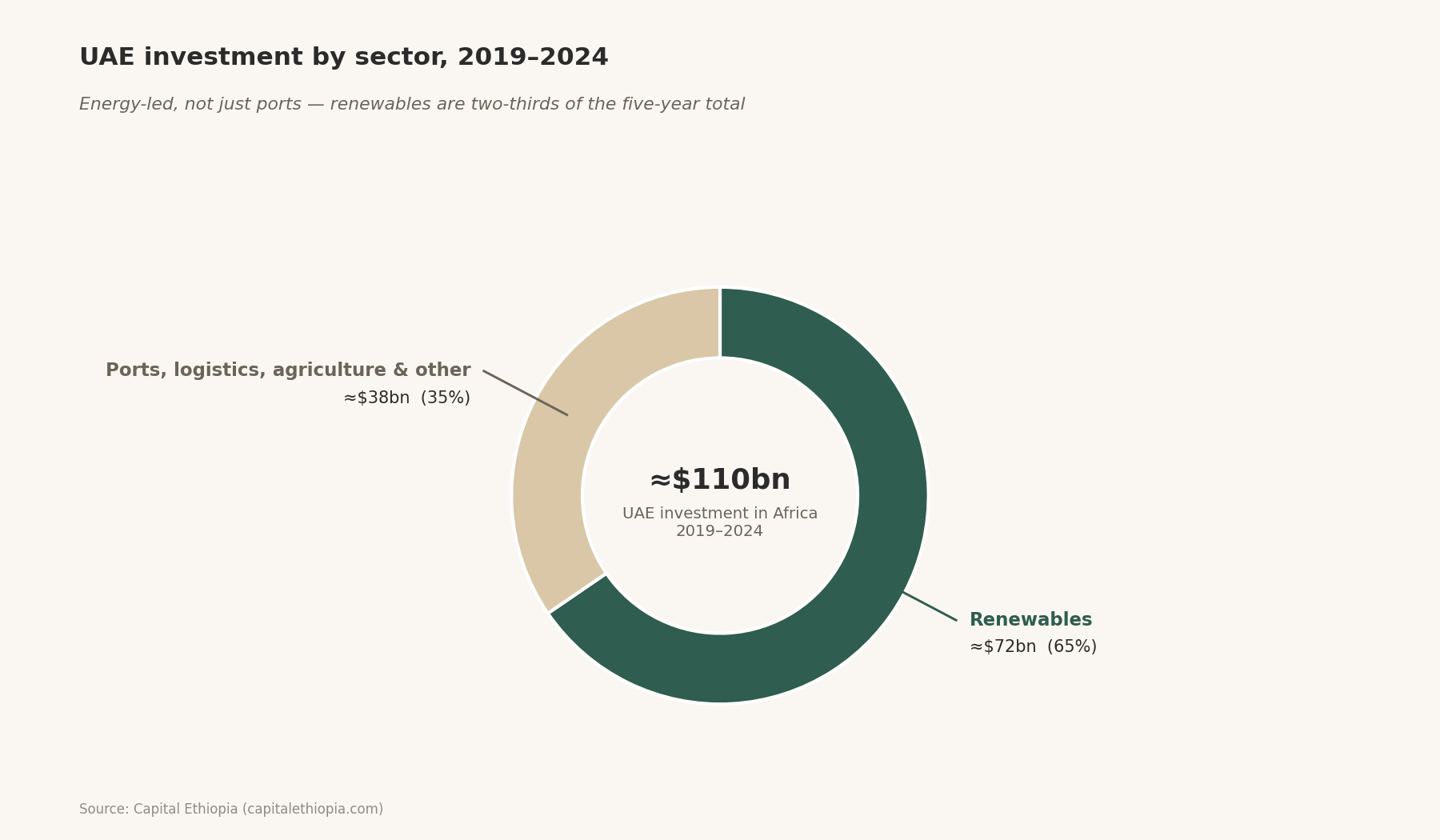
While Western commentary fixated on the US–China contest, another power quietly became Africa’s biggest new financier. Between 2019 and 2024, the UAE invested an estimated $110 billion across Africa — the continent’s largest single source of new FDI — with about $72 billion directed toward renewable energy alone (Capital Ethiopia). The Gulf, led by the UAE ($59bn), Saudi Arabia ($26bn) and Qatar ($7bn), has committed well over $100 billion to Africa over the past decade (ACCA/AB Magazine). These are not scattered bets but the expression of a deliberate strategy: Gulf states flush with hydrocarbon revenue are deploying capital to secure supply chains, food, energy transition assets and geopolitical reach as they diversify beyond oil at home.
Ports as strategy
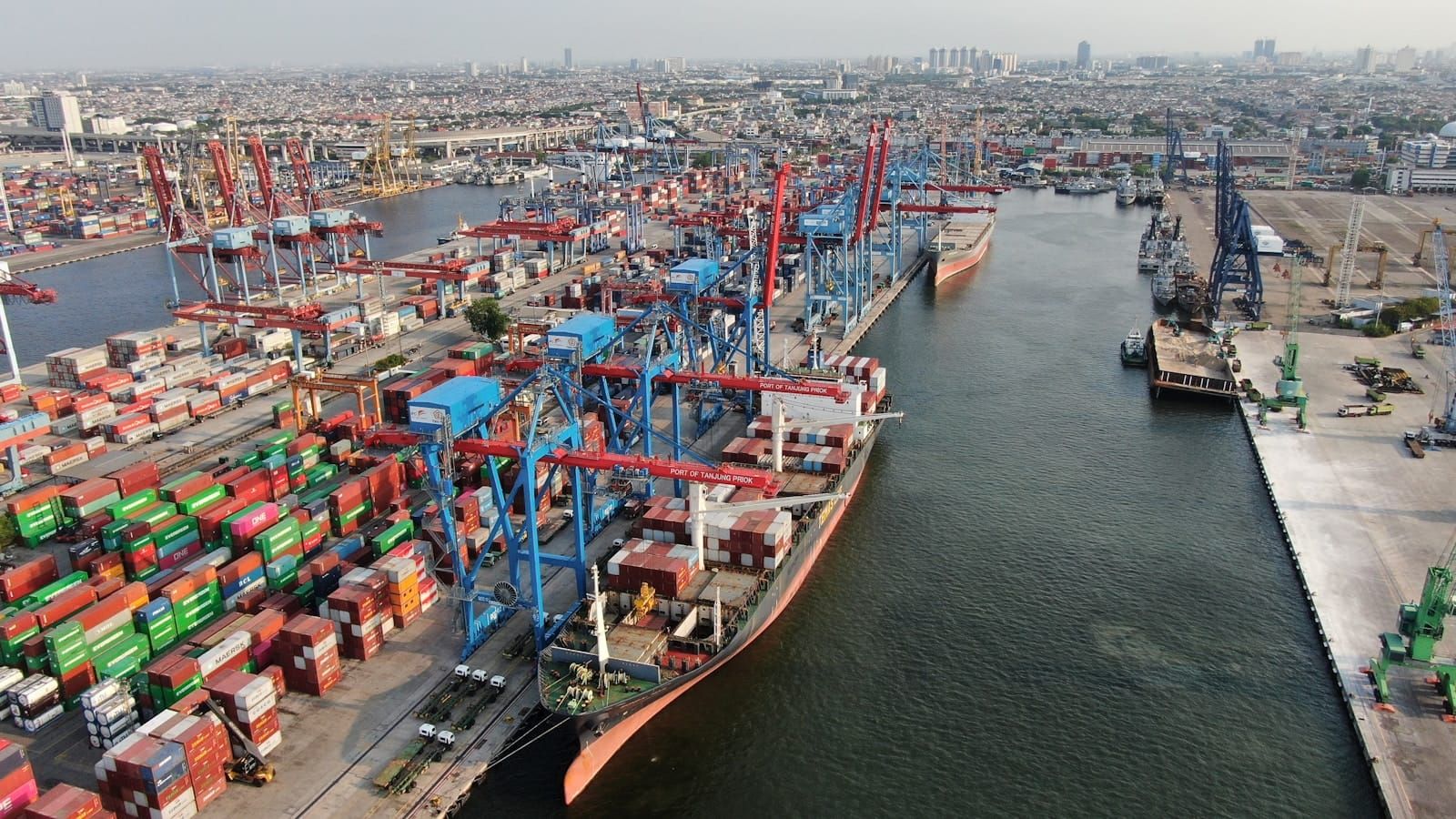
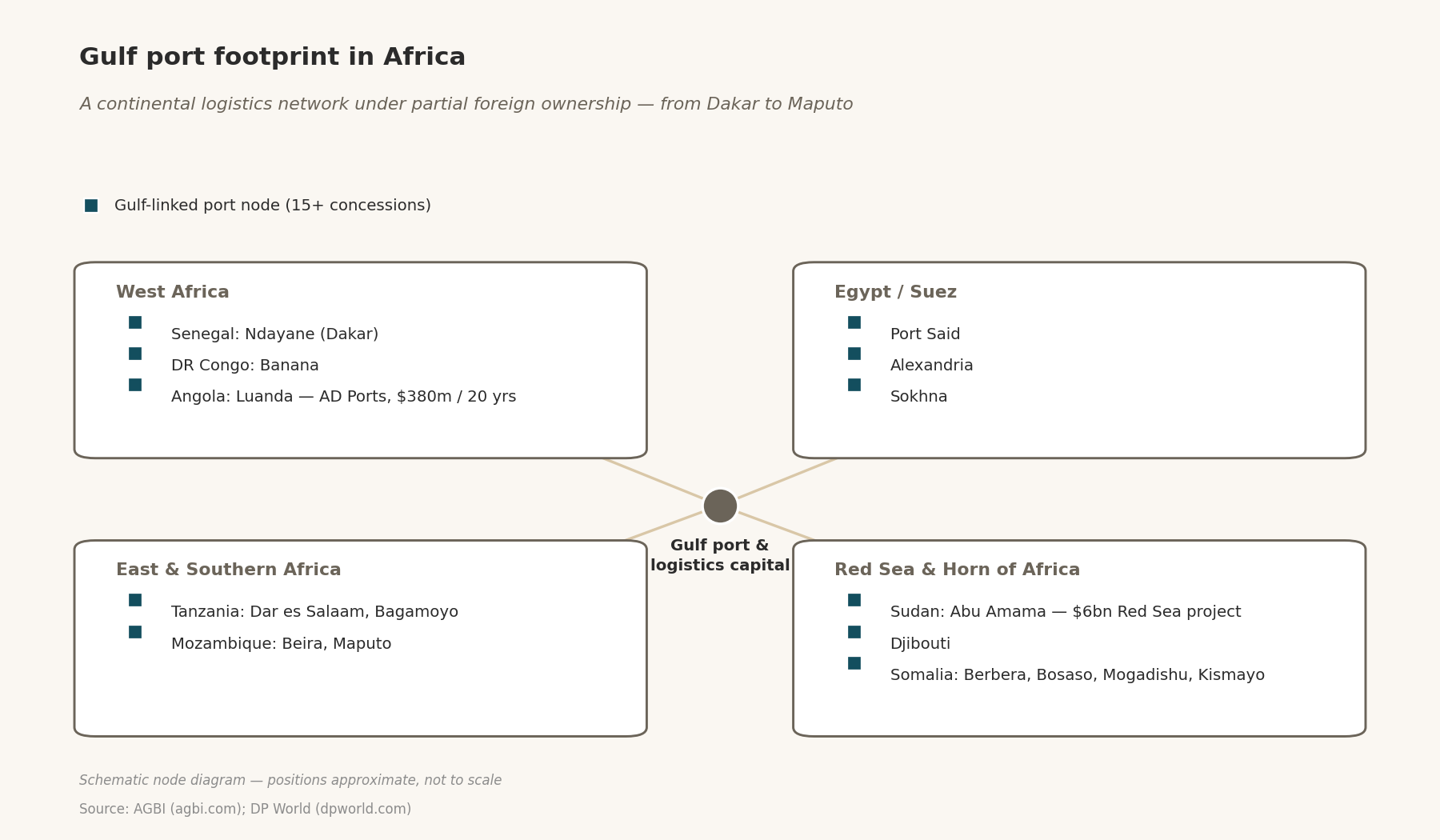
The clearest expression of Gulf ambition is maritime. DP World has invested more than $6 billion in African ports since 2010, with a further $3 billion planned, and by 2025 launched a $2.5 billion global logistics investment plan channeling significant funds into Africa (Capital Ethiopia; DP World). Between them, DP World and AD Ports operate or are developing more than 15 port assets across the continent — including Djibouti, Egypt, Senegal (Dakar and the new deep-water Ndayane port), the DRC (the greenfield Banana deep-sea port), Tanzania, Mozambique, Somalia and Angola (AGBI; DP World).
Ports are strategic in a way loans are not. A port concession is a decades-long position at a chokepoint of trade — a durable, revenue-generating foothold that also confers logistical influence over an entire hinterland. By assembling a network of them along both African coasts, the Gulf operators are not merely investing in individual assets; they are building a continental logistics system that could shape how African trade flows for a generation. This is precisely the infrastructure that makes the African Continental Free Trade Area viable (see Article 13) — and precisely the infrastructure whose foreign ownership raises sovereignty questions.
The Angola connection
Angola is squarely inside this map. AD Ports Group committed $380 million over 20 years to transform a Luanda facility into “Angola’s most advanced port facility and a logistics hub for Central Africa,” launching operations in 2025 following an investment reported at around $250 million (Ecofin Agency; The Voice of Africa). For Angola, this means its Gulf, US and Chinese relationships now overlap directly on its own coastline — the UAE modernising Luanda’s port even as the US finances the Lobito railway inland (see Article 4) and Angola retires its Chinese debt (see Article 5).
That overlap is the strategy in microcosm. A single stretch of Angolan coast now hosts capital and influence from three distinct power centres, none of them able to claim exclusivity. For Luanda, the Gulf port investment is another strand in the diversification web — a source of capital and logistics capability that reduces reliance on any one patron and strengthens its hand with all of them.
Beyond ports: renewables and food security
The Gulf strategy is broader than logistics. The bulk of UAE investment — some $72 billion — has flowed into renewable energy, via companies like Masdar (Capital Ethiopia; AGBI). This makes the Gulf one of the largest financiers of Africa’s energy transition (see Article 16) — a striking role for petrostates, and one driven by the same diversification logic pushing them into ports and food.
Food security is a parallel driver: Gulf states, dependent on food imports, view African agriculture as strategic insurance against supply shocks and price spikes. Securing farmland, agribusiness and the logistics to move produce is, for the Gulf, a matter of national resilience. And the UAE has signed trade deals across the continent — with Kenya, Angola, Mauritius, Morocco, Congo and the Central African Republic (AGBI). The $6 billion Abu Amama port and economic-zone agreement with Sudan on the Red Sea illustrates the scale of ambition — and its concentration along the strategically vital Red Sea corridor (The Voice of Africa).
The trust question
Gulf capital is not uncontroversial. As one Gulf-business publication put it, “trust is paramount as Gulf states deepen African investment” — the privatisation of maritime infrastructure is “often controversial in Africa,” and African transport costs run up to 175% higher than in other regions, creating both the need for investment and the risk of dependency on foreign-owned chokepoints (AGBI; AGBI). Concentrating control of a continent’s ports in a handful of Gulf state-linked firms raises legitimate sovereignty questions: who sets tariffs, who has priority access in a crisis, and what happens to a country’s trade if its critical port is controlled by a foreign government’s commercial arm? Ports, unlike loans, cannot simply be paid off; a concession, once signed, locks in a relationship for decades.
The New Axis read
The Gulf’s African decade reframes the whole “scramble” narrative. This is not a bipolar US–China contest but a genuinely multipolar competition in which Abu Dhabi, Riyadh and Doha are first-tier players — sometimes the largest. For African governments, that multipolarity is an asset: more suitors means more leverage, better terms, and less risk of capture by any single power. For Angola specifically, the arrival of AD Ports on its coast, alongside US rail money and shrinking Chinese debt, is the clearest possible sign of a state trying to be indispensable to everyone and captive to no one.
The strategy is elegant, and it is working — for now. The risk is structural: ports, unlike loans, are hard to reverse and easy to lose. A country can retire a debt and walk away; it cannot easily reclaim a 20- or 30-year concession over its most important trade infrastructure. The test for African governments is whether they can capture the investment while retaining enough control — through regulation, revenue-sharing, and clear sovereignty safeguards — that the ports serve national development rather than merely foreign strategy.
Charts & visuals
X: Quietly, the UAE became Africa’s biggest new investor — ~$110bn (2019–24), $72bn in renewables alone. DP World & AD Ports now run 15+ African ports, including Luanda. The “scramble” isn’t bipolar. It’s multipolar. 🧵
LinkedIn: Behind the US–China headlines, the Gulf has become a first-tier force in Africa: the UAE invested ~$110bn from 2019–2024, the largest single source of new FDI, with a coherent strategy spanning ports, renewables and food security. AD Ports is now modernising Luanda. New Axis Media on the Gulf’s African decade — and the sovereignty questions it raises.
Author
Sign up for New Axis Media newsletters.
Stay up to date with curated collection of our top stories.