Russia in Africa: A Security-for-Minerals Model Reaching Its Limits
Moscow rebranded Wagner as the state-controlled Africa Corps and expanded its footprint from the Sahel to the Gulf of Guinea. But its model — regime protection in exchange for resources — is proving fragile, and 2026 is testing whether it can deliver.
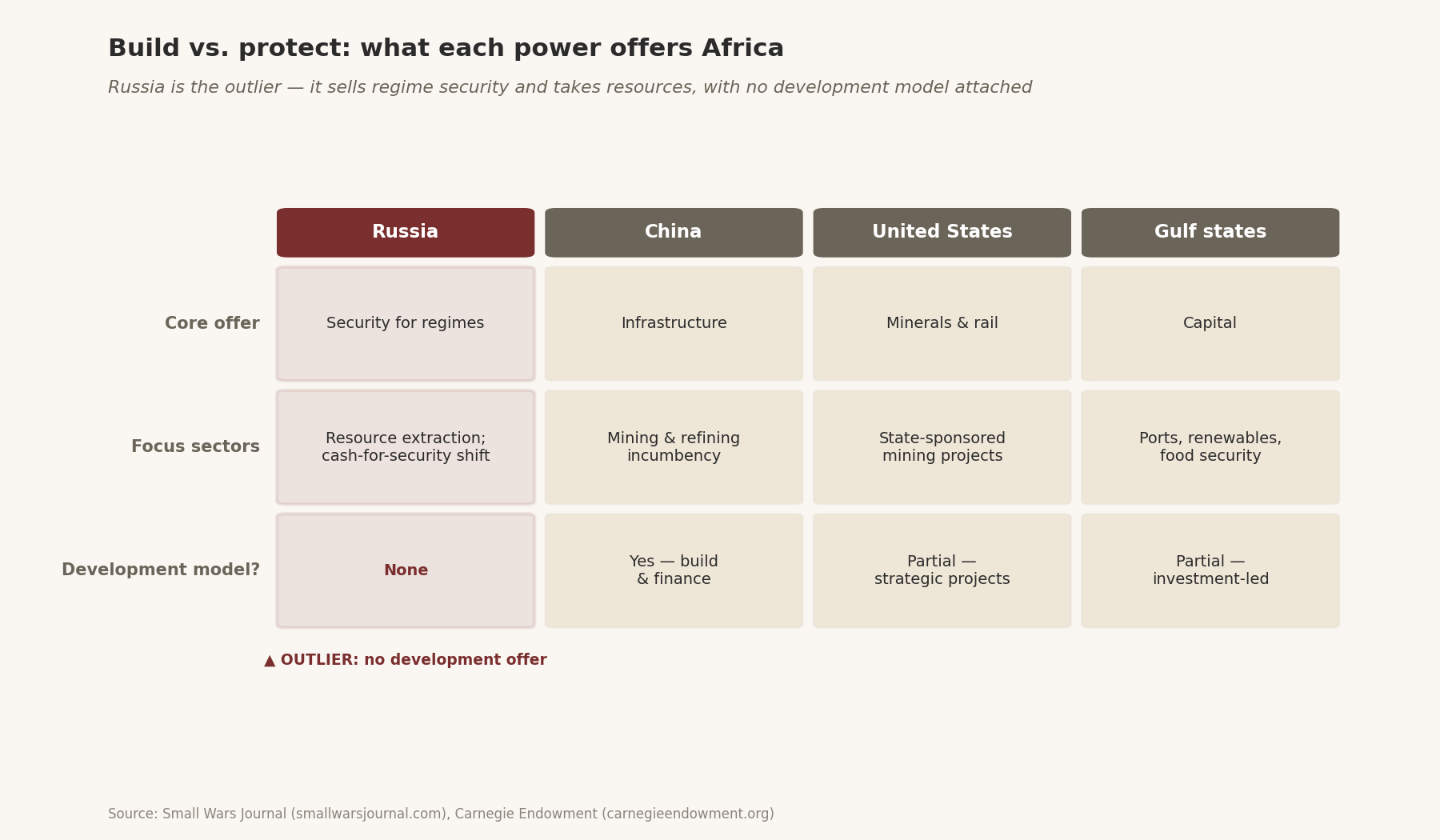
Russia's Africa strategy is the most transparently extractive of any major power's. As one analysis put it, "whereas China has made significant economic investments in Africa through its Belt and Road Initiative, Russia's engagement is far more transparently extractive," built on a "state capture strategy, whereby regime protection services are offered in exchange for access to illicit markets and natural resources" (Small Wars Journal). The Carnegie Endowment describes the offer bluntly: "mercenaries, weapons, and media operations… often in apparent return for opaque deals for natural resources and without the conditions that would be imposed by the West" (Carnegie Endowment). Where China builds and the Gulf invests, Russia offers something narrower and cruder: survival for regimes, resources for the Kremlin, and disruption of Western influence as a bonus.
From Wagner to Africa Corps
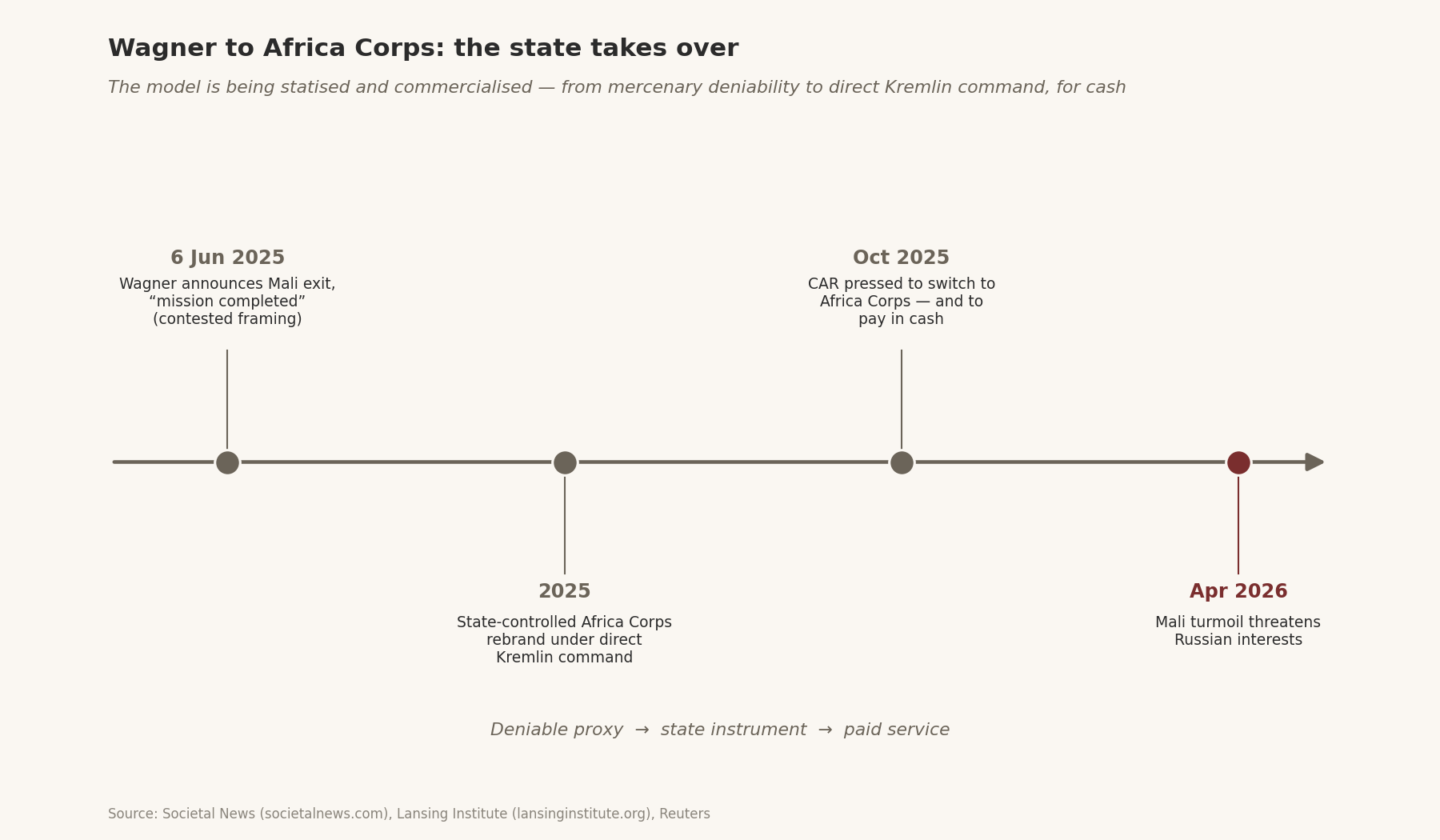
The mechanism has been formalised. On 6 June 2025 the Wagner Group announced it was ending its Mali deployment, claiming it had "completed its mission" — a framing one account called "anything but" a victory (Societal News). The declaration came after years in which Wagner had failed to defeat the jihadist insurgencies it was hired to suppress, and after a period of instability within the group following the death of its founder, Yevgeny Prigozhin. The name Wagner is now "officially retired" across most of Africa, replaced by Africa Corps, the state-controlled rebrand placing operations under direct Kremlin command (Societal News; Carnegie Endowment).
The rebrand matters. Bringing the mercenaries under direct state control gives Moscow tighter command and a more deniable-yet-deliberate instrument of foreign policy, but it also strips away the plausible-deniability buffer Wagner once provided and ties any failure directly to the Kremlin. Mali is "Russia's largest deployment in the Sahel and the first major test for Africa Corps" (Carnegie Endowment) — and, as such, the clearest gauge of whether the state-run model can succeed where the private one struggled.
Expansion — and its fragility
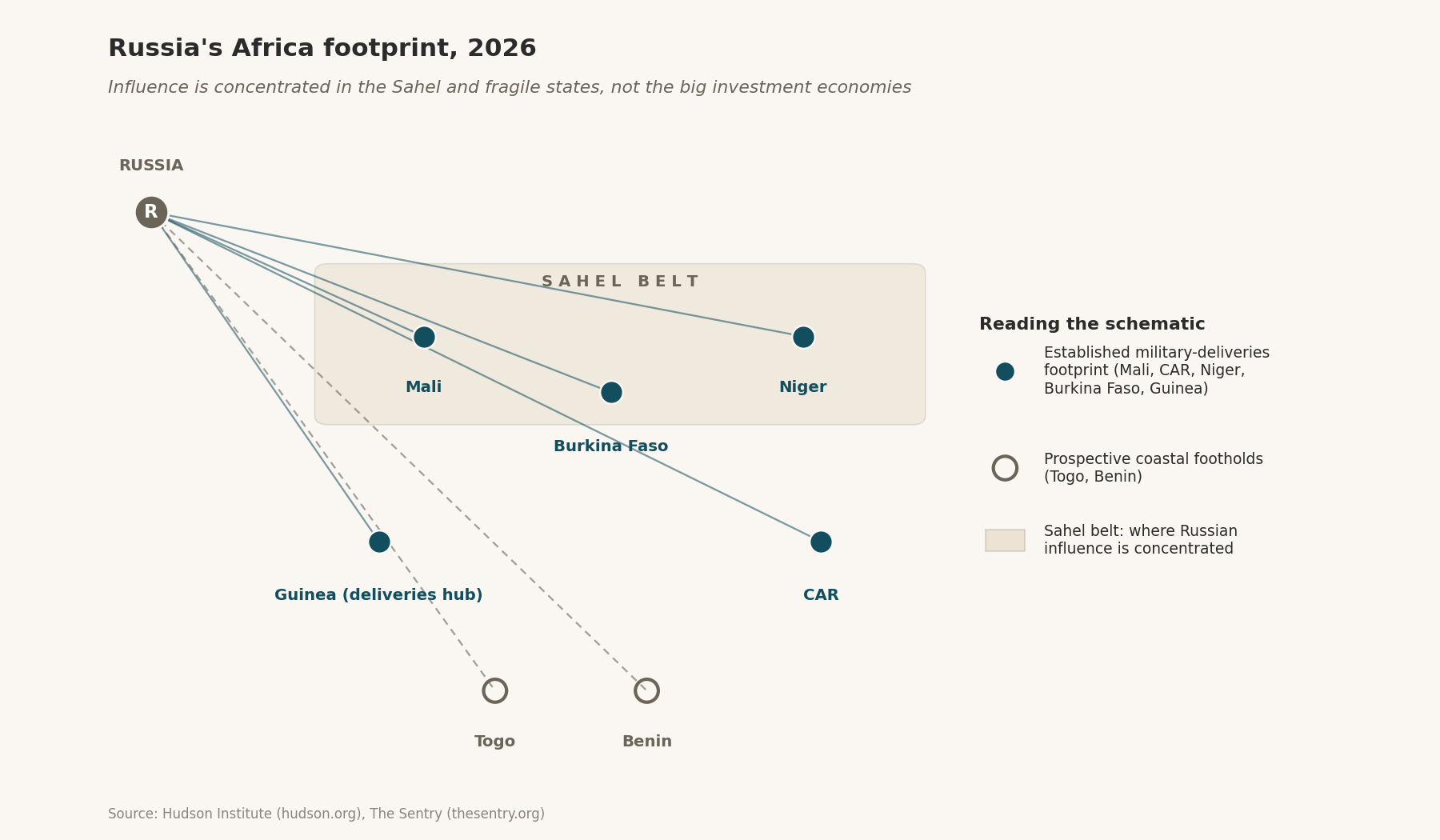
Moscow's footprint is widening even as Ukraine drains its resources. Three large Russian-made military convoys reached Mali in early 2025, with Russian businesses in Guinea facilitating deliveries and Africa Corps expanding across West Africa (The Sentry). Moscow is working to establish footholds in the coastal states of Togo and Benin to extend its maritime presence in the Atlantic, while Rosatom has signed nuclear-cooperation agreements with Mali, Niger and Burkina Faso (Hudson Institute). The push toward the Gulf of Guinea coast is strategically significant: a maritime foothold would let Russia project power beyond the landlocked Sahel and complicate Western naval dominance in the Atlantic.
But the model is showing strain. Carnegie notes Russia's Sahel relationships are "inherently fragile" (Carnegie Endowment). By April 2026, turmoil in Mali was seen as posing "a significant risk to Russian interests" at a time when Moscow's military resources are tied up in Ukraine and its influence challenged elsewhere (Reuters). The fragility is structural: the juntas Russia protects are themselves unstable, the insurgencies it was meant to defeat persist, and the war in Ukraine limits how much force Moscow can spare. The bar Africa Corps must clear is low but revealing — as one analyst framed it, merely to "protect the junta and protect the mines" (Carnegie Endowment). Even that minimal standard is proving hard to meet.
The commercialisation of the model
Tellingly, Russia is shifting from Wagner's resource-barter arrangements toward cash payment. In the Central African Republic, Russian officials — including a deputy defence minister — have urged the government to replace Wagner with the Kremlin-run Africa Corps and "start paying cash for security services" (Lansing Institute). That change hints at the model's underlying economics: resource-for-security deals may not have generated the returns Moscow needs, pushing it toward a more conventional, cash-based mercenary business.
The shift is quietly damning. If the mineral concessions were as lucrative as the "security-for-minerals" framing implies, Moscow would have little reason to demand cash instead. The move toward payment suggests the resource deals underdelivered — that the mines were less profitable, harder to exploit, or more contested than expected — and that Russia is trying to convert a strategic-influence operation into something closer to a paying business at exactly the moment its clients can least afford it.
Where Russia is — and isn't
Russia's influence is concentrated in the Sahel and a handful of fragile states, not in the stable, investment-hungry economies of Southern Africa like Angola, where the competition is between the US, China and the Gulf. This geographic concentration matters for the New Axis frame: Russia's Africa is a narrow, security-driven Africa of juntas and mines, distinct from the broader economic contest playing out along corridors and coastlines (see Articles 4, 7 and 10). Where the other powers compete over infrastructure, refining, ports and capital, Russia competes over regime survival and extraction — a fundamentally different, and more limited, game.
Moscow "seems content as long as it can weaken Western influence, gain access to markets and resources, and raise its profile as a global actor" (Carnegie Endowment) — a strategy of disruption more than construction. That is a real geopolitical achievement of a kind: expelling French and, in places, American influence from the Sahel has redrawn the region's alignments. But disruption is not development, and an influence built on the survival of unstable juntas is only as durable as those juntas themselves.
The New Axis read
Russia offers something no other power will: unconditional regime survival, no lectures on governance, and a quick security fix. That is a real and dangerous product for anxious rulers facing coups, insurgencies or popular unrest. But it does not build economies, ports, or middle classes, and its viability depends on a war economy that Ukraine is bleeding dry. The most important story of 2026 may be the growing evidence — flagged from CAR to Mali — that the security-for-minerals model is reaching its limits: the mines underdeliver, the juntas wobble, and the demand for cash betrays thin returns. Africa's most consequential relationships will be decided by who builds, not by who merely protects the junta — and on that measure, Russia is playing a weaker hand than the disruption narrative suggests.
Charts & visuals
X: Russia rebranded Wagner as the state-run Africa Corps and pushed from the Sahel toward the Atlantic. But the model — regime protection for minerals — is fraying: Mali turmoil, cash demands in CAR, a war economy stretched by Ukraine. 🧵
LinkedIn: Russia's Africa strategy is the most transparently extractive of any major power: security for regimes, minerals for the Kremlin. In 2026, Wagner has become the state-controlled Africa Corps, and the footprint is expanding toward the Gulf of Guinea. Yet the evidence — from Mali to CAR — suggests the model is reaching its limits. New Axis Media on who builds vs. who merely protects.
Author
Sign up for New Axis Media newsletters.
Stay up to date with curated collection of our top stories.